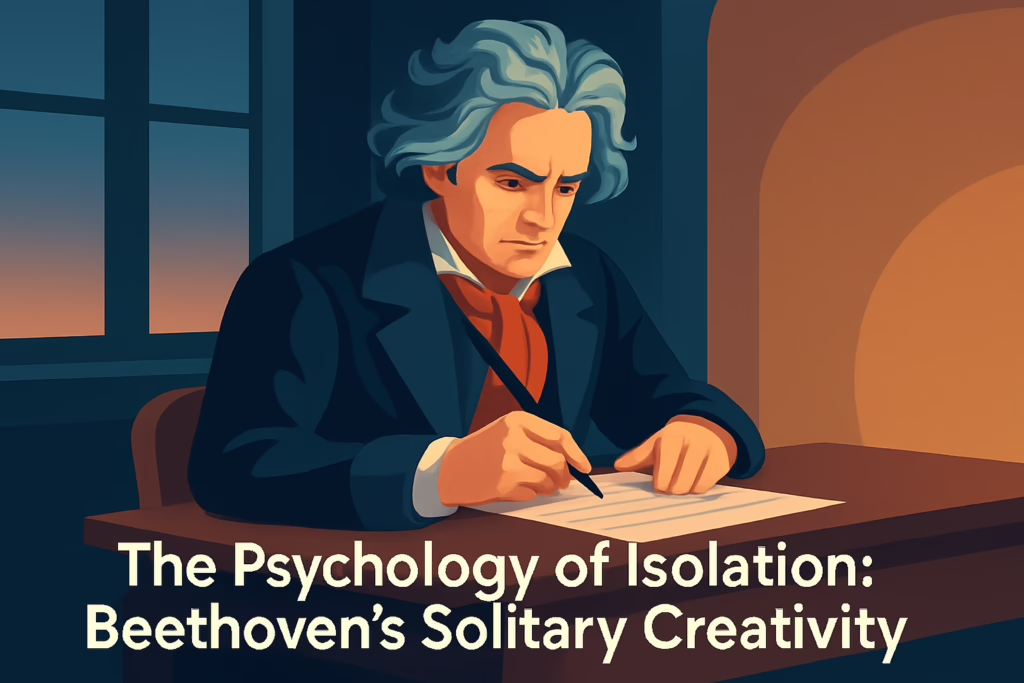
The Psychology of Isolation: Beethoven’s Solitary Creativity
Isolation shaped Ludwig van Beethoven’s life and work so profoundly that understanding his solitude is essential to understanding his creativity. In the context of Beethoven and the mind, isolation means more than being physically alone. It includes social withdrawal, emotional distance, sensory separation caused by deafness, and the deliberate seclusion many artists use to protect concentration. Solitary creativity, by contrast, is the ability to generate, refine, and complete original work without depending on constant collaboration or external stimulation. Beethoven embodied both conditions at once: he suffered from painful exclusion, yet he also turned seclusion into a disciplined artistic method. That tension makes his case psychologically rich.
This subject matters because Beethoven is often reduced to a myth: the tormented genius writing masterworks in heroic loneliness. The truth is more useful and more human. Across his letters, conversation books, notebooks, and the recollections of friends and patrons, we see a man negotiating humiliation, pride, illness, ambition, and an obsessive commitment to craft. I have worked through these sources with one recurring conclusion in mind: Beethoven’s isolation was neither purely tragic nor purely productive. It functioned as a psychological pressure chamber. At times it intensified anxiety, suspicion, and anger. At other times it protected his deepest musical experimentation, especially when social life became exhausting or impossible.
As a hub within the broader topic of Beethoven and the mind, this article maps the major psychological dimensions of his solitude and connects them to related questions readers often ask. How did deafness alter Beethoven’s inner world? Did loneliness help or harm his music? Was he naturally introverted, or driven into isolation by circumstance? How did his routines, relationships, and working habits change over time? To answer these questions well, we need biography, music history, and psychology together. We also need precision. Beethoven was not a laboratory case, and no modern diagnosis can fully explain him. But established concepts such as sensory loss, rumination, resilience, cognitive compensation, and creative incubation do illuminate his experience. Seen clearly, Beethoven’s solitary creativity reveals how isolation can deform identity while also deepening focus, imagination, and the need to leave something enduring behind.
Isolation in Beethoven’s life was social, physical, and self-imposed
Beethoven’s solitude developed in layers rather than appearing all at once. He arrived in Vienna in the 1790s as a formidable pianist and improviser who could command aristocratic salons, attract patrons, and compete publicly. This early visibility matters because it corrects the idea that he was always a withdrawn outsider. He had social ambition, professional networks, and enough confidence to challenge established norms. Yet even in these years, observers noted traits that complicated intimacy: abrupt manners, touchiness about status, irregular habits, and a fierce resistance to dependence. Those tendencies did not create full isolation, but they made sustained ease with others difficult.
The decisive shift came with hearing loss, which Beethoven recognized by the late 1790s and confessed with devastating clarity in the 1802 Heiligenstadt Testament. Hearing loss is not simply a medical impairment; psychologically, it disrupts reciprocity. Conversation becomes effortful, public settings become threatening, misunderstanding multiplies, and shame can lead to concealment. Beethoven described avoiding society because he could not admit his condition. For a musician, and especially a celebrated performer, deafness threatened identity at the root. He could still compose, but ordinary interaction became charged with fear that others would notice what he was losing. Many people with sensory decline report the same cycle today: strain, concealment, withdrawal, then loneliness reinforced by the very avoidance meant to protect dignity.
His isolation was also partly chosen. Beethoven often sought lodgings on the edge of town, walked alone for hours, carried sketchbooks, and guarded work in progress. He changed residences frequently, creating instability but also control. Solitude gave him relief from distraction and from the social friction his temperament invited. In modern terms, some of his isolation was defensive and some was strategic. That distinction is crucial. Defensive isolation narrows life because contact feels dangerous. Strategic isolation narrows life because concentration requires boundaries. Beethoven lived inside both forms, sometimes on the same day.
How deafness changed Beethoven’s psychology and creative process
Deafness transformed Beethoven’s mental world by forcing a migration from external sound toward internal hearing. Musicians use the term audiation for the capacity to hear music inwardly without external performance. Beethoven had exceptional audiation before hearing loss, but necessity intensified it. As his ability to hear actual instruments declined, he relied more on structural imagination, memory, and notated experimentation. This did not make composition easier. It demanded extraordinary working memory, analytical control, and repeated revision. His sketchbooks show that ideas did not emerge whole from mystical inspiration. He tested motifs, reordered transitions, recalculated harmonic pacing, and compressed large forms from tiny cells of material.
Psychologically, sensory loss often leads to compensation, but compensation is never cost-free. Beethoven’s inner hearing may have deepened, yet his social confidence weakened. The conversation books he used in later years reveal practical communication but also asymmetry. Others wrote to him; he often replied aloud or briefly in writing. This changed rhythm and intimacy. Nuance is easier to lose when exchange is uneven. It likely contributed to the suspiciousness and irritability many acquaintances reported. When people cannot hear accurately, they often must infer tone, intention, and context, and inference under stress easily turns negative.
At the same time, deafness reduced the immediate influence of performance convention. Beethoven increasingly conceived music on a scale that exceeded what many listeners and players expected. The late piano sonatas, Missa solemnis, Diabelli Variations, and late string quartets are not the products of social ease. They are works of inward authority, shaped by a composer less constrained by salon taste or audience comfort. That is not because suffering automatically creates genius. It is because Beethoven’s enforced inwardness strengthened certain cognitive habits: long-range planning, tolerance for abstraction, and commitment to ideas that could not be validated instantly by applause.
| Dimension of isolation | Psychological effect | Creative consequence |
|---|---|---|
| Progressive hearing loss | Shame, withdrawal, heightened inward attention | Greater reliance on inner hearing and structural composition |
| Social misunderstanding | Irritability, suspicion, emotional volatility | More guarded relationships and fewer external creative checks |
| Self-imposed seclusion | Protection of focus, reduced distraction | Extended revision, ambitious forms, thematic concentration |
| Physical illness and stress | Fatigue, rumination, uneven mood | Interrupted workflow but intensified urgency and purpose |
Loneliness did not create genius, but it intensified Beethoven’s drive
A common question is whether isolation helped Beethoven compose better. The best answer is qualified: loneliness did not create his talent, technique, or discipline, but it intensified motives that shaped his mature work. Beethoven already possessed elite training from Bonn, deep knowledge of Haydn and Mozart, formidable keyboard skills, and an unusual ability to develop small motifs into large structures. Those capacities existed before profound deafness. What isolation changed was the emotional fuel attached to them. Loss sharpened the need to prove durability, independence, and significance.
In my reading of his letters, the strongest recurring theme is not passive sadness but embattled self-assertion. Beethoven repeatedly frames artistic labor as destiny, duty, and resistance. That language matters psychologically. People under chronic threat often stabilize identity by investing in a domain where standards are exacting but controllable. For Beethoven, composition became that domain. He could not control hearing decline, unstable digestion, legal conflict, or romantic disappointment, but he could rework a fugue, extend a development section, or refine thematic recall across movements. Craft became a refuge from helplessness.
This pattern appears clearly in the so-called heroic middle period. Works such as the Eroica Symphony, the Fifth Symphony, and the Appassionata Sonata do not merely express suffering. They dramatize struggle, obstruction, propulsion, and transformation. That musical rhetoric aligns with the psychological posture visible in his writings after Heiligenstadt: not surrender, but survival through work. Yet there is a limit to romanticizing this process. Chronic isolation can narrow corrective feedback and worsen interpersonal conflict. Beethoven’s disputes with publishers, servants, relatives, and friends show the damage. Solitude supported focus, but it also amplified rigidity.
Daily habits, notebooks, and walking turned solitude into method
Beethoven’s solitary creativity was not an abstract temperament; it was sustained by concrete habits. He kept sketchbooks constantly, recording motifs, harmonic turns, rhythmic cells, and structural plans. These notebooks are among the strongest pieces of evidence against the myth of effortless genius. Ideas were generated in fragments, then revised across weeks, months, and sometimes years. Isolation served this process by reducing interruption. A composer who develops music iteratively benefits from long stretches of undisturbed return to the same material.
Walking was equally important. Numerous reports describe Beethoven taking extended walks in the countryside around Vienna, often carrying pencil and paper. Modern creativity research frequently links walking to divergent thinking and associative flow, and Beethoven’s practice fits that pattern well. Rhythmic bodily movement can support mental recombination, especially when a creator is cycling through unresolved problems. For Beethoven, walking also provided relief from rooms, conversation strain, and urban noise he increasingly could not process normally. It was both regulation and invention.
His routines, however, were not tidy in the modern productivity sense. He could be disorderly, financially careless, and difficult as a tenant. Coffee preparation became ritualized; reports claim he counted beans for each cup. Whether every anecdote is exact, the broader point stands: when external life feels unstable, artists often build micro-rituals that restore agency. Beethoven’s rituals were less about eccentricity than about control. They anchored a mind under constant pressure.
Relationships remained essential even at his most solitary
Calling Beethoven solitary should never imply that he created in total social isolation. Patrons such as Archduke Rudolf, Prince Lobkowitz, and Prince Kinsky provided crucial financial support. Publishers circulated his work. Copyists, performers, instrument makers, housekeepers, doctors, and friends all shaped daily conditions around him. Even the most inward late works emerged within a network. Creativity studies consistently show that originality depends not only on private imagination but also on systems of support, transmission, and reception. Beethoven is no exception.
His emotional life was also marked by frustrated attachment rather than indifference. The “Immortal Beloved” letter, whatever one concludes about its recipient, displays longing for union, not rejection of intimacy. His friendships with people such as Stephan von Breuning and Anton Schindler, though uneven and sometimes strained, show repeated efforts to maintain connection. The tragedy is that Beethoven often needed others intensely while finding them difficult to tolerate. This ambivalence is central to the psychology of isolation. Many isolated people are not detached; they are conflicted, proud, ashamed, over-sensitive, and afraid of dependency.
His guardianship battle over his nephew Karl reveals the darker side of this pattern. Beethoven pursued control obsessively, convinced of his moral seriousness, yet his rigidity damaged the relationship and contributed to household misery. Solitude can make conviction feel like clarity. Without enough trusted correction, certainty hardens. That lesson belongs in any balanced account of Beethoven’s solitary creativity: isolation protected his artistic standards, but it did not make him wise in every sphere.
Why Beethoven’s solitude still matters for understanding creativity today
Beethoven’s life offers a durable framework for thinking about isolation and creativity because it separates useful solitude from destructive loneliness. Useful solitude creates uninterrupted attention, supports incubation, and allows difficult ideas to mature before public judgment intervenes. Destructive loneliness erodes mood, distorts social perception, and can trap a person in rumination. Beethoven experienced both, often simultaneously. His example shows that great work may arise in lonely conditions, but the loneliness itself is not the magic ingredient. The real engines are disciplined practice, internalized standards, and the ability to convert adversity into sustained effort without pretending the adversity is beneficial on its own.
For readers exploring the wider Beethoven and the mind topic, this miscellaneous hub points toward several connected themes worth pursuing: the psychology of deafness, resilience after crisis, creative ritual, anger and perfectionism, attachment and conflict, and the mental world of the late quartets. Each of those subjects expands the picture traced here. Together they show a composer who became more inward as ordinary hearing and ordinary sociability receded, yet who never stopped reaching toward communication on the largest scale available to him: musical form itself.
The key takeaway is simple. Beethoven’s solitary creativity was not a romantic pose. It was the lived result of sensory loss, fierce ambition, defensive pride, disciplined habit, and an uncompromising commitment to artistic truth. Studying that psychology helps us hear the music more clearly and think more honestly about what isolation can do to a mind. If you are building out your understanding of Beethoven and the mind, use this hub as your starting point, then continue into the related articles on deafness, resilience, and late-style imagination.
Frequently Asked Questions
How did isolation influence Beethoven’s creativity?
Isolation influenced Beethoven’s creativity on several levels, and it is one of the most important lenses for understanding both his personality and his music. In Beethoven’s case, isolation was not simply a matter of spending time alone. It included emotional strain, social withdrawal, increasing separation from others because of his hearing loss, and a growing need to protect his inner world from distraction. These conditions shaped the way he thought, worked, and expressed feeling through composition.
As his deafness progressed, Beethoven became increasingly cut off from ordinary conversation and public life. That sensory separation forced him inward. Instead of relying on the external world in the same way many people do, he developed an unusually intense relationship with his imagination, memory, and inner hearing. He could build musical structures in his mind with extraordinary depth, revising and expanding ideas through concentration rather than through immediate social exchange or performance feedback.
At the same time, isolation did not make his music emotionally empty or detached. Quite the opposite. Many scholars and listeners hear in his work a heightened struggle between confinement and transcendence. His compositions often carry tension, defiance, intimacy, and release, suggesting that solitude became not only a condition of his life but a source of emotional and artistic pressure. In that sense, Beethoven’s creativity was shaped by isolation because solitude forced him inward, and once there, he transformed private experience into music of remarkable power and universality.
Was Beethoven’s solitude entirely caused by his deafness?
No, Beethoven’s solitude was not entirely caused by deafness, although deafness was certainly one of the most powerful factors. It is tempting to reduce his isolation to hearing loss because that part of his life is dramatic and historically well known. However, doing so oversimplifies both his psychology and his creative life. Beethoven’s solitude grew from a combination of personal temperament, emotional difficulty, artistic ambition, social friction, and the practical consequences of his worsening hearing.
Even before complete deafness overtook him, Beethoven had a reputation for intensity, independence, and unpredictability. He could be deeply devoted to friends and patrons, but he could also be suspicious, demanding, and difficult in close relationships. This suggests that some forms of distance were already present in his character. He valued autonomy and often resisted the compromises expected in polite society, which naturally contributed to social separation.
Deafness then magnified these tendencies. Conversation became exhausting and humiliating. Public appearances became harder. Everyday communication turned into a source of anxiety. The result was not just physical inconvenience but psychological burden. Beethoven felt misunderstood, exposed, and increasingly detached from the world around him. So while deafness intensified his isolation dramatically, his solitude also reflected broader emotional and artistic patterns in his life. It was the interaction between disability, personality, and creative discipline that made his isolation so profound.
What is meant by “solitary creativity” in relation to Beethoven?
“Solitary creativity” in relation to Beethoven refers to his ability to conceive, develop, and complete original artistic work through intense inward concentration, often with limited social participation and under conditions of personal separation. The phrase does not mean that Beethoven created in a vacuum or that he had no influences. He studied earlier composers, depended on patrons, interacted with performers, and lived within a rich musical culture. Rather, it means that the decisive labor of creation increasingly took place within an interior space that he guarded fiercely.
For Beethoven, composing was often a prolonged struggle. His sketchbooks reveal repeated revision, experimentation, and relentless reworking of musical ideas. This process reflects a mind that did not simply wait for inspiration to arrive fully formed. He wrestled with material privately, testing possibilities and refining emotional and structural meaning over time. Solitary creativity, then, involves discipline as much as inspiration. It is the capacity to sustain creative effort without constant external validation.
In Beethoven’s case, this form of creativity became especially significant because deafness made conventional musical participation more difficult. Yet he continued to compose works of astonishing scale and complexity. That fact demonstrates the power of internal hearing and imaginative construction. Solitary creativity also helps explain why his music can feel at once deeply personal and universally human. He transformed private struggle into forms that others could inhabit. His solitude was not merely withdrawal; it was a condition under which artistic vision was sharpened, deepened, and made enduring.
Did isolation help Beethoven artistically, or did it mainly cause suffering?
The most accurate answer is that it did both. Isolation caused Beethoven undeniable suffering, but it also contributed to the conditions under which some of his greatest artistic achievements became possible. Treating isolation as purely beneficial would romanticize pain, while treating it as purely destructive would ignore the extraordinary creative transformations that emerged from it. Beethoven’s life shows that suffering and artistic productivity can coexist without being the same thing.
On the painful side, isolation brought loneliness, frustration, and emotional distress. His deafness separated him from conversation, performance, and many forms of ordinary human closeness. That separation damaged his sense of belonging and made social life increasingly difficult. His letters and personal documents reveal despair, pride, vulnerability, and a longing for connection that was often unmet. Isolation, in this sense, was a wound.
Yet isolation also removed him from certain distractions and forced him into a more inward mode of work. In that inward space, Beethoven cultivated concentration, resilience, and independence of vision. He became less dependent on immediate approval and more committed to pursuing what he believed the music demanded. That determination helped produce works that feel bold, exploratory, and uncompromising. So isolation was not a gift in itself, but Beethoven’s response to it was artistically transformative. His achievement lies not in having suffered, but in having converted suffering into disciplined creative expression.
Why is understanding Beethoven’s isolation important for interpreting his music?
Understanding Beethoven’s isolation is important because it reveals the psychological and emotional environment in which much of his music was created. Without that context, listeners may still admire the grandeur, intensity, and innovation of his work, but they can miss how deeply those qualities are tied to his lived experience of separation, struggle, and inward resolve. His music is not a simple autobiography, but it is shaped by the pressures under which he lived.
Beethoven’s isolation helps explain the unusual emotional range in his compositions. Moments of tension, abrupt contrast, tenderness, defiance, and triumph can be heard not just as stylistic choices but as expressions of a mind wrestling with confinement and freedom. His music often seems to move from darkness toward release, from fragmentation toward coherence, from private turbulence toward shared meaning. That pattern becomes especially compelling when viewed through the lens of solitude.
It also helps modern readers and listeners avoid simplistic myths. Beethoven was not merely a heroic genius creating effortlessly in noble loneliness, nor was he only a tragic figure crushed by disability. He was a complex human being whose solitude was painful, productive, chosen in some moments, and imposed in others. Recognizing that complexity leads to richer interpretation. We hear not just the sound of genius, but the work of a person who turned isolation into form, struggle into structure, and inner life into music that continues to speak across centuries.