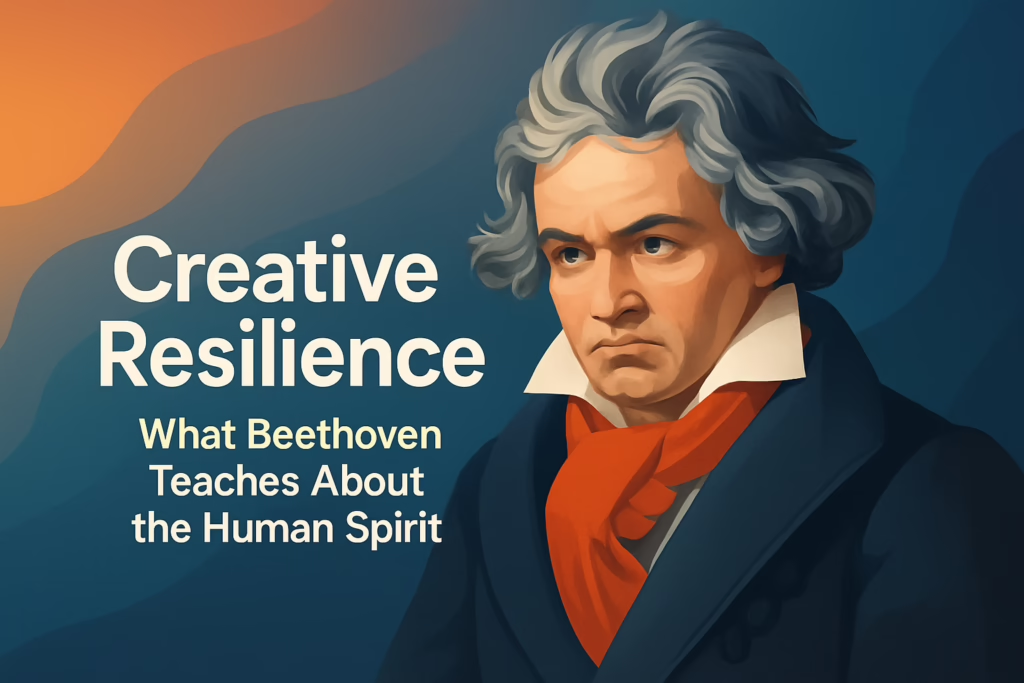
Creative Resilience: What Beethoven Teaches About the Human Spirit
Ludwig van Beethoven remains one of history’s clearest examples of creative resilience, the capacity to continue making meaningful work through pain, instability, loss, and uncertainty. In the “Beethoven and the Mind” topic, this miscellaneous hub examines how Beethoven’s life illuminates the human spirit not as a vague ideal, but as a practiced force built from discipline, adaptation, emotional honesty, and refusal to surrender purpose. When people ask what Beethoven teaches about perseverance, mental struggle, or artistic courage, they are really asking how a flawed human being transformed adversity into durable achievement.
Creative resilience means more than grit. It includes psychological flexibility, identity under pressure, the ability to revise goals after setbacks, and the habit of turning private suffering into structured action. Beethoven’s biography makes these ideas concrete. Born in Bonn in 1770, trained under exacting conditions, and later active in Vienna, he worked through family instability, chronic illness, financial pressure, social conflict, and progressive hearing loss. Yet he did not simply persist in the same way year after year. He changed methods, rewrote expectations, altered communication habits, and expanded his musical language as circumstances changed.
This matters because Beethoven is often reduced to myth: the deaf genius triumphing by will alone. That version is memorable but incomplete. The more useful lesson is that resilience was not a single heroic moment. It was a long sequence of decisions, routines, and recalibrations. His sketchbooks show relentless revision. His letters reveal irritability, hope, despair, and practical problem solving side by side. The Heiligenstadt Testament of 1802, written during a crisis over worsening deafness, shows a man confronting despair yet choosing continued work because he believed he still had something necessary to contribute. For modern readers, that combination of vulnerability and purpose is the real center of Beethoven’s example.
As a hub article, this page connects the broad “miscellaneous” questions surrounding Beethoven and the mind: how he handled adversity, what his habits suggest about focus, how illness shaped creativity, why his music feels morally serious, and what leaders, students, clinicians, and artists can learn from his life. The central answer is direct. Beethoven teaches that the human spirit is not proven by comfort. It is revealed by what a person builds when conditions are hardest.
Beethoven’s struggles were real, layered, and constant
Any serious discussion of Beethoven and resilience has to start with accuracy. His challenges were not decorative details attached to greatness after the fact; they were daily constraints. His father, Johann van Beethoven, was reportedly harsh and unreliable. Family instability placed pressure on the young Beethoven early, and by adolescence he was helping support the household. In Vienna, where reputation mattered, he navigated patronage, class expectations, and the precarious economics of freelance composing. Unlike many court musicians, he pursued unusual independence, negotiating stipends and commissions without permanent service to one employer. That freedom widened his artistic choices but increased financial uncertainty.
His health burdens were also extensive. Most famously, he developed progressive hearing loss, likely beginning in his twenties and becoming severe enough to transform his professional and social life. Scholars continue to debate the exact medical cause, proposing possibilities such as otosclerosis, Paget-related changes, autoimmune factors, or chronic gastrointestinal and inflammatory issues. What is undisputed is the effect: conversation became difficult, rehearsals more complicated, public performance more stressful, and isolation more tempting. He also suffered recurrent abdominal distress, eye problems, headaches, and later liver disease. Resilience in his case did not mean “overcoming one obstacle.” It meant operating inside a stack of recurring limitations.
That layered adversity helps explain why Beethoven’s example still speaks across disciplines. Psychologists see in his life evidence that meaning can buffer despair. Educators see the value of deliberate practice. Musicians see how constraint can sharpen invention. Anyone facing chronic difficulty can recognize a familiar pattern: the challenge is rarely one event; it is the accumulation of disruptions that threaten identity over time.
Hearing loss forced adaptation, not surrender
Beethoven’s deafness is the defining fact most people know, but the useful question is not whether he composed while deaf. He did. The deeper question is how he adapted his process as hearing changed. Early in his career, Beethoven was celebrated as a pianist known for improvisational power. Progressive hearing loss struck at the center of that identity. For a performing musician in Vienna around 1800, this was professionally devastating. Yet he shifted emphasis from public virtuosity toward composition, revision, and conceptual imagination. He relied more heavily on internal hearing, keyboard vibration, conversation books in later years, and trusted intermediaries in practical musical settings.
The adaptation was imperfect. He withdrew socially at times, misread interactions, and experienced humiliation. But imperfect adaptation is still adaptation. That matters. Modern resilience research does not define strength as frictionless coping. It recognizes compensatory strategies, environmental redesign, and task substitution. Beethoven did exactly that. He changed where value came from in his work. If performance became less reliable, he made the written score the primary vessel of his mind.
His middle and late works show that this shift did not shrink his ambition. The “Eroica” Symphony expanded symphonic scale and psychological range. The Fifth Symphony turned a compact rhythmic cell into a large argument. The late string quartets explored form, introspection, and contrast with startling freedom. The Ninth Symphony fused symphonic and vocal forces on an unprecedented scale. These are not the products of resignation. They are evidence that adaptation can open new artistic territory when an old route closes.
His working method shows resilience as disciplined labor
One of the most misleading myths about genius is that masterpieces arrive fully formed. Beethoven’s manuscripts prove the opposite. He was a heavy reviser. His sketchbooks preserve fragments, wrong turns, alternate transitions, rhythmic experiments, and structural rethinks. Themes we now hear as inevitable were often developed through repeated testing. This matters because resilience is easiest to romanticize and hardest to practice. In real work, it looks like returning to the desk, improving one measure, then another, while progress feels uncertain.
I have spent years studying composers’ drafts with students, and Beethoven’s pages consistently change how people think about talent. They expect inspiration; they find construction. They expect certainty; they find iteration. That is exactly why his process is so valuable beyond music. Writers revising a chapter, founders reworking a product, researchers rebuilding a failed design, and patients rebuilding daily routines after illness all face the same truth: progress is usually recursive. Beethoven normalized that reality in his own craft.
His methods also show the importance of structure under pressure. He walked regularly, kept notebooks, experimented at the keyboard, and preserved ideas for later use. These habits created continuity when mood or health fluctuated. Modern cognitive performance tools differ in language, but the principle is identical. External systems reduce the burden on an overstressed mind. Routine does not eliminate suffering. It keeps work moving when emotion is unreliable.
| Challenge | Beethoven’s response | Lesson for modern readers |
|---|---|---|
| Progressive hearing loss | Shifted from performer identity toward composition and internal hearing | Redesign the role when the old method fails |
| Emotional crisis | Used letters, reflection, and renewed commitment to work | Name despair directly, then anchor to purpose |
| Uncertain income | Negotiated patronage, commissions, and publication relationships | Protect independence with practical planning |
| Creative difficulty | Relentless sketching and revision | Treat excellence as iteration, not magic |
| Social isolation | Used trusted collaborators and conversation books later in life | Build support systems that fit new limits |
Emotional honesty gave his strength credibility
Beethoven’s resilience would be far less compelling if he had hidden his suffering behind polished legend. Instead, the documentary record shows conflict and candor. The Heiligenstadt Testament is the best known example. Addressed to his brothers and never sent, it reveals despair over deafness so severe that he considered ending his life. The crucial point is not melodrama. It is clarity. He names humiliation, isolation, and hopelessness without disguise, then explains why art held him back from self-destruction: he felt he had not yet completed what he was called to do.
This is one of the strongest historical cases for purpose as a stabilizing force. Not happiness. Not optimism. Purpose. In clinical and philosophical discussions alike, purpose functions differently from mood. Mood fluctuates quickly. Purpose can survive terrible days. Beethoven’s example demonstrates that a person may feel bitterness, anger, and grief while still committing to meaningful output. That distinction is essential for anyone who mistakenly believes resilience requires constant positivity.
His music supports the same point. Even in works commonly described as triumphant, Beethoven rarely skips struggle. He builds tension, delay, dissonance, interruption, and hard-won release. The Fifth Symphony does not begin in victory. The “Coriolan” Overture does not flatter comfort. The late quartets often sound searching, fractured, prayerful, or severe before they sound resolved. Listeners recognize themselves in this architecture because it mirrors lived experience: endurance has phases, and resolution means more when conflict has been admitted in full.
Beethoven’s independence was moral as well as artistic
Another lesson from Beethoven and the human spirit is that resilience includes self-respect. He lived in a world shaped by aristocratic power, yet he pushed against the older model in which composers functioned mainly as servants. He still depended on patrons, including Archduke Rudolph, Prince Kinsky, and Prince Lobkowitz, but he negotiated from a stronger sense of artistic autonomy than many predecessors. The annuity agreement arranged in 1809 to keep him in Vienna is a famous example. It was financially complicated and not always secure in practice, yet it reflected his unusual status as a creator whose independence itself was worth supporting.
This mattered psychologically. Independence allowed Beethoven to follow large artistic aims rather than narrow ceremonial demand. It also came with costs: conflict, administrative burden, and uncertainty. Resilience, then, was not passive endurance but active defense of values. He was often difficult, and no honest account should romanticize his temperament. Still, his insistence that serious work deserved dignity helped redefine what a composer could be in modern culture: not merely a supplier of entertainment, but a thinker with civic and spiritual weight.
That redefinition affects how people read his music today. Works such as the “Missa solemnis” and Ninth Symphony aim beyond diversion toward ethical breadth, communal feeling, and human solidarity. Even when listeners disagree about interpretation, the ambition is unmistakable. Beethoven teaches that resilient creativity is not just surviving for one more day. It is preserving the scale of one’s convictions despite pressure to become smaller.
Why this hub matters within “Beethoven and the Mind”
This page serves as a starting point for the wider miscellaneous branch of “Beethoven and the Mind” because resilience touches every adjacent question. If you want to understand Beethoven and focus, begin with his working habits. If you want to understand Beethoven and mental strain, begin with his letters and crises. If you want to understand Beethoven and leadership, study how he translated private conviction into public form. If you want to understand Beethoven and meaning, listen to how struggle is organized rather than denied.
Several related topics naturally branch from this hub: Beethoven’s daily routines and productivity; the psychology of revision in his sketchbooks; the relationship between illness and artistic identity; the emotional logic of the late quartets; lessons from the Heiligenstadt Testament for modern burnout; and how performers today interpret music shaped by hearing loss. Together, these articles show why Beethoven belongs in conversations about psychology, education, disability studies, creativity research, and moral imagination, not only in music history surveys.
For readers building resilience in their own fields, Beethoven offers a practical model. Accept reality early. Protect meaningful work. Use systems when willpower weakens. Revise without shame. Let purpose outlast mood. Seek support that matches current limits. Refuse myths of effortless excellence. Those lessons are durable because they come from evidence, not slogans.
Beethoven teaches that the human spirit is strongest when it remains truthful, adaptive, and purposeful under pressure. His life was marked by deafness, illness, conflict, and disappointment, yet he continued to create work of astonishing scale because he changed methods without abandoning mission. That is the core lesson of creative resilience. It is not invulnerability. It is the disciplined refusal to let hardship dictate the full meaning of a life.
As the miscellaneous hub within “Beethoven and the Mind,” this article points toward the many ways his example can be studied: through biography, psychology, listening practice, disability history, composition, and daily habit. Across those angles, the same conclusion holds. Beethoven did not wait for perfect conditions, emotional ease, or physical health before making something worthy. He worked within limits, and by doing so, enlarged what later generations believe a person can do.
If you are exploring this subtopic, use this page as your foundation. Read the connected articles, return to the primary documents, and listen again to the music with process in mind, not just legend. Beethoven’s greatest lesson is simple and usable: when circumstances narrow, deepen the work. That is how resilience becomes art, and how art reveals the human spirit.
Frequently Asked Questions
What does Beethoven teach us about creative resilience?
Beethoven shows that creative resilience is not the absence of suffering, doubt, or limitation. It is the decision to keep working through them. His life is often reduced to a simple inspirational slogan about composing while deaf, but the deeper lesson is more demanding and more useful. Beethoven endured physical decline, emotional turmoil, social difficulty, financial uncertainty, and repeated disappointment, yet he continued to revise, experiment, and produce work of enormous depth. That tells us resilience is not a personality trait granted to a lucky few. It is a practice built from discipline, adaptability, and commitment to a purpose larger than immediate comfort.
He also teaches that resilience is rarely neat or graceful. Beethoven could be volatile, isolated, and frustrated. He struggled openly. That matters because it corrects the myth that strong people remain calm and untroubled. In Beethoven’s case, strength often appeared as persistence in the middle of distress. He kept returning to the page, returning to the piano, returning to structure and craft. His example suggests that the human spirit is not defined by always feeling hopeful, but by continuing to act meaningfully even when hope feels strained.
For modern readers, this makes Beethoven especially relevant. His life demonstrates that meaningful work can continue under imperfect conditions. Waiting for total stability, confidence, or peace may mean waiting forever. Beethoven’s resilience came from making use of what remained available to him: his training, his imagination, his work ethic, his inner ear, and his refusal to let hardship become the final author of his life. That is one of his most enduring lessons about the human spirit.
How did Beethoven continue creating after losing his hearing?
Beethoven’s hearing loss is central to any discussion of his perseverance, but it should be understood as a long and painful adaptation rather than a miraculous single act of triumph. His deafness developed gradually, which meant he lived for years in uncertainty, fear, embarrassment, and practical difficulty. As a musician and composer, hearing loss threatened both his profession and his identity. He did not simply “overcome” it in an instant. He suffered through it, adjusted to it, and slowly restructured the way he worked.
Part of what allowed him to continue was his extraordinary grounding in musical form and sound. Beethoven had such deep internal command of harmony, counterpoint, rhythm, and instrumental possibilities that he could increasingly rely on inner hearing. In other words, he could imagine music with exceptional vividness even as external hearing faded. That ability was not magic. It was rooted in years of training, intense study, and relentless compositional practice. His example reminds us that resilience often depends on skills built before crisis arrives.
He also adapted materially and psychologically. He used conversation books to communicate later in life, changed aspects of his working process, and leaned more heavily on the music he could conceive inwardly. Importantly, his later works do not sound like the output of someone retreating from difficulty. Many are daring, structurally inventive, emotionally searching, and formally expansive. This shows that adaptation is not merely about maintaining function at a lower level. Sometimes it creates new pathways to depth, originality, and artistic freedom. Beethoven’s hearing loss did not erase suffering, but it did not extinguish purpose either.
Why is Beethoven often seen as a symbol of the human spirit?
Beethoven is seen as a symbol of the human spirit because his life joins vulnerability and greatness in a way that feels unmistakably human. He was not a mythic figure untouched by ordinary struggle. He was deeply affected by illness, disappointment, loneliness, conflict, and limitation. Yet he continued to pursue truth in his work with unusual seriousness. That combination gives his legacy emotional force. People do not admire Beethoven simply because he was talented. They admire him because he kept transforming hardship into disciplined expression.
His music also contributes to that symbolic power. Across his body of work, listeners often hear struggle, tension, resistance, release, and hard-won affirmation. While it is always risky to force biography directly onto music, there is no question that Beethoven’s art has become culturally associated with striving and transcendence. Works such as the Fifth Symphony or the Ninth Symphony are frequently heard as dramatizations of conflict moving toward resolution, darkness pressing toward light, or fractured experience being drawn into coherence. That pattern resonates because it mirrors a universal human desire: to find meaning without denying pain.
Perhaps most importantly, Beethoven represents the human spirit as something active rather than sentimental. His life does not teach that inner strength is a warm feeling or a vague belief that everything will work out. It teaches that spirit is enacted through labor, endurance, honesty, and refusal to abandon one’s calling. He remains compelling because he makes courage look concrete. It appears in revision, concentration, sustained effort, and the willingness to continue shaping something beautiful in a world that offers no guarantee of ease.
What can modern creatives and professionals learn from Beethoven’s perseverance?
Modern creatives, professionals, students, and leaders can learn several practical lessons from Beethoven. First, conditions do not have to be ideal for serious work to continue. Beethoven’s life is a direct challenge to the fantasy that creativity depends on perfect peace, uninterrupted confidence, or total external validation. He worked amid instability and personal difficulty, which suggests that consistency matters more than mood. This does not mean people should ignore burnout or suffering. It means they should not assume hardship automatically disqualifies them from making valuable contributions.
Second, Beethoven demonstrates the value of craft as a support system. During periods of upheaval, emotion alone is unreliable. Technique, routine, and training become anchors. Beethoven could keep creating because he had spent years developing mastery of his art. For people today, that translates into building strong foundations: learning the tools of a field, practicing deliberately, and creating habits that survive discouragement. Resilience is easier to sustain when it is attached to repeatable process rather than inspiration alone.
Third, his life emphasizes adaptation over self-pity. Beethoven did grieve, and rightly so, but he did not let grief become permanent paralysis. He adjusted methods when circumstances changed. That is a crucial lesson in any era shaped by disruption. Careers shift, bodies change, technologies evolve, and plans collapse. The resilient response is not to deny loss but to ask what remains possible now. Finally, Beethoven reminds modern people that meaningful work often grows deeper when it becomes more honest. His example encourages individuals not merely to push through adversity mechanically, but to let difficulty refine seriousness, empathy, and purpose.
Is Beethoven’s story really about perseverance, or is it also about discipline and emotional honesty?
It is very much about all three. Perseverance is the visible headline, but discipline and emotional honesty are what make that perseverance real and sustainable. Without discipline, perseverance becomes a slogan. Beethoven did not endure by sheer willpower alone. He endured by continuing to work, study, revise, and structure his life around artistic commitment. He returned to his craft repeatedly, even when doing so was painful. That is a disciplined resilience, not just an inspirational attitude.
Emotional honesty is equally important. Beethoven’s significance lies partly in the fact that he did not present human strength as emotional numbness. The historical record shows struggle, despair, anger, longing, and isolation. His life and work suggest that resilience does not require suppressing these realities. In fact, denying them can weaken a person. Beethoven’s legacy points toward a more mature understanding: people become resilient not by pretending they are untouched, but by facing what hurts without surrendering their deepest commitments.
This is why his example still matters in conversations about the human spirit. He teaches that purpose is not protected by avoiding suffering; it is protected by meeting suffering with form, labor, and truthfulness. That combination is what makes his life so compelling. He persevered, yes, but he also cultivated the inner and outer disciplines that allowed perseverance to take shape. And he did so without turning pain into performance or sentimentality. The result is a model of resilience that feels rigorous, humane, and enduringly relevant.