The Marketing Life of Beethoven’s Portrait
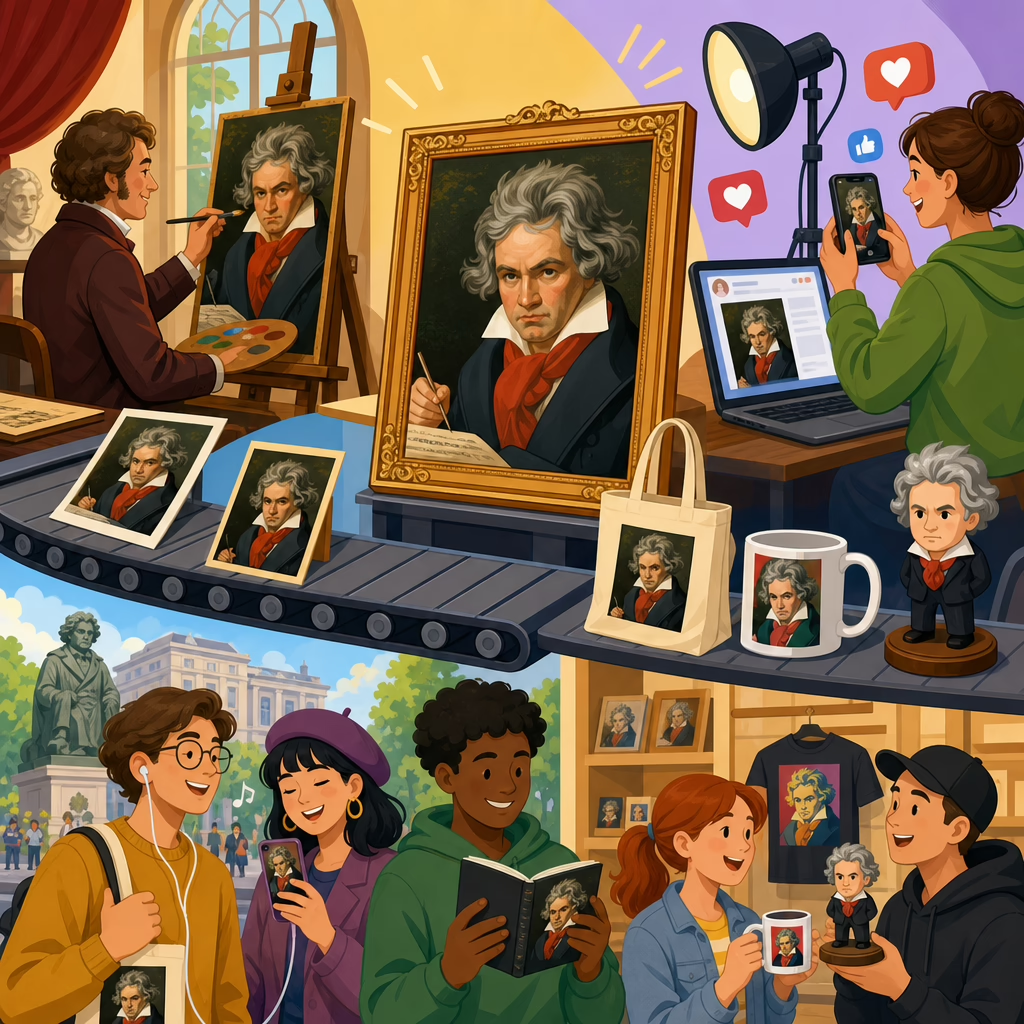
Ludwig van Beethoven’s face is one of the most marketed images in Western culture, and the career of that portrait has been almost as eventful as the music behind it. When people speak about “Beethoven’s portrait,” they usually mean the stern, dark-haired image of the composer with intense eyes, a red scarf, and a manuscript in hand, yet the phrase also includes dozens of paintings, engravings, busts, lithographs, medallions, posters, record sleeves, coffee tins, and digital thumbnails that have circulated for more than two centuries. The marketing life of Beethoven’s portrait matters because it shows how a historical likeness becomes a brand asset: copied, simplified, sentimentalized, politicized, and sold across changing media. I have worked with archives, museum catalogs, and campaign materials where the same visual logic appears again and again. A recognizable face reduces friction. It gives audiences a shortcut to meaning. In Beethoven’s case, that meaning has been remarkably stable: genius, struggle, seriousness, and cultural prestige.
Portrait marketing is not only about art history. It is about distribution, licensing, design conventions, audience targeting, and the commercial value of familiarity. Beethoven’s image has functioned as packaging for concerts, conservatories, publishers, films, tourism boards, luxury audio brands, and mass-market gift merchandise. The portrait does work before a customer reads a headline or hears a note. It signals that what follows belongs to the canon, and that it carries emotional weight. That is why the story deserves a focused look. By tracing how specific portraits were made, copied, and repurposed, we can see how an artist’s likeness becomes a durable cultural product and why Beethoven, more than nearly any composer, remains visually marketable today.
How a Composer’s Face Became a Marketable Symbol
Beethoven was portrayed during his lifetime by several artists, but a small number of images became commercially dominant because they solved a marketing problem: they made the composer legible at a glance. Joseph Karl Stieler’s 1820 portrait is the clearest example. It shows Beethoven outdoors, holding the manuscript of the Missa solemnis, hair windswept, expression concentrated. The composition condenses multiple narratives into one frame. He is not a court servant, not a salon entertainer, but an inspired creator wrestling with immortal work. That story was useful to nineteenth-century publishers and remains useful to cultural marketers now.
Images that survive in the marketplace typically combine recognizability with reproducibility. Stieler’s portrait translated well into engravings and later into posters, postcards, textbook illustrations, and album covers because the facial structure, the unruly hair, and the color contrast were easy to preserve even in reduced or monochrome form. Other portraits offered likeness, but fewer offered such strong visual branding. The market selected the image that could travel. Once audiences learned to identify Beethoven through a handful of repeated traits, every later reuse reinforced the same memory pattern.
This is where portraiture intersects with commercial design. Marketers prefer images that retain identity when cropped, recolored, or flattened into low-cost print. Beethoven’s severe gaze and distinctive hairline survived these transformations better than the softer likenesses of many contemporaries. A bookseller, impresario, or record label did not need art-historical precision. They needed immediate recognition, and Beethoven’s portrait delivered it.
Nineteenth-Century Reproduction and the Birth of Visual Canon
The real acceleration began after Beethoven’s death in 1827, when memorial culture and print technology expanded together. Lithography made image reproduction cheaper and faster, while the growth of middle-class domestic music-making created demand for composer portraits in sheet music, periodicals, and framed prints. Beethoven’s likeness moved from elite collections into bourgeois homes. This transition was decisive. A portrait seen in a museum has prestige; a portrait seen repeatedly in everyday settings acquires familiarity, and familiarity creates market power.
Publishers understood that sheet music sold better when it attached itself to recognized names and faces. Beethoven’s portrait often appeared as a frontispiece or decorative emblem, reinforcing authenticity and value. In practical terms, the image helped buyers distinguish serious repertoire from disposable salon fare. By mid-century, commemorative editions and anniversary publications intensified the process. Each new engraved copy cited earlier copies, and minor inaccuracies mattered less than continuity. The image was becoming canonical through repetition rather than originality.
Public monuments also fed the marketing cycle. Once sculptors and painters established a common facial type, souvenir makers could adapt it across medals, ceramics, and keepsakes sold around festivals or unveiling ceremonies. Bonn and Vienna both benefited from this visual standardization. Civic memory and commerce supported each other. Visitors wanted a Beethoven object they could recognize instantly, and merchants supplied one.
The Portrait Across Media and Markets
By the late nineteenth and early twentieth centuries, Beethoven’s portrait operated in several linked markets at once: education, performance, publishing, tourism, and consumer goods. In classrooms, the image represented musical greatness. In concert halls, it framed program books and anniversary banners. In publishing, it authenticated complete editions and biographies. In tourism, it marked sites as culturally significant. On merchandise, it lent ordinary objects a halo of intellect. The same portrait could appear above a conservatory entrance, on a cigar label, or inside a family encyclopedia.
That flexibility came from the symbolic density of the image. Beethoven’s portrait communicates effort, suffering, and achievement without needing explanatory text. For marketers, this is ideal. A visual that carries a story reduces copy length and increases recall. The image also helped bridge audiences with different levels of musical knowledge. Someone unfamiliar with the late string quartets could still recognize the face and understand that it stood for high culture.
One useful way to see the portrait’s commercial life is to compare how different sectors used it.
| Market | Typical use of the portrait | Main message conveyed |
|---|---|---|
| Sheet music publishing | Frontispieces, title pages, collected editions | Authority, authenticity, prestige |
| Concert promotion | Posters, festival banners, program covers | Serious artistic value, emotional intensity |
| Education | Textbooks, classroom portraits, reference works | Canonical importance, historical memory |
| Tourism and souvenirs | Postcards, busts, magnets, museum shops | Place-based heritage, recognizability |
| Recorded music | LP sleeves, CD booklets, streaming thumbnails | Timelessness, legitimacy, premium repertoire |
In each market, the face performed slightly different work, but the core promise remained consistent. Buyers were not only purchasing a concert ticket or a book. They were purchasing access to an established cultural symbol.
Branding Genius: Why This Image Outsold Others
Many composers have surviving portraits, but few became as commercially potent as Beethoven’s. The reason is not simply fame. It is fit between biography and image. Beethoven’s life story, especially deafness, struggle, and artistic independence, aligned perfectly with the severe portrait type that circulated after 1820. The image looked like the legend people wanted to believe. In marketing terms, verbal narrative and visual identity were tightly integrated.
Mozart’s youthful elegance, Haydn’s courtly decorum, and Schubert’s gentler features conveyed different associations, but Beethoven’s face projected drama. Drama sells. It works in commemorative branding, educational publishing, and prestige media because it implies that the subject mattered deeply. The portrait also resists trivialization better than many classical images. Even when reproduced cheaply, it retains force. A low-resolution print of Beethoven can still look intense; a low-resolution print of another composer may simply look old.
There is also a practical design factor. Beethoven’s head and shoulders create a strong silhouette. Designers can isolate the face, exaggerate the hair, or deepen the eye sockets, and the identity remains intact. This made the portrait adaptable for modernist posters, socialist commemorations, postage stamps, and later digital avatars. Long before contemporary brand manuals, Beethoven’s likeness had already proven modular, memorable, and resilient.
Twentieth-Century Reinvention: Records, Posters, and Mass Culture
The twentieth century expanded the portrait’s reach more than any previous era. The recording industry needed visual shorthand for repertoire categories, and Beethoven’s image became a reliable sales tool. Major labels routinely used painted likenesses, busts, signatures, or profile silhouettes on LP jackets for symphony cycles, piano sonatas, and overture collections. In record shops, the portrait distinguished “serious” catalog from lighter fare. It also supported premium pricing. A boxed Beethoven set wrapped in a familiar authoritative image looked educational, collectible, and giftable.
Film and television extended the same logic. Promotional stills and documentary posters often juxtaposed Beethoven’s portrait with storm clouds, manuscripts, or the opening motive of the Fifth Symphony. These choices were not accidental. They transformed the historical image into a flexible icon for struggle and transcendence. Even advertisements unrelated to classical music occasionally borrowed Beethoven’s head to imply discipline, genius, or sonic quality. Audio equipment marketing has done this repeatedly, especially when selling headphones, speakers, and hi-fi systems to buyers who associate Beethoven with serious listening.
Political systems also repurposed the portrait. Across democratic, imperial, and socialist contexts, Beethoven’s image could be framed as universal heritage. That broad usefulness increased circulation further. Every reuse, even when ideologically different, refreshed public recognition. The portrait’s commercial value grew because it had become unavoidable.
For a wider context on how this visual identity supported Beethoven’s larger cultural status, see this main guide on why Beethoven became a global cultural icon.
Digital Afterlives and the Economics of Recognition
Today, Beethoven’s portrait lives in search results, streaming platforms, museum databases, online course banners, and social media graphics. The economics are familiar, even if the tools are new. Attention is scarce, thumbnails are small, and users decide quickly. Under these conditions, Beethoven’s portrait remains effective because it is instantly legible on a phone screen. Designers often boost contrast, crop tightly around the face, or pair the image with manuscript texture. Those are digital adaptations of old print strategies.
Streaming services provide a good example. When platforms group works by composer, the selected image influences click-through behavior. A strong Beethoven portrait signals certainty and status. It tells users they are entering a major repertoire node. Museum and archive sites rely on similar logic. Even when better-documented or more accurate likenesses exist, institutions often choose the image that audiences already recognize, because recognition improves navigation and engagement.
The limitation is that repetition can flatten complexity. Beethoven had many moods, ages, and appearances, yet the market still favors the stormy, furrowed version. This selective memory is commercially efficient but historically narrow. The portrait’s success, in other words, comes with distortion. Still, from a marketing perspective, consistency usually beats nuance. That is why the same visual formula continues to dominate educational posters, streaming art, and souvenir design.
What the Portrait Teaches About Cultural Marketing
The marketing life of Beethoven’s portrait reveals a durable rule: a cultural image succeeds when it condenses biography, values, and status into a repeatable visual form. Beethoven’s best-known portraits did not circulate so widely by accident. They matched audience expectations, worked across technologies, and attached themselves to profitable institutions such as publishers, concert presenters, schools, museums, and record labels. Once that network was in place, each new reproduction increased the value of every other reproduction.
Another lesson is that authenticity in cultural marketing is often negotiated rather than fixed. Many commercial uses of Beethoven’s portrait were derivative, retouched, or simplified, yet audiences still accepted them because they preserved the symbolic essentials. The market rewarded recognizability over strict fidelity. That pattern remains visible in digital branding now. If a historical figure’s image is clear, narratively aligned, and endlessly adaptable, it can outlive the original artwork by centuries.
Beethoven’s portrait became more than a likeness. It became visual currency for genius. That is its real marketing life, and it explains why the image still sells concerts, books, courses, recordings, and museum tickets today. If you study Beethoven and culture, start with the face people think they already know, then look closely at who reused it, how they framed it, and what they needed it to promise. That is where the deepest story begins.
Frequently Asked Questions
Why is Beethoven’s portrait one of the most recognizable images in Western culture?
Beethoven’s portrait became unusually powerful because it does more than identify a famous composer—it communicates a complete cultural story at a glance. The best-known image, with the intense stare, unruly dark hair, red scarf, and manuscript in hand, presents him as the model of artistic seriousness. Viewers do not just see a man; they see genius, struggle, discipline, defiance, and creative authority. That combination made the portrait highly adaptable for publishers, concert promoters, educators, and later mass marketers who needed a visual shorthand for “great music” and “high culture.”
Another reason for its lasting recognition is repetition across media. Beethoven’s likeness circulated early through paintings, engravings, and lithographs, then expanded into busts, medallions, sheet music covers, posters, postcards, stamps, record sleeves, and eventually digital icons and streaming thumbnails. Every new technology of reproduction gave the image another life. Unlike many historical figures whose faces remain tied to a single museum object, Beethoven’s portrait was copied, simplified, dramatized, and redistributed so often that it entered everyday visual memory. By the time modern audiences encountered it on classroom walls or album covers, it already carried generations of symbolic authority.
Just as importantly, the image suits the mythology built around Beethoven’s life and music. His public identity as the stormy, independent, suffering genius aligned perfectly with a severe and memorable portrait. Marketers have long benefited from that alignment. A smiling or socially polished image would have suggested a different kind of celebrity. Beethoven’s familiar portrait instead reinforces the idea that true greatness is intense, uncompromising, and a little intimidating. That visual message has helped keep the portrait marketable for more than two centuries.
Which portrait do people usually mean when they say “Beethoven’s portrait,” and why did that image become dominant?
In most cases, people mean the iconic early nineteenth-century image of Beethoven holding a manuscript, with penetrating eyes, windswept hair, and a vivid red scarf or collar accent. While there are many portraits of Beethoven from different moments in his life, this version became dominant because it offered a clear, emotionally charged visual identity. It distilled his public legend into one frame: the solitary creator caught in a moment of concentration, as if music itself were still forming in his hand.
The dominance of this image owes much to its reproducibility. Strong portraits survive in public culture when they remain legible even after being reduced, copied, engraved, tinted, or adapted. Beethoven’s severe expression, distinctive hair, and manuscript provide instantly recognizable visual anchors. Even when the details changed from one printmaker, publisher, or designer to another, the essential formula remained intact. That made the portrait ideal for commercial reuse long before modern branding theory put a name to the process.
Its rise also reflects how nineteenth-century audiences wanted to remember Beethoven. After his death, cultural institutions, biographers, and publishers helped fix him in public imagination as a heroic master rather than merely a working composer. The portrait supported that memorial project. It looked canonical. It suggested permanence. Over time, the image became less a record of one sitting and more a branded emblem of genius. That is why today the phrase “Beethoven’s portrait” often refers not only to a specific artwork, but to an entire visual tradition built from that original type.
How did Beethoven’s image evolve from a portrait into a marketable brand?
Beethoven’s image became a brand through a long process of cultural repetition, simplification, and symbolic expansion. At first, portraits served traditional purposes: commemoration, social prestige, and circulation among admirers. But as print culture expanded, Beethoven’s likeness began appearing in forms that reached much wider audiences. Engravings could be sold cheaply, sheet music covers could use his image to boost appeal, and busts or medallions could transform admiration into collectible ownership. The portrait gradually moved from elite art settings into commercial and domestic space.
Over the nineteenth and twentieth centuries, the portrait took on meanings beyond biography. It came to signal seriousness, refinement, authenticity, and timeless artistic value. Businesses and institutions recognized that those meanings had commercial power. Record labels used Beethoven’s image to imply quality and prestige. Concert halls and festivals used it to evoke the classical canon. Educators and textbook publishers used it to stand for the entire tradition of European art music. In each case, the portrait worked like a visual logo: it instantly conveyed a set of values without needing explanation.
Branding also depends on flexibility, and Beethoven’s face proved remarkably adaptable. It could appear reverent on a museum poster, heroic on a monument, playful on a coffee tin, austere on an LP cover, or compressed into a tiny digital square online. Sometimes marketers emphasized the “great master” image; other times they leaned into caricature, turning the stern expression into something humorous or exaggerated. Yet even parody strengthened recognition. The more the portrait was reused, the more durable the brand became. In that sense, Beethoven’s marketing life is not separate from his cultural afterlife—it is one of the main reasons his image remains so visible today.
What kinds of products and media have used Beethoven’s portrait, and what does that reveal about its commercial appeal?
Beethoven’s portrait has appeared on an astonishing range of objects and platforms, from traditional fine-art reproductions to everyday consumer goods. Historically, it circulated through paintings, engravings, lithographs, busts, medals, and commemorative prints. As mass media developed, the image moved onto sheet music, magazines, postcards, classroom charts, postage stamps, advertisements, book jackets, posters, and record sleeves. In the twentieth century, it became common on CD packaging, festival branding, educational materials, souvenir merchandise, and novelty items. In the digital era, the same likeness survives in website headers, app artwork, social media graphics, streaming playlists, and tiny thumbnail images.
This broad spread reveals just how commercially versatile the portrait is. Few historical images can function equally well in high culture and popular culture. Beethoven’s face can authenticate a scholarly edition of a symphony, decorate a tourist souvenir, or add ironic sophistication to a household product. That range is possible because the portrait carries multiple meanings at once. It suggests artistic authority, but it is also visually dramatic enough to attract attention in crowded markets. It can signal prestige, education, nostalgia, and even a kind of rebellious intensity.
The commercial appeal also lies in immediate recognition. Marketers value images that can do cultural work quickly. Beethoven’s portrait tells consumers, almost instantly, that they are looking at something connected to classical music, greatness, tradition, or cultivated taste. It can raise the perceived status of a product or event simply by association. At the same time, because the image is so familiar, it can be reworked humorously or ironically without losing its identity. That rare combination—authority plus adaptability—is exactly what makes an image commercially durable across centuries.
Does the heavy marketing of Beethoven’s portrait change how people understand the composer and his music?
Yes, and that is one of the most fascinating aspects of the portrait’s afterlife. Repeated marketing tends to compress a complex historical person into a concise, emotionally powerful image. In Beethoven’s case, the constant circulation of the stern portrait reinforces a particular interpretation of who he was: serious, solitary, heroic, tormented, and almost superhumanly committed to art. That image is not entirely false, but it is selective. It highlights certain traits while overshadowing others, such as humor, social relationships, practical career decisions, and the broader collaborative world in which his music was performed, published, and received.
The marketing of the portrait also shapes listening habits. Audiences often encounter Beethoven visually before they encounter him musically. When they see the severe face and dramatic pose, they may expect music that is monumental, emotionally intense, and morally elevated. That expectation can deepen appreciation, but it can also narrow perception. Lighter, more playful, or more intimate works may be overlooked because they do not fit the branded image. In this way, the portrait influences not only how Beethoven is remembered, but how his catalog is interpreted and consumed.
At the same time, the marketing life of the portrait has undeniably kept Beethoven present in public culture. Without such persistent visual circulation, he might still be revered by specialists and concertgoers, but he would likely be less visible in everyday life. The portrait has helped carry his name across generations and media environments that his own era could never have imagined. So the marketing effect is double-edged: it simplifies him, but it also preserves him. For historians, critics, and readers, that tension is exactly what makes Beethoven’s portrait such a rich subject—not just as an artwork, but as a case study in how culture turns a face into a lasting brand.