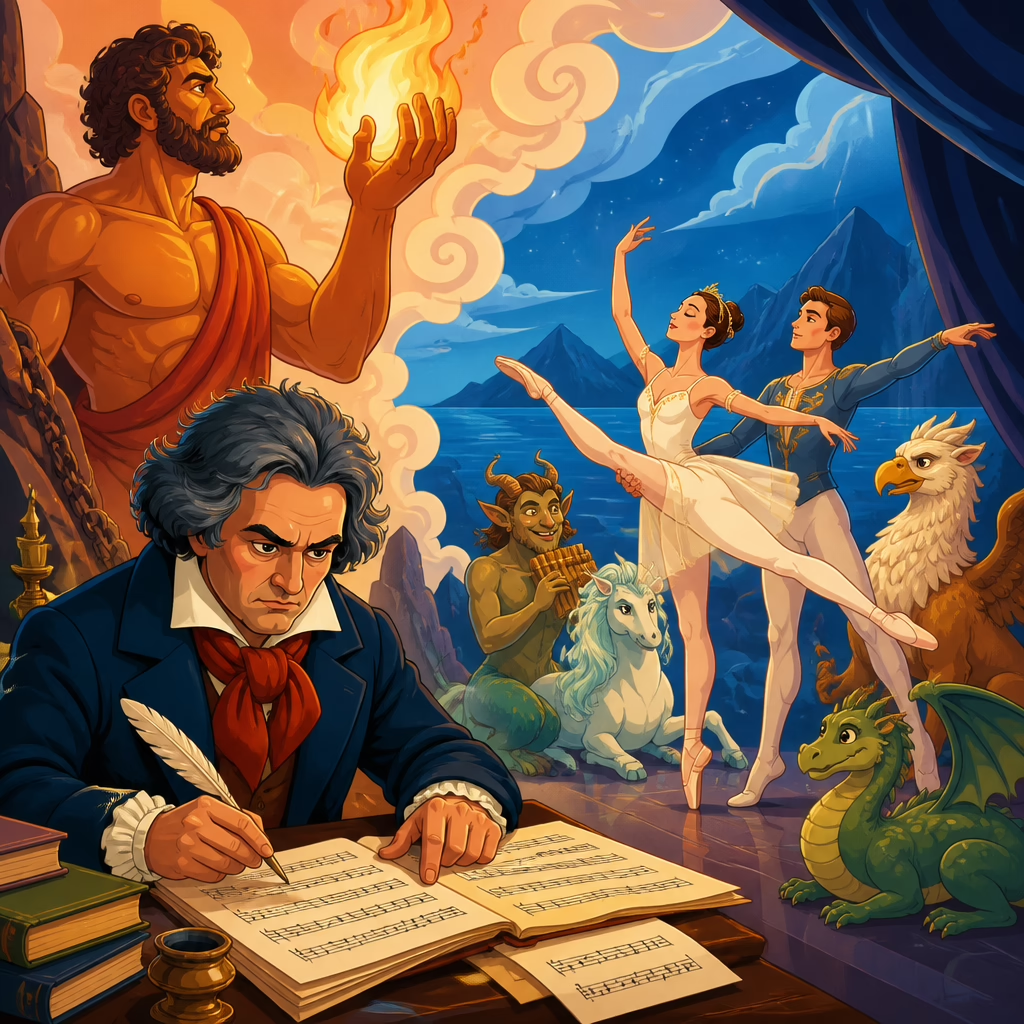
The Creatures of Prometheus and Beethoven’s Ballet Imagination
Beethoven’s only full-length ballet, The Creatures of Prometheus, stands at a fascinating crossroads in his career, revealing how a composer celebrated for symphonies and piano works used dance, myth, and theatrical pacing to test ideas that would later define his mature style. Premiered in Vienna in 1801, the work is often treated as a historical curiosity, yet that view misses its real importance: this ballet shows Beethoven imagining music as physical action, moral drama, and public spectacle at the same time. The title points to Prometheus, the culture-bearing Titan who shapes human beings and brings them enlightenment, and Beethoven’s score follows that civilizing theme through scenes of animation, instruction, conflict, and communal celebration. In practical terms, the ballet matters because it lets listeners hear Beethoven solving stage problems—entrances, transitions, character contrast, cumulative energy—with unusual directness. I have found that when musicians, students, and listeners return to this score without expecting the emotional architecture of the middle symphonies, they discover a composer thinking vividly in motion. Its overture is famous, and its finale theme later gained wider life, but the full ballet deserves attention as a coherent act of imagination, not simply a quarry for future masterpieces.
Understanding the work requires a few basic terms. A ballet score is not just concert music attached to dance; it must organize time according to bodies moving in space, changes of scene, dramatic gesture, and the practical demands of the theater. A number such as an adagio, gavotte, or contredanse is defined partly by rhythm and tempo, but also by social function and choreographic expectation. In this context, Beethoven’s “ballet imagination” means his ability to translate narrative and ethical ideas into sharply profiled musical events that dancers and audiences can grasp instantly. That imagination also includes economy: recurring motives, clear tonal plans, and decisive orchestral coloring make stage action legible. The score was created for the choreographer Salvatore Viganò, one of the most ambitious dance-makers in Vienna, whose reformist approach sought dramatic unity rather than decorative diversion. Their collaboration placed Beethoven inside a genre that demanded discipline as much as inspiration. Far from being peripheral, The Creatures of Prometheus offers a concentrated view of how he handled theatrical narrative before Fidelio, and why movement, embodiment, and public rhetoric remained central to his art.
Why Prometheus attracted Beethoven
The choice of Prometheus was not accidental. Around 1800, the myth carried strong associations with Enlightenment culture, education, and the perfectibility of humanity. In many versions, Prometheus creates or animates human beings, then elevates them through knowledge, the arts, or fire stolen from the gods. That broad symbolic field suited Beethoven, whose works repeatedly dramatize struggle turning into expansion. Viganò’s scenario narrows the myth to a didactic pageant: Prometheus brings two newly formed creatures to Parnassus, where Apollo and the Muses, along with other divine figures, awaken them to sensibility, intellect, and artistic expression. The point is not psychological realism in the modern sense. It is transformation through art.
That idea gave Beethoven a clear structural problem to solve. How do you depict beings who begin as unformed matter and gradually become responsive, rhythmic, social, and expressive? In the score, the answer is contrast. He places abrupt gestures next to poised lyricism, ceremonial passages beside lively dance types, and orchestral outbursts beside more transparent textures. The creatures do not “develop” through a single long symphonic argument; they are educated through encounters, each marked by a distinctive musical profile. This is one reason the ballet can feel episodic in performance if handled carelessly. Yet when conducted with dramatic purpose, the sequence makes sense as a chain of lessons in movement and response.
Prometheus also let Beethoven engage a moral narrative without writing sacred or overtly political music. The civilizing arts become the medium of emancipation. That outlook links the ballet to a broader Beethovenian conviction: music is not mere ornament but an active force shaping human character. Listeners who know only the overture or the famous finale often miss how insistently the complete work returns to this proposition. Even its lighter numbers serve the central allegory by presenting dance itself as a school of order, grace, and communal intelligence.
How the ballet is built
The Creatures of Prometheus, Op. 43, opens with an introduction and overture, followed by a sequence of numbers designed to accompany specific scenes and dances. The exact numbering can vary slightly across editions because eighteenth- and early nineteenth-century stage works often circulated in practical performing materials, but the dramatic arc remains consistent: creation, transport, instruction, awakening, and festive culmination. Beethoven writes for a classical orchestra with pairs of winds, brass, timpani, and strings, and he uses that ensemble less for sheer weight than for articulation and color. Wind writing is especially important, often signaling character and grace where strings drive momentum.
The overture is not a summary in the modern operatic sense, but it establishes tension and release with unusual concentration. The stern opening gestures suggest a heroic frame, while the fast section introduces propulsion and theatrical expectancy. Once the curtain rises on the subsequent numbers, Beethoven becomes remarkably economical. Short dances, processional episodes, pantomimic cues, and ensemble pieces succeed one another quickly. In the theater, that economy is a strength. Every minute must communicate a setting, an action, or a change of affect.
| Element | How Beethoven uses it in the ballet | Why it matters dramatically |
|---|---|---|
| Overture | Compressed tension, bold contrasts, energetic allegro writing | Creates expectation and gives the myth a serious public frame |
| Dance numbers | Distinct rhythms such as adagio, gavotte, and contredanse types | Makes each phase of instruction immediately legible |
| Wind color | Solo and paired winds often soften or clarify the texture | Suggests refinement, grace, and individualized response |
| Finale theme | Simple, balanced, highly memorable melody with variations | Represents achieved order and collective joy |
One practical listening strategy is to hear the numbers less as isolated miniatures than as functional scenes. Beethoven is managing attention the way a skilled dramatist does: after high energy, he resets; after formal display, he offers a clearer tune; after instruction, he gives communal dance. That alternation is the engine of the score. It also explains why concert excerpts can underrepresent the full work. Detached from the stage sequence, some pieces sound brief or occasional. In context, their brevity is exactly right.
What Beethoven learned from dance writing
Writing for ballet forced Beethoven to sharpen traits that later became central to his instrumental music. First, he learned the value of kinetic rhythm. In symphonic repertoire, people often speak of his rhythmic drive abstractly, but in the ballet that drive is tied to actual bodies. Accents must be felt as weight shifts; phrase lengths must support turns, groupings, and exits; tempo must balance elegance with propulsion. Composers who cannot imagine movement tend to write either squarely or awkwardly for dance. Beethoven, even when brusque, almost always writes with physical consequence in mind.
Second, the score shows his gift for characterization through economy. He does not need an elaborate leitmotivic system to distinguish functions. A rhythmic type, a wind color, a change from duple to triple emphasis, or a cadential pattern can be enough. This is expert theatrical thinking. I have seen performers transform audiences’ response simply by articulating these contrasts clearly: what looks thin on the page becomes vivid when every number has a profile. The ballet teaches that Beethoven’s dramatic instinct was already practical, not merely visionary.
Third, dance writing encouraged a more public kind of clarity. In a theater, ambiguity can be costly because the eye and ear are processing several layers at once. Beethoven therefore keeps many textures transparent and cadences firm. That is not a limitation of invention; it is a sign of genre intelligence. The same composer capable of dense motivic argument knew when to let rhythm and phrase structure do the explanatory work. For readers exploring Beethoven’s shorter forms across genres, the contrast is revealing, and the discipline of concise utterance also helps illuminate works discussed in the broader guide to Beethoven’s keyboard miniatures at https://lvbeethoven.com/a-complete-guide-to-beethovens-bagatelles/.
The finale theme and its afterlife
No part of The Creatures of Prometheus has had a richer afterlife than the finale theme, which Beethoven later reused in the Contredanse in E-flat major, WoO 14, No. 7, and most famously as the basis of the finale variations in the Eroica Symphony and the piano variations Op. 35. This is not a trivial self-borrowing. The melody and its bass pattern clearly fascinated him because they offer unusual structural flexibility. The theme is plain enough to sustain transformation, but strong enough to remain recognizable under pressure. In the ballet, it crowns a process of education and social integration; in later works, it becomes the seed of large-scale variation thinking.
That migration tells us something crucial about Beethoven’s imagination. Material first conceived for the stage did not remain secondary in his mind. He could identify within a theatrical number the abstract potential for symphonic growth. At the same time, the theme’s original dramatic function should not be forgotten. In the ballet finale, it signifies achieved form—creatures who can now participate in ordered communal life. The tune’s balance, periodicity, and danceability are part of that meaning. When it reappears in the Eroica, listeners often hear only heroic transformation, but its roots lie in embodied social motion.
Scholars have long noted that Beethoven sometimes thought from basses upward, and the Prometheus finale is a prime example. The underlying pattern is as important as the surface melody. This helps explain why the idea could support contrapuntal play, variation, and large formal expansion. For listeners, the takeaway is simple: the ballet is not merely a prelude to greater things, but a workshop where Beethoven tested one of his most generative musical concepts in a dramatic setting.
Performance, reception, and modern listening
The ballet enjoyed respectable success in its early Vienna run, with numerous performances, though it never secured a permanent repertory place comparable to standard nineteenth-century operas. That history is understandable. Full ballets from the period depend heavily on choreography, theater practice, and scenario conventions that later audiences do not automatically know. Without effective staging, the work can seem fragmentary. Without musical conviction, it can seem lighter than it is. Yet modern historically informed performance has improved its chances. Conductors who observe brisk but not breathless tempos, clean articulation, and crisp dynamic contrast reveal the score’s backbone. Orchestras using classical bows, narrower vibrato, and transparent balances often clarify inner detail that can disappear in a heavier symphonic manner.
For dancers and directors, the challenge is narrative legibility. Viganò belonged to a reform tradition that valued expressive action, not just decorative divertissement. A modern production must therefore make the creatures’ awakening visible as a sequence of changing capacities: instinct, imitation, responsiveness, coordination, then fully socialized dance. When that progression is clear, the audience understands why the score alternates between pantomime and formal numbers. I have found that pre-performance notes, concise surtitles, or spoken introductions can help enormously, because once viewers grasp the allegory, Beethoven’s pacing feels purposeful rather than miscellaneous.
Reception has also been shaped by the dominance of Beethoven’s later masterpieces. Compared with the Third or Fifth Symphony, this ballet inhabits a different expressive economy. It is less about overwhelming teleology than about enacted instruction. Judging it by symphonic standards alone is a category mistake. Heard on its own terms, The Creatures of Prometheus is one of the clearest windows into Beethoven’s early theatrical craft, and one of the best demonstrations that his understanding of form was inseparable from gesture, motion, and public meaning.
The Creatures of Prometheus endures because it captures Beethoven in the act of discovering how ideas move when music must educate the eye as well as the ear. The ballet takes an Enlightenment myth and turns it into a practical sequence of musical lessons: rhythm teaches coordination, melody teaches expression, form teaches order, and communal dance confirms that art completes the civilizing process. Its overture frames the myth with urgency, its middle numbers show Beethoven’s precision in theatrical timing, and its finale provides one of the most fertile themes of his entire career. For anyone interested in Beethoven’s works as living dramatic objects rather than isolated concert monuments, this score is indispensable.
The main benefit of hearing the ballet whole is that it restores proportion to Beethoven’s creativity. It reminds us that he was not only a builder of monumental instrumental forms, but also a stage composer who understood bodies, gesture, and audience perception with real sophistication. That insight changes how the overture sounds, how the finale theme functions, and how the early Beethoven of 1801 connects to the revolutionary artist of the next decade. If you know only excerpts, listen to a complete performance and follow the scenario scene by scene; the ballet’s imagination becomes far richer when its creatures learn to move before your ears.
Frequently Asked Questions
Why is The Creatures of Prometheus important if it is not as famous as Beethoven’s symphonies?
The Creatures of Prometheus matters because it captures Beethoven at a crucial moment of artistic development, when he was actively experimenting with how music could shape drama, movement, and public meaning. Although it does not occupy the same popular place as the Eroica, the Fifth Symphony, or the late string quartets, the ballet reveals a composer thinking beyond the concert hall and testing ideas in a theatrical environment. In this work, Beethoven is not simply writing pleasant dance music to support choreography. He is exploring how instrumental music can suggest character, conflict, transformation, and moral elevation through pacing, gesture, and contrast.
The ballet premiered in Vienna in 1801, a period when Beethoven was building his reputation and refining the musical language that would later define his mature style. Seen from that perspective, the score becomes much more than a historical side project. It offers a window into his evolving dramatic instincts: sharp rhythmic definition, vivid orchestral color, energetic momentum, and an interest in music as a force that can enact change. These qualities would become central to his later symphonic writing, but in Prometheus they are being tested in a medium where movement and story are inseparable from sound.
Its importance also lies in the subject itself. The myth of Prometheus, a bringer of fire and knowledge, naturally connects with Enlightenment ideals of education, human progress, and the shaping of civilization. Beethoven responded to that framework with music that often suggests animation, instruction, and awakening. In other words, the ballet allows us to see how he linked art with moral and intellectual development. That connection would remain vital throughout his career. So while the work may be less famous, it is deeply revealing: it shows Beethoven imagining music as action in space, as ethical drama, and as a communal spectacle intended to move an audience both physically and emotionally.
What does the myth of Prometheus add to Beethoven’s ballet imagination?
The Prometheus myth gives Beethoven a dramatic and philosophical structure that is unusually rich for a ballet. In the version associated with this work, Prometheus brings two human figures to life and guides them toward cultivation through the arts. That premise is ideal for a composer interested in transformation, because it turns music into more than accompaniment. Music becomes part of the civilizing process itself. Instead of merely decorating scenes of dance, the score can embody animation, education, aspiration, and refinement.
This is where Beethoven’s ballet imagination becomes especially fascinating. He was drawn to narratives in which struggle leads to growth, and the Prometheus story allowed him to explore that pattern in a visual, theatrical context. The idea of raw beings being awakened and elevated through artistic experience resonates strongly with broader themes in Beethoven’s output, where music often feels like a journey from darkness to clarity, from tension to release, or from limitation to freedom. In the ballet, those ideas appear in a more explicit dramatic form. Movement onstage gives the music a physical counterpart, making transformation visible as well as audible.
The myth also suits Beethoven’s public voice. Prometheus is not a passive figure; he is a bringer of possibility, a challenger, and a cultural benefactor. Those associations align well with Beethoven’s reputation as a composer of heroic energy and moral seriousness, even if that later image had not yet fully solidified in 1801. The ballet therefore shows him engaging with a subject that invites grandeur, theatrical tension, and idealistic purpose. Rather than treating myth as remote ornament, Beethoven uses it as a framework for human development, artistic power, and social imagination. That is one reason the score still rewards attention today: beneath its elegant stage function lies a strikingly serious vision of what art can do.
How does The Creatures of Prometheus anticipate Beethoven’s later mature style?
The ballet anticipates Beethoven’s mature style in several important ways, even though it belongs to an earlier phase of his career. One of the clearest signs is its sense of propulsion. Beethoven already shows a strong command of rhythmic drive and directional energy, qualities that later become essential to the emotional architecture of his symphonies. Instead of writing dances that simply repeat formulas, he often shapes music so that it seems to push forward, intensify, and define dramatic situations with unusual force. That instinct for motion is very much the Beethoven listeners recognize from his larger orchestral works.
Another important feature is his handling of contrast. In Prometheus, Beethoven uses shifts of mood, texture, and tempo not just for variety but for narrative effect. He understands that theatrical music must change character quickly and convincingly, and this sensitivity to sharp dramatic contrast foreshadows the expressive range of his middle-period masterpieces. The ballet also reveals his growing confidence with orchestral color. While the score remains grounded in the conventions of its time, it frequently displays a vividness and decisiveness in instrumental writing that point toward later achievements in symphonic drama.
Perhaps the most famous link to Beethoven’s future is thematic. The finale uses material associated with the melody that would later reappear in the Eroica Symphony and in the Eroica Variations for piano. This is more than a trivia point. It shows that Beethoven recognized lasting potential in ideas first explored in the ballet context. He was willing to revisit and transform musical material across genres, suggesting that Prometheus was part of a broader creative laboratory rather than a disposable occasional work.
Most importantly, the ballet hints at Beethoven’s lifelong concern with transformation through structure. Even in a genre often regarded as light or decorative, he is thinking about how music can enact development and reveal inner purpose. That is a hallmark of his mature style. So while The Creatures of Prometheus may not sound identical to the revolutionary Beethoven of the middle and late periods, it unmistakably contains the seeds of the composer he would become.
Was Beethoven comfortable writing for dance and the theater, or was this ballet an exception?
Beethoven’s relationship with theater was complicated, but The Creatures of Prometheus shows that he was fully capable of thinking theatrically when the project engaged his imagination. He was not primarily a ballet composer, and he did not build his career around stage dance in the way some of his contemporaries did. His reputation rested far more on piano music, chamber music, and symphonic writing. Even so, this ballet demonstrates that he understood the demands of theatrical pacing, scene construction, and music designed to interact with bodies in motion.
What makes the work so interesting is that Beethoven did not approach dance music as something beneath him or outside his artistic seriousness. Instead, he used the theatrical setting to investigate questions that mattered deeply to him: how to shape a public dramatic arc, how to embody character through musical gesture, and how to communicate ideas of struggle and elevation to a broad audience. In that sense, the ballet is not an isolated curiosity but part of his wider engagement with dramatic expression. His opera Fidelio, of course, would later become the major stage work of his career, and many of the same instincts visible in Prometheus—moral intensity, dramatic contrast, and a concern with liberation—can be felt there as well.
At the same time, ballet did place special constraints on him. Music for dance must coordinate with timing, gesture, and stage action in a particularly exact way. That practical reality likely shaped how Beethoven organized sections, balanced clarity with momentum, and wrote with physical movement in mind. The score therefore reveals a side of his craft that is easy to overlook when focusing only on concert music. He is attentive not just to abstract musical logic but to spectacle, embodiment, and audience immediacy.
So the ballet was unusual within Beethoven’s output, but it was not alien to his gifts. It shows a composer testing how far his dramatic imagination could operate in a collaborative theatrical form. Rather than seeing it as an exception that sits awkwardly outside his career, it is better to understand it as a revealing extension of his broader artistic concerns.
Why should modern listeners and readers pay attention to The Creatures of Prometheus today?
Modern listeners should pay attention to The Creatures of Prometheus because it deepens our understanding of Beethoven as a dramatic thinker, not just a master of symphonic argument. Too often, the work is mentioned only in passing, as if its chief value were that it contains a tune later reused elsewhere. In reality, the ballet offers a vivid portrait of Beethoven at a formative stage, exploring how music can animate bodies, organize theatrical time, and communicate ideals to a public audience. For anyone interested in how great composers develop, that is invaluable evidence.
The ballet also matters because it broadens the image of Beethoven himself. He is often presented in monumental terms: the heroic symphonist, the uncompromising genius, the architect of overwhelming concert works. Prometheus reminds us that he could also be agile, stage-aware, witty, elegant, and responsive to visual drama. It reveals a composer who understood that meaning in music can emerge through gesture, sequence, and