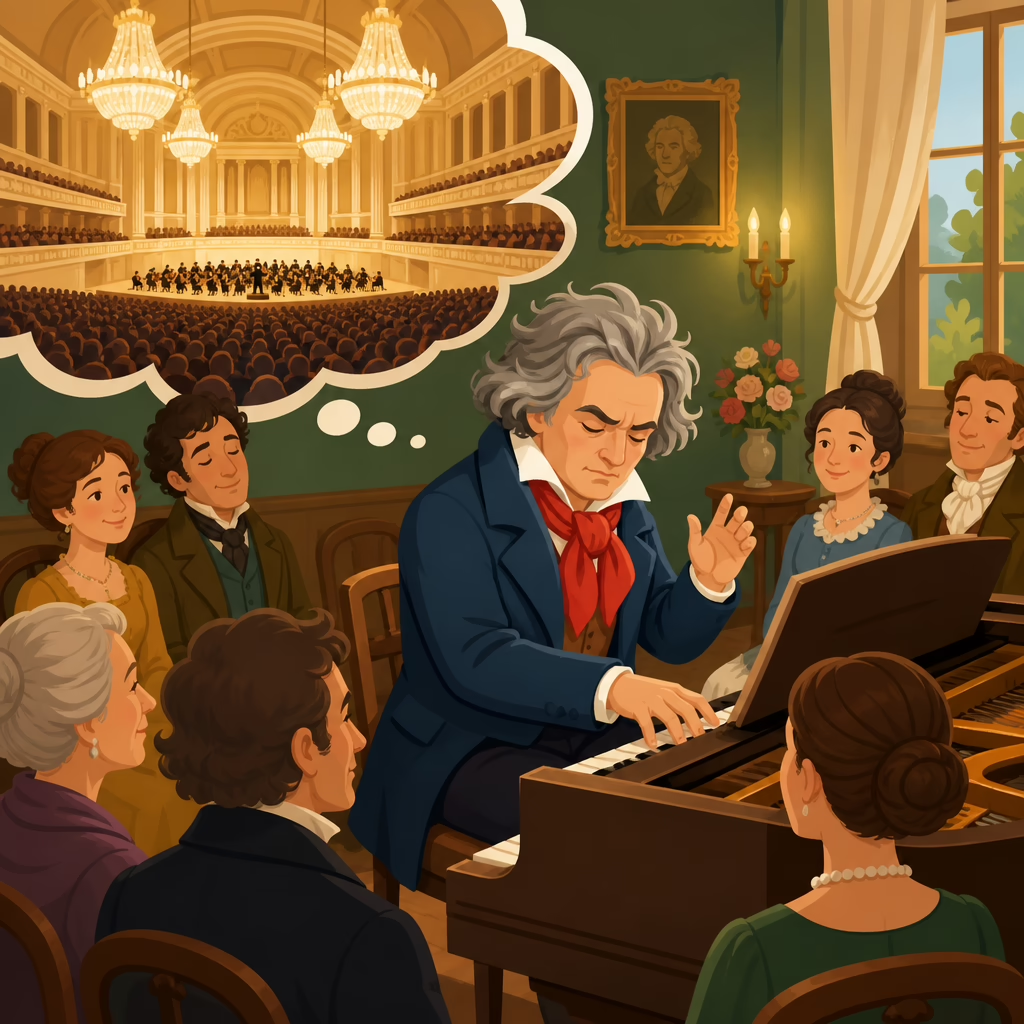
The Case for Hearing Beethoven in Smaller Halls
Beethoven is often presented as a composer who demands scale: larger orchestras, broader gestures, and monumental concert spaces that match the cultural weight attached to his name. Yet after years of listening to his symphonies, concertos, overtures, and choral works in venues ranging from intimate eighteenth-century theaters to vast modern auditoriums, I have become convinced that smaller halls frequently reveal more of Beethoven’s art than large ones do. The case for hearing Beethoven in smaller halls is not nostalgic sentiment. It rests on acoustics, orchestral balance, historical context, listener perception, and the practical realities of how his music communicates.
By smaller halls, I mean venues that typically seat roughly 600 to 1,800 listeners, with moderate reverberation times, clear lateral reflections, and a close visual relationship between audience and performers. These rooms differ from cavernous symphony spaces that hold 2,200 people or more and are often designed to project a large late Romantic orchestra. Beethoven, of course, spans periods and performance traditions. He wrote for the theaters, court spaces, and civic halls of Vienna at the turn of the nineteenth century, not for twentieth-century acoustic monuments. That fact alone does not settle the matter, but it does frame a serious question: what kind of room lets his rhythmic precision, dynamic contrasts, and instrumental argument come across most convincingly?
This matters because Beethoven’s music is built less on sheer mass than on tension, attack, pacing, and the audibility of structural events. A sforzando in the “Eroica,” a bassoon line under a transition in the Fifth Symphony, or the exchange between timpani and lower strings in the Seventh only achieves full force when the ear can identify where the energy begins and how it moves through the ensemble. In too-large acoustics, those details can blur into generalized grandeur. In a smaller hall, they often register as living drama. For listeners comparing interpretations, venue size can change what they think they are hearing almost as much as tempo or orchestral style.
Acoustic clarity serves Beethoven better than sheer volume
The strongest argument for smaller halls is acoustic clarity. Beethoven’s scores thrive on sharply profiled rhythm, quick dynamic reversals, exposed wind writing, and motivic interplay passed among sections. In a hall with a moderate reverberation time, often around 1.5 to 1.9 seconds when occupied, attacks remain defined and inner lines stay legible. In a larger room with longer decay, especially one optimized for sonic bloom, the same passage may sound impressive but less intelligible. The listener hears size before syntax.
I have heard this difference repeatedly in the opening movement of the Fifth Symphony. In a compact hall, the famous four-note motive does not merely announce itself; it ricochets through the orchestra with near-physical inevitability. You hear the rests, the silences, and the string articulation that turn the motive into argument. In a larger hall, the passage can gain theatrical weight, but the rhythmic compression that drives the movement is often softened. Beethoven’s rhetoric relies on contour plus interruption, not just decibel level.
The issue is not whether large halls can sound good. Many do, especially with careful seating plans, reduced vibrato, classical timpani sticks, and disciplined dynamic control. But smaller halls give performers less room to hide and listeners more information to process. Woodwind doublings in the Second Symphony, horn calls in the “Eroica,” and the violas’ role in developmental texture all emerge with less effort. That means the audience perceives Beethoven’s orchestration as active design rather than as background color behind the strings.
Smaller venues improve orchestral balance and conversational texture
Beethoven writes orchestrally in layers that resemble debate. Strings drive momentum, winds comment, brass punctuate, timpani stabilize or provoke, and registral spacing creates hierarchy. In a smaller hall, this conversational texture tends to balance naturally because the room does not force the orchestra to overproject. Players can use a wider range of true piano and mezzo-forte dynamics without fearing that detail will vanish past the front stalls. The result is not simply quieter Beethoven. It is more proportionate Beethoven.
Consider the slow introduction to the Fourth Symphony. Its mystery depends on harmonic suspense, low-register transparency, and the sense that each new entry slightly shifts the floor beneath the listener. When played in a dry-to-moderately resonant smaller room, the bass line retains pitch definition and the wind chords retain grain. You can follow how Beethoven withholds release. In a broad, heavily resonant auditorium, low frequencies may accumulate while upper voices disperse, creating atmosphere but reducing harmonic precision. That tradeoff matters because suspense in Beethoven is structural, not merely atmospheric.
Concertos show the same advantage. In the Fourth Piano Concerto, the soloist’s opening statement must sound intimate yet public, almost improvised yet inevitable. In smaller halls, the piano can speak in a singing tone without excessive force, and the orchestra can answer with chamber-like tact. The famous Orpheus-and-Furies exchange in the second movement gains dramatic credibility because the strings can sound threatening without becoming an undifferentiated wall. I have heard performances in large rooms where the pianist had to brighten the attack and push the line just to reach the rear seats, sacrificing some of the work’s inward character.
| Beethoven feature | What smaller halls reveal | What can be lost in larger halls |
|---|---|---|
| Sforzando accents | Clear attack and release | Impact turns into generalized loudness |
| Wind counterpoint | Distinct timbral identities | Lines blend into string resonance |
| Rhythmic cells | Precise repetition and tension | Pulse softens under reverberation |
| Dynamic contrasts | Wide expressive range at moderate volume | Players overproject, narrowing nuance |
| Transitions | Formal architecture is easy to follow | Structural joints feel less explicit |
Historical scale supports the musical argument without dictating it
Arguments for smaller halls are sometimes dismissed as simple historicism, as though the point were merely to recreate Beethoven’s Vienna. That misses the deeper issue. Historical scale matters because it affects musical function. The Theater an der Wien, the Kärntnertortheater, and related early nineteenth-century spaces did not resemble today’s largest symphonic venues in seating capacity, stage depth, or acoustic spread. Orchestras were smaller, instruments projected differently, and listeners sat nearer to the source. Beethoven wrote into that reality.
This does not mean every modern performance should use period instruments or reduced forces. It does mean that many features of the scores make more immediate sense in smaller rooms. Natural horns cut through with thrilling edge rather than brute force. Hard-stick timpani articulate rhythm instead of producing only atmospheric rumble. Gut-string attacks and lighter bows clarify phrase beginnings. Even with modern instruments, conductors who understand classical proportion often get more persuasive results in midsize venues because the room supports transparency instead of rewarding saturation.
I have found that the First and Second Symphonies especially benefit from this environment. Heard in large halls, they can sound like preliminary versions of later masterpieces. Heard in smaller ones, their wit, asymmetry, and audacious handling of inherited forms become unmistakable. The finales bite harder, the pauses matter more, and the surprise accents feel genuinely disruptive. The room helps restore their dangerousness. That is one reason a listener trying to judge different performance traditions should pay attention not just to orchestra and conductor but to venue. For a broader method of listening critically across recordings and interpretations, this guide is useful: How to Compare Beethoven Symphony Cycles Like a Critic.
Audience perception changes when distance shrinks
Smaller halls alter not only sound but attention. When the audience is physically closer, visual cues reinforce musical understanding. You see bow distribution in repeated figures, the timing of wind breaths, the conductor’s choice of rebound after a fermata, and the degree of risk in a horn entry. These details matter in Beethoven because the music dramatizes process. The listener benefits from sensing how coordination happens in real time. A smaller room turns symphonic listening into something more like chamber listening, without reducing scale.
This proximity also changes emotional perception. The funeral march of the “Eroica” in a smaller hall can feel less like a public monument and more like collective witnessing. The Scherzo of the Ninth gains volatility when the timpani and low strings speak with immediate presence rather than distant mass. In the Missa solemnis, where architectural breadth still matters, smaller but resonant spaces can make fugal episodes and text setting easier to follow, even if they may not supply the overwhelming bloom some listeners want in the most exalted climaxes.
There is a psychological reason for this effect. Human hearing localizes direct sound faster and more confidently when early reflections arrive coherently and the source remains visually anchored. In plain terms, when you can both hear and see Beethoven’s musical arguments being built, you grasp them more fully. Large halls often privilege spectacle and collective event. Smaller halls privilege comprehension. With Beethoven, comprehension intensifies emotion rather than diminishing it.
Not every work or interpretation benefits equally
A balanced case must admit limits. Some Beethoven pieces can profit from the breadth of a large hall, particularly when the performance concept aims for maximum ceremonial grandeur. The Ninth Symphony’s final movement, the Missa solemnis, and occasionally the “Emperor” Concerto may gain thrilling amplitude from a room that allows choral and orchestral sonority to expand. Likewise, a conductor pursuing broad tempos and blended legato may prefer a more generous acoustic, where the sound can fuse and carry.
But even here, bigger is not automatically better. I have heard Ninths in large spaces where the Turkish march episode turned diffuse, the fugato lost articulation, and the closing pages became loud rather than cumulative. By contrast, a well-designed hall of around 1,500 seats can preserve enough resonance for exaltation while keeping text, counterpoint, and rhythmic profile intact. The ideal is not smallness alone. It is the right proportion between ensemble, repertoire, and room.
Listeners should also remember that some modern chamber orchestras can sound undernourished in spaces that are too dry, while some full symphony orchestras can adapt superbly to midsize halls by adjusting seating, bowing, brass placement, and timpani choice. Venue size is one variable among many, but it is a decisive one because it shapes every other musical decision. If Beethoven sounds congested, opaque, or relentlessly monumental, the hall may be partly responsible.
How to choose the best hall for Beethoven listening
If you are deciding where to hear Beethoven live, look beyond reputation and prestige. Check capacity, stage configuration, and the hall’s acoustic profile if available. Vineyard-style rooms often provide strong clarity, though some can feel analytically exposed. Traditional shoebox halls often deliver an ideal blend of warmth and definition. Aim for venues in the midsize range with a record of successful classical programming. Seats in the front half of the main floor or lower balcony usually provide the best balance of direct sound and blend.
Also match the hall to the work. For the First through Eighth Symphonies, the violin sonatas, the piano concertos, and overtures such as “Coriolan,” smaller spaces routinely produce more vivid results. For the Ninth and Missa solemnis, seek a hall that is still controlled enough to preserve diction and counterpoint. If you stream performances, the same principle applies indirectly: recordings made in smaller venues often capture cleaner attacks, better stereo imaging, and more truthful orchestral scale than those engineered to inflate grandeur with excess reverberation.
The larger point is simple. Beethoven’s power does not depend on maximum size. It depends on maximum intelligibility joined to expressive force. Smaller halls often supply exactly that combination. They let the music strike, argue, sing, and surprise with the immediacy built into the scores. If you want to hear not just Beethoven’s reputation but Beethoven himself, choose the smaller hall when you can. Then listen for the details that suddenly sound indispensable: the bite of the accents, the independence of the winds, the architecture of the transitions, and the human scale inside the monument. That is where the case becomes audible.
Frequently Asked Questions
Why do smaller halls often suit Beethoven better than large concert venues?
Smaller halls often suit Beethoven because they let listeners hear the internal logic of his music with far greater clarity. Although Beethoven is regularly associated with grandeur, force, and public monumentality, his writing is just as much about precision, tension, surprise, and the play of musical ideas between instrumental lines. In a more intimate acoustic, rhythmic motives speak more sharply, sudden dynamic contrasts register more vividly, and the dialogue among strings, winds, brass, and timpani feels immediate rather than generalized. Instead of hearing a broad wall of “Beethoven sound,” audiences can follow the actual architecture of the score.
There is also an important historical dimension to this argument. Beethoven did not compose for the cavernous modern concert halls that now dominate major orchestral life. The spaces available to him were usually smaller, more direct, and less acoustically diffuse than many contemporary auditoriums. That does not mean every work should be treated as miniature, but it does suggest that modern assumptions about sheer scale can distort what the music is doing. In smaller halls, accents bite, silences matter, and transitions feel dramatically charged. The result is not a reduction in power, but often an increase in intensity. Beethoven can sound less like a marble monument and more like a living, thinking, volatile presence.
Does hearing Beethoven in a smaller hall make the music feel less powerful or dramatic?
Not at all; in many cases, smaller halls make Beethoven feel more powerful because they concentrate the energy rather than dispersing it. Power in Beethoven is not simply a matter of volume or orchestral mass. It comes from conflict, propulsion, harmonic pressure, rhythmic insistence, and the release of accumulated tension. In a very large space, some of those qualities can blur into a generalized impression of loudness. In a smaller hall, by contrast, the attack of the orchestra reaches the listener more directly, the pulse remains more clearly defined, and climaxes feel earned because the steps leading to them are easier to hear.
Dramatic impact also depends on contrast. Beethoven’s force is inseparable from his control of quiet passages, suspenseful pauses, sudden turns of texture, and intimate exchanges between instruments. When those details are audible and present, the larger moments become more shattering. A fortissimo has greater meaning when it emerges from a genuinely tense pianissimo. A triumphant tutti is more thrilling when one has clearly heard the fragments, hesitations, and arguments that preceded it. Smaller halls do not shrink Beethoven’s drama; they often sharpen it by making every stage of the drama more legible and more human.
Which aspects of Beethoven’s music become clearer in an intimate acoustic?
One of the first things that becomes clearer in an intimate acoustic is Beethoven’s motivic workmanship. He is famous for building large structures from tiny cells: a rhythmic figure, a repeated note, a sharply profiled interval, a short gesture that keeps returning in altered form. In a smaller hall, these building blocks are easier to track, so listeners can hear not just the sweep of a movement but the way it is constructed from persistent, evolving material. This is especially important in the symphonies and overtures, where the sense of inevitability often comes from relentless development rather than from simply expansive melody.
Orchestral balance also improves in many smaller venues. Woodwind lines that can disappear in larger halls often come alive, revealing how central they are to Beethoven’s expressive world. Inner string voices gain definition, brass interjections have more rhetorical purpose, and timpani strokes contribute contour rather than mere impact. The listener may also become more aware of Beethoven’s humor, abruptness, and conversational quality. His music is full of interruptions, feints, sudden emphases, and surprising changes of direction. In a more intimate space, these traits come across vividly, reminding us that Beethoven was not only monumental but also theatrical, witty, and startlingly inventive in real time.
Is this argument only relevant to historically informed performances, or does it apply to modern orchestras too?
It applies to both. Historically informed performance has helped many listeners reconsider Beethoven by emphasizing leaner textures, clearer articulation, brisker tempos, and a stronger awareness of period style. Those qualities often pair naturally with smaller halls, where transparency and immediacy can be especially rewarding. However, the case for intimate venues is not limited to period instruments or historically scaled ensembles. Modern orchestras also benefit from spaces that allow detail, rhythmic precision, and dynamic nuance to come through without excessive reverberant wash.
In fact, a skilled modern orchestra in a well-sized hall can make Beethoven sound exceptionally compelling. The richer sonority of modern strings, the broader dynamic range of contemporary instruments, and the technical finish of today’s players do not have to lead to heaviness. In the right acoustic, those assets can support a Beethoven performance that is both full-bodied and transparent. The key issue is not ideology but audibility. Whether one hears a chamber-sized period band or a major modern symphony orchestra, the music often gains when the venue lets listeners perceive articulation, ensemble interplay, and structural tension clearly. Smaller halls can therefore serve not as a niche preference, but as an ideal environment for a wide range of Beethoven approaches.
What should listeners pay attention to when hearing Beethoven in a smaller hall?
Listeners should pay close attention to how much more conversational Beethoven can seem in a smaller hall. Instead of experiencing the orchestra as a distant collective mass, notice how phrases pass between sections, how winds answer strings, how brass punctuate rather than simply dominate, and how timpani can propel the argument with remarkable clarity. Try following a single motive through a movement and listening for the ways Beethoven transforms it through repetition, fragmentation, expansion, and harmonic displacement. In an intimate setting, these processes are often much easier to hear, and they reveal how Beethoven’s most famous works derive their force from rigorous musical thinking.
It is also worth listening for expressive extremes at both ends of the dynamic spectrum. In smaller halls, quiet passages can feel intensely focused rather than merely soft, and sudden loud eruptions can be viscerally startling without becoming muddy. Notice too the role of silence and pacing: Beethoven often creates drama by stopping the flow, suspending expectation, or making the listener wait a beat longer than expected. Those moments gain extraordinary tension in a direct acoustic. Ultimately, hearing Beethoven in a smaller hall invites a shift in perspective. The music may still sound grand, but its grandeur emerges from vivid detail, friction, and immediacy. What becomes clear is that intimacy and scale are not opposites in Beethoven; very often, intimacy is the path through which true scale is most convincingly heard.