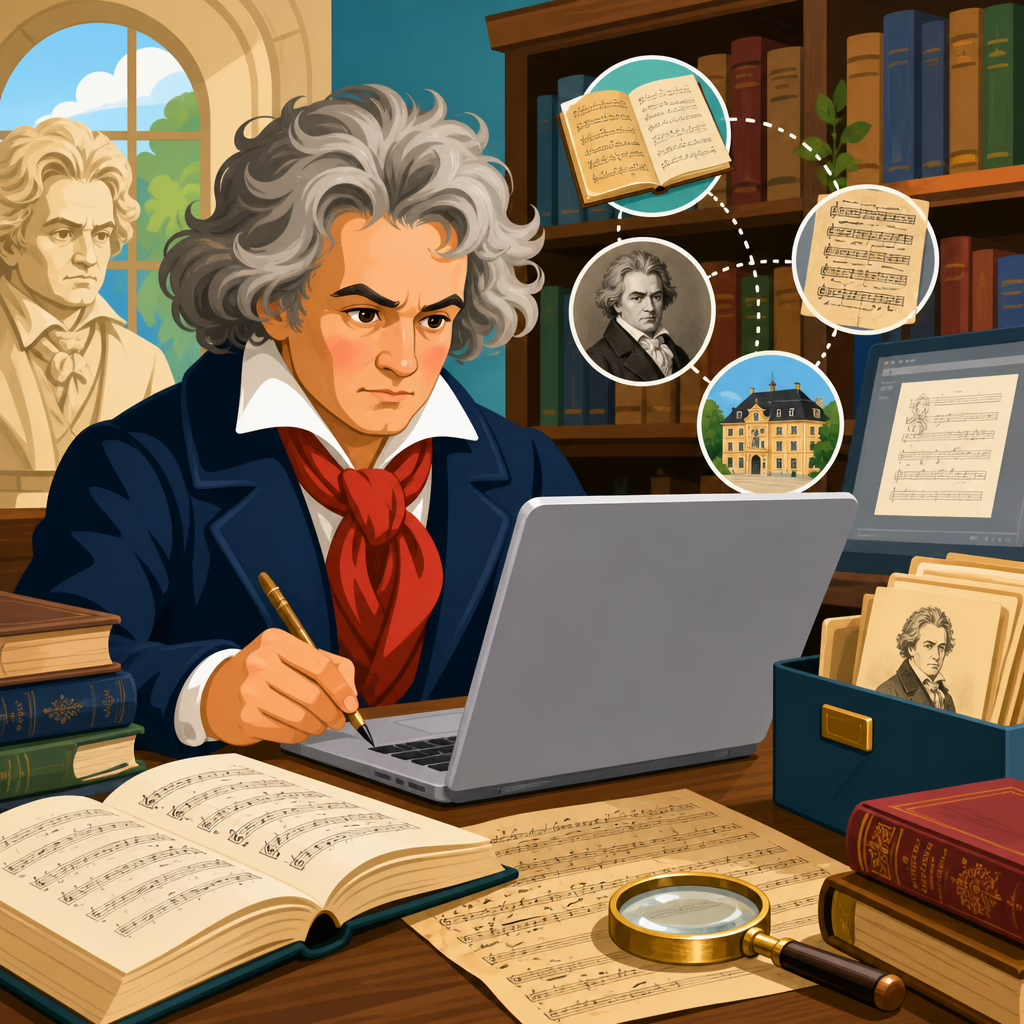
The Best Digital Archives for Beethoven Research
Serious Beethoven research now begins online, because the best digital archives make manuscripts, early editions, letters, sketches, and performance documents searchable in minutes instead of months. For scholars, performers, teachers, and informed listeners, a digital archive is more than a website that hosts scans. It is a structured research environment that combines images, metadata, provenance, catalog records, and often transcription layers that help users verify dates, compare sources, and trace how a work evolved. In Beethoven studies, that distinction matters. A low-resolution scan of a score may be convenient, but a properly curated archive can reveal paper types, copyist hands, watermark evidence, revisions in ink, and ownership history that affect editorial decisions and analytical claims.
I have used these archives to check source readings, confirm movement titles, inspect autograph corrections, and cross-reference correspondence before writing program notes and source commentaries. The practical difference is immediate. Instead of relying on a single printed edition, you can test assumptions against surviving primary materials. That matters because Beethoven’s oeuvre survives in a dispersed documentary record. Autograph manuscripts are scattered across Berlin, Bonn, Vienna, New York, and private collections. Sketchbooks are fragmented. Early prints exist in variant states. Letters survive in original manuscripts, copies, and auction catalogs. No single repository contains everything, so the best digital archives for Beethoven research are the ones that either hold crucial source material directly or provide high-quality gateways to multiple institutions.
This subject matters now for two reasons. First, digitization quality has improved enough that remote work can answer questions that once required travel grants. Second, research workflows increasingly depend on interoperable metadata, persistent identifiers, and image standards such as IIIF, which let users compare sources across institutions efficiently. If you are studying the Eroica sketches, checking the transmission of the late quartets, or tracing a letter to a publisher, the right archive saves time and reduces error. The resources below stand out because they are reliable, source-rich, and genuinely useful for Beethoven-specific work rather than merely tangential to it.
Beethoven-Haus Bonn Digital Collections
If I had to name the single most important starting point for Beethoven research, it would be the digital collections of Beethoven-Haus Bonn. Beethoven-Haus is not simply a museum; it is one of the core documentary centers for Beethoven scholarship. Its online holdings include autograph manuscripts, sketch leaves, letters, first and early editions, portraits, and a deeply useful thematic and catalog framework. For many projects, this archive provides the first authoritative answer to basic source questions: what survives, where it is held, how it is dated, and whether images are available.
The archive is especially valuable because it reflects the logic of Beethoven scholarship rather than generic library organization. Works can be approached through catalog records connected to source types and bibliographic references. When I need to verify whether a fragment belongs to a particular compositional stage, Bonn is often the first place I check because the metadata is usually more musicologically meaningful than what a general library catalog provides. The institution’s long editorial history also gives confidence that the descriptions are not superficial.
For users working on sketches and genesis, the Bonn materials are indispensable. Beethoven’s compositional process was nonlinear, and sketch evidence often survives in disbound leaves or partial gatherings. A strong archive helps by tying images to established research conventions and shelf marks. Even when a record does not resolve a scholarly dispute, it usually identifies the relevant object clearly enough to let you pursue the issue responsibly. That is the difference between a research archive and a simple digitization project.
Beethoven Digital at the Staatsbibliothek zu Berlin
The Staatsbibliothek zu Berlin is one of the most important holders of Beethoven sources, and its digital platform deserves a permanent place in any serious workflow. Berlin preserves major autograph materials, including landmark manuscripts and sketch resources that repeatedly surface in textual criticism and source studies. The value of the site lies in the combination of image access and robust library control. You are not just seeing pages; you are seeing objects embedded in an institutional catalog tradition with stable identifiers and established provenance practice.
For manuscript study, Berlin’s scans are often strong enough to support detailed visual comparison of corrections, cancellations, and layout decisions. That matters in Beethoven because page turns, staff spacing, and overwritten readings can illuminate chronology or workshop practice. Researchers interested in the Ninth Symphony, piano sonatas, or large-scale sketch transmission regularly encounter Berlin holdings. Even when the archive requires careful navigation, the effort pays off because these are primary materials that shape modern editions.
Berlin is also useful for understanding how Beethoven sources circulated after his death. Ownership marks, binding history, and acquisition trails can matter when evaluating authenticity or completeness. In practice, I often move between Berlin and Bonn when checking whether a source cited in a critical report is available in one archive at higher image quality or with fuller description in another.
Österreichische Nationalbibliothek and Viennese Source Context
Any deep Beethoven inquiry needs Viennese context, and the Österreichische Nationalbibliothek provides exactly that. Beethoven spent the decisive part of his career in Vienna, where publishers, copyists, aristocratic patrons, and fellow musicians shaped the documentary record. The Austrian National Library’s digital collections are therefore essential not only for Beethoven autographs and early prints, but also for the surrounding print culture that helps explain how his works were transmitted and received.
One of the most practical uses of the library is checking early editions and publication context. Beethoven’s publishing history was notoriously complex. The same work might exist in simultaneous or near-simultaneous editions from different cities, with meaningful textual discrepancies. A digitized Viennese print can help establish title-page wording, plate numbers, dedications, and notation variants. Those details sound minor until they alter questions of priority, authenticity, or editorial choice.
Viennese archives also help with documentary atmosphere. If you are tracing references to a first performance, patronage network, or publisher relationship, adjacent material in Austrian collections often sharpens the picture. This is where digital research becomes more than score reading. It becomes reconstruction of Beethoven’s working environment.
Library of Congress, Juilliard, and Major Performance-Oriented Collections
Not every important Beethoven source sits in a Europe-based national library. American repositories hold consequential manuscripts, annotated editions, correspondence, and performance materials that can answer specific research questions, especially about reception and later interpretation. The Library of Congress is particularly valuable for early printed music, historical programs, and special collections that illuminate how Beethoven’s works circulated in the United States. For reception history, that kind of evidence is often as important as autograph study.
Juilliard and comparable conservatory-linked archives matter for a different reason. They preserve the afterlife of Beethoven in pedagogy and performance. Annotated scores used by major teachers or performers can show how traditions developed around tempo, articulation, fingering, and phrasing. These are not primary compositional sources in the strictest sense, but they are primary evidence for performance history. When I need to separate what Beethoven wrote from what later schools imposed, those materials become highly revealing.
Researchers focused on technology-assisted score study may also find it useful to connect archive work with analytical methods discussed in the main guide at how AI tools can help analyze Beethoven scores. The key is sequence: start with authoritative digital sources, then apply computational tools to clean, compare, or annotate what the sources actually transmit.
How to Compare the Best Digital Archives for Beethoven Research
Not all digital archives are equally useful for every Beethoven project. The best choice depends on whether your question involves source criticism, work genesis, publication history, correspondence, or reception. I assess archives using the same criteria every time: image quality, metadata depth, search precision, citation stability, rights clarity, and cross-linking to related objects. An archive that looks elegant but lacks shelf marks or bibliographic specificity will slow down real research.
| Archive | Best For | Key Strength | Main Limitation |
|---|---|---|---|
| Beethoven-Haus Bonn | Core Beethoven manuscripts, letters, sketches | Beethoven-specific cataloging and scholarly framing | Not every external source is imaged there |
| Staatsbibliothek zu Berlin | Major autograph and sketch sources | High research value of holdings and strong catalog control | Navigation can be less intuitive for new users |
| Österreichische Nationalbibliothek | Viennese print culture and early editions | Publication context and Austrian documentary environment | Coverage varies by source type |
| Library of Congress and related U.S. collections | Reception history and performance materials | Useful non-European evidence and historical programs | Less central for autograph-based textual work |
The most efficient workflow is comparative. If Bonn gives better Beethoven-centered metadata and Berlin offers sharper manuscript images, use both. If Vienna supplies the clearest early print and the Library of Congress provides reception evidence, combine them. Digital research is strongest when you resist the temptation to treat any one platform as complete.
Letters, Sketches, and Editions: Matching Archives to Research Questions
A common mistake in Beethoven research is choosing an archive before defining the question. Start with the evidence type. If your question concerns compositional process, prioritize sketchbooks, loose sketch leaves, and autograph layers. If it concerns what performers first encountered, consult early editions and parts. If it concerns biography or chronology, letters and documentary records may matter more than score sources. The archive follows the question, not the other way around.
For letters, Beethoven-Haus is especially strong because correspondence is integrated into a broader Beethoven documentary ecosystem. A letter to a publisher gains significance when viewed alongside the edition it references or the worklist entry it affects. For sketches, Berlin and Bonn are recurring anchors because much of the modern understanding of Beethoven’s working method depends on those dispersed but now increasingly accessible materials. For early editions, Viennese and other major national libraries remain essential because publication states and regional variants can reshape textual arguments.
There is also a methodological point worth stressing. Digital images do not eliminate the need for scholarly caution. Ink color can shift in reproduction. Cropping may obscure edges, bindings, or pastedowns. Some catalogs inherit old datings that later research has challenged. The best digital archives for Beethoven research reduce uncertainty, but they do not abolish it. Good practice means checking catalog notes, consulting critical reports, and recording exactly which digital surrogate you used.
Practical Research Habits That Save Time and Improve Accuracy
The archives themselves are only half the equation; the other half is disciplined use. Save permanent links, record shelf marks immediately, and note whether you are viewing an autograph, a copyist manuscript, or a printed edition. In Beethoven work, confusing those categories can distort an argument fast. I keep a source log with institution name, collection title, shelf mark, page or folio reference, date accessed, and a note on why the item matters. That simple habit prevents the common disaster of finding a decisive reading and being unable to cite it later.
Use zoom strategically rather than indiscriminately. First inspect the full opening for layout and sequence. Then move to details such as overwritten notes, inserted dynamics, or verbal annotations. Compare title pages and final leaves, not just musical content. Provenance stamps, plate numbers, and subscription information often live at the edges of an object, and those details can answer questions that the central notation cannot.
Finally, treat digital archives as a network. Follow references outward to thematic catalogs, critical editions, RISM records, and institutional finding aids. Beethoven research rewards triangulation. When multiple archives, catalogs, and editorial reports align, your conclusion becomes stronger. When they diverge, you have located the real scholarly problem.
The best digital archives for Beethoven research are the ones that let you move confidently from curiosity to verifiable evidence. Beethoven-Haus Bonn remains the strongest all-purpose starting point because it combines Beethoven-specific scholarship with substantial digitized holdings. The Staatsbibliothek zu Berlin is indispensable for major autograph and sketch materials that shape textual and analytical work. The Österreichische Nationalbibliothek provides crucial Viennese publication context and access to early print culture. American repositories such as the Library of Congress add reception history and performance documentation that round out the picture.
Together, these archives make modern Beethoven research faster, broader, and more precise, but only when used critically. The central lesson is simple: match the archive to the question, compare sources across institutions, and document every step. That approach turns digitized material into defensible scholarship rather than convenient illustration. Whether you are preparing an edition, writing a paper, building a lecture, or refining a performance, the right archive will help you ground every claim in primary evidence.
Start with one focused question, open the most relevant archive, and build your source trail carefully from there. That is still the surest path to better Beethoven research.
Frequently Asked Questions
What makes a digital archive truly valuable for Beethoven research?
A strong digital archive does much more than display scanned pages. For serious Beethoven research, its real value lies in how well it connects images to reliable metadata, source descriptions, provenance, catalog records, and scholarly context. When researchers study Beethoven manuscripts, sketchbooks, first editions, letters, or copyists’ materials, they need to know not only what a document looks like, but also when it was created, how it relates to other sources, whether it is autograph or copied, what its ownership history is, and how it has been described in previous scholarship. The best digital archives make all of that information accessible in one place.
Another major advantage is searchability. A high-quality archive allows users to search by work number, genre, date, repository, correspondent, source type, or even specific shelfmarks. That means a scholar comparing sources for a piano sonata, a performer tracing articulation differences between editions, or a teacher looking for a letter tied to a particular period of Beethoven’s life can locate relevant materials in minutes instead of conducting weeks of manual archival inquiry. This speed matters, but accuracy matters even more. Good archives reduce confusion by standardizing records, linking variant titles, and clarifying relationships among sketches, fair copies, printed editions, and later editorial interventions.
The best platforms also support close comparison. Beethoven research often depends on examining revisions, crossings-out, pagination, watermarks, handwriting changes, and source layers. Archives with high-resolution zoom, page sequencing, downloadable citations, stable URLs, and side-by-side viewing tools are especially useful because they help users verify claims for themselves. In other words, a valuable digital archive functions as a structured research environment, not just a digital display case. It gives scholars, performers, teachers, and informed listeners a way to move from image to interpretation with much greater confidence.
Which types of Beethoven materials can researchers usually find in leading digital archives?
The best digital archives for Beethoven research typically include a wide range of primary sources, and that breadth is one of the main reasons they are so powerful. Manuscripts are often the first priority, especially autograph scores, sketch leaves, draft materials, and partial working copies. These sources are essential for studying Beethoven’s compositional process, because they reveal revision patterns, discarded ideas, structural experiments, and the evolving state of a work before publication. For musicologists, sketch studies remain central to Beethoven scholarship, and digital access has made this area far more efficient.
Researchers can also often find early printed editions, including first editions and other historically significant impressions. These are invaluable for source criticism because they preserve variants that may differ from surviving manuscripts or reflect editorial and engraving choices made during Beethoven’s lifetime. In addition, many archives include correspondence: letters written by Beethoven, letters sent to him, and letters among publishers, copyists, patrons, and family members. These documents help establish chronology, illuminate professional relationships, and provide evidence about commissions, performances, publication history, finances, health, and reception.
Beyond these core materials, strong archives may include performance documents such as concert programs, subscription lists, reviews, dedications, legal records, portraits, notebooks, conversation books, thematic catalogs, and institutional finding aids. Some platforms also offer transcriptions, diplomatic descriptions, translations, or editorial notes that make difficult handwriting and historical terminology easier to interpret. For performers and educators, this broader documentary ecosystem is especially helpful because it situates the music within real historical practice rather than isolating the score from the world in which it circulated. The richer the archive’s range of materials, the more effectively it supports both focused source analysis and wider historical interpretation.
How can scholars and performers use digital archives to compare Beethoven sources effectively?
Comparing sources is one of the most important uses of a digital archive, because Beethoven’s works often survive in multiple forms that do not agree in every detail. A scholar may need to compare an autograph manuscript with a copyist’s score, an early edition, and a later corrected printing. A performer may want to check whether phrasing, accents, slurs, dynamics, or articulation marks differ across sources. The best digital archives make this possible by offering clear pagination, consistent metadata, zoomable images, and enough contextual information to understand what each source represents in the transmission history of the work.
An effective comparison begins with identifying the source type and date. Not every document has equal authority for every question. A sketch may be crucial for understanding Beethoven’s development of an idea, but less decisive for final performance details than a later fair copy or corrected edition. Likewise, an early printed edition may preserve valuable readings while also introducing engraving errors or editorial smoothing. Digital archives help users navigate these distinctions by labeling sources carefully and, ideally, linking related records together. When the archive provides source descriptions, shelfmarks, and provenance details, researchers can place each item within a more reliable hierarchy of evidence.
Practically speaking, users should compare parallel passages page by page and note recurring differences rather than isolated anomalies. If several sources diverge at the same point, that location often deserves deeper investigation. High-resolution scans are essential here, since they allow close inspection of overwritten notes, erased dynamics, altered stems, or ambiguous slurs that may not be visible in older print reproductions. Some archives also support transcription layers or integration with scholarly catalogs, which can save time and reduce misreadings. Even so, the archive is most useful when researchers approach it critically. Digital access speeds up comparison, but it does not eliminate the need for source evaluation, editorial judgment, and knowledge of Beethoven’s notational habits.
Are digital Beethoven archives reliable enough to replace visiting physical libraries and archives?
In many cases, digital archives can handle a substantial portion of Beethoven research, but they do not completely replace physical consultation. For preliminary source identification, chronology checks, catalog verification, and many kinds of close reading, a well-built digital archive is often sufficient and dramatically more efficient than traditional travel-based research. Scholars can inspect manuscripts, check bibliographic details, compare early editions, and gather citations from anywhere in the world. For teachers and performers, this access is transformative, because it opens materials that would otherwise remain confined to major European or North American institutions.
That said, there are still important limits. Not every relevant source has been digitized, and even digitized collections may be incomplete, outdated, or missing technical details such as watermark data, paper structure, binding evidence, or color accuracy. Physical examination can still matter when researchers need to assess material features that are difficult to capture fully in scans, including page texture, chain lines, ink layering, impressions, pasted corrections, or subtle signs of chronological sequence within a manuscript. In highly specialized source-critical work, those physical attributes can affect interpretation in significant ways.
The best approach is to treat digital archives as the foundation of modern Beethoven research rather than as a total substitute for traditional archival methods. They are excellent for discovery, comparison, citation, and first-stage analysis. They also help researchers decide whether an in-person visit is necessary at all, which can save enormous time and resources. In many projects, especially those involving teaching, performance preparation, repertory study, and broad historical research, digital materials are entirely adequate. For advanced philological or forensic work, however, physical consultation may still be essential. The archive is most powerful when it is understood as part of a research continuum that combines digital efficiency with archival rigor.
What should researchers look for when choosing the best digital archive for a Beethoven project?
The right archive depends on the question being asked, so researchers should begin by defining the project’s purpose. If the goal is to study Beethoven’s compositional process, archives rich in sketches, drafts, and autograph materials are most useful. If the project concerns publication history or editorial transmission, early printed editions and linked bibliographic records become more important. If the focus is biographical or contextual, correspondence, institutional records, and documentary collections may matter more than musical sources alone. Once the research goal is clear, users can judge whether an archive’s strengths match the demands of the project.
From a practical standpoint, several features distinguish the best archives. Reliable metadata is at the top of the list. Records should identify dates, source types, shelfmarks, repositories, related works, and prior catalog references with clarity. Image quality matters just as much; serious Beethoven research requires scans sharp enough to read notation, handwriting, corrections, and marginal details. Search functionality should be robust, allowing users to filter by work, correspondent, date range, genre, or collection. Stable citations and persistent links are also essential, especially for academic writing and collaborative research. If the archive includes transcriptions, translations, editorial commentary, or interoperability with larger library systems, that adds further value.
Researchers should also pay attention to transparency. Authoritative archives explain where their descriptions come from, how records were created, and whether transcriptions or datings are provisional. That kind of scholarly openness is especially important in Beethoven studies, where dating, attribution, and source relationships can remain contested. Finally, usability matters more than many people expect. An archive may contain extraordinary materials, but if navigation is confusing or relationships among sources are not clearly displayed, important evidence can be missed. The best digital archives combine scholarly reliability with intuitive design, allowing users not only to locate Beethoven materials quickly, but also to interpret them within a coherent documentary framework.