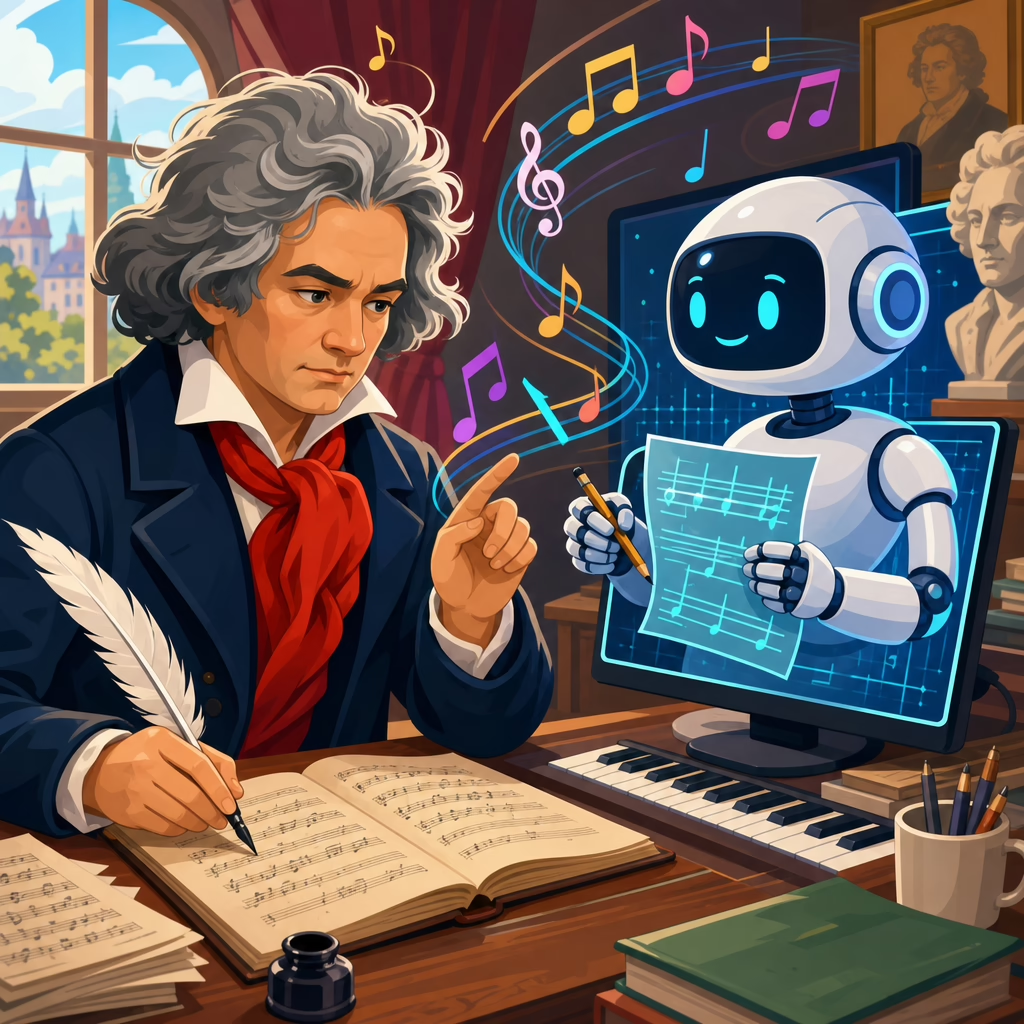
Synthesizing Beethoven: When Computers Compose in His Style
Beethoven has become an unlikely benchmark for machine creativity because his music is both deeply individual and structurally legible, making it ideal for testing how computers compose in his style. In practical terms, “synthesizing Beethoven” means using software systems to analyze patterns in his works and generate new musical material that resembles his harmonic language, motivic development, rhythmic drive, and large-scale form. This sits at the intersection of musicology, artificial intelligence, signal processing, and cultural ethics. It matters because Beethoven is not just a famous composer; he is a stress test for whether algorithms can model intention, tension, surprise, and emotional architecture rather than merely imitate surface features. I have worked with symbolic music datasets, MIDI reconstructions, and style-transfer models, and Beethoven consistently exposes the difference between statistical resemblance and musical understanding. A machine can easily produce a phrase that sounds “classical.” Producing something that sustains argument the way Beethoven does across an exposition, development, and recapitulation is far harder. That challenge explains why this topic has become a focal point within the broader field of technology and Beethoven.
The core vocabulary is worth defining at the start. Symbolic music generation works from note-based representations such as MIDI, MusicXML, or piano-roll matrices rather than raw audio waveforms. Style modeling refers to training a system on a corpus so it learns recurring melodic intervals, harmonic progressions, voice-leading habits, texture, and formal cues associated with a composer. Computational creativity asks whether a system can do more than copy by producing novel outputs that still satisfy recognizable constraints. In Beethoven’s case, the inputs may include sonatas, quartets, symphonies, sketchbooks, or edited thematic catalogs, while the outputs range from short motives to fully orchestrated movements. Some projects use rule-based systems grounded in species counterpoint and harmonic grammar. Others use Markov models, recurrent neural networks, transformers, variational autoencoders, diffusion approaches for symbolic sequences, or hybrid pipelines that combine learned probabilities with human editorial control. The result is a rich but uneven landscape, and this hub article maps the major questions, methods, examples, and limitations that define miscellaneous work on computers composing in Beethoven’s style.
Why Beethoven is uniquely difficult for computers
Beethoven is difficult to model because his style depends on process, not just vocabulary. Many composers can be approximated by capturing their preferred cadences, phrase lengths, accompaniment patterns, and common melodic turns. Beethoven certainly has fingerprints at that level: sforzando accents, obsessive rhythmic cells, dramatic registral spacing, abrupt dynamic contrasts, and motivic compression. Yet what makes his music recognizable is the way a tiny idea mutates across a movement, gathering structural consequence. The famous four-note opening of the Fifth Symphony is not memorable only because of its contour; it becomes the engine for the entire movement. Computers that generate locally plausible phrases often fail on this deeper requirement. They may imitate sonority while missing teleology: the sense that each event pushes toward a destination.
Form creates another obstacle. Beethoven’s middle-period works regularly stretch inherited templates without abandoning them. Sonata form in the “Waldstein” Sonata or the “Eroica” Symphony is not a rigid box; it is a framework Beethoven bends through harmonic delay, fragmentation, false returns, and expanded codas. When I evaluate machine outputs against Beethoven, the first breakdown usually appears at the sectional level. Openings can sound convincing for eight or sixteen bars, but developments wander, transitions lack pressure, and recapitulations arrive mechanically rather than inevitably. This is why serious Beethoven generation requires hierarchical modeling. The system must represent motives, phrases, sections, and movement-level plans together. Without that hierarchy, outputs resemble competent pastiche, not Beethovenian argument.
How computers learn Beethoven’s style
Most Beethoven-style systems start with data preparation, and the quality of that stage determines the ceiling of the results. Scores must be encoded accurately, normalized for key or transposition where appropriate, segmented into phrases or formal zones, and annotated if the project needs labels such as cadence type, meter, instrumentation, or thematic identity. Researchers often rely on MIDI files for convenience, but Beethoven pushes teams toward richer formats like MusicXML because articulation, dynamics, slurs, and voice separation matter. A piano sonata reduced to bare pitch and duration loses critical information about touch, accent, and structural emphasis. For orchestral works, instrument mapping and score alignment become major tasks, especially when comparing different editions.
Once encoded, models learn in different ways. Rule-based approaches encode harmonic syntax directly: allowable chord successions, voice-leading constraints, phrase templates, and orchestration rules. These systems are interpretable and can enforce stylistic discipline, but they struggle to produce convincing surprise. Statistical approaches such as n-grams and Markov chains learn local continuations from a corpus. They are useful for motif continuation and cadence prediction, yet they tend to loop or flatten long-range structure. Neural networks improved this by learning distributed representations of musical events. Recurrent networks can track temporal dependencies better than Markov models, while transformer architectures handle broader contexts through attention mechanisms. In practice, the strongest Beethoven projects are hybrid. They use neural models to propose material, then apply rule filters, harmonic planning, or human curation to preserve structural coherence.
| Method | What it learns well | Typical weakness in Beethoven style | Best use case |
|---|---|---|---|
| Rule-based systems | Harmony, voice leading, cadence control | Can sound rigid or predictable | Chorale textures, phrase harmonization |
| Markov and n-gram models | Local note-to-note continuation | Poor long-range form and repetition control | Motivic sketches, short continuations |
| Recurrent neural networks | Temporal patterns over moderate spans | Sectional drift in long movements | Piano textures, variation generation |
| Transformers | Longer context, thematic recall, flexible conditioning | Can mimic style without real formal logic | Movement planning, thematic development |
| Hybrid human-in-the-loop pipelines | Balance between novelty and stylistic control | Labor intensive and less fully automated | Publishable reconstructions and completions |
What successful Beethoven synthesis actually sounds like
A convincing Beethoven-style output usually succeeds in four areas at once: motive, harmony, rhythm, and form. First, the motive must be distinctive enough to carry development. Beethoven often begins with cells that are rhythmically charged and intervallically compact, making them easy to invert, sequence, fragment, or displace. Second, the harmony must balance clarity and tension. He uses conventional tonal grammar, but he intensifies it through deceptive moves, diminished seventh pivots, dominant prolongation, and strategic harmonic rhythm. Third, rhythm has to propel the piece. Beethoven’s style is often more rhythmically assertive than melodically ornate, and machine systems that overemphasize smooth melody usually miss his profile. Fourth, the output must sustain a formal journey. Even a short generated sonata exposition should articulate primary theme, transition, secondary area, and closing material with audible contrast.
In listening tests, audiences often rate AI-generated Beethoven as plausible when the excerpt is short and the texture is familiar, especially for solo piano. The illusion weakens as duration increases. That pattern matches my own work reviewing generated continuations. Systems can produce Beethoven-like openings by borrowing common features from sonatas such as op. 2, op. 10, or op. 31. But when the music must modulate purposefully, transform a motive under pressure, and return with structural payoff, weaknesses emerge. A strong model may understand that Beethoven repeats, but not why he repeats; it may sequence a fragment upward without creating rising stakes. Therefore, “successful” synthesis should not mean simply fooling casual listeners for a few bars. It should mean preserving the composer’s method of musical reasoning.
Major projects, reconstructions, and public demonstrations
The most visible modern example is the 2021 completion of Beethoven’s unfinished Tenth Symphony, a project involving musicologists and AI researchers. The team combined surviving sketches with machine-learning tools trained on Beethoven’s works, then used expert musicians to shape, evaluate, and orchestrate the result. Public reaction was mixed but instructive. Supporters saw a serious attempt to use computation as an extension of scholarly reconstruction rather than a novelty act. Critics argued that the finished score still reflected contemporary editorial assumptions more than Beethoven’s compositional will. Both views contain truth. The project demonstrated that AI can assist thematic extrapolation and stylistic consistency, yet it also showed that attribution becomes murky once human experts make hundreds of consequential decisions.
Other projects have focused on smaller-scale tasks that are often more musically persuasive. Systems have generated Beethoven-like piano miniatures, proposed continuations for fragmentary sketches, harmonized melodies in a late-classical idiom, or produced variation sets from a seed theme. Open-source environments such as Magenta, Music21, MuseScore workflows, and transformer-based symbolic music repositories have allowed researchers and composers to run Beethoven-style experiments without building everything from scratch. In my experience, these narrower tasks often outperform grand symphonic ambitions because the problem is better bounded. A model asked to continue a sixteen-bar keyboard fragment in the manner of Beethoven has clearer constraints than one asked to invent an entire symphonic movement from nothing. This is an important takeaway for anyone exploring technology and Beethoven: the most credible machine results often come from modest, well-scoped goals.
The role of human editors, performers, and musicologists
Computers do not compose in Beethoven’s style alone. Every serious project depends on human framing, and that framing shapes the output more than headlines usually admit. Musicologists decide which works belong in the training corpus, which editions to trust, how to classify sketches, and what counts as stylistically relevant. Engineers choose tokenization schemes, context windows, loss functions, and sampling temperatures, all of which influence whether the music sounds conservative, unstable, or incoherent. Editors then reject weak outputs, splice promising passages, adjust voice leading, fix impossible ranges, and regularize formal transitions. Performers add another layer by shaping tempo, articulation, pedal, and rubato, which can make machine-generated material sound either more persuasive or more exposed.
This human involvement is not a flaw; it is the real story. In reconstruction work, I have seen excellent raw outputs become useless because they violated instrumental practicality, and mediocre outputs become convincing after informed revision. Beethoven synthesis works best when the computer is treated as a generative assistant, not an autonomous genius. That division of labor mirrors established creative practice in film scoring, game audio, and digital composition, where software proposes possibilities and humans impose taste, context, and accountability. It also aligns with scholarship. A completion of a Beethoven fragment should be presented as an informed contemporary realization, not as recovered authorship. Clear labeling preserves intellectual honesty and helps audiences appreciate both the historical source and the modern intervention.
Ethical, legal, and cultural questions
Because Beethoven’s works are in the public domain, legal barriers around copyright are relatively limited compared with modern artists. The harder questions are ethical and cultural. Should a machine-generated piece be marketed as “new Beethoven”? In my view, no. Even when a system is trained only on Beethoven and guided by experts, the result is an interpretation filtered through modern datasets, coding choices, editorial preferences, and performance conventions. Claims of authenticity should therefore be narrow and precise. It is reasonable to say a work is “in the style of Beethoven” or “informed by Beethoven’s sketches.” It is misleading to imply direct authorship.
There is also a pedagogical issue. These systems can enrich music education by exposing students to motive analysis, stylistic fingerprints, and the mechanics of form. Yet they can also encourage superficial listening if people treat style as a checklist of clichés. Beethoven is more than stormy dynamics and heroic themes. His late works especially involve discontinuity, compression, fugue procedures, variation logic, and philosophical ambiguity that resist easy emulation. Cultural value lies partly in that resistance. Good Beethoven technology should illuminate why his music is hard to replicate, not reduce it to branding. Used responsibly, synthesis can sharpen historical understanding. Used carelessly, it can flatten one of Western music’s most challenging artistic voices into background content.
Where this miscellaneous hub leads next
As a hub within technology and Beethoven, this topic connects several neighboring strands. One branch covers score digitization and optical music recognition, which provide the machine-readable materials generation systems depend on. Another examines audio restoration, performance analysis, and expressive timing studies, all relevant because Beethoven style is encoded not only in notes but in interpretation. A third branch addresses sketch analysis and manuscript studies, crucial for any attempt to complete unfinished works. There is also a practical branch focused on symbolic generation tools, dataset curation, and benchmarking methods for evaluating stylistic fidelity. If you are building a reading path, start with data and notation, move to generation methods, then compare reconstruction case studies such as the Tenth Symphony with smaller continuation experiments.
The central lesson is straightforward. Computers can compose in Beethoven’s style to a meaningful extent, but only when the task is carefully framed, the source material is rigorously prepared, and humans remain visibly responsible for interpretation. The best systems capture local gestures, thematic continuations, and portions of tonal design. The weakest overpromise originality while recycling surface mannerisms. For researchers, composers, educators, and listeners, the real benefit is not replacing Beethoven. It is using computation to understand more precisely what makes Beethoven Beethoven: motivic economy, formal pressure, harmonic drama, and the transformation of simple ideas into large-scale thought. Explore the linked articles in this subtopic to go deeper into datasets, reconstruction projects, analysis tools, and performance technology, and you will see how this single question opens onto the whole relationship between Beethoven and modern computing.
Frequently Asked Questions
What does “synthesizing Beethoven” actually mean in the context of computer-generated music?
In this context, “synthesizing Beethoven” does not mean recovering lost works or perfectly resurrecting the composer’s mind. It refers to using computational systems to study Beethoven’s musical language and then generate new material that resembles key features of his style. These systems may analyze harmony, melodic contour, motivic development, rhythm, phrase structure, voice leading, and large-scale formal design. The goal is to model not just the surface sound of Beethoven’s music, but also some of the processes that make it feel recognizably Beethovenian, such as the transformation of short motives, dramatic contrast, tension and release, and the sense of architectural direction across an entire movement.
In practice, this can involve a range of methods, from rule-based programs built on music theory to machine learning models trained on digitized scores. A program might learn how Beethoven tends to handle cadences, modulations, accompaniment textures, or developmental sequences, then use those patterns to produce a new theme, variation, or sonata-style passage. The result is best understood as a computational imitation or stylistic simulation. It is not Beethoven himself composing, but a system using measurable traits from his work to create music that echoes his harmonic language, rhythmic energy, and formal logic.
Why is Beethoven such an important test case for machine creativity?
Beethoven is a particularly attractive benchmark because his music combines strong individuality with structural clarity. On one hand, his works are unmistakably personal: they often feature intense motivic concentration, dramatic pacing, bold harmonic choices, and a powerful sense of forward motion. On the other hand, they are also analytically legible. Musicologists can identify recurring techniques in his sonata forms, developmental procedures, phrase expansions, rhythmic cells, and tonal planning. That makes his music well suited to computational analysis, because there are enough consistent patterns to model without reducing the style to something trivial.
He also occupies a central place in Western art music, so audiences, performers, and scholars already have strong intuitions about what sounds plausibly Beethovenian and what does not. That makes evaluation easier. If a machine-generated excerpt claims to be in Beethoven’s style, listeners can assess whether it captures the characteristic economy of motives, the dramatic transitions, or the way a small figure can govern an entire movement. In other words, Beethoven provides both rich musical complexity and a high bar for authenticity, making him an ideal subject for testing the limits of computational creativity.
How do computers learn to compose music in Beethoven’s style?
Computers typically learn Beethoven’s style by working from symbolic musical data rather than raw audio alone. Researchers often use machine-readable scores, such as MIDI or encoded notation, because those formats clearly represent pitch, duration, meter, voicing, dynamics, and structural relationships. The system is then designed to detect patterns across Beethoven’s works. Depending on the approach, it might calculate the probability of one chord following another, track how motives are repeated and transformed, map common phrase lengths, or model how a movement departs from and returns to its home key.
Older systems often relied on explicit rules derived from music theory and stylistic analysis. For example, a program could be told how Beethoven tends to prepare a cadence, develop a short rhythmic motive, or construct a sequence. More recent systems may use machine learning, including neural networks and transformer-based models, to infer these tendencies from data. These models can capture subtle statistical relationships that would be difficult to write by hand, such as recurring textures or long-range dependencies between opening ideas and later developments. Even so, the most convincing results often come from hybrid methods that combine data-driven learning with musicological constraints, because Beethoven’s style is not just a collection of local patterns. It also depends on coherence, dramatic timing, and formal balance over longer spans of music.
Can AI truly create a new Beethoven composition, or is it only producing a convincing imitation?
Most experts would say that current systems produce stylistic imitations rather than genuinely new Beethoven compositions in any historical or philosophical sense. A machine can generate music that sounds close to Beethoven by recombining learned patterns, extending fragments, and following stylistic norms extracted from his corpus. In some cases, the results can be highly persuasive, especially in short passages or tightly defined tasks such as harmonizing a melody, completing a sketch, or generating variations. But there is an important difference between sounding like Beethoven and being Beethoven. Human creativity involves intention, historical context, personal struggle, artistic judgment, and a lived relationship to musical tradition that machines do not possess.
That said, imitation is not necessarily trivial. Producing an output that captures Beethoven’s motivic rigor, harmonic boldness, and large-scale formal logic is a formidable challenge. In fact, this challenge is exactly why such projects matter. They reveal which aspects of style can be formalized, learned, and generated, and which aspects remain resistant to computation. So while AI is not literally reviving Beethoven, it can illuminate how much of musical style depends on identifiable structure and how much depends on human interpretive intelligence. The value, then, lies not only in the generated music itself, but also in what the process teaches us about creativity, authorship, and musical understanding.
What are the main limitations and controversies surrounding computer-generated Beethoven-style music?
The biggest limitation is that style is more than a set of reusable musical fingerprints. A system may reproduce Beethoven-like chord progressions, rhythmic gestures, or motivic fragments while still missing the deeper logic that gives his music its expressive force. Beethoven’s works are remarkable not just because of what materials they use, but because of how those materials are developed over time, how expectations are shaped and disrupted, and how local details contribute to a compelling large-scale narrative. Many computer-generated pieces sound plausible moment to moment yet fail to sustain the same level of structural inevitability across a full movement.
There are also aesthetic and ethical debates. Some critics argue that using AI to compose “in the style of” a canonical composer risks reducing art to pattern replication and encourages a shallow understanding of creativity. Others worry that audiences may overvalue technological novelty or confuse imitation with artistic insight. On the other side, supporters argue that these systems can be valuable tools for scholarship, education, and creative experimentation. They can help test musicological theories, generate hypotheses about compositional process, and offer composers new ways to engage with historical styles. The controversy ultimately comes down to how the technology is framed: as a replacement for human artistry, it is deeply problematic; as a research instrument and creative collaborator, it can be genuinely illuminating.