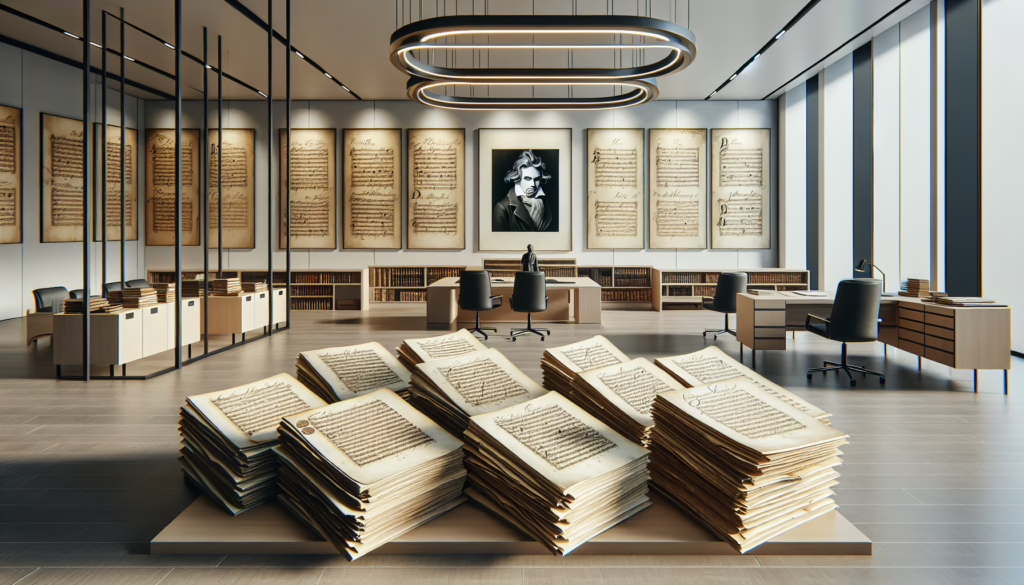
Rare Beethoven Manuscripts in Public and Private Collections
Rare Beethoven manuscripts in public and private collections occupy a special place within Beethoven collections because they preserve the composer’s working process, his revisions, and the afterlives of scores that passed through aristocratic libraries, auction rooms, museums, and family archives. A manuscript can mean an autograph score in Beethoven’s hand, a sketchleaf, a corrected copy prepared for performance, a fragment, or a letter containing musical notation. In practice, collectors, librarians, and scholars distinguish between complete autograph manuscripts, conversation books, sketchbooks, copyists’ manuscripts with Beethoven’s annotations, and associated documentary material such as dedications, receipts, and provenance records. That distinction matters because rarity is not just about age or fame. It is about survival, condition, completeness, provenance, and research value.
I have worked with digitized autograph sources, auction catalogues, and library finding aids long enough to know that no two Beethoven manuscripts tell the same story. One score may reveal how he rethought a transition by scraping away ink and rewriting a passage; another survives only as detached bifolia sold decades apart. Public institutions preserve these materials for scholarship and access, while private collectors have often rescued items that might otherwise have disappeared, though restricted access can limit study. For anyone interested in Beethoven collections, this hub article explains what counts as a rare manuscript, where major holdings are concentrated, why private ownership remains significant, how authenticity and provenance are established, and which related articles this miscellaneous subtopic should connect to. The result is a practical overview for readers who want a grounded map of Beethoven manuscripts beyond the most famous monuments.
What makes a Beethoven manuscript rare
A rare Beethoven manuscript is usually defined by a combination of scarcity, uniqueness, and documentary importance. Autograph manuscripts are unique by nature, but rarity increases when the source captures a decisive creative stage. Sketchbooks are especially valued because they document Beethoven’s compositional method in sequence, including false starts, thematic transformations, and working notes unrelated to the final score. Isolated leaves can still be rare if they preserve a lost movement, an abandoned cadenza, or corrections made close to publication. Manuscripts linked to major works such as the “Eroica,” the late quartets, the “Missa solemnis,” or the Ninth Symphony tend to attract the widest attention, yet smaller genres can be equally significant. A page for a bagatelle, canon, or folksong setting may carry unusual annotations, ownership marks, or evidence of intended performers.
Condition also shapes rarity. Beethoven manuscripts often survive with heavy wear because they were functional objects used by copyists, publishers, and musicians. Water damage, trimming, mounting, iron-gall ink corrosion, and nineteenth-century rebinding are common problems. A complete autograph score in stable condition is exceptional, but fragments can be just as important if they can be matched to dispersed leaves elsewhere. In manuscript studies, rarity is inseparable from provenance. A score with a continuous chain of ownership through known collectors, houses such as Artaria, or institutions like the Gesellschaft der Musikfreunde in Vienna carries greater evidentiary weight than a leaf that appears without documentation. This is why catalogues raisonnés, archival correspondence, and paper studies matter. They let scholars determine whether a manuscript is complete, altered, or associated with a particular phase of Beethoven’s career.
Major public collections and why they matter
Public institutions hold the backbone of Beethoven manuscript research because they combine preservation, cataloguing, and increasing digital access. The largest concentration is the Beethoven-Haus Bonn, whose archives preserve autograph manuscripts, sketchbooks, letters, first editions, and conversation books. For scholars, Bonn is indispensable because it links manuscript evidence to biographical documentation and modern critical editions. Berlin’s Staatsbibliothek zu Berlin also holds major autograph sources, including material central to symphonic and chamber works. The Austrian National Library, the Gesellschaft der Musikfreunde in Vienna, and the music division of major European libraries preserve manuscripts tied to Beethoven’s Viennese professional network. In the United States, institutions such as the Morgan Library & Museum, the Juilliard collections, the Library of Congress, and university special collections have acquired leaves, letters, and copies with important provenance trails.
These public repositories matter for three reasons. First, they use established conservation standards: climate control, acid-free housing, and careful limits on light exposure protect paper and ink from ongoing degradation. Second, they create scholarly metadata. A manuscript is far more useful when the institution records watermark evidence, scribal hands, pagination, previous shelfmarks, and acquisition history. Third, public access changes the questions researchers can ask. Once an autograph score is digitized at high resolution, specialists can compare overwritten measures, pasted slips, and paper types across repositories without moving the object. That has transformed Beethoven studies. Reconstructing dispersed sketchbook leaves, tracing corrections between autograph and first edition, and revising dating arguments are all easier when institutional images and catalogues are reliable. For readers exploring Beethoven collections broadly, public holdings form the essential reference point against which private material is identified and interpreted.
Private collections, market history, and access limits
Private ownership has played a decisive role in the survival of rare Beethoven manuscripts. During the nineteenth and early twentieth centuries, autograph collecting became a status marker among European aristocrats, industrialists, and later American bibliophiles. Families who inherited Beethoven-related papers sometimes preserved them quietly for generations; others sold them through dealers and auction houses such as Sotheby’s, Christie’s, or specialist manuscript firms. The market has dispersed important materials, but it has also brought unknown items to light. I have seen cases where a sketchleaf in a sale catalogue, initially described in minimal terms, proved valuable because its paper type and musical content connected it to a larger, partly reconstructed source. Private collectors can fund conservation, commission scholarly opinions, and eventually place treasures on long-term loan or donate them to institutions.
Still, private collections create real limits. Access may depend on owner discretion, insurance constraints, or the policies of intermediaries. That means a manuscript can be cited in older auction catalogues yet remain unavailable for decades. Provenance may also be harder to verify if family papers are incomplete or if items were broken up intentionally to maximize sale value. Single leaves from larger Beethoven manuscripts have sometimes circulated separately, reducing context and complicating dating. For this reason, responsible scholarship treats private claims cautiously until handwriting, paper, ink, and historical documentation align. Collectors who publish images, lend to exhibitions, or work with recognized experts contribute meaningfully to the field. Those who do not may still own authentic material, but the manuscript’s broader importance remains partially locked away. In any serious survey of Beethoven collections, the public-private balance must be acknowledged rather than romanticized.
Authentication, provenance, and conservation in practice
Authenticating a Beethoven manuscript is a multidisciplinary process, not a simple judgment based on handwriting alone. Specialists compare letter forms, musical notation habits, and correction patterns with securely dated autographs. They also examine paper stocks, chain lines, rastral spacing, watermarks, and the inks used by Beethoven and by copyists. Provenance research tests whether the ownership history makes sense: did the item pass through known publishers, friends such as Anton Schindler despite his reliability problems, or documented collections? Modern cataloguing often cross-references thematic catalogues and critical editions to identify where a fragment belongs. Conservation adds another layer. Iron-gall ink can eat into the paper, old repairs can stain or obscure notation, and pressure-sensitive tapes added in the twentieth century can cause long-term damage. Professional treatment aims to stabilize, not cosmetically perfect, the source.
| Factor | What experts examine | Why it matters |
|---|---|---|
| Handwriting and notation | Letter shapes, clefs, stems, accidentals, correction habits | Distinguishes Beethoven’s hand from copyists and later imitators |
| Paper evidence | Watermarks, chain lines, ruling, sheet dimensions | Helps date the manuscript and link dispersed leaves |
| Provenance | Auction records, collector marks, archival references, dealer notes | Establishes lawful ownership and historical credibility |
| Musical content | Themes, variants, movement order, erased passages | Shows relation to known works, revisions, or abandoned ideas |
| Condition | Ink corrosion, tears, trimming, old mounts, restorations | Affects legibility, value, and treatment priorities |
In practice, no single criterion is decisive. A manuscript with secure handwriting but weak provenance still raises questions. Conversely, excellent provenance cannot rescue a source whose notation habits are inconsistent with Beethoven’s known practice. This is why major institutions rely on curators, paper historians, conservators, and Beethoven specialists together. Their work protects both scholarship and the market from mistakes. For collectors and readers, the lesson is simple: rarity without documentation is interesting; rarity with documentation becomes historically useful.
Notable categories and examples across collections
The public imagination gravitates toward complete autograph scores, but rare Beethoven manuscripts appear in many forms. Sketchbooks are among the richest sources because they preserve development across months or years. Individual sketchleaves can illuminate the path from a rhythmic cell to a finished movement. Conversation books, used during Beethoven’s later deafness, are not musical manuscripts in the narrowest sense, yet they belong in this subtopic because they document performance planning, finances, publishing negotiations, and social networks around the works. Letters with musical examples can settle questions of chronology or intended instrumentation. Copyists’ scores corrected by Beethoven are equally valuable. They may represent the practical source from which performers worked, revealing cuts, articulation changes, and corrections not carried into early printed editions.
Examples from public collections show this range clearly. Beethoven-Haus Bonn preserves manuscript layers connected to major works and everyday professional life. Berlin and Vienna preserve autograph and copied materials that reveal circulation among publishers and patrons. The Morgan Library & Museum has held important Beethoven autographs and letters that demonstrate the American role in manuscript collecting. Outside the best-known repositories, regional archives and university libraries sometimes hold overlooked leaves acquired through estate donations. Private collections add another category: presentation manuscripts, signed leaves extracted from albums, and family papers with local provenance. Some are musically minor but culturally revealing. A seemingly modest canon or dedicatory page can document Beethoven’s relationships, gift practices, or workshop procedures. That is why a miscellaneous hub under Beethoven collections should not rank sources only by fame. Utility for research often lies in the margins, fragments, and contextual documents surrounding the canonical scores.
How this hub connects the miscellaneous Beethoven manuscript landscape
As a sub-pillar hub, this page should direct readers to narrower articles that break down the field into usable paths. The most natural related topics include autograph scores of major works, Beethoven sketchbooks and sketchleaves, conversation books, Beethoven letters with musical content, copyists’ manuscripts and annotated performance materials, auction history of Beethoven autographs, conservation and digitization projects, and guides to key repositories in Bonn, Vienna, Berlin, London, New York, and Washington. Internal links to those articles help readers move from this overview to focused studies without losing the bigger picture. They also reflect the real structure of the evidence. Beethoven manuscripts are not one category but an ecosystem of primary sources that overlap through provenance, revision history, and institutional custody.
The central takeaway is that rare Beethoven manuscripts matter because they preserve creation, transmission, and reception all at once. Public collections provide the most dependable access and scholarly infrastructure. Private collections remain important, especially for discoveries and provenance chains, but they are strongest when owners collaborate with experts and institutions. Rarity should never be reduced to price alone. A damaged sketchleaf with secure context can be more significant than a handsome signed page with little musical substance. If you are building out Beethoven collections content, use this hub as the starting point, then follow the linked articles on sketchbooks, autograph scores, conversation books, auction records, and repository guides to understand where each manuscript fits in Beethoven’s surviving paper trail.
Frequently Asked Questions
What counts as a rare Beethoven manuscript in public and private collections?
A rare Beethoven manuscript is not limited to a fully finished autograph score written neatly from beginning to end in Beethoven’s own hand. In collecting and cataloguing practice, the term is broader and includes sketchleaves, draft pages, fragmentary movements, corrected copyists’ manuscripts marked by Beethoven, parts prepared for rehearsal or performance, and even letters that contain short passages of musical notation. These materials are valuable because they document different stages of composition, revision, circulation, and use. A heavily worked sketch can reveal how Beethoven tested motifs, altered harmonic direction, or rethought formal design, while a corrected copy may show what changed between a private draft and a version intended for musicians or publishers.
The word “rare” can refer to several factors at once. Rarity may be based on uniqueness, survival, condition, subject matter, provenance, or historical significance. A single leaf connected to a major symphony or piano sonata may be rarer in practical terms than a more complete but less important manuscript tied to an occasional work. Manuscripts associated with famous commissions, aristocratic patrons, first performances, or notable owners often attract exceptional scholarly and collector interest. Materials that preserve Beethoven’s revisions are especially prized because they offer direct evidence of his working process rather than only the polished end result.
In both public and private collections, these manuscripts are treated as primary historical witnesses. Libraries, archives, museums, and private owners may classify them differently, but the underlying importance is the same: each manuscript is a physical trace of Beethoven’s creative life and the later history of collecting. The same item can illuminate compositional technique, performance history, book and paper history, and the movement of cultural property through noble libraries, dealers, auctions, and family archives.
Why are Beethoven manuscripts in public and private collections so important to scholars and collectors?
These manuscripts matter because they preserve evidence that printed editions alone cannot provide. Beethoven’s handwriting, corrections, cancellations, inserted leaves, and marginal instructions allow scholars to reconstruct how a work evolved. This is essential in Beethoven studies, where revision was often central to composition. A manuscript may show an abandoned opening, a rewritten transition, altered dynamics, or a late-stage structural decision that changes how a piece is understood. For musicologists, editors, and performers, such details can clarify chronology, establish relationships among sources, and sometimes challenge long-held assumptions about an authoritative text.
Collectors value them for overlapping reasons, though not always identical ones. A manuscript connects the owner directly to Beethoven as a historical individual, not just as a canonical composer. The immediacy of the object matters: the paper stock, ink, folds, seals, annotations, and signs of use all create a vivid link to the conditions under which the music was conceived or circulated. A manuscript that passed through an aristocratic library, a prominent nineteenth-century collection, or a well-documented auction trail acquires an additional layer of cultural prestige through its provenance. In that sense, the afterlife of the manuscript becomes part of its significance.
Public institutions and private collectors also play complementary roles. Public repositories provide preservation, scholarly access, digitization, and long-term stewardship. Private collections, meanwhile, have often been crucial to the survival of individual items, especially during periods when archives were dispersed or underfunded. Although access may be more limited in private hands, many important manuscripts have resurfaced because families, collectors, and dealers preserved them. Together, public and private collections form the broader documentary landscape through which Beethoven’s compositional history is studied and understood.
How do experts authenticate and evaluate a Beethoven manuscript?
Authentication is a careful, multi-step process that combines musical, historical, and material analysis. Experts begin with handwriting comparison, examining whether the notation, verbal annotations, and characteristic habits of script match known Beethoven autographs from the relevant period. Beethoven’s hand changed over time, so specialists compare the manuscript not only to general exemplars but also to dated sources from similar years. They also consider whether the paper type, ruling, ink, watermarks, and page format are consistent with what Beethoven and his circle used. Watermark study can be especially helpful because certain paper stocks recur across manuscripts linked to particular locations or compositional phases.
Provenance is another major factor. A manuscript with a documented chain of ownership—from Beethoven or his associates to an early patron, publisher, copyist, collector, or institution—carries far more authority than one that appears without history. Auction records, estate inventories, library stamps, dealer descriptions, family letters, and old catalogues can all help establish continuity. At the same time, experts examine the musical content itself. Does the notation correspond to a known work, variant, or lost stage of composition? Are the corrections plausible in relation to Beethoven’s known methods? Does the source fit within the wider web of sketches, copies, and early editions?
Evaluation, meanwhile, goes beyond authenticity. Condition matters, but so do completeness, legibility, rarity, and scholarly importance. A damaged sketchleaf may still be extraordinarily significant if it preserves a key developmental stage of a major work. Conversely, a clean later copy without Beethoven’s direct involvement may be less consequential, even if visually attractive. Experts ultimately assess the manuscript as both an artifact and a source: a physical object with market value and a documentary witness with intellectual value. The strongest evaluations balance those two dimensions rather than treating the manuscript as merely a collectible relic.
What is the difference between manuscripts held by museums and libraries and those kept in private collections?
The main difference is not importance but access, stewardship, and institutional context. Public institutions such as national libraries, university archives, and museums typically hold manuscripts within catalogued collections governed by conservation standards, access policies, and long-term preservation plans. These repositories often support scholarly consultation, exhibitions, digitization projects, and formal provenance research. Because their holdings are more visible, manuscripts in public collections are usually easier to cite, compare, and integrate into academic work. They become part of a shared research infrastructure, which is especially important for source-critical editing and performance scholarship.
Private collections operate differently. A manuscript in private hands may be preserved with great care, but access often depends on the owner’s preferences, legal arrangements, or estate planning. Some private collectors actively collaborate with scholars, lend to exhibitions, and permit digitization; others keep materials largely out of view. This does not make the manuscripts less significant. In fact, some of the most important Beethoven sources have spent long periods in private ownership, sometimes preserved within families or assembled by dedicated collectors with deep expertise. The challenge is that private custody can make verification, consultation, and broader scholarly use more difficult unless the owner supports documentation and access.
There is also an important historical dimension. Many Beethoven manuscripts moved repeatedly between public and private spheres over the nineteenth and twentieth centuries. A score may have begun in Beethoven’s possession, passed to a patron or publisher, entered a noble library, been sold at auction, disappeared into private ownership, and later been acquired by a museum. That movement is part of the manuscript’s biography. Understanding whether an item is in a public or private collection today is useful, but understanding how it traveled between those worlds is often even more revealing.
How do provenance, auctions, and family archives shape the history of rare Beethoven manuscripts?
Provenance is central because it tells the story of where a manuscript has been, who valued it, and how it survived. For Beethoven materials, provenance can connect a source to patrons, performers, publishers, copyists, aristocratic households, and later collectors. A manuscript preserved in a princely or noble library may reflect early elite patronage and collecting culture, while one that remained in a family archive may preserve a more intimate chain of transmission. These ownership histories can influence both scholarly interpretation and market value, especially when the chain of custody helps confirm authenticity or explains why a source remained unknown for decades.
Auctions have played a major role in the dispersal and rediscovery of Beethoven manuscripts. When major collections were broken up and sold, individual leaves, letters, and scores often changed hands rapidly, sometimes crossing national borders and entering new collecting networks. Auction catalogues, although sometimes imperfect, are now important research tools because they preserve descriptions, lot groupings, and earlier attributions. They can help scholars reconstruct the fate of manuscripts that have since been fragmented, rebound, or absorbed into anonymous private holdings. In some cases, an auction appearance is the key link that reconnects a manuscript to an older library or estate.
Family archives are equally important because they often preserve material that never entered the formal market for long stretches of time. Letters with musical notation, presentation copies, and inherited papers may survive in descendants’ holdings long after institutional records go quiet. These archives can contain overlooked evidence about ownership, dating, and the practical use of a manuscript. Taken together, provenance records, auction histories, and family papers show that Beethoven manuscripts are not static treasures. They have biographies. Their importance lies not only in what Beethoven wrote on the page, but also in how those pages were protected, traded, forgotten, rediscovered, and interpreted across generations.