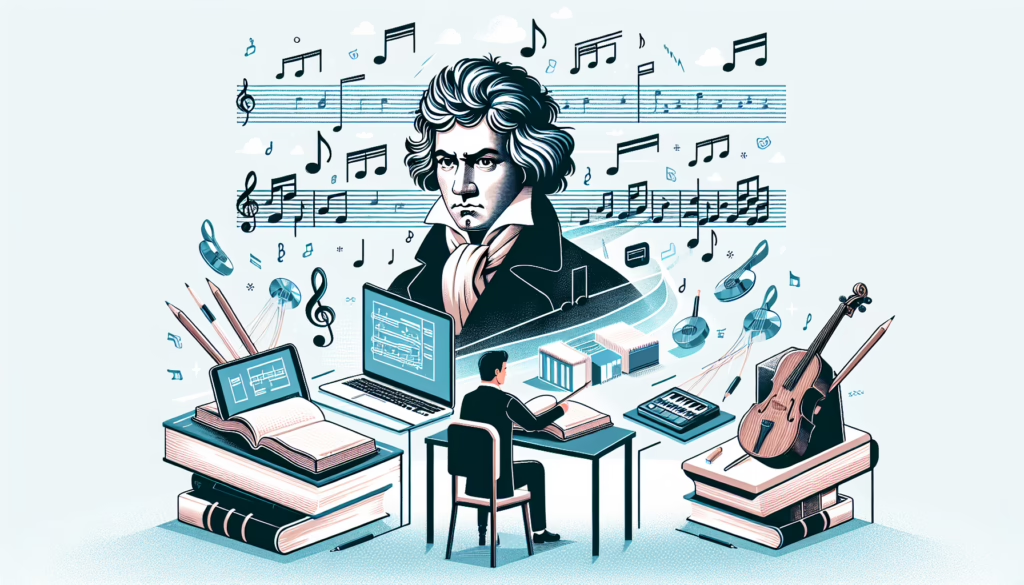
How Beethoven Is Taught Through Textbooks Today
Beethoven remains one of the most assigned composers in music education, yet the way textbooks teach him today is very different from the heroic, simplified portraits that dominated classrooms for most of the twentieth century. In current music textbooks, “Beethoven” usually refers not only to Ludwig van Beethoven the person, but to a cluster of teaching themes: the Classical-to-Romantic transition, motivic development, symphonic form, patronage, deafness, genius mythology, and the politics of canon formation. That broader framing matters because textbooks shape first impressions for millions of students, from middle school general music classes to university music history surveys, and those first impressions often determine whether Beethoven is understood as a living historical figure or as a marble bust with dates attached.
Having reviewed recent survey texts, anthology companions, AP Music Theory materials, and classroom editions used by teachers in secondary and collegiate settings, I have seen a clear shift. Older books often taught Beethoven through chronology and reverence: Bonn childhood, Vienna studies, Eroica, Fifth Symphony, Ninth Symphony, deafness, death. Newer textbooks still cover those landmarks, but they increasingly add context about Enlightenment ideals, the French Revolution, aristocratic networks, publishing economics, performance practice, and reception history. They also ask better questions. Why did Beethoven expand sonata form? How did his sketchbooks reveal compositional process? Why has the Fifth Symphony become a shorthand for “fate” when that phrase is historically shaky? How should teachers discuss disability without turning deafness into a sentimental plot device?
For readers exploring Beethoven books, this miscellaneous hub matters because textbook treatment sits at the center of the subtopic. Textbooks influence which biographies get assigned, which scores get purchased, which recordings are recommended, and which classroom myths survive. They also reveal what education systems value now: diversity of perspective, close listening, evidence-based interpretation, and links between musical works and social history. Understanding how Beethoven is taught through textbooks today helps parents choosing supplements, teachers updating curricula, students preparing essays, and general readers deciding which Beethoven books provide depth rather than recycled legend.
This article explains the major textbook approaches used now, the recurring themes students encounter, the pieces most often assigned, the classroom methods tied to those readings, and the limitations educators still face when teaching a composer so central to the Western canon.
The Core Narrative Textbooks Still Use
Most current textbooks still organize Beethoven around a familiar backbone because it works pedagogically. Students need an anchor before they can interpret nuance. That backbone usually includes his birth in Bonn in 1770, his move to Vienna, studies with Haydn and others, success as pianist-composer, increasing hearing loss, middle-period expansion of scale and rhetoric, late-period experimentation, and death in 1827. In broad survey books such as those modeled after standard music appreciation and Western music history courses, Beethoven is typically positioned as the composer who stretched Classical conventions until they pointed toward Romanticism.
What has changed is the tone. Instead of presenting inevitability, textbooks now present development. They show Beethoven learning from Mozart and Haydn rather than arriving fully formed. They describe him as working within established genres such as piano sonata, string quartet, concerto, and symphony, then progressively altering their proportions and expressive range. This matters because students can hear transformation more clearly when books compare an early piano sonata with a middle-period work like the “Appassionata,” or an early symphony with the Third and Fifth. The teaching goal is no longer simply “memorize masterpieces.” It is “understand how style evolves through choices in rhythm, harmony, texture, instrumentation, and form.”
Textbooks also increasingly define terms directly around Beethoven examples. “Motivic development” is often explained through the four-note opening of Symphony No. 5. “Cyclic unity” may be discussed through the Ninth Symphony. “Sonata form” is illustrated with first movements from piano sonatas or symphonies. “Absolute music” versus “programmatic meaning” appears in discussions of the “Pastoral” Symphony. By linking abstract concepts to a composer students are likely to encounter repeatedly, textbooks make theory and history reinforce each other.
How Modern Textbooks Reframe the Beethoven Myth
One of the biggest changes in textbook teaching is a more careful handling of genius. Older school materials often framed Beethoven as an almost supernatural individual who conquered fate through sheer will. That story remains attractive because it is memorable and emotionally direct, but contemporary textbooks are more likely to balance it with verifiable context. They discuss his difficult personality, business negotiations, legal battles over his nephew Karl, dependence on patrons, and constant revisions. They note that the “heroic artist” image was shaped not just by Beethoven himself, but by later critics, publishers, biographers, and nation-building cultural institutions.
In practice, this means students increasingly encounter Beethoven as a constructed image as well as a historical person. A textbook may pair the Heiligenstadt Testament with discussion of self-fashioning. It may explain that the famous “fate knocking at the door” comment associated with the Fifth Symphony rests on weak documentary foundations. It may challenge the old claim that Beethoven single-handedly invented Romanticism by showing overlapping trends in the works of Cherubini, Méhul, Schubert, and E. T. A. Hoffmann’s criticism. This is a healthier way to teach because it preserves Beethoven’s importance without requiring mythmaking.
Disability is also handled differently now. Better textbooks avoid reducing Beethoven’s deafness to inspiration material. Instead, they explain what historians can document: progressive hearing loss affected his performance career, communication methods, social life, and compositional workflow. Some books introduce conversation books and medical speculation while admitting uncertainty about diagnosis. In classroom discussion, this helps students think about disability history, accommodation, stigma, and artistic labor with more seriousness than the old “he could not hear but composed anyway” formula.
The Works Students Most Often Study and Why
Across textbooks, a predictable group of Beethoven works appears because each one teaches multiple concepts at once. The “Eroica” Symphony is assigned for scale, formal expansion, political association, and the idea of the heroic style. Symphony No. 5 is used for motivic unity, dramatic trajectory, and reception history. Symphony No. 6, the “Pastoral,” introduces representation of nature and the limits of program music. Symphony No. 9 anchors conversations about chorus in the symphony, universal brotherhood rhetoric in Schiller’s “Ode to Joy,” and the afterlife of Beethoven in public culture, from the fall of the Berlin Wall to European Union symbolism.
Piano sonatas also dominate textbook examples, especially the “Pathétique,” “Moonlight,” “Waldstein,” “Appassionata,” and Op. 111. They are practical teaching pieces because excerpts fit easily into anthologies, recordings are abundant, and instructors can demonstrate form at the keyboard. String quartets appear less often in introductory books, but advanced textbooks increasingly bring in late quartets to discuss fragmentation, fugue, variation, and historical difficulty. The Missa solemnis and Fidelio are usually treated more selectively, often in upper-level texts, because they require broader liturgical and operatic background.
| Work commonly assigned | Main concept textbooks teach | Typical classroom question |
|---|---|---|
| Symphony No. 3 “Eroica” | Expansion of symphonic form and heroic rhetoric | How does Beethoven enlarge expectations inherited from Haydn and Mozart? |
| Symphony No. 5 | Motivic development and narrative listening | How can a tiny rhythmic cell organize an entire movement? |
| Symphony No. 6 “Pastoral” | Programmatic suggestion versus pure form | What does music represent without becoming literal sound effects? |
| Symphony No. 9 | Choral symphony, ideology, and reception history | Why has this piece carried so many political meanings? |
| Piano Sonata Op. 27 No. 2 “Moonlight” | Genre expectations and popular reception | Why does its nickname shape listening more than Beethoven’s title? |
| String Quartet Op. 131 | Late style and formal experimentation | Why did later listeners hear these works as difficult or visionary? |
Teaching Methods: Listening Guides, Scores, and Context Windows
Textbooks today rarely rely on prose alone. They teach Beethoven through multimodal apparatus: listening guides, annotated score excerpts, timelines, portraiture, sidebars on instruments, and short source readings. In a typical chapter, students read a biographical overview, then move to a listening map of a symphonic movement with timestamps, thematic labels, and prompts such as “notice the oboe cadenza” or “listen for the return of the scherzo motive.” This format supports beginners who do not yet read full scores but still need structure for active listening.
In theory and analysis textbooks, Beethoven functions differently. There, he becomes a source of model passages for phrase structure, cadence types, tonicization, chromatic harmony, sonata deformation, and thematic process. William Caplin’s formal functions, Hepokoski and Darcy’s sonata theory, and traditional Roman numeral pedagogy all frequently draw on Beethoven examples because his works are both canonical and analytically rich. Students learn not just to admire the music but to parse it. In my experience, this analytical use is where textbooks have become most rigorous: they now show multiple valid readings instead of pretending every piece fits a single diagram.
General education textbooks also build historical empathy through “context windows.” A page on Vienna around 1800 may discuss public concerts, domestic music making, fortepianos, subscription publishing, or Napoleon’s impact on European politics. These windows are important because Beethoven’s innovations make more sense when students understand the material world around them. For example, larger halls, stronger pianos, and a growing market for published keyboard music helped support the bolder textures and wider dynamic ranges textbooks ask students to notice.
Where Textbooks Place Beethoven in Today’s Curriculum
Beethoven now appears across far more courses than music history alone. In world history classes, excerpts from the Ninth Symphony may surface in discussions of nationalism, liberalism, or European identity. In disability studies, he appears in units on embodiment and cultural narratives of impairment. In humanities surveys, he is paired with Goethe, Kant, or Romantic literature. In conducting and orchestration pedagogy, his symphonies remain foundational. In piano pedagogy, sonatas are used to teach touch, structure, pedaling decisions, and stylistic restraint. That cross-curricular presence explains why textbook portrayals matter so much: one composer can mean very different things depending on the classroom.
At the same time, textbooks have become more self-aware about canon pressure. Many now explicitly acknowledge that the prominence of Beethoven reflects institutional history, not neutral merit alone. This does not mean they dismiss his achievement. It means they place him alongside neglected composers, women composers, and global traditions more intentionally than older textbooks did. A chapter may still devote substantial space to Beethoven, but it is less likely to imply that nineteenth-century music can be reduced to a straight line from Haydn to Mozart to Beethoven to Brahms. That broader curricular design helps students understand both why Beethoven has endured and how educational systems chose to center him.
Digital textbooks and course platforms add another layer. Norton, Oxford, and other publishers increasingly bundle streaming audio, quiz banks, interactive timelines, and linked primary documents. For Beethoven, this is especially useful because students can compare recordings by conductors such as Furtwängler, Toscanini, Gardiner, or Harnoncourt and hear how tempo, articulation, vibrato, and orchestral size alter interpretation. A printed textbook might describe historically informed performance in one paragraph; a digital platform can let students hear the difference immediately.
Common Problems and What Good Textbooks Do Better
Despite real progress, textbook teaching of Beethoven still has predictable weaknesses. The first is overconcentration on a few blockbuster works, especially the Fifth and Ninth Symphonies. Students may finish a course thinking Beethoven wrote only symphonies and piano sonatas, with little sense of the quartets, bagatelles, sacred music, songs, or variation sets. The second is narrative compression. Because survey texts have limited space, they often flatten chronology and skip contradictory evidence. The third is language drift. Terms like “struggle,” “triumph,” and “transcendence” can quietly reintroduce romanticized clichés even in otherwise modern chapters.
The best textbooks solve these issues through selection and framing. They include at least one less predictable work, such as the “Grosse Fuge,” the Diabelli Variations, or a late bagatelle, to challenge expectations. They distinguish documented fact from later anecdote. They make room for reception history, showing how Beethoven has been used by political movements, advertisers, filmmakers, and public institutions. They also encourage comparison: Beethoven with Haydn on wit, with Mozart on opera and pianism, with Schubert on lyricism, with Berlioz on orchestral imagination. Comparison is one of the clearest signs of strong teaching because it prevents isolated hero worship.
For anyone building a reading list under Beethoven books, that is the practical takeaway. Choose textbooks and companions that present Beethoven as a composer, worker, historical actor, and cultural symbol all at once. Look for current editions with listening guides, source excerpts, and discussions of reception, disability, and canon formation. If you teach, supplement textbook chapters with sketches, letters, and contrasting recordings. If you study independently, use the textbook as a map, then branch into biographies, score study, and specialized books on the sonatas, quartets, and symphonies. Beethoven is taught best when textbooks open doors instead of closing debate. Use this miscellaneous hub as your starting point, then explore the connected Beethoven books that deepen each theme and turn classroom familiarity into real understanding.
Frequently Asked Questions
How do music textbooks present Beethoven differently today than they did in older classrooms?
Today’s music textbooks usually present Beethoven less as a one-dimensional heroic icon and more as a complex historical figure whose music can be studied from multiple angles. In many older classrooms, Beethoven was often reduced to a familiar legend: the suffering genius who transcended deafness and single-handedly transformed Western music through force of will. That version was memorable, but it tended to flatten the broader social, political, and musical contexts that shaped his work. Contemporary textbooks still acknowledge his extraordinary influence, but they are much more likely to place him within the systems he worked inside, including patronage networks, publishing markets, performance culture, and the changing expectations of audiences in late eighteenth- and early nineteenth-century Europe.
Another major shift is that current textbooks often treat “Beethoven” as a teaching framework rather than just a biographical subject. Instead of simply memorizing dates, genres, and a few famous anecdotes, students are now encouraged to use Beethoven to understand larger concepts such as the Classical-to-Romantic transition, the expansion of symphonic scale, the role of motivic development, and the rise of composer-centered prestige in European art music. In this approach, Beethoven becomes both an individual composer and a case study in how music history is constructed. Textbooks often ask not only what he wrote, but also why later generations elevated him in the way they did.
Current materials are also more critical of inherited myths. Rather than repeating the idea that genius operates outside history, newer textbooks frequently show how the image of Beethoven was shaped by nineteenth- and twentieth-century writers, educators, and institutions. That means students may encounter Beethoven not only as a composer of the Fifth and Ninth Symphonies, piano sonatas, and string quartets, but also as a cultural symbol whose reputation has been continually interpreted and reinterpreted. The result is a more nuanced and historically grounded classroom portrait.
Why is Beethoven still so central in music education textbooks?
Beethoven remains central because his music sits at the intersection of so many core topics that music textbooks are designed to teach. Few composers allow educators to cover form, harmony, genre, historical change, biography, reception, and cultural meaning all at once. His works are especially useful in survey courses because they can illustrate how inherited Classical conventions were stretched, intensified, and reimagined in ways that later writers associated with Romanticism. A single Beethoven piece can open discussion about sonata form, motive, orchestration, public concert life, emotional rhetoric, and canon formation.
He is also central because the modern music curriculum itself was built around repertories in which Beethoven had already been elevated to canonical status. For generations, conservatories, universities, and school textbook traditions treated him as a benchmark for serious listening and formal analysis. That institutional history still matters. Even when authors revise older narratives, Beethoven remains deeply embedded in the architecture of music education. He appears in listening guides, score excerpts, timelines, test questions, and unit structures because his works have long been used as models for close study.
At the same time, textbooks keep returning to Beethoven because he helps teachers connect technical musical ideas with broader human questions. His life and reception history invite discussion about disability, artistic labor, public identity, politics, and the storytelling habits of cultural institutions. In other words, Beethoven persists not just because of tradition, but because he continues to serve as an unusually flexible teaching subject. He can anchor lessons in analysis, history, criticism, and cultural interpretation all at once, which is exactly why textbook writers still rely on him so heavily.
What musical concepts do textbooks most often teach through Beethoven?
One of the most common concepts is motivic development. Textbooks frequently use Beethoven to show how a short musical idea can generate an entire movement through repetition, variation, fragmentation, and recombination. The opening of the Fifth Symphony is the classic example, not simply because it is famous, but because it demonstrates in a clear and dramatic way how a compact rhythmic and melodic figure can shape large-scale structure. This makes Beethoven especially valuable in introductory analysis, where students need to hear how small musical units create coherence across longer spans of time.
Textbooks also use Beethoven to teach formal design, especially sonata form, symphonic form, variation procedures, and the expansion of inherited Classical structures. His music is often presented as ideal for showing how conventions can be respected while still being pushed to new expressive and architectural extremes. A textbook may compare Haydn, Mozart, and Beethoven in order to show continuity and change, with Beethoven serving as the figure through whom students can hear increasing contrast, dramatic tension, longer codas, and stronger tonal conflict. In this sense, he often functions as the hinge between textbook chapters on the Classical period and those on Romanticism.
Beyond structure, Beethoven is commonly used to teach aesthetics and interpretation. His music supports classroom discussions about expressive intensity, the idea of the autonomous artwork, and the emergence of the composer as a powerful cultural figure rather than merely a skilled servant or entertainer. Many textbooks also use him to introduce issues of orchestral growth, piano writing, chamber music innovation, and the listening habits associated with concert culture. As a result, Beethoven is not taught only as a composer to be admired, but as a highly effective vehicle for understanding how musical materials, historical developments, and cultural values interact.
How do current textbooks handle Beethoven’s deafness and the idea of “genius”?
Current textbooks generally still discuss Beethoven’s deafness, but they are more careful about how they frame it. Older educational narratives often turned his hearing loss into a dramatic moral lesson about triumph over adversity, presenting it as the defining fact of his identity and the direct source of his greatness. While that story remains influential, contemporary textbooks are increasingly likely to treat deafness in a more historically and ethically responsible way. They may explain when his hearing problems emerged, how they affected his professional life, correspondence, and performance career, and why later generations found the story so compelling. This approach preserves the importance of the subject without reducing Beethoven to inspirational cliché.
Similarly, the language of genius is now often handled with more scrutiny. Textbooks still acknowledge that Beethoven played an enormous role in shaping the modern ideal of the composer as visionary individual, but they are less likely to present genius as a mysterious trait existing outside society. Instead, they may ask how the “Beethoven as genius” narrative was built: by critics, biographers, concert institutions, publishers, and educators who helped transform him into a model of artistic seriousness. This shift matters because it teaches students that reputations are not simply earned in a vacuum; they are produced, circulated, and reinforced through cultural systems.
Many current textbooks also use Beethoven’s case to open broader conversations about disability, authorship, and mythmaking. Rather than asking students only to admire his perseverance, they may invite them to consider how stories about suffering and exceptionalism can both illuminate and distort the historical record. In that sense, Beethoven’s deafness and his reputation for genius remain central topics, but they are increasingly taught as subjects for critical reflection, not just reverent repetition.
Do textbooks connect Beethoven to politics, culture, and canon formation, or mainly to musical analysis?
In many current textbooks, Beethoven is connected to all of these areas at once. Musical analysis remains important, of course, and students are still often asked to identify formal procedures, thematic development, tonal plans, and genre features in his works. But textbook authors increasingly frame those analytical observations within broader cultural and political contexts. Beethoven’s career is often linked to the aftermath of the French Revolution, changing ideas of heroism and individuality, the rise of public concert culture, and shifting relationships between artists, aristocratic patrons, and commercial publication. These contexts help explain why his music was heard as so significant in his own time and why it became so symbolically powerful later.
Textbooks also frequently use Beethoven to explain canon formation, meaning the process by which certain composers and works come to be treated as indispensable. Rather than assuming that the canon is simply a neutral list of the “best” music, current teaching materials may ask how Beethoven became one of its central figures and what institutions helped preserve that status. This can include discussion of concert programming, academic curricula, music criticism, memorial culture, and the social prestige attached to certain repertories. By doing so, textbooks show students that Beethoven’s dominance in music history did not happen automatically; it developed through historical choices and cultural repetition.
This broader approach makes Beethoven especially useful in present-day education because he can anchor both close listening and critical thinking. A textbook can move from a score excerpt to a discussion of political symbolism, from a symphonic motive to the history of cultural authority, and from biography to the mechanics of reputation. That range is precisely why Beethoven continues to occupy so much space in textbooks today: he is not taught only as a composer of influential works, but as a key site where music, history, ideology, and education all intersect.