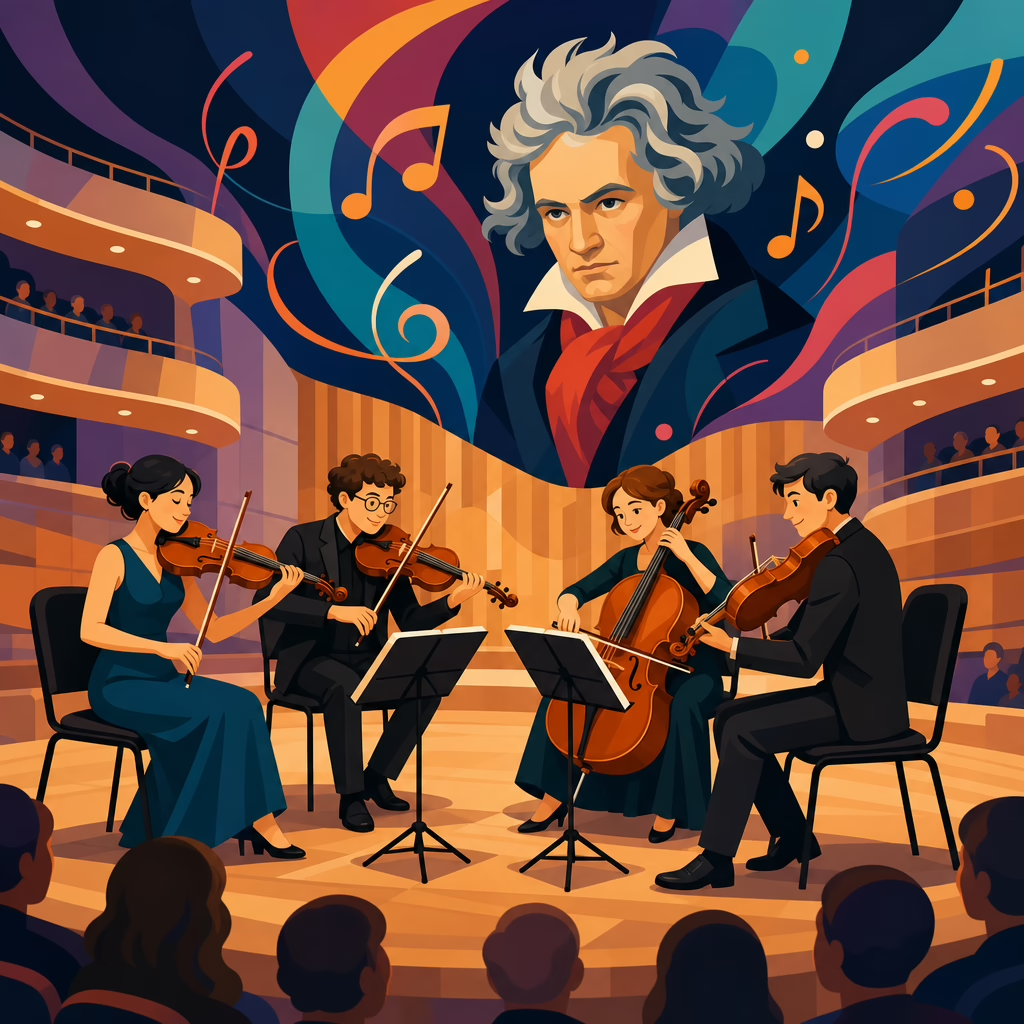
Programming Beethoven’s Chamber Music in the Modern Concert Hall
Programming Beethoven’s chamber music in the modern concert hall requires more than choosing admired scores and famous ensembles; it demands a practical understanding of repertoire, audience behavior, acoustics, ensemble logistics, and the larger storytelling role that chamber music plays within a season. In this context, programming means the full curatorial process: selecting works, pairing them intelligently, placing them in the right venue, framing them for listeners, budgeting rehearsal and artist resources, and linking one event to a broader artistic plan. Beethoven’s chamber music includes the familiar string quartets, piano trios, violin sonatas, cello sonatas, and wind-inflected works, but a useful miscellaneous hub must also account for mixed-ensemble pieces, less frequently programmed sets, educational formats, cross-period pairings, and special presentation models that do not fit neatly into a single repertoire bucket. That wider field matters because modern audiences rarely encounter chamber music in isolation; they experience it through festival arcs, digital promotion, pre-concert interpretation, and competing entertainment choices. After years of building chamber series, I have found that Beethoven succeeds best when presenters treat each program as both an artistic statement and an audience pathway. The challenge is not simply preserving a canon. The challenge is making Beethoven legible, vivid, and worth hearing now, without flattening his complexity or relying on reputation alone.
A modern Beethoven chamber music program succeeds when it answers several listener questions clearly. Why this piece tonight? Why these players? Why this venue? What should a first-time listener notice? What emotional or historical journey ties the works together? Presenters who can answer those questions in concrete terms sell more tickets, earn stronger repeat attendance, and generate better critical response. Beethoven is especially demanding because his chamber output spans early classicism, middle-period expansion, and late-style experimentation. The difference between offering Op. 18 quartets as elegant conversation pieces and presenting Op. 131 as a continuous dramatic structure is not just scholarly; it changes rehearsal planning, front-of-house messaging, and audience expectations. Chamber music also behaves differently from orchestral repertory in a hall. Balance, intimacy, and visual communication matter more, and weak programming becomes obvious quickly. This hub article maps the miscellaneous programming issues that shape successful Beethoven presentation today: repertoire framing, concert architecture, venue fit, artist preparation, audience development, educational context, and digital extension. Used well, these principles help organizations create Beethoven chamber concerts that feel coherent to experts, welcoming to newcomers, and sustainable for presenters.
Build the program around a listener journey, not just a list of masterpieces
The strongest Beethoven chamber music programming starts with a governing idea that can be explained in one or two sentences. That idea might be formal, such as tracing Beethoven’s evolution from Op. 18 to the late quartets; instrumental, such as exploring the piano as partner rather than accompanist; or experiential, such as presenting Beethoven works that move from salon scale to public intensity. What matters is coherence. Audiences can feel when a concert is assembled from availability and prestige alone. They respond differently when the program has internal logic, even if they cannot name every analytical connection.
In practice, this means programming by contrast and continuity at the same time. A violin sonata recital that pairs an early sonata with the “Kreutzer” and closes with a compact modern response gives listeners a clear arc of expansion, conflict, and reflection. A string quartet evening built only on high-status late works may impress specialists but can overwhelm mixed audiences, especially in general subscription series. I have seen first-time patrons respond more strongly to a pathway program, for example Op. 18 No. 4, Op. 59 No. 1, and a single late movement discussed from the stage, than to a more intimidating all-late marathon. The lesson is simple: difficulty needs framing, and familiarity needs fresh context.
Miscellaneous repertoire choices often unlock that context. Beethoven’s Septet in E-flat major, Op. 20, remains one of the most useful bridge works in the entire catalog because it attracts listeners who enjoy wind color, social elegance, and melodic immediacy while still introducing Beethoven’s large-scale thinking. The Serenade for String Trio, Op. 8, and the Duo “with Two Obbligato Eyeglasses” can function similarly in lighter-format concerts, museum partnerships, or shorter evening events. These works are not peripheral filler. They are programming tools that widen the entry points into the chamber music world and can direct audiences toward denser works later in a season.
Choose formats that match repertoire, venue, and audience tolerance
Modern concert halls host many kinds of chamber events: traditional evening recitals, one-hour no-intermission performances, festival marathons, lecture-recitals, family programs, and cross-genre presentations. Beethoven can work in all of them, but not every piece belongs in every format. The late quartets reward concentration and acoustic stillness. The Septet and selected variation sets can thrive in more relaxed settings. Piano trios often work well in a classic two-half format because they combine structural heft with timbral variety, whereas an all-sonata evening may need spoken guidance or a shorter total duration to avoid fatigue.
Programming decisions should account for actual audience stamina, not idealized listening habits. In many urban markets, weeknight buyers are more responsive to 75- to 90-minute chamber events than to long traditional programs with extensive spoken remarks. Weekend festival audiences tolerate greater density if the event feels distinctive. Student audiences engage more readily when examples are demonstrated from the stage. These are not assumptions; they are patterns visible in ticketing data, post-concert surveys, and retention rates across chamber series. The practical presenter watches those patterns and adapts without diluting artistic standards.
| Program type | Best Beethoven fit | Why it works | Main caution |
|---|---|---|---|
| One-hour no-intermission | Single trio, sonata pairing, Septet highlights | Accessible length and strong focus | Avoid overloading with dense late works |
| Traditional evening recital | Quartets, full sonata recitals, mixed-era surveys | Allows contrast and broader narrative arc | Needs careful pacing between large works |
| Festival immersion | Late quartets, complete cycles, chronological sets | Draws dedicated listeners seeking depth | Requires strong contextual support |
| Lecture-recital | Variation works, late-style excerpts, unusual instrumentation | Explains structure and listening cues directly | Talk must clarify, not dominate |
Venue fit is equally important. A 300-seat hall with warm resonance may flatter string quartet detail better than a large proscenium room built for amplified events. Beethoven’s chamber music loses impact when visual contact is weak or piano sound overprojects. If the organization must use a larger hall, stage shell placement, riser height, and seat configuration should be adjusted. I have seen modest physical changes improve clarity enough to alter audience perception of the performance itself. Good programming includes these technical decisions because repertoire is only half the event.
Use mixed-ensemble and lesser-programmed works to expand the season
A miscellaneous hub for Beethoven chamber music should emphasize that successful seasons do not rely exclusively on the canonical quartets and sonatas. Mixed-ensemble works provide flexibility for casting, pricing, and audience targeting. The Clarinet Trio in B-flat major, Op. 11, often reaches listeners who enjoy vocal lyricism and transparent textures. The Quintet for Piano and Winds, Op. 16, is especially valuable for institutions with strong wind principals or conservatory partnerships, because it can anchor collaborative programming that feels both substantial and fresh. The Horn Sonata, Op. 17, though not chamber music in the strictest market category for every presenter, can enrich a Beethoven series through instrumental variety and broaden press angles beyond string repertoire.
These pieces also solve practical artistic problems. A season built entirely around quartets may overtax resident ensembles or limit casting possibilities. Integrating piano-and-wind repertoire allows organizations to feature different artists, build thematic weekends, and create educational residencies around instrumentation. For example, a presenter might pair Op. 16 with Mozart’s K. 452 and a new work for the same forces, using Beethoven as the historical hinge. Another might build a “Beethoven and the public virtuoso” program around the “Kreutzer” Sonata, Horn Sonata, and selected variations, highlighting the composer’s awareness of star performers and public taste.
Lesser-programmed does not mean secondary. Often it means underexplained. When audiences receive a clear reason to care, they respond. A concise note that Op. 20 helped establish Beethoven’s early fame, or that Op. 16 shows him absorbing and enlarging Viennese wind style, gives listeners an immediate frame. In my experience, these contextual cues increase audience confidence more effectively than dense historical essays. People attend unfamiliar repertoire when the stakes are understandable.
Support performers with realistic rehearsal, edition, and acoustic planning
Programming Beethoven responsibly means understanding the workload hidden behind the title. Beethoven’s chamber music is exposed, structurally unforgiving, and often rhythmically or rhetorically unstable in ways that require significant rehearsal time. Presenters sometimes assume that elite ensembles can absorb any Beethoven score on short preparation because the works are standard repertoire. That assumption causes uneven results. Even famous quartets need rehearsal to adjust articulation, tempo relationships, repeats, seating, and hall response, particularly when mixing Beethoven with contemporary works or using unfamiliar instruments.
Edition choice matters more than many administrators realize. For performers, differences among Bärenreiter, Henle, and older practical editions can affect bowings, slurs, dynamics, and rehearsal efficiency. Urtext editions are not a guarantee of interpretive consensus, but they provide a cleaner foundation. If a festival presents period-informed Beethoven, the planning needs go further: gut strings, classical bows, historical pianos or replicas, lower pitch standards, and different balance expectations all influence venue choice and rehearsal scheduling. Those details should shape the budget from the start, not appear as artistic afterthoughts.
Acoustics deserve the same attention. Beethoven’s chamber scores rely on motivic exchange and registral definition. In dry rooms, players may need broader phrasing and more legato to sustain line; in reverberant halls, faster figurations can blur and force more detached articulation. Piano lid position, string seating, and audience wrap all matter. I have programmed the same trio in two rooms a week apart and watched the interpretive center of gravity shift simply because one hall supported bass resonance while the other highlighted upper strings. Presenters who build extra sound check time into the schedule usually get better performances and better audience satisfaction.
Frame Beethoven for contemporary audiences without trivializing the music
Audience development for Beethoven chamber music works best when presenters replace generic prestige language with specific listening guidance. Saying that a late quartet is profound may be true, but it does not tell a newcomer what to hear. Saying that Op. 132 interrupts suffering with a slow movement of thanksgiving, or that Op. 95 compresses conflict into unusually tight proportions, gives the listener a handle. Effective framing is concrete, brief, and tied to what will happen in the room.
Pre-concert talks, stage remarks, program notes, podcasts, and email campaigns should all reinforce the same core message. If the event theme is Beethoven’s experimentation, every touchpoint should explain where the experiment appears: continuous form, sudden silence, extreme contrast, unusual instrumental dialogue, or radical variation technique. Consistency improves understanding and strengthens conversion from curiosity to attendance. Institutions that separate marketing copy from artistic content often miss this advantage. The box-office message and the musicological message should support each other.
Digital extension is now part of programming, not an add-on. Short rehearsal clips, annotated listening guides, and artist interviews help audiences prepare and give educational value to those who cannot attend. A chamber series page should link related events clearly: quartets to sonatas, sonatas to trios, trios to mixed-ensemble works. That internal structure helps users navigate the topic and encourages deeper engagement with Beethoven’s chamber music as a connected body of work rather than a set of isolated masterpieces. It also supports schools, journalists, and curious listeners looking for a reliable entry point.
Community partnerships can further widen the audience. Universities, conservatories, museums, libraries, and instrument societies often provide natural contexts for Beethoven programming. A manuscript exhibition can accompany a lecture-recital on revision and notation. A hearing and music panel can address Beethoven’s deafness responsibly, avoiding cliché while discussing creativity, adaptation, and historical evidence. The key is substance. Audiences recognize when extra programming illuminates the music and when it exists only as promotional packaging.
Create a season hub that guides exploration across the full subtopic
Because this page serves as a miscellaneous hub within the broader Beethoven’s chamber music topic, its curatorial task is to connect the subtopic’s many strands. A useful hub does not try to replace focused articles on quartets, sonatas, trios, or individual works. Instead, it helps readers and presenters see how those pieces function inside a modern season. It should point them toward articles on repertoire categories, historical context, performance practice, venue selection, education formats, and audience strategy, while also answering the practical question that brings many users here: how do you actually build successful Beethoven chamber programs now?
The answer is to combine artistic rigor with audience intelligence. Choose repertoire with a clear narrative. Match pieces to format and venue. Use mixed-ensemble works to broaden entry points. Budget rehearsal and acoustic preparation realistically. Explain what listeners should hear in plain language. Then connect each concert to the next so Beethoven’s chamber music unfolds as an ongoing journey rather than a sequence of disconnected events. That approach respects the music, serves performers, and builds long-term audience trust.
For presenters, artists, educators, and writers, the main benefit is sustainability. Thoughtful Beethoven programming can deepen loyalty, diversify attendance, and strengthen a chamber series without sacrificing complexity. Use this hub as the starting point for planning the next recital, refining the season narrative, and exploring the linked topics that turn strong individual concerts into a compelling Beethoven chamber music ecosystem.
Frequently Asked Questions
What does it really mean to program Beethoven’s chamber music effectively in a modern concert hall?
Programming Beethoven’s chamber music effectively means treating each concert as a curatorial argument rather than a simple lineup of great pieces. In practical terms, that involves far more than selecting well-known quartets or sonatas and hiring respected artists. A successful program considers the specific repertoire, the length and pacing of the event, the acoustic profile of the hall, the rehearsal demands of the chosen works, the audience’s familiarity with the music, and the broader narrative role the concert plays within a season. Beethoven’s chamber output is especially demanding because it spans early, middle, and late styles, and each period asks different things of performers and listeners. A program built around Op. 18 quartets communicates something very different from one centered on the late quartets or the “Archduke” Trio.
In a modern concert hall, effective programming also means recognizing that the venue itself shapes perception. Beethoven’s chamber music was not conceived for oversized spaces in the way symphonic repertoire often is, so presenters have to think carefully about scale, projection, seating configuration, and audience intimacy. Some works flourish in a smaller, acoustically warm room where detail and conversational interplay can register naturally. Others can succeed in a larger hall if the ensemble is strong, the stage setup is intelligent, and the framing helps listeners engage with the music’s structure and dramatic range. Good programming therefore balances artistic ambition with practical realism. The goal is not simply to present Beethoven, but to create the conditions in which the music can be heard clearly, understood deeply, and remembered as part of a coherent artistic experience.
How should presenters choose which Beethoven chamber works to include in a season?
The best seasonal planning begins by thinking in terms of range, contrast, and purpose. Beethoven’s chamber music is not one homogeneous category; it includes string quartets, piano trios, violin sonatas, cello sonatas, string trios, quintets, and mixed-ensemble works that differ widely in style, duration, technical difficulty, and audience accessibility. A strong season usually avoids relying only on the most famous titles. Instead, it builds a repertoire arc that might introduce listeners to Beethoven’s early craft, highlight the public confidence of the middle-period works, and reserve the spiritual and structural complexity of the late works for contexts where they can be absorbed properly. This does not mean every season must attempt a comprehensive survey, but it does mean each programming choice should serve a larger artistic logic.
Presenters should also match the repertoire to the artists and the expected audience. Some ensembles are especially compelling in the Op. 18 quartets, where elegance, rhythmic precision, and transparency matter enormously. Others may be better suited to the rhetorical weight and interpretive risk of the late quartets. The same principle applies to piano trios and sonatas: the “Ghost” Trio, the “Archduke,” and the Kreutzer Sonata each carry different expressive profiles and practical demands. It is often wise to mix anchor works with less frequently heard pieces so that the program offers both familiarity and discovery. Seasonal balance matters as well. If a hall already presents large-scale orchestral Beethoven frequently, the chamber series can illuminate a more intimate, experimental, and structurally daring side of the composer. In that sense, repertoire selection is not just about quality; it is about perspective, contrast, and the role each concert plays within the institution’s overall artistic identity.
How important are venue acoustics and hall size when programming Beethoven’s chamber music?
They are critically important. Chamber music depends on clarity, internal balance, and the listener’s ability to perceive musical dialogue in real time. Beethoven’s chamber writing often places enormous expressive weight on small gestures: an inner-voice response, a sudden shift in texture, a rhythmic interruption, or a fragile transition that only works when the acoustic allows detail to speak. In a hall that is too large, too dry, or too reverberant, those interactions can blur or flatten, and the performance may lose the sense of tension and conversational immediacy that is central to the repertoire. That is why programming decisions should always include a serious assessment of where the music will be heard, not just who will perform it.
Hall size also affects audience psychology. In an intimate venue, listeners can feel directly involved in the unfolding of the performance, which is especially valuable in works such as the late quartets, where concentration and nuance are everything. In a large hall, chamber music can still succeed, but it often requires additional planning: thoughtful stage placement, shell adjustments, strategic seating sales that avoid visual emptiness, and program notes or spoken introductions that help orient the audience. Some presenters pair Beethoven chamber concerts with alternative formats, such as onstage seating, pre-concert conversations, or shorter, focused programs, precisely because those choices compensate for the scale of the room. The broader point is simple: acoustics and venue size are not technical afterthoughts. They are central artistic variables, and they can determine whether Beethoven’s chamber music feels urgent and alive or remote and underpowered.
How can programmers make Beethoven’s chamber music more engaging for modern audiences without oversimplifying it?
The most effective approach is to frame the music clearly without diluting its complexity. Modern audiences do not need Beethoven reduced to slogans; they need context that sharpens listening. That can take many forms: a concise spoken introduction from performers, well-written program notes, digital content released in advance, or thematic pairings that make the concert’s logic immediately legible. For example, a program might explore Beethoven’s idea of conversation, his expansion of classical forms, or his relationship to private versus public musical expression. When listeners understand what to listen for, they are far more likely to connect with long-form chamber works that might otherwise seem abstract or forbidding.
Engagement also comes from pacing and design. A modern audience often responds better when a concert has a persuasive shape rather than feeling like a museum display of canonical works. That might mean pairing Beethoven with a contemporary piece that echoes his formal experimentation, placing a shorter work before a major late quartet, or avoiding overlong programs that demand more concentration than most listeners can realistically sustain. Presentation style matters too. A conversational, confident tone from the stage can make a major difference, especially when the artists illuminate the stakes of the music without becoming academic. Importantly, accessibility does not mean lowering standards. It means removing unnecessary barriers to entry while preserving the depth, difficulty, and emotional range that make Beethoven worth programming in the first place. Audiences often rise to the occasion when the invitation is clear, the environment is welcoming, and the programming trusts both the music and the listener.
What logistical and budgeting factors should be considered when presenting Beethoven chamber music successfully?
Logistics and budgeting are foundational, because even the most imaginative artistic concept can fail if the practical structure underneath it is weak. Beethoven’s chamber works vary greatly in personnel, rehearsal needs, and production complexity. A string quartet concert may seem straightforward on paper, but the artistic standard expected in Beethoven is exceptionally high, and that often translates into significant rehearsal time, coaching, travel planning, and schedule coordination. Piano-based repertoire introduces additional considerations, including instrument quality, tuning, stage crew timing, and balance testing in the hall. Mixed-instrument programs may require more complicated setup changes and more careful attention to backstage flow. Presenters should budget not only for artist fees, venue costs, and marketing, but also for the less visible expenses that support musical quality: adequate rehearsal access, technical labor, instrument preparation, recording or streaming needs, and staff time devoted to audience engagement materials.
There is also a strategic financial dimension. Beethoven’s name has strong market value, but not every Beethoven chamber program sells equally well. The “Archduke” Trio or a famous quartet cycle may attract a broader audience than a program of less familiar early works, even if the latter is artistically excellent. That means programmers should think in portfolio terms across a season, balancing dependable box-office events with more exploratory offerings. Marketing should reflect the actual appeal of the program: the ensemble’s reputation, the emotional world of the music, the rarity of a complete cycle, or the chance to hear Beethoven in an intimate setting. Rehearsal and performance schedules should also respect the demands of the repertoire, especially for late works, where insufficient preparation is immediately audible. In the end, successful budgeting is not about spending lavishly; it is about aligning resources with artistic goals so the performance, the audience experience, and the institutional investment all support one another.