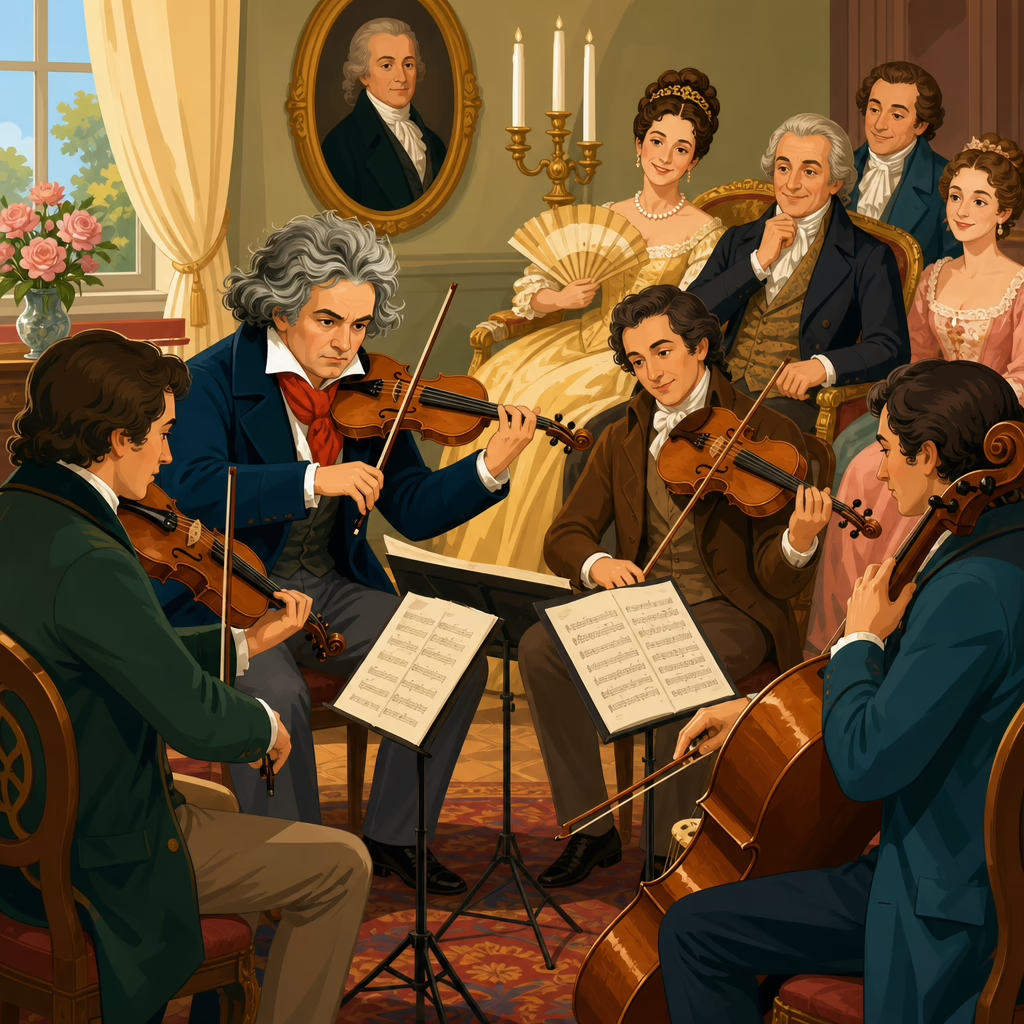
Beethoven’s Chamber Music and the Patronage System
Beethoven’s chamber music cannot be understood without understanding the patronage system that sustained, constrained, and ultimately transformed his career. In practical terms, patronage meant financial and social support from aristocrats, wealthy music lovers, publishers, and institutions that commissioned works, hosted performances, offered stipends, and elevated a composer’s reputation. For Beethoven, chamber music included string quartets, piano trios, violin sonatas, cello sonatas, wind works, and mixed-ensemble pieces written for private salons as much as for public concert life. The relationship between this repertoire and patronage matters because it explains why certain works were written, for whom they were intended, how they circulated, and why Beethoven gradually redefined the balance between artistic independence and elite support. After years of working with Beethoven sources, letters, opus timelines, and dedications, one fact stands out clearly: his chamber music charts the decline of older courtly dependence and the rise of the modern freelance composer.
That shift was neither quick nor clean. In late eighteenth-century Vienna, a composer rarely survived on ticket sales alone. Noble households funded musicians, purchased manuscripts, organized domestic concerts, and treated music as a mark of cultivation and prestige. Beethoven entered this world from Bonn, where service culture still shaped musical employment, yet he arrived in Vienna determined to be more than a servant in livery. His chamber works became ideal vehicles for this ambition. They could be dedicated to patrons, performed in semi-private spaces, sold to publishers, and tailored to accomplished amateurs or leading professionals. The result is a body of music that reveals both dependence and defiance. To read Beethoven’s chamber music historically is to see each sonata, trio, and quartet not just as abstract art, but as evidence of negotiation among money, taste, status, friendship, and creative authority.
How Patronage Worked in Beethoven’s Vienna
The patronage system in Beethoven’s Vienna operated through overlapping channels rather than a single fixed model. Aristocrats such as Prince Karl Lichnowsky, Count Andreas Razumovsky, Archduke Rudolph, Prince Kinsky, and Prince Lobkowitz offered housing, cash gifts, introductions, and performance opportunities. Some arrangements were formal, including annuities or contracts; others were informal, built on personal loyalty and social exchange. A dedication could function as a public thank-you, a strategic appeal for future support, or both. Chamber music fit this system especially well because it thrived in aristocratic salons and private rooms, where cultivated listeners could hear complex works repeatedly. In that environment, a new piano trio or quartet was not background entertainment. It was social capital.
Beethoven exploited every available avenue while resisting subordination. He accepted dedications, cultivated noble students, and benefited from private performances, but he also insisted on being treated as an artist of exceptional rank. His famous break with Prince Lichnowsky, though dramatized in later retellings, captures a real pattern: Beethoven would accept patronage, yet he recoiled from commands that implied servitude. This tension shaped his chamber output. Some works clearly address aristocratic taste and domestic practicality; others challenge players and listeners with unprecedented scale, motivic density, and formal experimentation. In my experience tracing the reception history of these pieces, the pattern is consistent: Beethoven used patronage structures to fund work that increasingly exceeded the expectations of patrons themselves.
Dedications, Commissions, and Financial Strategy
Dedications in Beethoven’s chamber music were rarely ornamental. They were part of a financial strategy linking composition, reputation, and reciprocity. The three Op. 1 piano trios were dedicated to Prince Lichnowsky, one of Beethoven’s earliest and most important Viennese supporters. Those trios announced Beethoven as a formidable composer for the keyboard-centered chamber genre that affluent households loved to perform. The Op. 18 string quartets, dedicated to Prince Lobkowitz, similarly aligned Beethoven with a patron known for serious support of ambitious music. Later, the Op. 59 “Razumovsky” quartets did more than honor Count Razumovsky; they reflected a patron wealthy enough to maintain a resident quartet and sponsor works on a scale few amateurs could manage.
Commissions and quasi-commissions also mattered. Not every work came from a direct written request, but patron expectation could shape genre choice, instrumentation, and timing. The Septet in E-flat major, Op. 20, became a celebrated success partly because it met social demand for brilliant, mixed-ensemble chamber music suited to elite gatherings. By contrast, the late quartets emerged from a more complex ecology involving publishers, prestige, and the support network surrounding Beethoven’s final years. Money came not only from one patron but from layered sources: annuities, dedication payments, manuscript sales, and subscription interest. Beethoven understood this ecosystem well. He negotiated aggressively with publishers across Vienna, Leipzig, London, and Paris, often playing one offer against another. Patronage did not disappear when publishing expanded; instead, the two systems interacted, and chamber music sat at the center of that interaction.
Key Patrons and the Chamber Works Linked to Them
Specific patrons left visible marks on Beethoven’s chamber catalog. Lichnowsky provided early lodging, introductions, and a socially crucial platform. Without that support, the Op. 1 trios and the early sonatas would have reached Vienna more slowly and with less prestige. Razumovsky’s importance lies not only in his name on Op. 59 but in what his resources enabled: a quartet culture capable of testing highly demanding music. Archduke Rudolph, Beethoven’s student, patron, and dedicatee of several major works, represented a different kind of support: stable, educated, and personally loyal. His role in Beethoven’s life demonstrates that patronage could be intellectually meaningful, not merely financial.
| Patron | Type of support | Representative chamber link | Why it mattered |
|---|---|---|---|
| Prince Karl Lichnowsky | Lodging, money, introductions | Op. 1 Piano Trios | Helped launch Beethoven in Viennese elite circles |
| Prince Lobkowitz | Performance backing, prestige | Op. 18 String Quartets | Associated Beethoven with serious quartet writing |
| Count Razumovsky | Commissioning environment, resident quartet | Op. 59 Quartets | Enabled large-scale, technically advanced works |
| Archduke Rudolph | Annuity, study relationship, long-term loyalty | Later dedications and broader chamber support | Provided stability during artistic expansion |
These names should not obscure the wider network of aristocratic women, salon hosts, amateur players, and professional collaborators who made chamber music viable. Beethoven wrote for violinists such as Ignaz Schuppanzigh and interacted with cellists, pianists, and publishers who influenced what could be performed and sold. Patronage was social infrastructure. It determined who heard a new quartet first, who rehearsed it, who copied the parts, and whether the work reached a publisher quickly. For a hub article on Beethoven’s chamber music and the patronage system, that is the central insight: support came from a network, not a single benefactor, and the network shaped both access and ambition.
Private Performance, Amateur Culture, and Public Reputation
One of the most important questions readers ask is whether Beethoven’s chamber music was written for private rooms or public concerts. The answer is both, but the balance changed over time. In the 1790s and early 1800s, much chamber music still belonged primarily to domestic and semi-private performance culture. Skilled amateurs played piano trios and violin sonatas at home. Noble households sponsored quartet sessions. New music circulated first among insiders before reaching larger audiences. This setting rewarded works that displayed intelligence, refinement, and instrumental brilliance without requiring a public orchestra or theater. Beethoven mastered that market, then stretched it.
The stretching is crucial. Early works often retain links to amateur consumption, though even there Beethoven raises technical and expressive demands. As his middle-period style matured, some chamber works effectively surpassed the abilities of ordinary household players. The “Razumovsky” quartets, the “Kreutzer” Sonata, and later the “Archduke” Trio require professional-level ensemble discipline, large-scale architectural thinking, and interpretive stamina. Yet these works still emerged from patronage networks. That is one of Beethoven’s most consequential achievements: he used private support to create music that pointed toward a broader public sphere and a more modern idea of canonical art. Patrons financed the laboratory in which Beethoven remade chamber music from elite pastime into high artistic statement.
Publishing, Rights, and the Composer’s Independence
If patronage explains why Beethoven could compose, publishing explains how he broadened his autonomy. Chamber music was especially valuable in this respect because it sold. Piano arrangements, sonatas, trios, and quartets appealed to consumers in multiple cities, and Beethoven recognized that print income could reduce reliance on any one aristocrat. He tracked editions carefully, complained about piracy and unauthorized copies, and sought better terms whenever his reputation increased. His business letters reveal a composer who knew the market. He might flatter a noble dedicatee in one context and bargain hard with a publisher in another, all while preserving ownership over his artistic direction as much as the period allowed.
This mixed model changed the meaning of patronage. Instead of simply serving a court, Beethoven leveraged patrons to gain visibility, then converted visibility into sales and prestige. The annuity agreement of 1809 involving Archduke Rudolph, Prince Kinsky, and Prince Lobkowitz is often discussed in relation to large public works, but it also illuminates the chamber sphere. Beethoven’s supporters were effectively paying to keep him in Vienna as an independent master rather than a household employee elsewhere. That arrangement marks a historical turning point. Chamber music, because it was portable, performable, and publishable, became one of the strongest foundations for this new economic identity.
What the Chamber Repertoire Reveals About Social Change
Beethoven’s chamber music reveals a society in transition from hereditary cultural authority to a more fluid marketplace of taste. The old order still mattered: titles opened doors, salon invitations built careers, and dedications signaled allegiance. But increasingly, works achieved value beyond the room of first performance. The late quartets are the clearest example. No narrow patronal framework can fully explain them, yet they would not exist in the same form without the habits of concentrated listening, repeat performance, and elite support cultivated by patronage culture. The system gave Beethoven time, players, and legitimacy; Beethoven returned music that transcended the system’s original social function.
This is why discussions of Beethoven’s chamber music and the patronage system should avoid simple moral contrasts between dependence and freedom. Patronage was not merely restrictive, and independence was never absolute. Beethoven needed money, instruments, copyists, rehearsal access, and influential allies. At the same time, he consistently enlarged the composer’s authority over the work itself. He expected patrons to recognize genius rather than command labor. In practical terms, that expectation changed music history. It helped establish the nineteenth-century model of the serious composer whose chamber works demand reverent study, not just elegant consumption. Readers exploring related articles on individual quartets, sonatas, trios, and patrons should keep that larger arc in view.
Beethoven’s chamber music is therefore the ideal lens for understanding patronage as a living, adaptive system rather than a static relic of aristocratic culture. The early trios and quartets show how noble sponsorship launched a career. The middle-period masterpieces show how elite resources could underwrite radical experimentation. The late works show how a composer, having absorbed and outgrown the expectations of patrons, could still rely on networks of support while writing for posterity as much as for contemporaries. Across the repertoire, dedications, private performances, publication deals, and personal alliances form part of the music’s meaning, not just its background. For anyone studying Beethoven’s chamber world, the main lesson is simple: follow the money, the names, the rooms, and the relationships, and the works become clearer. Use this hub as a starting point, then move outward to the individual pieces and patrons that made Beethoven’s chamber legacy possible.
Frequently Asked Questions
Why is the patronage system so important to understanding Beethoven’s chamber music?
The patronage system is central because it shaped the conditions under which Beethoven composed, performed, circulated, and profited from his chamber music. In late eighteenth- and early nineteenth-century Europe, composers rarely worked as fully independent artists in the modern sense. Instead, they relied on networks of aristocratic patrons, wealthy amateurs, publishers, and cultural institutions for income, prestige, and access to performance opportunities. For Beethoven, this support system affected everything from the kinds of chamber works he wrote to the social settings in which those works were first heard. String quartets, piano trios, violin sonatas, cello sonatas, and wind chamber pieces often moved through elite private salons and noble households before reaching a wider public.
At the same time, patronage did not simply “support” Beethoven in a neutral way. It could also constrain him. Patrons had tastes, expectations, and social agendas. They might prefer music suitable for domestic performance, works dedicated to them as signs of status, or compositions tailored to the abilities of particular performers in their circle. Beethoven had to navigate these realities while pursuing increasingly ambitious artistic goals. That tension helps explain why his chamber music can seem both socially grounded and radically original. His early chamber works often reflect established conventions that made sense within aristocratic musical culture, while later works push beyond those conventions in ways that suggest a composer gradually redefining his relationship to patrons, audiences, and artistic authority.
In other words, patronage provides the missing framework that connects Beethoven’s creative output to his lived professional world. Without it, chamber music can appear as a purely abstract artistic achievement. With it, the music comes into focus as part of a dynamic exchange among money, taste, social prestige, performance practice, and artistic innovation.
Who were Beethoven’s patrons, and how did they influence his chamber music career?
Beethoven’s patrons came from several overlapping groups, and each played a distinct role in the development of his chamber music career. The most visible were members of the aristocracy, especially Viennese nobles who admired his talent, provided financial assistance, hosted performances, and attached social prestige to his work. Figures such as Prince Karl Lichnowsky, Archduke Rudolph, Prince Lobkowitz, and Count Rasumovsky are especially important in discussions of Beethoven’s chamber music. Their homes and musical circles offered practical venues where chamber works could be rehearsed, premiered, and evaluated by influential listeners.
These patrons influenced Beethoven in direct and indirect ways. Directly, they commissioned works, received dedications, paid stipends, or employed musicians capable of performing demanding chamber repertory. Indirectly, they helped create the social ecosystem in which chamber music flourished. A composer writing for private performance in an aristocratic salon might think differently about scoring, technical demands, and genre than a composer writing primarily for a large public concert. For example, the prestige associated with dedicated works often encouraged Beethoven to produce chamber music of exceptional ambition, knowing that the piece would circulate among elite connoisseurs and reflect both on the patron and on himself.
Publishers also functioned as a kind of patronage force. They offered fees, widened distribution, and helped transform chamber music from a private social art into a commodity for a growing market of skilled amateurs and professionals. Wealthy music lovers and institutions contributed as well by sponsoring concerts, purchasing manuscripts, or supporting performance culture. Taken together, these relationships gave Beethoven more opportunities than a court-bound composer might have had, but they also demanded strategic negotiation. One of Beethoven’s great achievements was his ability to use patronage without being entirely absorbed by it, gradually asserting a stronger sense of artistic independence while still benefiting from elite support.
How did patronage affect the style and difficulty of Beethoven’s chamber works?
Patronage affected both style and difficulty because chamber music was deeply tied to who would play it, where it would be heard, and why it was being commissioned or dedicated. In aristocratic and upper-middle-class circles, chamber music often served social as well as artistic purposes. Some works needed to be accessible enough for talented amateurs to participate in domestic music-making. Others were intended for highly skilled performers associated with noble households or prominent musical circles. Beethoven responded to these conditions by writing chamber music across a wide spectrum, from works that still engage with sociable performance traditions to pieces of extraordinary complexity that challenged players and listeners alike.
His early chamber works often show a keen awareness of audience and setting. They can be brilliant, elegant, and technically polished, but they usually remain within recognizable generic expectations. As Beethoven’s reputation grew and as he gained more leverage within the patronage system, he increasingly expanded the expressive and technical range of these genres. The “Rasumovsky” Quartets are a famous example: they were connected to Count Rasumovsky, yet they far exceed what many listeners of the period expected from string quartets. Their scale, contrapuntal richness, emotional intensity, and formal experimentation suggest that patronage could provide a platform for innovation rather than merely encourage conventional writing.
That said, Beethoven’s boldness did not emerge in isolation from patronage; it emerged through his negotiation with it. Support from influential patrons gave him room to take risks, but those risks sometimes strained the expectations of the very audiences who first encountered the music. This is one of the defining features of Beethoven’s chamber style. He began within a patronage-based world that valued refinement, skill, and social distinction, then gradually transformed chamber music into a medium of deeper personal expression and structural daring. The increasing difficulty of the works reflects not just his evolving imagination, but also his shifting confidence that chamber music could be something more than elegant entertainment for elite circles.
Did patronage limit Beethoven’s artistic freedom, or did it help him become more independent?
The most accurate answer is that it did both. Patronage undeniably imposed limits. Patrons could shape a composer’s opportunities, influence what types of works were likely to be rewarded, and create social obligations through commissions, dedications, and financial support. In Beethoven’s world, maintaining aristocratic favor mattered. A composer who alienated important supporters risked losing income, visibility, and access to performers. Chamber music, with its close connection to private performance settings, was especially embedded in these elite relationships. Beethoven therefore had to remain attentive to social diplomacy even as he cultivated an image of uncompromising genius.
Yet patronage also enabled Beethoven’s independence in crucial ways. Unlike a composer permanently tied to a single court or church position, Beethoven built a broader network of support. Multiple patrons, along with publishers and public reputation, gave him a degree of flexibility that earlier generations often lacked. One of the most significant developments in his career was the emergence of arrangements that supported him without forcing him into conventional service. The annuity agreement offered by aristocratic supporters is often cited as a landmark in this respect: it helped Beethoven remain in Vienna and continue composing without being fully subordinate to one employer’s daily demands.
This partial independence had profound consequences for his chamber music. It allowed him to stretch forms, deepen expressive contrasts, and write works that were not always immediately marketable or socially comfortable. The late string quartets, in particular, stand as evidence of a composer who had moved well beyond the expectations of polite patronage culture, even though that culture had helped sustain him earlier. So patronage should not be seen only as a system of control or only as a system of benevolence. It was a complex framework that Beethoven learned to work within, exploit, resist, and ultimately transform in the service of a more autonomous artistic identity.
How did Beethoven’s chamber music help transform the patronage system itself?
Beethoven’s chamber music helped transform the patronage system by changing what patrons, performers, publishers, and listeners expected chamber music to be. Traditionally, much chamber repertory functioned within relatively intimate, socially bounded settings. It was refined, often brilliant, and highly valued, but it frequently served the pleasures of cultivated domestic or aristocratic music-making. Beethoven inherited that world, yet his chamber works gradually expanded the genre’s cultural authority. He treated string quartets, piano trios, sonatas, and other chamber forms not as secondary or merely decorative genres, but as vehicles for serious artistic thought, emotional depth, and formal experimentation.
As a result, patrons who supported Beethoven were not simply sponsoring tasteful entertainment; they were becoming associated with music of lasting intellectual and cultural prestige. A dedication from Beethoven could signal sophistication and seriousness, not just social standing. Publishers, too, recognized that chamber music could command attention beyond a narrow circle of insiders, especially when linked to Beethoven’s growing reputation. This helped shift the economics of music from older models centered on direct noble support toward a more mixed system that included publication, public reception, and a broader marketplace for high-status art music.
Perhaps most importantly, Beethoven’s chamber music contributed to a new image of the composer. Instead of appearing primarily as a skilled servant or provider of elegant works for elite use, the composer increasingly emerged as an autonomous creative force whose art demanded respect on its own terms. That idea did not eliminate patronage overnight, but it altered the balance of power within it. Patrons still mattered, yet they were now also lending their names to an artist whose authority could rival or exceed their own social prestige. In this sense, Beethoven’s chamber music was not merely shaped by patronage; it actively