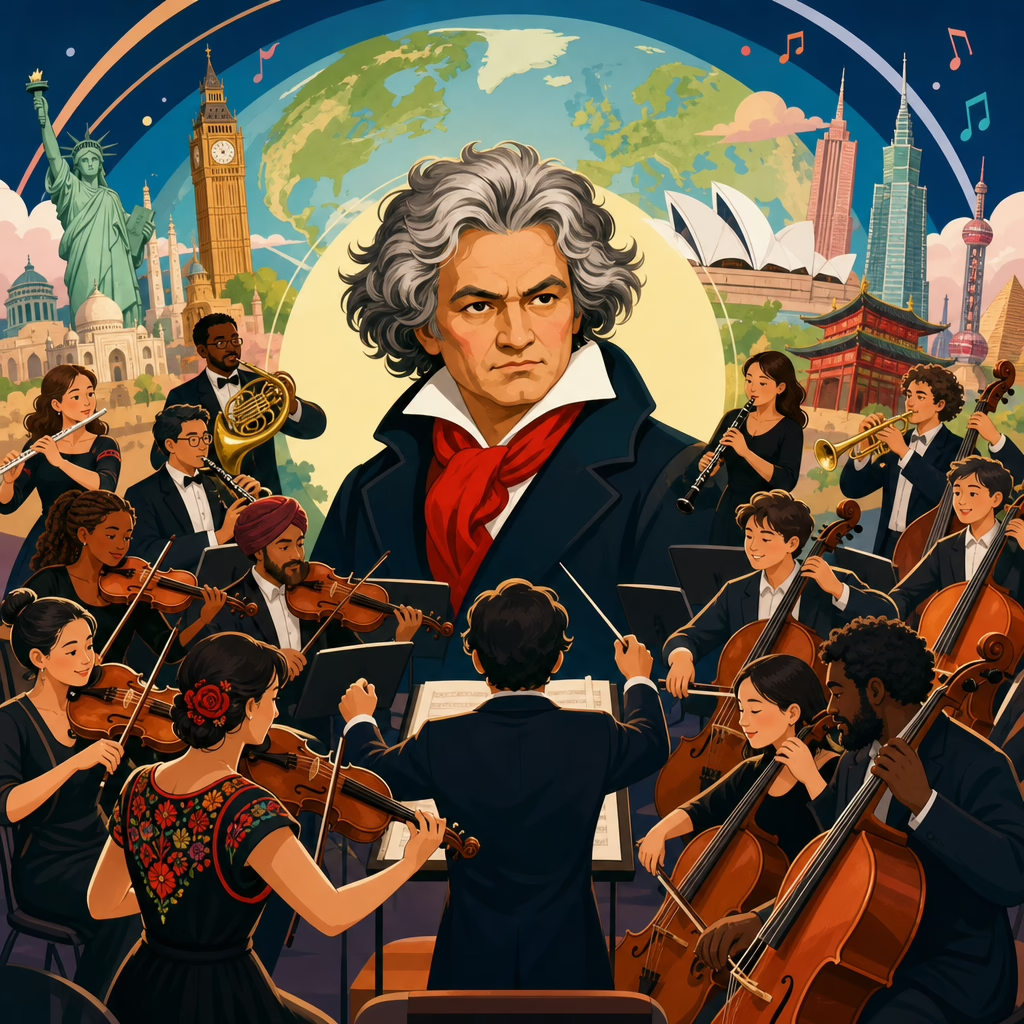
Orchestras Worldwide Still Centering Beethoven—Why?
Beethoven remains the gravitational center of orchestral programming because his music sits at the crossroads of artistic ambition, institutional tradition, audience recognition, and the practical realities of concert life. When people ask why orchestras worldwide still center Beethoven, they are really asking why one composer continues to dominate a cultural form that has expanded across continents, technologies, and social expectations. The answer is not a single myth about genius. It is a network of factors: the scale and flexibility of the symphonies, their role in music education, the economics of ticket sales, the expectations of conductors and boards, and the way later composers defined themselves through Beethoven, whether by imitation, resistance, or revision.
In practical terms, “centering Beethoven” means that orchestras repeatedly return to the symphonies, overtures, concertos, and choral works as anchors of subscription seasons, tours, festivals, auditions, recordings, and outreach programs. Across North America, Europe, Asia, Australia, and Latin America, Beethoven functions as repertory infrastructure. A season may include new commissions, film concerts, crossover events, and historically underperformed composers, yet Beethoven often remains the symbolic core. His Fifth, Seventh, and Ninth Symphonies are not simply popular pieces. They are benchmarks by which ensembles measure sound, stamina, style, and seriousness. I have seen programming meetings where adventurous ideas gained approval only because a Beethoven title elsewhere in the season stabilized projected attendance.
This matters because programming choices shape public understanding of classical music. If Beethoven is repeatedly centered, he becomes both gateway and gatekeeper. He introduces new listeners to orchestral sound, but he can also crowd out equally valuable voices when institutions rely too heavily on familiar titles. Understanding this dynamic is essential for anyone studying Beethoven’s influence on future generations. His legacy is not only musical. It lives in conservatory curricula, fundraising language, recording catalogs, national celebrations, and the very idea of what a symphony concert should accomplish. To understand modern orchestral culture, you must understand why Beethoven still occupies its most visible center of gravity.
Beethoven as the modern orchestra’s benchmark
Beethoven’s centrality begins with the repertoire itself. The nine symphonies span a remarkable range of scale, mood, and technical demand, making them ideal reference points for orchestras. The First and Second still speak the language of Haydn and Mozart but stretch it with stronger contrast and propulsion. The “Eroica” resets the scale of the symphony and turns it into a public, philosophical statement. The Fifth condenses motivic development into one of music history’s clearest examples of structural unity. The Sixth links symphonic form to vivid scene painting. The Seventh tests rhythm, drive, and ensemble precision. The Ninth expands the genre by adding chorus, soloists, and an overtly universal message.
For conductors, these works are laboratories. Tempo relationships, articulation, repeat choices, string vibrato, brass balance, timpani tuning, and seating layout all matter in Beethoven, and each decision reveals an interpretive philosophy. That is why Beethoven remains central even in the age of specialized period-instrument ensembles. Historically informed performance did not dislodge him; it deepened the field. Modern orchestras now program Beethoven through multiple lenses, from weighty late-Romantic sonorities to leaner, more transparent approaches influenced by scholars and practitioners such as Nikolaus Harnoncourt, John Eliot Gardiner, and Roger Norrington. The repertoire keeps generating new interpretive questions without losing public recognizability.
Players also use Beethoven as a professional benchmark. In auditions and trial weeks, excerpts from the Fifth, Seventh, and Ninth Symphonies appear constantly because they test the fundamentals: rhythmic discipline, articulation, blend, endurance, and stylistic awareness. An orchestra that can play Beethoven convincingly demonstrates core ensemble health. That utility reinforces his presence in rehearsal culture and institutional memory. Once a work becomes the standard by which musicians are trained and hired, it gains a self-sustaining position in the repertory.
Why audiences still respond so strongly
Beethoven endures because audiences hear both immediacy and depth in the music. The themes are memorable, the rhythmic profiles are clear, and the emotional arcs are legible even to listeners with little technical training. The opening of the Fifth Symphony is one of the most recognized gestures in Western music. The slow movement of the Seventh can communicate grief, dignity, and forward motion to first-time concertgoers. The “Ode to Joy” from the Ninth has circulated so widely through ceremonies, films, public events, and political symbolism that many listeners arrive with a sense of ownership before they ever attend a live performance.
Familiarity alone does not explain longevity. Plenty of once-popular works fade when repeated listening exposes thin substance. Beethoven survives repetition because the music rewards different levels of attention. A casual listener can be carried by momentum and contrast; an experienced listener can follow harmonic strategy, long-range architecture, and motivic transformation. This layered accessibility matters enormously in subscription programming. Orchestras need works that satisfy donors, longtime subscribers, students, and newcomers in the same hall on the same night. Beethoven does that better than almost anyone.
There is also a ritual dimension. Hearing Beethoven live connects audiences to a transnational concert tradition stretching back two centuries. The Ninth Symphony on New Year events in Japan, the Fifth on major tours, and complete symphony cycles tied to anniversaries all demonstrate how Beethoven became embedded in collective listening habits. These habits are cultural, not natural, but once established they are powerful. Institutions build traditions around pieces people expect to encounter at meaningful moments, and Beethoven’s catalogue supplies an unusually rich set of ceremonial anchors.
The economic logic behind Beethoven-heavy seasons
Artistic reasons matter, but budgets matter too. Beethoven helps orchestras manage financial risk because his name is a reliable demand signal. Single-ticket buyers recognize it instantly. Corporate sponsors understand the prestige association. Development departments can frame Beethoven concerts as major cultural events. Touring managers know presenters are more likely to book a Beethoven program than an evening built around unfamiliar repertoire. Even in cities with sophisticated audiences, tested titles reduce uncertainty.
I have watched the planning logic repeatedly: an orchestra places a Beethoven concerto or symphony in a week that also includes a living composer or a neglected historical figure, knowing the familiar anchor makes the full program easier to sell. This cross-subsidy effect is one reason Beethoven can support broader repertory diversity rather than simply suppress it. The problem appears when institutions stop at the safety strategy and never move beyond it. Then Beethoven becomes not a bridge but a bottleneck.
| Programming factor | Why Beethoven helps | Institutional result |
|---|---|---|
| Ticket sales | High public recognition of symphonies and concertos | Stronger baseline attendance |
| Fundraising | Prestige and cultural familiarity appeal to donors | Easier campaign messaging |
| Touring | Presenters prefer repertory with proven draw | More booking confidence |
| Education | Students often already know key themes and narratives | Lower entry barrier for outreach |
| Recordings and streams | Search demand remains consistently high | Reliable catalog value |
Catalog economics reinforce the pattern. Beethoven is central to recording history, from shellac and LP eras to digital streaming. Complete symphony cycles remain marketable products because listeners compare conductors, orchestras, and performance styles across generations. A Mahler cycle may signal ambition; a Beethoven cycle signals legitimacy. That distinction still shapes artistic branding. When an orchestra wants to announce that a new music director means business, Beethoven often appears early for exactly that reason.
Education, canon formation, and the power of repetition
Another reason orchestras worldwide still center Beethoven is that musicians are trained inside systems that place him near the middle of everything. Conservatories, youth orchestras, music history surveys, theory classes, and listening guides all return to Beethoven as a turning point in form, harmony, orchestration, and aesthetics. Students analyze sonata form through Beethoven, practice excerpt discipline through Beethoven, and learn the narrative of the “heroic” artist partly through Beethoven. By the time they become professionals, administrators, critics, or informed audience members, his importance feels self-evident because institutions have repeated it for years.
This repetition has consequences. Canon formation is not merely a neutral recognition of quality; it is also the result of curricular design, publishing history, archive access, and performance habits. Beethoven benefits from extraordinary editorial attention, abundant scholarship, and a dense performance tradition that gives musicians confidence. If an orchestra chooses Beethoven Seven, it can draw on countless editions, reference recordings, essays, and rehearsal precedents. Programming an underperformed symphony by a neglected nineteenth-century composer usually requires more investigative labor and carries greater artistic uncertainty. In overstretched organizations, convenience matters.
Still, the educational case for Beethoven is real. Few composers teach orchestral thinking so efficiently. His scores clarify how rhythm can unify a movement, how motives generate structure, and how dynamic contrast can shape large-scale drama. For youth orchestras, selected Beethoven movements build discipline and listening habits. For adult audiences, pre-concert talks on Beethoven often succeed because the musical examples are concrete and audible. This pedagogical usefulness helps explain why his influence extends beyond performance into the broader ecology of musical literacy.
How later generations defined themselves through Beethoven
Beethoven remains central not only because his works endure but because later composers kept making him unavoidable. Brahms delayed his First Symphony for years under the pressure of Beethoven’s example. Wagner treated Beethoven’s Ninth as a world-historical event that pointed beyond instrumental music. Bruckner and Mahler inherited the idea that the symphony could carry spiritual and existential weight. Even composers who rejected Beethoven’s methods, from Debussy to Stravinsky, did so against a landscape Beethoven had helped define. Future generations were influenced by him partly through admiration and partly through strategic refusal.
This is why a subtopic hub on miscellaneous aspects of Beethoven’s influence must include institutional, aesthetic, and symbolic dimensions together. Beethoven shaped expectations about what composers are supposed to be: serious, individual, transformative, and historically consequential. He also shaped expectations about what audiences are supposed to seek in orchestral music: struggle, development, triumph, interiority, and public meaning. Those expectations still affect reviews, commissioning language, and season announcements. When a new symphony is promoted as “monumental” or “Beethovenian in scope,” the old benchmark quietly returns.
His influence also travels outside Europe. In the United States, Beethoven became foundational to the identity of major orchestras building prestige in the late nineteenth and early twentieth centuries. In Japan, annual massed performances of the Ninth created a distinct local tradition with national visibility. In Latin America, youth orchestra systems have used Beethoven as training repertoire and public symbol. In China and South Korea, Beethoven cycles have signaled both mastery of a global canon and participation in international concert culture. The worldwide centering of Beethoven is therefore not one story but many local stories connected by shared repertory and institutional aspiration.
Critiques, corrections, and what a healthier center looks like
There are valid criticisms of Beethoven’s dominance. Overprogramming familiar masterworks can narrow public imagination, reduce opportunities for living composers, and perpetuate a Eurocentric hierarchy that sidelines women, composers of color, and noncanonical traditions. These concerns are not attacks on Beethoven’s quality. They are critiques of institutional overreliance. A healthy repertory should preserve Beethoven while resisting the lazy assumption that artistic seriousness depends on constant return to the same handful of titles.
The most effective orchestras now treat Beethoven as a context builder rather than a default. They pair the “Eroica” with works about revolution and political memory. They program the Fifth alongside contemporary pieces that engage fate, conflict, or motive-driven design. They use the Pastoral Symphony to open conversations about nature, landscape, and climate. They place underheard composers in dialogue with Beethoven instead of relegating them to token curtain-raisers. This is the strongest model because it keeps the center dynamic. Beethoven remains present, but his presence illuminates a wider field.
For readers exploring Beethoven’s influence on future generations, the key takeaway is simple: orchestras still center Beethoven because his music solves many artistic and institutional problems at once. It offers interpretive depth, educational value, economic security, global recognizability, and historical prestige. Those advantages are real, and I have seen them shape decisions from rehearsal rooms to board meetings. But centering should not mean crowding out. The best orchestral programming uses Beethoven as a foundation for discovery, comparison, and renewal. If you are mapping this subtopic further, follow the links between repertoire, education, audience behavior, and canon formation. That is where Beethoven’s continuing influence becomes clearest, and where the future of orchestral culture will be decided.
Frequently Asked Questions
Why do orchestras around the world still program Beethoven so often?
Orchestras continue to center Beethoven because his music sits at a rare intersection of artistic prestige, audience familiarity, and institutional usefulness. His symphonies, concertos, and overtures are not just admired as historical masterpieces; they also function as dependable anchors in the programming ecosystem. Conductors use Beethoven to shape the artistic identity of an ensemble, musicians measure themselves against his technical and expressive demands, and audiences often recognize his name before they recognize almost any other composer. That combination is exceptionally powerful.
There is also a practical reason. Beethoven’s works are flexible within concert planning. A symphony can anchor an entire evening, a concerto can pair with new music, and an overture can open almost any program. His music helps orchestras balance risk and familiarity, which matters in a field where ticket sales, donor confidence, and critical reception all influence institutional survival. In other words, Beethoven remains central not only because he is considered great, but because his works continue to solve real artistic and organizational problems for orchestras worldwide.
Is Beethoven’s dominance mainly about “genius,” or are there broader reasons?
It is tempting to explain Beethoven’s prominence through the familiar story of solitary genius, but that account is too narrow. His status was built not only by the music itself, but also by the institutions that elevated it over time: conservatories, publishers, critics, concert presenters, recording companies, and music education systems. These networks turned Beethoven into a core reference point for how orchestral music was taught, performed, and evaluated. Once his works became central to the canon, each new generation inherited that centrality.
That does not mean the music is merely famous because institutions said so. Beethoven’s works genuinely reward repeated listening and repeated performance. They offer dramatic contrast, structural clarity, emotional force, and a sense of large-scale argument that many listeners and performers find compelling. But the key point is that canonization is never just aesthetic. Beethoven remains dominant because extraordinary music met durable systems of cultural reinforcement. His place in concert life is the result of both artistic achievement and historical infrastructure.
What makes Beethoven especially useful for orchestras compared with other major composers?
Beethoven is unusually valuable to orchestras because his music works on multiple levels at once. For musicians, it demands discipline, ensemble precision, tonal balance, and deep interpretive thought. For conductors, it offers repertory in which tempo, phrasing, articulation, proportion, and orchestral sound can all become defining artistic statements. For audiences, it often feels immediately legible: the rhythmic drive, memorable themes, and dramatic architecture make even complex works easier to follow than some later repertory.
He is also useful because his music can carry symbolic weight. Programming Beethoven can signal seriousness, tradition, ambition, celebration, memorial, resistance, or renewal depending on the context. The Ninth Symphony, for example, has been used in settings ranging from civic ceremony to political commemoration to festive season-ending concerts. Few composers provide orchestras with repertory that is at once canonical, emotionally communicative, pedagogically central, and publicly marketable. Beethoven does, and that makes him uniquely durable in orchestral life.
Does centering Beethoven limit diversity and innovation in orchestral programming?
It can, depending on how orchestras use him. Beethoven himself is not the problem; the issue is what happens when a limited set of canonical works crowds out living composers, underperformed historical figures, and repertory from different regions, traditions, and identities. If every season leans on the same Beethoven symphonies as a default solution, programming can become conservative by habit rather than thoughtful by design. That can reinforce the impression that orchestral music is a closed inheritance instead of a living, expanding field.
At the same time, Beethoven does not have to be an obstacle to innovation. Many orchestras use his music as a point of entry, pairing it with contemporary works, reframing it through new themes, or placing it in dialogue with composers who have historically been marginalized in standard concert life. In that sense, Beethoven can serve as a bridge rather than a barrier. The real question is whether institutions rely on him passively or curate him actively. Centering Beethoven becomes limiting only when it substitutes for imagination instead of supporting it.
Will orchestras eventually move away from Beethoven, or is he likely to remain central?
Beethoven is likely to remain central for the foreseeable future, but the meaning of that centrality may change. His music is deeply embedded in the training of orchestral musicians, the expectations of many concertgoers, and the traditions of programming inherited by major institutions. Those structures do not disappear quickly. As long as orchestras continue to present themselves partly through the history of the symphonic canon, Beethoven will remain one of the most reliable and recognizable figures at the center of that story.
What is more likely than disappearance is recalibration. Orchestras may program Beethoven less as an unquestioned default and more as one powerful voice among many. That could mean fewer routine repetitions, more inventive contextual framing, and greater effort to place his works alongside broader repertoires from across time and geography. In that future, Beethoven would still matter enormously, but his presence would no longer imply that orchestral culture revolves around a single heroic lineage. He would remain central, just not unchallenged.