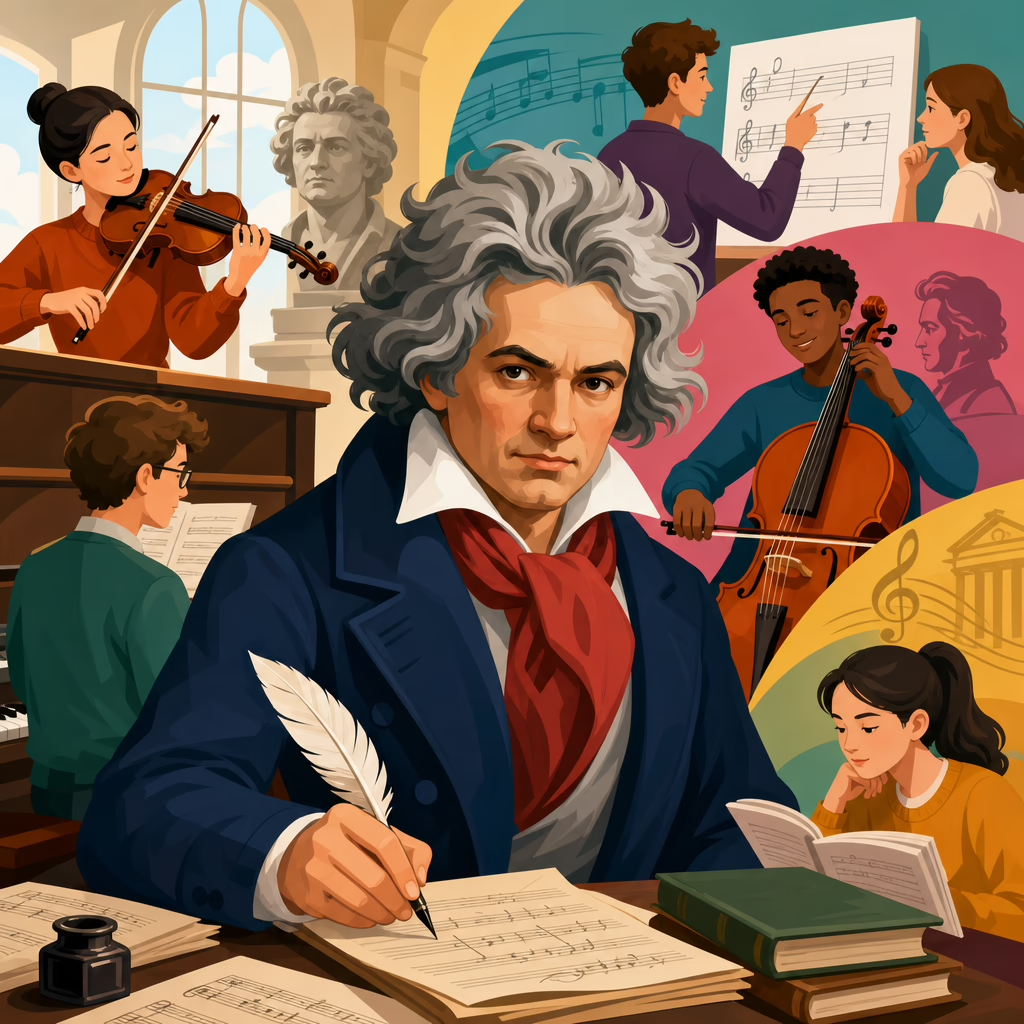
Beethoven as a Model in Conservatory Curricula
Beethoven remains one of the most durable models in conservatory curricula because his music sits at the intersection of technique, interpretation, history, and artistic identity. In teaching studios, theory classrooms, conducting seminars, and musicology programs, his works function as more than repertory; they are structured training grounds for how musicians learn to hear, analyze, practice, and communicate. When conservatories use Beethoven as a model, they are not simply celebrating a famous composer. They are using a body of work that exposes students to formal design, motivic development, harmonic tension, pianistic and orchestral problem solving, chamber collaboration, and the practical challenge of turning notation into conviction.
The phrase conservatory curricula refers to the organized course of study in professional music training, including private lessons, ensemble work, keyboard studies, ear training, music theory, history, analysis, composition, conducting, and performance practice. A hub article on this topic must therefore address miscellaneous uses of Beethoven across departments, because his influence is not confined to a single discipline. In my experience working with students preparing juries, auditions, lecture recitals, and orchestral excerpts, Beethoven appears again and again as the benchmark by which seriousness, style awareness, and musical maturity are judged.
This matters for three reasons. First, Beethoven’s music is difficult in ways that reveal a student’s real level. A performer cannot hide weak rhythm, unclear structure, shallow articulation, or undeveloped tone in a Beethoven sonata or quartet. Second, his output links Classical models to Romantic expansion, making it ideal for teaching stylistic transition rather than isolated periods. Third, conservatories need shared reference points. When faculty members from piano, strings, winds, conducting, and theory all discuss Beethoven, they can align expectations around phrasing, form, balance, and expressive responsibility. That makes Beethoven not just historically important, but institutionally useful as a common language.
Why Beethoven Anchors Core Conservatory Training
Beethoven anchors core conservatory training because his catalog offers graded challenges across nearly every stage of professional development. Early undergraduate pianists may encounter selected sonatas such as Op. 14 or Op. 49 to learn clarity of texture and proportion. More advanced students move into Op. 31, Op. 57, Op. 81a, or the late sonatas, where continuity, voicing, and large-scale architecture become central issues. String players meet Beethoven through sonatas, quartets, and symphonies that demand exact rhythmic agreement and mature ensemble listening. Conductors study him because balance, tempo relationships, and transition management become immediately audible in Beethoven’s orchestral writing.
His usefulness also comes from transparency. In heavily pedaled or densely orchestrated repertory, students can sometimes create an impression of effect without solving the underlying musical problem. Beethoven usually refuses that shortcut. The opening of the “Pathétique” Sonata makes rhythmic character, register, and harmonic pacing explicit. The first movement of the Fifth Symphony exposes pulse control and motivic cohesion within seconds. The slow movement of the Seventh Symphony tests whether a performer can sustain line without sentimentality. Faculty choose Beethoven because the music reveals whether the student understands structure from the inside or is merely producing surface gestures.
Another reason Beethoven remains central is the quality of the source materials and scholarly discussion around them. Students can compare urtext editions from Henle, Bärenreiter, and Wiener Urtext, examine autograph issues, and discuss editorial decisions with real evidence. That supports rigorous training in notation literacy and historical judgment. Conservatories need repertory that can sustain repeated study from freshman year through doctoral seminars. Beethoven does exactly that.
Beethoven in Performance, Technique, and Jury Repertoire
In performance curricula, Beethoven is often the repertory through which juries and recitals evaluate musical fundamentals. Piano departments use his sonatas because they expose touch, balance, voicing, tempo stability, articulation, and formal pacing. A student who can shape the transition to the recapitulation in Op. 10 No. 3 or maintain the long harmonic span of Op. 110 demonstrates more than finger facility. The faculty hears command of syntax. For string players, the violin sonatas and cello sonatas test partnership, not solo display alone. Wind players encounter Beethoven in symphonic excerpts where precision, breath planning, and classical restraint matter as much as brilliance.
Beethoven also teaches technique through musical purpose. Scales, arpeggios, repeated chords, trills, sforzando attacks, and octave writing appear constantly, but rarely as empty patterns. In lessons, I have found that students improve faster when technical drills are tied directly to Beethoven passages. The repeated-note energy in the “Waldstein,” the left-hand control in Op. 111, or the offbeat articulation in the Fourth Piano Concerto provide context that abstract exercises cannot. The same applies in strings, where bow distribution and articulation become concrete through quartet writing, or in conducting, where upbeat preparation and cueing are sharpened through Beethoven’s sudden dynamic turns.
Because Beethoven is common jury repertory, conservatories also use him to standardize assessment. Faculty can disagree about interpretive taste, but they usually agree on whether phrase rhythm is coherent, whether inner voices are audible, whether cadences land convincingly, and whether transitions are structurally understood. That shared evaluative framework is valuable in professional training.
How Theory, Analysis, and Aural Skills Use Beethoven
Theory and analysis courses rely on Beethoven because his music demonstrates textbook concepts while also challenging simplistic rules. Students can identify sentence and period structures, sonata form, variation technique, enharmonic reinterpretation, fragmentation, and tonic-dominant relationships, yet they also see how a major composer bends conventions for expressive effect. A classroom discussion of the first movement of the “Eroica” can address form, harmony, orchestration, and rhetoric at once. The opening of the “Moonlight” Sonata can launch analysis of texture and pedal implication, while the Diabelli Variations introduce transformational listening and character contrast at an advanced level.
Aural skills teachers use Beethoven because his motifs are memorable and structurally active. Dictation exercises based on his themes help students hear intervallic identity, rhythmic motive, sequence, and cadential closure. The famous four-note idea from the Fifth Symphony is not just iconic; it is pedagogically efficient because it illustrates economy and development. Students hear how a tiny cell generates a movement. That lesson is foundational for performers and composers alike. In score reading classes, Beethoven piano reductions and quartet textures train students to track multiple voices without losing the larger trajectory.
Importantly, Beethoven helps students answer a practical question: how does analysis improve performance? When a pianist understands why a deceptive motion delays arrival, phrasing becomes more convincing. When a quartet recognizes which voice carries the motivic thread, balance decisions become easier. Conservatories value Beethoven because he turns analysis into audible results.
Beethoven Across Departments and Professional Skills
One reason this miscellaneous hub matters is that Beethoven functions across departments, not only in performance majors. Composers study him for motivic concentration, expansion of form, and instrumental thinking. Conductors learn rehearsal economy by working on Beethoven symphonies, where articulation, hierarchy of beats, and sectional dialogue must be clarified quickly. Music historians use Beethoven to discuss patronage, publication, public concert life, deafness, authorship, and the changing status of the composer in early nineteenth-century Europe. Collaborative pianists study him because balance with strings and singers requires style awareness and disciplined pedaling.
Even courses in career preparation and audition strategy often include Beethoven. Orchestra auditions regularly require excerpts from the Third, Fifth, Seventh, and Ninth Symphonies, along with overtures such as Leonore or Coriolan. Chamber music residencies, summer festivals, and graduate auditions frequently expect a Beethoven work on the repertory list because it signals seriousness and stylistic grounding. Students therefore encounter Beethoven not just as an academic requirement but as a professional necessity. When faculty assign him, they are often preparing students for the real gatekeeping mechanisms of the field.
Beethoven also supports interdisciplinary teaching. A seminar on hearing science may discuss his deafness alongside modern understanding of hearing loss and adaptive musicianship. A class on notation and editing may compare manuscript, first edition, and urtext readings. A humanities elective can place the Ninth Symphony within debates about freedom, politics, and cultural memory. Few composers offer that range.
Common Curricular Uses of Beethoven by Area
| Area | Typical Beethoven Material | Main Skill Developed | Concrete Conservatory Use |
|---|---|---|---|
| Piano | Sonatas Op. 10, Op. 31, Op. 57, Op. 110 | Voicing, form, pedaling, structural pacing | Juries, degree recitals, studio classes |
| Strings | Violin sonatas, cello sonatas, quartets | Ensemble coordination, bow articulation, dialogue | Chamber coaching and partner rehearsals |
| Orchestra | Symphonies Nos. 3, 5, 7, 9 | Section precision, balance, excerpt mastery | Excerpt classes and audition preparation |
| Conducting | Symphonies and overtures | Beat clarity, transition control, rehearsal planning | Score study and podium labs |
| Theory and Aural Skills | Sonata movements, variations, motivic passages | Formal hearing, harmonic analysis, dictation | Analysis papers and listening exams |
| History and Musicology | Letters, editions, reception history | Contextual reading, source criticism, canon studies | Seminars and research projects |
Benefits, Limits, and Current Debates in Using Beethoven as a Model
Using Beethoven as a model has clear benefits, but conservatories also have to handle the limitations intelligently. The benefits are substantial. His music provides a shared standard, deep scholarly infrastructure, and repertory that connects technical training to artistic meaning. Students who work seriously on Beethoven usually improve in rhythm, texture, proportion, and interpretive discipline. The repertory also creates continuity: a student may first meet Beethoven in a simple sonata movement, then later in a full concerto, string quartet, or dissertation topic. That longitudinal value is rare.
At the same time, no conservatory should let Beethoven crowd out other traditions. A curriculum dominated by a single canonical figure can narrow stylistic imagination, reinforce outdated hierarchies, and underrepresent women composers, non-European traditions, living composers, and vernacular practices. The strongest programs now teach Beethoven as a model, not as the only model. That means placing him alongside Haydn and Mozart for classical syntax, Schubert and Brahms for long-line development, Chopin and Liszt for piano color, Bartók and Shostakovich for rhythmic edge, and Florence Price, William Grant Still, Unsuk Chin, Kaija Saariaho, and others for broader historical and aesthetic perspective.
There is also the issue of performance practice. Beethoven should not be taught through one inherited tradition alone. Conservatories increasingly encourage students to compare modern concert grand performance with fortepiano evidence, reduced vibrato approaches in certain contexts, eighteenth- and early nineteenth-century articulation concepts, and historically informed tempo debates. The metronome markings remain controversial, and students should know why. A mature curriculum treats Beethoven as a living field of inquiry, not a museum object.
For conservatories, the best use of Beethoven is practical, expansive, and honest. His music remains one of the finest tools for teaching how musicians think, listen, rehearse, analyze, and perform under pressure. It gives students a demanding but coherent path from technical control to interpretive responsibility. Because the repertory is shared across studios and disciplines, it helps institutions build common standards without reducing music training to mechanical assessment. That is why Beethoven continues to matter in curricula focused on future generations: he trains habits of attention that transfer far beyond his own works.
The most effective programs treat this hub topic as a gateway. From here, students and readers can move into related studies on Beethoven in piano pedagogy, chamber music coaching, orchestral audition culture, score analysis, conducting instruction, historical performance, and canon debates. Each of those areas reveals a different reason his influence persists. Taken together, they show that Beethoven’s place in conservatory curricula is not simply inherited prestige. It is sustained by utility, depth, and the unusual capacity of the music to expose both weakness and growth.
If you are shaping a syllabus, preparing auditions, or building a broader understanding of Beethoven’s influence on future generations, start by mapping where his works intersect with actual learning outcomes. Choose pieces that teach specific skills, compare editions and recordings, and connect Beethoven study with a wider repertory rather than isolating it. That approach preserves what is strongest about the tradition while keeping the curriculum responsive, rigorous, and relevant.
Frequently Asked Questions
Why is Beethoven such a central model in conservatory curricula?
Beethoven holds a central place in conservatory education because his music brings together nearly every major area of professional musical training in one body of work. Students encounter technical demands, formal design, harmonic logic, rhythmic control, expressive range, and historical awareness all at once. His sonatas, quartets, symphonies, concertos, and smaller keyboard works do not function merely as canonical pieces to be admired; they serve as practical laboratories in which developing musicians learn how structure and expression interact. A pianist can study voicing, articulation, tempo relationships, and long-range architecture in a Beethoven sonata, while a theory student can examine motivic development, tonal planning, and phrase expansion in the same score. This overlap makes his music especially useful in institutions that aim to connect performance, analysis, and historical understanding rather than teach them as isolated subjects.
Another reason Beethoven remains durable in conservatory curricula is that his music asks students to make interpretive decisions rather than simply reproduce surface effects. The notation is precise, but the expressive stakes are high, which means performers must learn to justify choices about timing, dynamics, pedaling, balance, articulation, and character. That process teaches artistic responsibility. Beethoven also occupies an important historical position: he links Classical procedures with later Romantic expectations, allowing students to understand continuity and change across styles. In that sense, using Beethoven as a model is not only about preserving tradition. It is about training musicians to hear deeply, think structurally, and communicate convincingly through repertory that rewards both discipline and imagination.
How do conservatories use Beethoven’s music to teach technique and interpretation at the same time?
One of the strongest pedagogical advantages of Beethoven’s music is that technical work and interpretive work cannot easily be separated. In many pieces, technique exists in direct service of musical argument. A passage of repeated chords may seem like a physical exercise at first, but it quickly becomes a study in tension, accent hierarchy, harmonic direction, and orchestral sonority at the keyboard. Fast scales, abrupt dynamic contrasts, wide registral shifts, and sharply profiled articulations all require physical command, yet they also shape character and form. For that reason, teachers often use Beethoven to help students move beyond the idea that technique is merely mechanical. The real goal is controlled, intentional sound that reflects the meaning of the passage.
In lessons and coachings, instructors may ask students to solve technical problems by tracing phrase goals, harmonic rhythm, motivic emphasis, or dramatic pacing. A difficult left-hand accompaniment pattern, for example, becomes easier and more convincing when the student understands which notes support the melodic line and which serve a lighter structural role. Likewise, decisions about bow distribution, breath pacing, pedaling, or conducting gesture are guided by formal function and expressive rhetoric. Beethoven is especially effective here because his music exposes weak thinking. If rhythm is unstable, structure becomes unclear. If articulation is generalized, character collapses. If tempo lacks internal logic, the larger arc of the movement loses force. As a result, conservatories often rely on Beethoven to teach students that mature interpretation is built from disciplined technical choices shaped by analytical and historical awareness.
What makes Beethoven especially valuable in theory, analysis, and musicology courses?
Beethoven is invaluable in academic coursework because his music is rich enough to support many levels of inquiry, from introductory formal analysis to advanced research in style, aesthetics, source studies, and performance practice. In theory classrooms, his works are often used to demonstrate phrase structure, sonata form, motivic unity, harmonic expansion, thematic transformation, and the relationship between local detail and large-scale design. His music frequently presents clear models of formal expectations while also challenging them, which is ideal for teaching. Students can learn standard procedures and then observe how a master composer stretches, disrupts, or redefines those procedures for expressive purposes. This makes Beethoven especially useful for showing that analysis is not just labeling sections, but understanding how musical ideas generate momentum, surprise, and coherence.
In musicology, Beethoven opens broader questions about canon formation, authorship, reception history, patronage, performance culture, and the development of the composer as a public artistic figure. His career sits at a crucial historical moment when changing social structures affected how music was composed, published, performed, and discussed. That allows students to place scores within larger cultural frameworks rather than treating them as self-contained masterpieces. Musicology courses may examine early editions, sketchbooks, critical reception, and evolving myths about artistic genius, all of which help students understand how Beethoven’s reputation was built and why it has remained so powerful. In this way, Beethoven serves not only as a composer to analyze, but also as a case study in how musical value is constructed, transmitted, debated, and taught across generations.
How does studying Beethoven help young musicians develop artistic identity?
Studying Beethoven helps young musicians form artistic identity because his music demands more than technical accuracy; it requires a stance. Students cannot remain neutral for long when approaching a Beethoven work. They must decide how bold or restrained to be, how to shape continuity across contrasting ideas, how to balance rigor with spontaneity, and how to project a persuasive musical voice without distorting the score. Those decisions foster habits of artistic self-definition. In conservatory settings, where students are learning not only how to play or conduct but also how to think of themselves as musicians, Beethoven often becomes a proving ground for seriousness, conviction, and interpretive accountability.
Just as importantly, Beethoven invites students to engage with the tension between tradition and individuality. His music comes with a strong performance history, extensive scholarship, and established pedagogical expectations, so students must learn how to respect inherited knowledge while still making thoughtful personal choices. That process is foundational to artistic growth. It teaches them to ask informed questions: What does the structure suggest? What does the historical context support? What kind of sound world does this movement require? Where is flexibility appropriate, and where would it undermine the music? By working through those questions, students begin to understand artistic identity not as self-expression alone, but as the disciplined ability to unite knowledge, imagination, and communicative purpose. Beethoven remains useful in conservatories precisely because he pushes students toward that higher level of musical self-awareness.
Is there any criticism of using Beethoven so heavily in conservatory training?
Yes, and it is an important conversation. While Beethoven is undeniably a powerful pedagogical model, some educators question whether his dominance in conservatory curricula can narrow students’ sense of what counts as essential musical training. When one composer or one canon becomes the primary measure of seriousness, institutions risk reinforcing historical hierarchies that exclude other traditions, voices, and repertoires. This concern is not an argument against teaching Beethoven well; rather, it is a reminder that curricular choices carry cultural implications. Students benefit when they understand why Beethoven has been elevated, how that status developed, and what may be overlooked when his music is treated as the universal standard for musical depth, rigor, or artistic legitimacy.
Thoughtful conservatories increasingly respond by teaching Beethoven in a broader, more reflective framework. Instead of presenting him as the unquestioned summit of musical education, they position him as one influential model among many. His works can still be used to teach form, interpretation, ensemble discipline, and historical listening, but alongside repertories that illuminate different approaches to rhythm, sonority, improvisation, authorship, and musical transmission. This broader approach does not weaken Beethoven’s value; in many cases, it clarifies it. Students come to see more precisely what his music teaches, what it does not teach, and how his role in the curriculum reflects both genuine artistic merit and institutional history. In that form, Beethoven remains highly relevant—not as a symbol of unquestioned authority, but as a rich and demanding resource within a more inclusive and critically aware conservatory education.