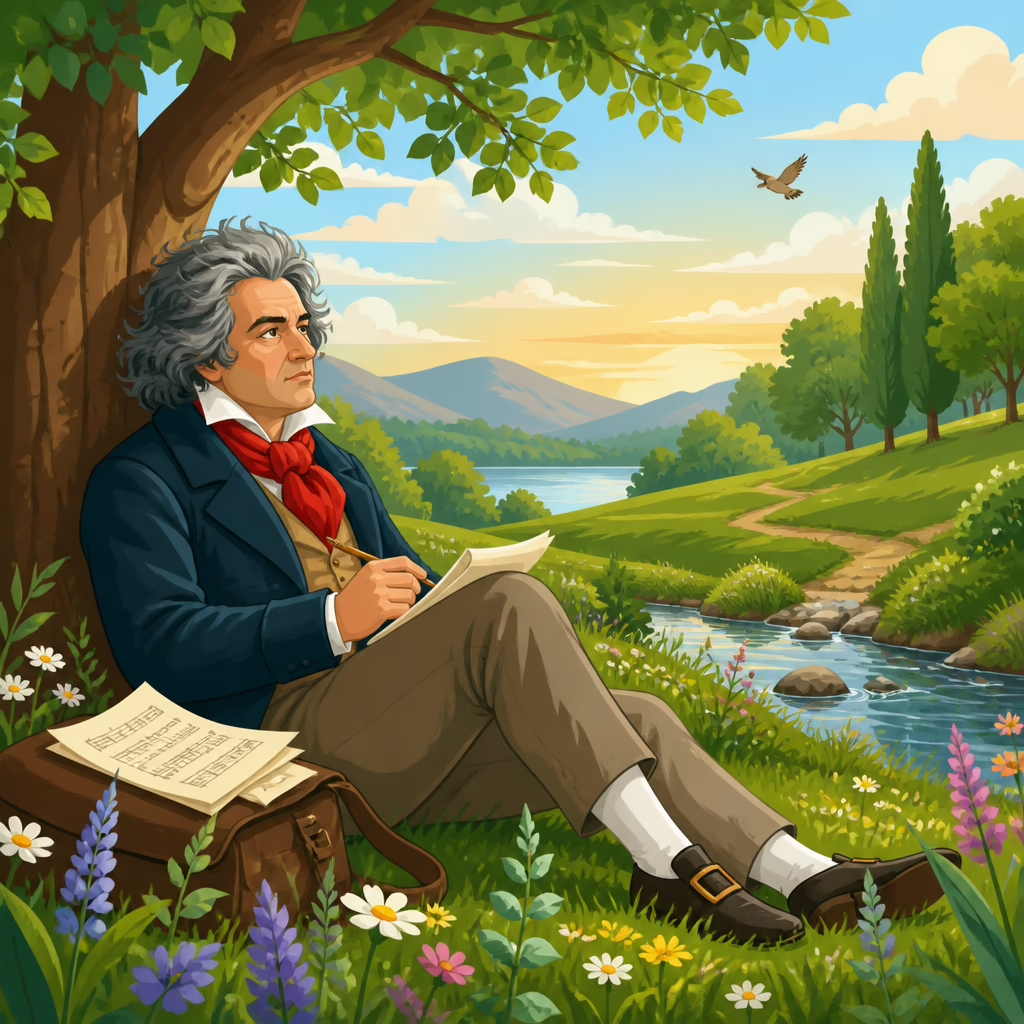
Nature as Consolation in Beethoven’s Life
Nature as consolation in Beethoven’s life was not a decorative preference or a poetic pose. It was a working refuge, a psychological necessity, and a spiritual counterweight to suffering. To understand this clearly, it helps to define consolation in Beethoven’s case as more than temporary comfort. Consolation meant restoration of inner order when pain, illness, deafness, disappointment, and social strain threatened to break concentration and hope. Nature meant fields, wooded paths, streams, changing weather, birdsong, rural silence, and the physical act of walking through them. In Beethoven’s letters, conversation books, reported habits, and music, these things appear repeatedly not as background scenery but as conditions under which he could endure life and continue creating. That matters because Beethoven’s biography is often told through struggle alone: the heroic composer overcoming fate. Yet that familiar story is incomplete. He did not survive hardship by willpower in isolation. Again and again, he turned outward to the natural world for steadiness, perspective, and renewal, and that habit shaped both his daily existence and the emotional language of his art.
When I have worked through Beethoven’s letters and the accounts of friends, one pattern becomes impossible to miss: he sought relief in movement through landscape. This was practical and deeply personal. Urban Vienna offered patronage, theaters, publishers, and social contact, but it also brought noise, obligation, and frustration. The countryside offered the opposite. There he could walk for hours, sketch musical ideas, and regain the sense of proportion that illness and conflict often destroyed. Nature gave him a place where neither social etiquette nor physical decline had the final word. It did not remove suffering. It made suffering bearable. That distinction is crucial if we want a truthful picture of Beethoven’s life rather than a sentimental one.
Why Beethoven Needed Consolation So Intensely
Beethoven’s need for consolation grew from several pressures acting at once. The most obvious was progressive hearing loss, documented from the late 1790s and confessed with devastating clarity in the 1802 Heiligenstadt Testament. Deafness threatened not only his profession but his identity, sociability, and dignity. He withdrew from conversation, misread people, and feared humiliation. On top of that came chronic gastrointestinal illness, periods of severe depression, recurring financial concerns despite success, unstable housing, family conflict, and later the exhausting custody battle over his nephew Karl. These were not occasional setbacks. They formed the climate of his adult life.
In that climate, nature became one of the few reliable means of emotional regulation available to him. Today, clinicians might speak of stress reduction, attentional recovery, or mood stabilization through contact with green space. Beethoven did not use that language, but the function is recognizable. Walking slowed agitation. Solitude reduced social strain. Open air interrupted obsessive thought. The natural environment provided sensory richness that remained accessible even as hearing diminished: wind, light, river movement, tree forms, cloud shifts, and bodily rhythm through walking. For a man whose inner life was intense to the point of volatility, this was not incidental relief. It was a stabilizing practice.
The key point is that Beethoven did not seek nature merely when inspired. He sought it when burdened. That is what makes nature a form of consolation rather than simple pleasure. Accounts of his summers outside central Vienna, especially in places such as Heiligenstadt, Döbling, Baden, and Mödling, show a repeated pattern of retreat to semi-rural settings where composition and recovery could happen together. These locations mattered because they made a different kind of daily life possible.
Walking as Beethoven’s Method of Relief
Beethoven’s walks have sometimes been romanticized, but their consoling function was concrete. He walked long distances, often carrying a notebook, and used the repetitive motion of walking to think musically and emotionally. Friends and observers described him roaming fields and forest paths, stopping to jot motifs, and returning with ideas clarified. This habit linked body and mind in a disciplined routine. Walking was not an escape from work. It was the condition that often made work possible.
That matters especially because Beethoven’s mental strain could turn inward and become destructive. The Heiligenstadt Testament shows how close he came to despair in 1802. Yet even around this crisis, his relationship with the natural surroundings of Heiligenstadt was not passive. He was there for rest prescribed by doctors, but the environment also supplied a setting in which he could continue reflecting, walking, and recommitting himself to life through art. Nature did not cure deafness. It offered enough calm and spaciousness for him to resist collapse.
Readers who want the broader context of Beethoven’s outdoor habits can trace that pattern in this pillar guide on Beethoven’s love of walking and what it meant for his music. Within the narrower question of consolation, the important point is that walking gave Beethoven repeatable relief. It imposed rhythm when his emotions felt chaotic. It replaced constricted rooms with open distances. It let difficult feelings move instead of stagnate.
| Pressure in Beethoven’s life | What nature provided | Why it consoled him |
|---|---|---|
| Progressive deafness | Reduced social demand and sensory overload | He could exist without the embarrassment of strained conversation |
| Creative blockage or fatigue | Walking routes, solitude, fresh air | Physical movement often released musical ideas and restored concentration |
| Depression and irritability | Open views, weather, seasonal change | Nature shifted attention away from obsessive inward pressure |
| Urban stress in Vienna | Rural lodgings in Heiligenstadt, Baden, and nearby villages | The countryside made a calmer daily routine possible |
| Family and legal conflict | Temporary withdrawal into landscape | Distance gave emotional breathing room, even when problems remained unresolved |
The Heiligenstadt Crisis and the Restorative Landscape
No episode reveals the meaning of consolation more sharply than Heiligenstadt in 1802. Beethoven went there partly on medical advice, hoping rural quiet might help his hearing and general health. It did not reverse the condition, and he knew that. What Heiligenstadt did provide was the setting for a profound confrontation with despair. In the Testament, addressed to his brothers though never sent in his lifetime, he described isolation, shame, and suicidal thoughts. He also explained why he chose to continue living: art held him back.
Nature’s role here should be described carefully. The countryside did not deliver a sudden conversion scene. Instead, it formed the physical environment in which Beethoven could endure introspection without being crushed by it. Rural distance, paths for walking, and separation from urban performance life gave him room to think through catastrophe. The result was not serenity in a simple sense. It was recommitment. Consolation, in this context, meant enough peace to continue bearing what could not be changed.
This distinction guards against cliché. Beethoven was not consoled because birds and trees made him forget suffering. He was consoled because the natural world offered order without argument. Seasons turned, streams moved, light changed, and living patterns continued beyond his private anguish. For someone facing permanent hearing loss, that continuity mattered. It suggested a reality larger than personal ruin. The fact that this perception later informed works associated with pastoral feeling is significant, but the biographical foundation comes first: he found in nature a model of endurance.
Country Summers, Rural Lodgings, and Daily Survival
Beethoven’s repeated summer stays outside Vienna were not simply fashionable retreats. They were part of how he managed life. Composers, aristocrats, and professionals often left the city during warm months, but Beethoven’s attachment to these environments had unusual intensity. In Baden, for example, he could combine therapeutic bathing culture, relative quiet, and access to surrounding countryside. In villages on Vienna’s edge, he rented rooms that brought him closer to fields, vineyards, and woodland paths than urban apartments allowed.
These moves mattered because Beethoven’s working life depended on modulation of stress. He needed intervals away from social performance, teaching obligations, and the friction of crowded living. Rural settings lowered those pressures. Reports of him striding through the landscape, hat on, notebook in hand, fit what many creators know from experience: certain environments are not luxuries but supports for functioning. Beethoven’s letters sometimes praise trees, valleys, and the country with direct warmth. Such expressions are credible precisely because they align with habit. He went back repeatedly because these places helped him live.
There is also an economic and practical side to this consolation. Country lodgings could be cheaper, healthier, and more spacious than city quarters. Fresh air was widely valued in early nineteenth-century medicine, even if theories of disease were incomplete. For a man with chronic stomach trouble, fluctuating mood, and auditory distress, the countryside represented a reasonable health strategy by the standards of the time. Consolation was therefore emotional, artistic, and bodily at once.
How Nature Entered Beethoven’s Inner World
Beethoven’s consoling bond with nature was not limited to direct observation. It became an inner resource he could carry back into more difficult settings. This is one reason his response to landscape should not be reduced to tourism or picturesque taste. He internalized natural processes as emotional structures. Calm after turbulence, growth from small beginnings, repetition with variation, and spacious unfolding all have analogues in his musical thinking. Such patterns did not arise only from nature, but nature reinforced them in lived experience.
The clearest example is the Sixth Symphony, the “Pastoral,” completed in 1808. Beethoven explicitly stated that the work was “more an expression of feeling than painting,” a crucial remark. He was not trying to imitate a brook in a merely descriptive way. He was translating the emotional effect of being in the countryside: arrival, ease, gratitude, storm, recovery. That sequence mirrors consolation. The symphony gives listeners not a postcard of rural life but a dramatized experience of distress passing into restored balance.
Even outside the “Pastoral,” many Beethoven works reveal a mind that trusted renewal after darkness. It would be simplistic to claim every such gesture came from walking outdoors, yet his documented reliance on nature makes that source impossible to ignore. Consolation became part of his artistic language because it was part of his survival. He composed from within struggle, but he also composed from practices that made struggle inhabitable.
What Nature Could Not Solve
A balanced account must acknowledge limits. Nature did not make Beethoven easy to live with, free from anger, or safe from collapse. He remained capable of suspicion, abruptness, and emotional extremes. His health worsened over time. His hearing deteriorated irreversibly. The conflict over Karl brought years of agitation that no country walk could settle. If we overstate nature’s healing power, we lose the truth of Beethoven’s predicament.
Yet limitations do not weaken the case for consolation. They clarify it. Consolation is valuable precisely because it falls short of cure. Beethoven did not need an idyllic myth. He needed places and habits that gave him enough strength to continue. Nature did that repeatedly. It offered reprieve, not perfection; orientation, not rescue from every consequence of illness and temperament.
That realism is useful today because it prevents sentimental misuse of Beethoven’s example. Contact with the natural world can steady a person under strain, but it does not erase structural problems, medical conditions, or grief. Beethoven’s life shows a more credible lesson: sustained engagement with landscape can support endurance, deepen self-command, and preserve creative energy when circumstances remain hard.
Why This Consolation Still Matters
Nature as consolation in Beethoven’s life still matters because it corrects a distorted image of genius. Great work did not emerge from suffering alone. It emerged from suffering managed through disciplined habits, chosen environments, and repeated returns to sources of inward steadiness. Beethoven’s walks, rural summers, and love of open country were not charming side notes. They were part of the machinery of survival.
Seen this way, Beethoven becomes more human and more instructive. He did what many resilient people do: he built recovery into routine. He recognized, whether instinctively or consciously, that the mind cannot remain under relentless pressure and still produce its best work. Nature gave him silence without emptiness, solitude without total isolation, and order without demand. That combination is rare, and he relied on it.
The main takeaway is simple. If you want to understand Beethoven’s endurance, look beyond the drama of fate and into the fields, paths, trees, and village edges where he repeatedly restored himself. Nature did not stand outside his life’s struggle. It answered it. Read his biography with that in view, listen to the emotional logic of the “Pastoral,” and the pattern becomes unmistakable. Consolation was not abstract. It was walked, breathed, and lived. That is the perspective worth carrying forward.
Frequently Asked Questions
Why was nature so important to Beethoven personally?
Nature mattered to Beethoven because it gave him something far deeper than pleasant scenery. In his life, nature functioned as a place of recovery when physical suffering, emotional disappointment, and increasing deafness threatened his balance. He did not turn to the countryside simply because it was fashionable or because pastoral imagery appealed to him aesthetically. He relied on it as a living refuge. Walks through fields, wooded paths, and rural surroundings helped him regain concentration, calm agitation, and reassemble his inner life when it felt under siege.
For Beethoven, consolation meant restoration rather than distraction. Nature helped restore order to the mind. It offered rhythm, movement, silence, and spaciousness at a time when his personal circumstances often felt constricting. The regularity of flowing water, wind, birdsong, and seasonal change stood in contrast to the instability of illness and the social frustrations he frequently endured. In that sense, nature was not peripheral to his life. It was one of the conditions that allowed him to endure suffering without surrendering to it.
How did nature console Beethoven during his struggles with deafness?
Beethoven’s deafness was not only a medical condition; it was a profound emotional and professional crisis. For a composer and pianist, losing hearing threatened identity, livelihood, and human connection all at once. Nature became consoling because it remained available to him as a realm of presence even as social and musical life grew more difficult. The countryside offered a kind of companionship that did not depend on conversation, explanation, or the embarrassment he often felt in public because of his hearing loss.
Even as deafness advanced, nature retained spiritual and imaginative force. It gave Beethoven space to think, to walk, and to remain in contact with forms of life larger than his own pain. Consolation here did not mean that nature erased suffering. Rather, it provided a setting in which suffering could be borne. The natural world suggested endurance, continuity, and order beyond individual misfortune. That perspective was powerful for Beethoven. It helped counter despair by reminding him that life still contained beauty, movement, and meaning, even when his own circumstances had become deeply painful.
Did Beethoven’s love of nature influence his music?
Yes, very clearly, but not in a superficial or merely descriptive way. Beethoven’s engagement with nature shaped both the emotional atmosphere and the deeper structure of some of his music. He is often associated with the “Pastoral” Symphony, which is the most obvious example, but the significance of nature in his work goes beyond one composition. Natural experience informed his sense of renewal, contrast, spaciousness, and emotional release. He did not simply imitate birds or storms for novelty. He translated the experience of being restored by the natural world into musical form.
What makes this influence especially important is that Beethoven himself understood the difference between depiction and feeling. In works connected to pastoral life, the point is not just to paint a rural scene but to communicate the emotional effect of that scene on the human spirit. Nature in his music often appears as a force of rebalancing, gratitude, and recovered vitality. That mirrors its role in his life. The same landscapes that calmed him, clarified his thoughts, and strengthened him also provided a model for musical expression rooted in resilience, wonder, and inward peace.
Was Beethoven’s relationship with nature religious or spiritual?
It was certainly spiritual, though not always in a narrow doctrinal sense. Beethoven often experienced nature as a place where the human mind could encounter something ordered, elevated, and morally serious. For him, the natural world was not empty background. It was charged with significance. Fields, trees, streams, and open air could evoke gratitude, humility, and a sense of connection to a reality greater than immediate suffering. That helps explain why nature brought him not only rest but dignity and hope.
This spiritual dimension is important because it shows that consolation in Beethoven’s life was not just emotional soothing. Nature could awaken a sense of harmony between the self and the larger order of existence. In moments when illness, frustration, and isolation threatened to reduce life to pain, the natural world suggested permanence and coherence. It allowed Beethoven to feel that suffering was real but not ultimate. That is one reason nature remained so powerful for him. It offered not escape from reality, but a deeper reality within which pain could be placed and endured.
Why is it misleading to treat Beethoven’s love of nature as a simple Romantic cliché?
It is misleading because it reduces a serious human necessity to literary decoration. Beethoven’s attachment to nature was not a borrowed posture meant to make him appear sensitive, artistic, or fashionable. While Romantic culture certainly valued nature, Beethoven’s connection to it was intensely practical, personal, and rooted in daily survival. He walked for relief, for clarity, for compositional thought, and for emotional preservation. Nature was one of the few environments in which he could reestablish equilibrium when his body and circumstances became overwhelming.
Calling it a cliché also misses the severity of what he was facing. Beethoven dealt with chronic illness, social tensions, disappointment in relationships, and the devastating progression of deafness. In that context, the consoling role of nature takes on greater seriousness. It was not a symbolic accessory to genius. It was a working refuge and a psychological counterweight to despair. Understanding this gives a more accurate picture of Beethoven himself: not an abstract hero communing poetically with landscapes, but a suffering, disciplined artist who found in nature one of the strongest supports for endurance, creativity, and inner restoration.