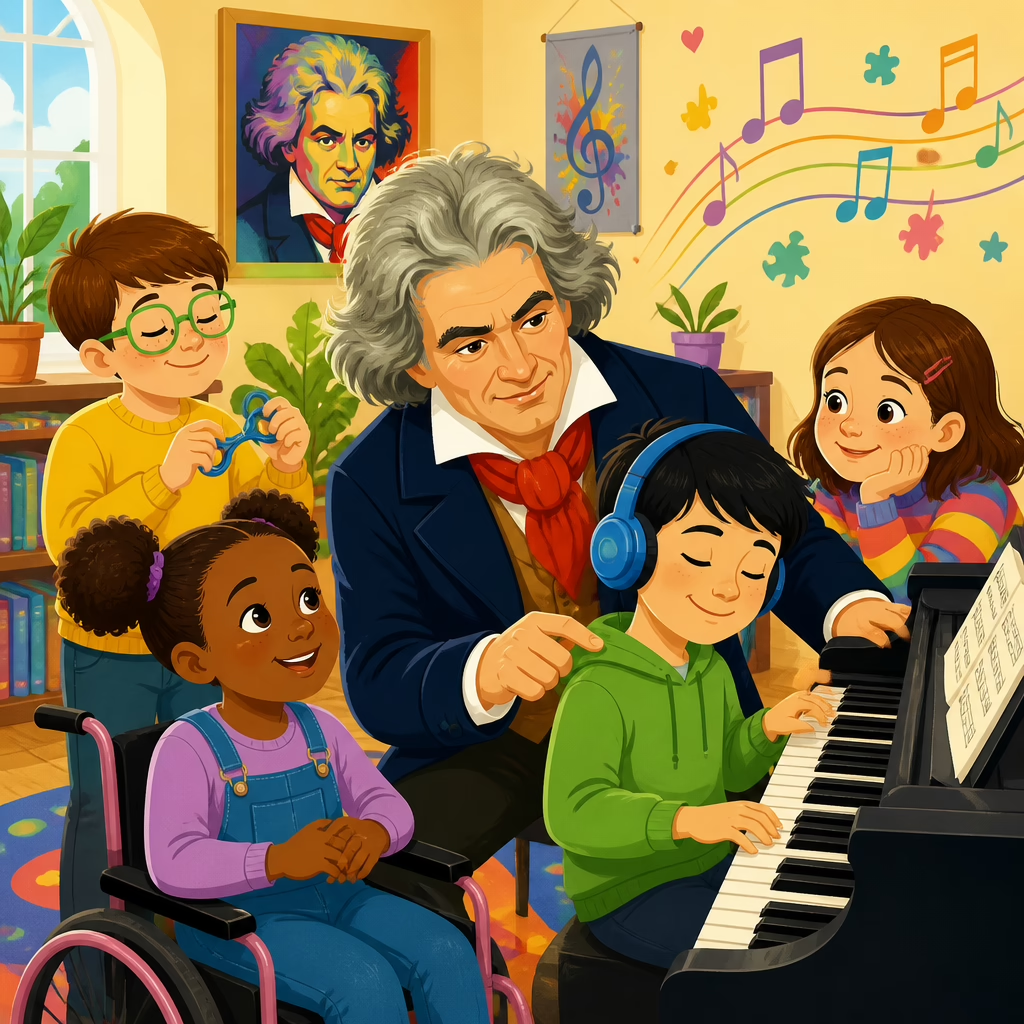
Inclusive Beethoven Teaching for Neurodiverse Learners
Inclusive Beethoven teaching for neurodiverse learners starts with one practical truth: students do not need to fit a single instructional mold to understand Beethoven’s music, and teachers should not expect them to. In classrooms, studios, and mixed-age community settings, I have seen students with ADHD, autism, dyslexia, dyspraxia, sensory processing differences, and anxiety respond strongly to Beethoven when lessons are built around predictability, choice, movement, and meaningful listening. Neurodiverse learners are students whose brains process attention, language, sensory input, memory, social cues, or motor planning in varied ways. Inclusive teaching means designing instruction so those differences are expected from the start, rather than treated as problems to fix after a lesson fails.
That matters because Beethoven is often introduced through long explanations, dense notation, and historical reverence that can shut students out before curiosity has a chance to grow. Yet his music offers exactly the kind of clear contrast many learners need: obvious rhythmic motives, dramatic dynamics, repeated patterns, emotional storytelling, and recognizable themes such as the opening of Symphony No. 5 or “Ode to Joy” from Symphony No. 9. When I adapt Beethoven lessons effectively, engagement rises fast. Students who struggle with sustained lecture often focus when a four-note motive becomes a body percussion pattern. Students who avoid writing often contribute sophisticated ideas through drawing, speaking, tapping, or arranging visual icons. Inclusion here is not dilution. It is precise lesson design that preserves musical rigor while widening access.
For Beethoven teaching, key terms should be clear. Neurodiversity is the idea that neurological differences are normal forms of human variation. Accommodations are changes that help a student access the same learning goal, such as extra processing time or reduced visual clutter. Modifications change the task itself, such as simplifying a notation-reading demand when the goal is listening analysis. Universal design means planning multiple entry points in advance, including spoken directions, visual cues, movement, and structured choice. These distinctions help teachers stay focused on the real objective: understanding Beethoven through listening, creating, performing, and reflecting, not merely completing a conventional worksheet.
Good inclusive practice also protects artistic integrity. Beethoven’s music is not made “easier” by stripping away complexity; it becomes teachable when complexity is sequenced. A student can notice tension and release in the “Moonlight” Sonata without first decoding every Italian term. A learner can compare the heroic profile of Symphony No. 3 with the intimacy of “Für Elise” using image cards, tempo words, and guided listening maps. Once access improves, content knowledge follows. That is why inclusive Beethoven teaching belongs at the center of community and education work: it helps more students participate fully in a shared musical culture while building attention, confidence, communication, and critical listening.
Start with learner profiles, not assumptions
The strongest inclusive Beethoven lessons begin before the music starts. I plan from learner profiles, not labels. Two students with the same diagnosis may need completely different supports. One autistic student may crave detailed historical context and pattern analysis; another may need minimal verbal input and a calm listening environment. A student with ADHD may thrive in fast transitions and active response tasks, while another needs a visual schedule to reduce task-switching stress. The practical step is to identify barriers across five domains: attention, language processing, sensory regulation, executive function, and motor output. Then match those barriers to instructional choices.
For example, if sustained attention is a challenge, use short listening excerpts of thirty to ninety seconds, each with one clear focus: rhythm, mood, instrument family, or dynamic contrast. If receptive language is the barrier, reduce spoken directions and pair them with icons, gesture, and modeled examples. If fine motor output limits written work, offer alternatives such as magnetic phrase cards, verbal response, digital drag-and-drop sequencing, or movement-based demonstrating. I have found that lesson planning improves when the question shifts from “Can this student handle Beethoven?” to “What format lets this student show musical understanding accurately?”
This approach also prevents a common error: confusing compliance with learning. A quiet student staring at a worksheet may not be processing the music, while a student bouncing lightly and humming the motive may be deeply engaged. Inclusive practice requires observable success criteria. Can the student identify recurring motifs? Can the student distinguish loud from soft, stable from unstable, major from minor, fast from slow? Can the student connect a listening choice to an emotional effect? Those outcomes matter more than whether the response was spoken, written, drawn, or enacted.
Use Beethoven’s musical features as access points
Beethoven is especially teachable for neurodiverse learners because his music often foregrounds pattern, contrast, and narrative momentum. The famous short-short-short-long motive from Symphony No. 5 is ideal for students who benefit from chunking. Instead of introducing the entire movement at once, isolate the motive and let students clap it, step it, point to a visual rhythm strip, or find it in repeated listening. This creates an anchor. Once students recognize the motive, they can track how Beethoven transforms it across the piece, which supports higher-order listening without overwhelming working memory.
Dynamic contrast is another strong access point. Many learners who struggle with abstract terminology respond quickly when crescendos and sudden accents are paired with visual metaphors such as growing lines, expanding shapes, or color shifts. In the “Pathétique” Sonata, teachers can map dramatic changes with simple visual contours before introducing formal terms. In “Für Elise,” the recurring A section helps students predict return points, which lowers anxiety and strengthens listening stamina. Predictable recurrence is not trivial; for many neurodiverse students, predictability frees cognitive energy for expression and analysis.
Emotional storytelling also matters. Beethoven’s music is useful because it invites interpretation without requiring one “correct” narrative. A student can describe the opening of Symphony No. 7, Allegretto, as footsteps, a march, fog, or determination, as long as the description is tied to audible features. This lowers the language barrier while preserving evidence-based thinking. I ask, “What did you hear that made you say that?” That single prompt builds listening discipline and validates diverse communication styles.
Design lessons with structure, choice, and sensory regulation
Inclusive Beethoven teaching works best when lesson architecture is visible. A simple sequence such as warm-up, first listen, guided response, active music-making, second listen, and reflection reduces uncertainty. Visual schedules are effective for elementary classes, private lessons, and community groups because they clarify beginnings, transitions, and endings. For students with anxiety or executive function difficulties, knowing the order of events can be the difference between participation and shutdown.
Choice should be limited but genuine. Instead of asking, “How do you want to respond to this piece?” offer two or three options aligned to the same objective: draw the shape of the melody, arrange dynamic cards, or perform the rhythm on a drum pad. This is not lowering expectations; it is separating the musical target from a single response mode. I use this routinely with Beethoven listening tasks, especially when introducing denser textures that may overwhelm students if every demand arrives at once.
Sensory regulation deserves equal planning. Recordings of Beethoven can contain sharp dynamic shifts, especially in symphonic excerpts. Some students need advance warning before a loud entrance, lower volume, noise-reducing headphones between activities, or seating away from speakers. Others regulate best through movement. A steady beat walk during “Ode to Joy” can improve attention more effectively than repeated reminders to sit still. If a learner seeks pressure or tactile input, rhythm sticks, a lap pad, or chair push-ups before listening may improve readiness. None of these supports are extras. They are part of making the musical experience usable.
| Teaching goal | Common barrier | Inclusive Beethoven strategy |
|---|---|---|
| Recognize a motif | Auditory overload | Use a ten-second excerpt, visual rhythm strip, and repeated call-and-response clapping |
| Describe musical mood | Expressive language difficulty | Offer emotion cards, image choices, and sentence starters tied to audible evidence |
| Follow form | Executive function weakness | Provide a color-coded listening map showing return sections and transitions |
| Perform rhythm | Motor planning challenge | Allow tapping on knees, large-arm conducting, or digital pad input instead of notation writing |
| Compare two works | Working memory limits | Play short paired excerpts with a side-by-side visual checklist of tempo, dynamics, and texture |
Teach history and biography without creating unnecessary barriers
Beethoven’s life story can motivate students, but it must be handled carefully. Teachers often overload lessons with dates, patronage systems, and stylistic chronology before students have any sensory connection to the music. For neurodiverse learners, that can obscure relevance. Start with one human-scale fact linked directly to the listening task. For example: Beethoven expanded musical drama through stronger contrasts; now listen for sudden changes in loudness and character. Or: Beethoven continued composing after profound hearing loss; now notice how vividly he shapes inner rhythm and tension. Biography should illuminate the sound, not compete with it.
It is also important to avoid using deafness or disability as simplistic inspiration messaging. Beethoven’s hearing loss is historically significant, but presenting it as a moral lesson about “overcoming” can alienate disabled students and flatten the complexity of his experience. A more respectful approach is factual and nuanced: his hearing loss progressed over time, affected his performing and social life, and changed how he worked. Students can understand that musicians create under constraints, and that artistry often involves adaptation, persistence, and support systems. This framing connects authentically with neurodiverse learners who already know that access matters.
When you need curricular support for age-appropriate sequencing, adaptable activities, and broader classroom context, use resources that can be modified rather than followed rigidly. A strong starting point is Beethoven lesson plans for elementary music classes, then refine each activity around learner needs, response options, and sensory demands. The principle is simple: materials are tools, not scripts.
Assess understanding through multiple forms of evidence
Assessment is where inclusive intention often breaks down. Teachers may offer engaging supports during instruction, then require every student to prove learning through dense writing or formal notation. That mismatch hides real understanding. In Beethoven teaching, assessment should align to the musical objective and allow multiple valid outputs. If the goal is identifying rondo-like return, a student can point to section cards, raise a colored token when the theme returns, or sequence audio clips. If the goal is expressive interpretation, the student might select adjectives, choose matching artwork, improvise movement, or explain verbally with teacher prompting.
Rubrics help maintain rigor. I use criteria such as accuracy of motif recognition, use of listening evidence, ability to compare contrasts, and consistency in following form. These can be applied across response modes. A spoken response is not inherently easier than a written one if both must include precise musical evidence. In fact, some students demonstrate more sophisticated thinking when freed from transcription demands. This is especially true for students with dysgraphia, language retrieval challenges, or slow processing speed.
Technology can support fair assessment when used deliberately. Tools like Google Slides for drag-and-drop form maps, Seesaw for audio reflection, and interactive whiteboards for collective annotation reduce motor barriers and preserve student thinking. However, digital tools are not automatically inclusive. Too many on-screen choices, autoplay sounds, or cluttered layouts can increase cognitive load. Keep interfaces simple, with one task visible at a time and clear visual contrast. The best assessment feels calm, direct, and closely tied to what students actually heard in Beethoven’s music.
Build belonging through ensemble norms and family communication
Inclusion is not only about task design; it is also about social climate. Neurodiverse learners participate more fully when group norms make different response styles ordinary. In Beethoven activities, I explicitly teach that listening can look different: some students look at the speaker, some track a map, some tap quietly, some need a fidget to focus. I also normalize rehearsal supports such as countdowns before loud entries, posted cues, and break signals. When peers understand that these tools help everyone engage, stigma drops and collaboration improves.
Family communication strengthens this work. Caregivers often know which sensory triggers, regulation tools, and motivators are most effective, and that information can transform a lesson. I ask short practical questions: Does the student respond better to visual preview? Are sudden loud sounds difficult? Is movement helpful during listening? What topics or instruments spark interest? Families may also share that a student loves trains, patterns, stories, or drumming, allowing the teacher to connect Beethoven material to existing strengths. These details are more useful than broad labels.
The long-term benefit is larger than one composer study. When neurodiverse students experience Beethoven through accessible, respectful instruction, they learn that canonical music is not reserved for a narrow type of learner. They build musical vocabulary, confidence, and self-advocacy together. Teachers gain a repeatable model: define the listening goal, reduce avoidable barriers, provide structured choices, and accept multiple forms of evidence. That model can travel to any repertoire, but Beethoven is an excellent place to refine it because his music rewards close listening so clearly.
Inclusive Beethoven teaching for neurodiverse learners succeeds when teachers treat access as a design responsibility, not a last-minute accommodation. Start with learner profiles, use motif and contrast as entry points, build predictable lesson sequences, regulate sensory load, teach biography with care, and assess through varied evidence. These practices keep musical standards high while making participation realistic for more students. The result is deeper listening, stronger engagement, and a classroom where Beethoven’s music feels available rather than intimidating. Review one upcoming Beethoven lesson, remove one unnecessary barrier, add one new response option, and watch how quickly understanding expands.
Frequently Asked Questions
How can teachers make Beethoven lessons more accessible for neurodiverse learners?
Accessible Beethoven teaching begins with flexible design rather than trying to make students conform to one narrow way of learning. Many neurodiverse learners engage more successfully when teachers provide a clear lesson structure, visual supports, predictable routines, and multiple ways to participate. For example, a Beethoven lesson might open with a short listening excerpt, followed by guided observation, movement, pattern finding, and then performance or creative response. That sequence gives students a framework they can trust. Visual schedules, color coding, gesture cues, and chunked instructions can reduce cognitive overload and help students focus on the musical idea instead of the stress of decoding the task itself.
It also helps to offer meaningful choice. A student might respond to Beethoven by clapping rhythmic motives, drawing the shape of a phrase, identifying emotional contrasts, improvising on a recurring pattern, or playing a short passage. These options preserve rigor while respecting differences in attention, processing speed, motor planning, language access, and sensory regulation. Accessibility does not mean lowering expectations. It means removing unnecessary barriers so learners can actually reach the musical goal. When teachers build lessons around predictability, clarity, and choice, Beethoven’s music becomes less intimidating and far more teachable for a wide range of students.
Why does Beethoven’s music work well in inclusive and neurodiversity-affirming teaching?
Beethoven’s music is especially effective in inclusive teaching because it is full of strong contrasts, memorable motifs, physical energy, and clear emotional direction. These qualities give teachers many entry points for learners who do not all process music in the same way. Some students connect to the pulse and drive of a movement. Others notice repeated patterns, dramatic dynamics, or shifts in texture and mood. A short motive from Beethoven can be sung, tapped, moved to, visually mapped, spoken in rhythm, or located in a score. That adaptability makes his music highly useful in mixed learning environments.
Another reason Beethoven works well is that his music rewards close listening without requiring students to begin from an advanced theoretical level. Learners can identify tension and release, question and answer shapes, sudden surprises, or the return of a familiar idea before they can explain those experiences in technical language. This is particularly valuable for students with dyslexia, anxiety, or language-based processing differences who may understand the music deeply but struggle with conventional verbal analysis. Beethoven’s repertoire invites embodied, auditory, visual, and emotional forms of understanding, which aligns naturally with inclusive practice and helps more students experience genuine success.
What strategies support students with ADHD, autism, dyslexia, dyspraxia, or sensory processing differences when teaching Beethoven?
Although every learner is different, several practical strategies are consistently helpful across neurodiverse profiles. For students with ADHD, concise tasks, frequent shifts in activity, and active listening methods can improve engagement. Instead of asking for long periods of passive attention, teachers can break a Beethoven piece into short listening goals such as “raise your hand when the main motive returns” or “step the beat while the dynamics grow.” For autistic learners, explicit expectations, reduced ambiguity, visual structure, and advance notice of transitions often support confidence and participation. Many benefit from knowing exactly what will happen in the lesson and what the listening purpose is before the music starts.
For students with dyslexia, minimizing dense text and emphasizing auditory learning, symbols, icons, and spoken instructions can make a major difference. For dyspraxic learners, movement tasks should be purposeful but adaptable, with options for small gestures, seated responses, or object-based beat tracking rather than demanding complex coordination. Students with sensory processing differences may need lower volume, noise-reduced spaces, breaks, headphones, or control over how close they sit to sound sources. Across all groups, one of the strongest strategies is to separate the musical objective from the mode of response. If the goal is to recognize contrast in Beethoven, a student should be able to show that understanding through speech, gesture, drawing, playing, sorting cards, or selecting images. That flexibility keeps the learning musical rather than punitive.
How can movement and listening be used together when teaching Beethoven inclusively?
Movement and listening are a powerful combination because they help students feel musical structure in the body before they are asked to name it intellectually. Beethoven’s music often has a strong pulse, dramatic contour, and sharply defined contrasts, all of which lend themselves to embodied learning. A teacher might ask students to walk the beat during a march-like passage, freeze on cadences, stretch upward during crescendos, or use scarves to show phrase length and melodic shape. These activities can improve attention, memory, and emotional connection, especially for learners who regulate better through motion or who understand abstract ideas more easily when they are physically experienced.
The key is to keep movement purposeful and optional in form. Not every student will want to stand, mirror gestures, or perform in front of peers. Inclusive teaching allows for alternatives such as finger tapping, tracing shapes on the desk, manipulating a soft ball to the pulse, or choosing cards that represent contrasting sections. Movement should clarify the music, not become a separate performance demand. When paired with focused listening prompts, these strategies help students notice recurring motifs, dynamic changes, and formal patterns in Beethoven’s works. In practice, this often leads to stronger comprehension because students are not just hearing the music passively; they are organizing and experiencing it through multiple channels at once.
How should teachers assess understanding in Beethoven lessons without relying on one traditional method?
Inclusive assessment asks a simple but important question: what is the musical understanding we want to see, and how can students show it in more than one valid way? If the goal is to understand a Beethoven motif, formal contrast, expressive change, or historical style, then assessment should not depend solely on written analysis or verbal explanation. Some learners can demonstrate deep comprehension by performing a phrase with accurate character, arranging section cards into the correct order, choosing descriptive language, conducting dynamic changes, matching listening excerpts, or creating a visual map of the piece. These methods are often more accurate than a single written task because they capture musical thinking directly.
Strong inclusive assessment is also ongoing rather than saved for the end. Teachers can gather evidence during listening, rehearsal, discussion, movement activities, and creative response. Short check-ins, observation notes, student self-reflection, and repeated low-stakes demonstrations often provide a richer picture than one formal test. This approach is especially helpful for students with anxiety, processing delays, or uneven expressive skills. The standard should remain high, but the route to demonstrating mastery should be flexible. In Beethoven teaching, that means assessing whether students can hear, recognize, interpret, connect, and respond to the music in meaningful ways, not whether they all happen to express that understanding through the same format on the same day.