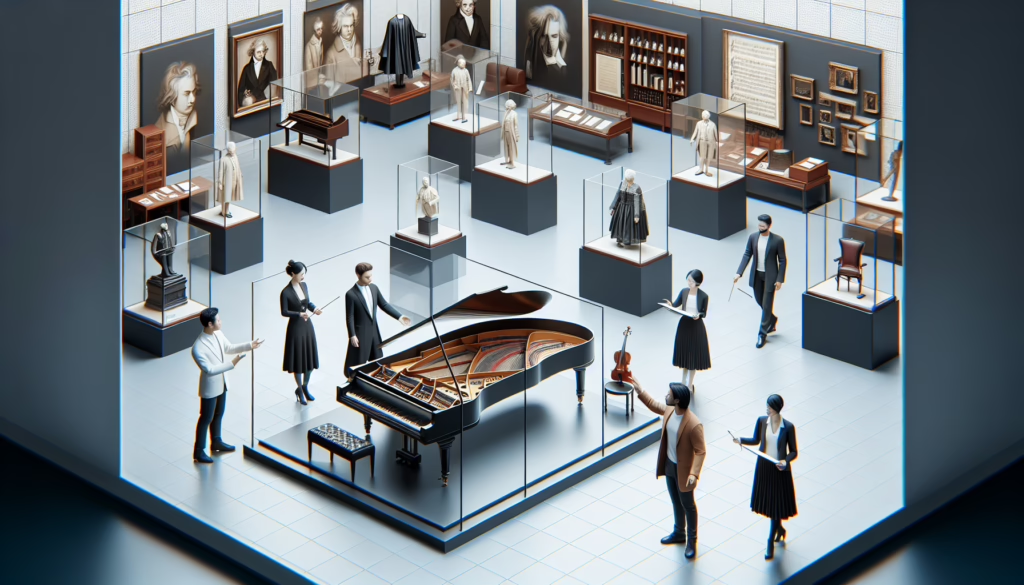
How Museums Curate Beethoven Exhibits
How museums curate Beethoven exhibits begins with a deceptively simple task: deciding which version of Beethoven to present to the public. Is he the revolutionary composer of the Eroica and Ninth Symphony, the private man behind intimate letters, the deaf artist who rewired musical history, or the cultural symbol repeatedly reinterpreted by collectors, scholars, and institutions? In practice, a strong Beethoven exhibition includes all of these versions, because museum curation is not just object display. It is the structured interpretation of material evidence through scholarship, conservation, design, and public engagement. For visitors exploring Beethoven collections, this matters because exhibits shape how they understand authenticity, genius, disability, performance, and memory.
Curating a Beethoven exhibit usually means bringing together manuscripts, first editions, portraits, instruments, hearing devices, furniture, medals, concert programs, correspondence, legal documents, and later commemorative objects. Each item carries different research and display requirements. A sketch leaf from a string quartet reveals Beethoven’s working process, while a lock of hair or death mask raises questions about scientific testing, provenance, and ethics. In my experience working with historical music collections, the hardest curatorial decisions are rarely about choosing famous objects. They are about building a coherent argument from fragile, uneven, and sometimes disputed evidence without flattening Beethoven into a legend.
Museums also curate Beethoven differently depending on their mission. A composer house museum may emphasize place and biography. An art museum may center portraiture and image-making. A library exhibition often highlights manuscripts, editorial history, and provenance trails. A city museum may frame Beethoven through Vienna, Bonn, patronage, and political change after the French Revolution. This hub article covers that miscellaneous landscape comprehensively so readers can understand how Beethoven exhibits are planned, researched, installed, and interpreted across institutions, and how related articles under the Beethoven Collections topic connect back to this central curatorial question.
At the core, curation means selecting, authenticating, preserving, and contextualizing objects to answer visitor questions clearly. What did Beethoven write with his own hand? How did he compose? What can objects prove, and what remains uncertain? Why do certain relics attract crowds while working documents explain more? The best museums answer these questions directly, pairing iconic pieces with strong labels, conservation logic, and narrative structure. That approach turns a room of rare items into an exhibition visitors can actually read, trust, and remember.
Defining the curatorial narrative and scope
Every successful Beethoven exhibition starts with a thesis. Curators do not simply assemble valuable objects; they decide what the exhibition argues. One show might focus on Beethoven’s creative process through sketchbooks and corrected proofs. Another might examine Beethoven in public memory, tracing monuments, centenary celebrations, recordings, and merchandising. A broader hub-style exhibition often combines biography, works, performance history, and collecting. The scope determines loans, layout, interpretation, and budget from the first planning meeting.
In practice, curators begin with a checklist of object categories and storylines. For Beethoven, common storylines include the Bonn years, arrival in Vienna, aristocratic patronage, the “heroic” middle period, deafness and communication books, domestic life, legal struggles over guardianship of Karl, late works, death, and posthumous mythmaking. The challenge is balance. If an exhibit leans too heavily on biography, visitors may miss the music itself. If it becomes too technical, non-specialists disengage. The strongest exhibitions use clear anchors: one room on process, one on patronage, one on hearing loss, one on legacy. That structure helps visitors build knowledge progressively.
Scope also depends on what an institution can credibly obtain. Original autographs of the Fifth Symphony or Missa solemnis are not routinely available, and many key artifacts are split across archives such as the Beethoven-Haus Bonn, the Austrian National Library, the Berlin State Library, and private or regional collections. Curators therefore mix originals with facsimiles, digital interactives, period objects, and contextual material. Used well, facsimiles are not a compromise; they are interpretive tools that let visitors study pages too sensitive for long display.
Research, provenance, and authentication
Beethoven exhibits live or die on documentation. Provenance research establishes where an item came from, who owned it, and whether the attribution is reliable. This is especially important with Beethoven because the market has long rewarded association pieces: allegedly owned quills, furniture, locks of hair, casts, signatures clipped from letters, and portraits with shaky histories. A responsible museum does not repeat inherited claims uncritically. It checks accession records, dealer correspondence, auction catalogs, watermark analysis, handwriting comparisons, and scientific reports where appropriate.
Manuscripts require close technical study. Curators and catalogers compare paper types, watermarks, rastral rulings, ink, revisions, and known scribal hands. Beethoven often worked in layers, moving from sketches to drafts to fair copies and engraver’s proofs. Distinguishing autograph material from copyist intervention matters because it shapes what a visitor is told about Beethoven’s compositional decisions. The same care applies to letters and conversation books, which are central to exhibits about deafness and daily life. Dates, addressees, and editorial history must be precise.
Scientific authentication sometimes enters the picture. Hair samples associated with Beethoven, for example, have been used in modern forensic and genomic studies, but museums must explain that not every attributed sample is genuine and that chain of custody can be weak. Likewise, death masks and life masks require careful provenance and production history. Presenting uncertainty is not a weakness. It demonstrates curatorial integrity and helps visitors understand the difference between evidence, tradition, and speculation.
Selecting objects that tell the fullest story
Once the research base is sound, curators choose objects that work together rather than simply objects with the highest prestige. In Beethoven exhibits, that usually means mixing “relic” objects with documentary objects. A hearing trumpet draws attention immediately, but a conversation book may explain deafness more effectively by showing how communication functioned day to day. A piano connected to Beethoven is evocative, but a page of revisions can reveal his actual working mind. Good curation pairs emotional pull with explanatory power.
Selection often follows three practical tests: significance, condition, and interpretive value. Significance asks whether an item advances the exhibition thesis. Condition determines whether it can survive the display period under light and environmental limits. Interpretive value asks whether visitors can understand why it matters within a few seconds and then deepen that understanding through labels or media. In my experience, many overstuffed music exhibitions fail on the third point. They show too many near-identical printed editions without explaining differences in dedications, corrections, publishers, or performance use.
| Object type | Why museums use it | Main curatorial challenge |
|---|---|---|
| Autograph manuscript | Shows Beethoven’s hand, revisions, and process | Extreme light sensitivity and loan restrictions |
| First edition score or parts | Connects composition to publication and circulation | Visitors need context to see why one edition matters |
| Portrait or bust | Builds public image and recognition | Can dominate the story if not balanced with documents |
| Hearing device or conversation book | Explains deafness in concrete human terms | Requires nuanced interpretation, not sentimental framing |
| Instrument or furniture | Creates physical presence and domestic context | Attribution and overreliance on atmosphere |
| Commemorative object | Shows how later generations shaped Beethoven’s legacy | Needs clear dating and historical framing |
This mix is why miscellaneous Beethoven collections are so useful at hub level. They catch the material that does not fit neatly into manuscripts, portraits, instruments, or archives alone, yet often provides the connective tissue of a memorable exhibition. Medals, exhibition catalogs, anniversary posters, annotated programs, and educational models all help museums explain not just Beethoven’s life, but the history of collecting Beethoven.
Conservation and display design for fragile materials
Beethoven exhibits are conservation-driven from the outset. Paper objects are vulnerable to light, fluctuations in relative humidity, and handling stress. Most institutions limit illumination for manuscripts and letters to around 50 lux, with tightly controlled display durations. Mounts must support bindings and single sheets without strain. Cases need stable environmental buffering and security hardware, particularly for high-value loans. If an exhibit includes mixed materials such as wood, metal, textiles, wax, and paper, conservators coordinate separate thresholds so one object type is not protected at the expense of another.
Design must also solve a classic music exhibition problem: many important objects are visually quiet. A sheet of notation can look inaccessible behind glass unless the design makes it legible and the interpretation directs attention. Curators use enlarged details, transcriptions, translations, and carefully angled casework so visitors can identify a forceful revision, a crossed-out phrase, or a famous dedication. Audio points placed nearby can connect the page to the sounding result, but sound bleed must be managed with directional speakers or headphones.
When museums display period instruments linked to Beethoven, conservation choices affect meaning. A historic piano may be shown closed to preserve its structure, but then visitors lose a sense of mechanism and sound. Some institutions solve this by displaying the original statically while using a replica or digital model to demonstrate action, tuning, and tonal character. That distinction should always be explicit. Visitors deserve to know what is original, what is reconstructed, and why.
Writing labels and interpretation that answer visitor questions
Interpretation is where scholarship becomes public understanding. The best Beethoven labels answer the obvious question first. What is this object, when was it made, and why is it here? Only then should a label move to nuance: how the item entered the collection, what scholars debate, and what detail deserves close looking. Dense curatorial prose loses visitors quickly, especially in music exhibitions where objects often require explanation before they become visually interesting.
Effective labels use plain terms without dumbing anything down. Instead of saying a manuscript is important because it reveals “genetic criticism,” a label might explain that scholars study layered drafts to trace how Beethoven tested and replaced musical ideas. Instead of merely noting “conversation book,” it should state that after Beethoven’s hearing deteriorated, visitors often wrote their side of conversations in notebooks, leaving a remarkable record of daily business, social contact, and practical communication. Direct language makes specialist knowledge usable.
Museums increasingly build interpretation in layers. A short label offers the takeaway. A nearby panel gives historical context. A digital station may add transcription, translation, performance extracts, or x-ray and watermark data for deeper readers. This layered model works especially well for a Beethoven collections hub because audiences vary widely, from tourists seeking an introduction to researchers comparing versions and provenance histories.
Using sound, media, and public programming wisely
No Beethoven exhibit is complete without sound, yet audio can easily overwhelm galleries. Curators need disciplined media planning. The goal is not to create a constant soundtrack of greatest hits. It is to connect specific objects to specific listening moments. A sketch for the Grosse Fuge should cue a passage that demonstrates the musical idea under discussion. A first edition of the Pathétique Sonata should link to historically informed performance choices, publication context, and reception rather than generic background music.
Programming extends the exhibit’s reach. Lecture-recitals, manuscript workshops, conservation talks, school visits, and family guides help institutions serve multiple audiences without overcrowding labels. The best public programs also address difficult themes honestly: deafness without romantic myth, patronage without nostalgia, and canon formation without pretending Beethoven’s status was inevitable. I have seen visitors engage most deeply when museums show process and contradiction instead of repeating the familiar genius narrative.
Digital media can widen access beyond the gallery. High-resolution manuscript viewers, timeline maps of Bonn and Vienna, object databases, and thematic microsites help a miscellaneous hub page connect users to deeper subtopic articles on letters, instruments, portraits, and commemorative objects. This internal structure benefits both readers and institutions because it mirrors how Beethoven collections are actually organized behind the scenes.
Balancing biography, myth, and legacy
The final curatorial challenge is managing Beethoven’s afterlife. Few composers have generated such a dense legacy industry of monuments, festivals, scholarship, recordings, souvenirs, and political appropriations. Museums must decide how much of that reception history belongs alongside life-and-works material. The answer, in most cases, is more than you might expect. Legacy objects explain why certain artifacts were preserved, why some stories hardened into fact, and why Beethoven continues to attract collectors and pilgrims.
Balance is essential. Exhibits should neither worship relics nor strip away emotional resonance. A death mask can be powerful if presented with clear provenance, casting history, and explanation of why nineteenth-century audiences valued such objects. Anniversary medals and centenary posters can reveal how institutions turned Beethoven into a civic symbol. Recordings and film clips show how each era heard him differently. This broader view helps visitors understand that museums do not just preserve Beethoven; they preserve changing ideas about Beethoven.
For anyone building or studying a Beethoven collections resource, this is the main lesson. Curating Beethoven exhibits is a rigorous blend of research, authentication, conservation, design, interpretation, and audience strategy. The best museums choose objects that can withstand scrutiny, explain them in direct language, and connect them to larger themes of creativity, material culture, disability, and memory. Use this hub as a starting point for exploring the full miscellaneous side of Beethoven collections, then follow the related articles to go deeper into the objects and methods that make these exhibits work.
Frequently Asked Questions
How do museums decide which version of Beethoven to present in an exhibit?
Museums usually begin by accepting that there is no single, complete version of Beethoven to display. He can be interpreted as a radical composer who reshaped Western music, as a deeply private individual revealed through letters and personal documents, as an artist who continued composing while losing his hearing, and as a cultural icon whose image has been constantly redefined by later generations. A strong exhibition does not treat these identities as competing stories. Instead, curators build a framework that allows visitors to see how all of these perspectives coexist.
That process typically starts with a curatorial thesis: a central question or interpretive goal that gives the exhibition focus. For example, one museum may emphasize Beethoven’s creative process through sketches, drafts, and annotated scores, while another may focus on how public memory transformed him into a symbol of genius, struggle, and artistic freedom. Once that thesis is established, curators select objects, texts, sound elements, and spatial design choices that support it. The result is not simply a collection of artifacts, but a carefully shaped argument about who Beethoven was, how he worked, and why he continues to matter.
Importantly, museums also think about audience expectations. Many visitors arrive with familiar images of Beethoven as the stormy, deaf genius. Curators often use that recognition as an entry point, then complicate it by introducing less expected material such as domestic items, business correspondence, legal papers, portraits commissioned after his death, or evidence of how his reputation evolved. In this way, the exhibit becomes both accessible and intellectually rich, presenting Beethoven not as a fixed legend but as a layered historical figure.
What kinds of objects are most important in a Beethoven exhibition?
The most important objects in a Beethoven exhibition are those that help connect music, biography, and historical context in a tangible way. Manuscripts and sketchbooks are often central because they let visitors see composition as a process rather than a miracle. Drafts with revisions, crossed-out passages, and reworked ideas reveal that Beethoven’s masterpieces were built through experimentation, persistence, and structural thinking. These materials are especially powerful because they translate an abstract art form into something visual and immediate.
Personal documents are equally significant. Letters, conversation books, legal records, and household items can illuminate Beethoven’s relationships, finances, health, and daily life. These materials help museums move beyond the myth of isolated genius and show him as a working professional navigating patrons, publishers, family tensions, and social networks. When presented carefully, such objects humanize Beethoven without diminishing his artistic stature. They also allow curators to address more intimate topics, including his deafness, communication methods, and emotional world.
In addition, museums often include instruments, portraits, first editions, listening stations, and later commemorative objects. A piano associated with Beethoven’s era can anchor discussions of performance practice and sound. Portraits can demonstrate how his public image was constructed visually. Early printed scores show how his music circulated, while medals, busts, posters, and anniversary memorabilia reveal how institutions and collectors turned him into a cultural symbol. The strongest exhibits combine these categories so visitors encounter Beethoven through sound, paper, image, material culture, and historical memory all at once.
How do curators balance Beethoven’s personal life with his musical legacy?
Curators balance Beethoven’s personal life with his musical legacy by treating biography as a tool for interpretation rather than as an end in itself. A museum exhibition about Beethoven is not simply a life story, nor should it reduce his work to a set of personal hardships. Instead, effective curation asks how life circumstances, artistic ambition, social environment, and historical events intersected. His deafness, for example, is relevant not because it creates drama, but because it shaped communication, performance, self-understanding, and the reception of his music.
This balance often appears in the structure of the exhibit. A gallery may move between major compositions and the documents that surround them, allowing visitors to understand both the works themselves and the conditions under which they were created. The “Eroica” Symphony might be paired with political context and evidence of changing attitudes toward heroism. The late string quartets may be connected to manuscripts and reflections on Beethoven’s final years. Personal letters may be included not to satisfy curiosity, but to deepen understanding of artistic development, emotional intensity, and the pressures of public reputation.
Curators also have to be disciplined about avoiding sensationalism. Beethoven’s illnesses, family conflicts, and romantic speculations can attract attention, but museums generally aim to interpret these matters responsibly and with scholarly care. The goal is to present a fuller person without turning the exhibition into gossip or melodrama. When done well, this balance allows visitors to appreciate Beethoven’s humanity while still recognizing the scale and originality of his musical achievement.
Why is sound design so important in museums curating Beethoven exhibits?
Sound design is essential because Beethoven’s primary medium was music, and no exhibition about him can rely on visual artifacts alone. Manuscripts, portraits, and historical objects provide context, but visitors ultimately need some way to hear the ideas those objects represent. Thoughtful sound design turns the exhibition from a static historical display into a sensory and interpretive experience. It helps audiences connect notation with performance, historical evidence with emotional impact, and Beethoven’s working process with the final musical result.
Museums use sound in several ways. Listening stations may focus on complete works, key passages, or comparative recordings that show differences in tempo, instrumentation, or interpretive style. In some exhibitions, audio is localized so that sound does not overwhelm the space; in others, immersive galleries use carefully controlled acoustics to create a more dramatic environment. Curators and designers may also pair manuscript pages with synchronized audio so visitors can follow revisions while hearing the corresponding music. This is particularly effective for showing how Beethoven developed motifs and transformed simple ideas into monumental structures.
Sound design also helps museums address accessibility and interpretation. Audio programs can be supplemented with captions, transcripts, visualizations, and tactile or interactive components to support varied learning styles. Some exhibitions even use sound strategically to explore Beethoven’s hearing loss, not by simulating disability in a simplistic way, but by prompting reflection on listening, vibration, adaptation, and artistic imagination. In short, sound is not an optional feature in a Beethoven exhibit. It is one of the main curatorial tools for making the exhibition meaningful, memorable, and intellectually coherent.
How do museums make Beethoven exhibits relevant to modern audiences?
Museums make Beethoven exhibits relevant by connecting historical material to questions that still resonate today: creativity under pressure, the construction of public identity, disability and adaptation, politics and art, cultural memory, and the continued reinterpretation of canonical figures. Rather than assuming Beethoven’s importance is self-evident, curators explain how and why his music has been used, debated, celebrated, and challenged across time. This approach helps visitors see that a Beethoven exhibition is not only about the past, but also about how societies create meaning around major artists.
One common strategy is to present Beethoven as a figure whose legacy has never been stable. Museums may show how 19th-century admirers elevated him into a hero, how nationalist movements appropriated his image, how performance traditions changed the way his works were heard, and how contemporary musicians and scholars continue to revisit him. By including this history of reception, curators demonstrate that even the most famous composers are shaped by institutions, collectors, critics, and audiences. That makes the exhibition more dynamic and more honest.
Relevance also comes from exhibition design and interpretation. Interactive media, strong storytelling, accessible labels, and multimedia experiences can invite both specialists and first-time visitors into the subject. Museums may frame Beethoven through universal themes such as perseverance, innovation, ambition, and contradiction, while still grounding every claim in historical evidence. The best exhibits do not modernize Beethoven by flattening him into a motivational symbol. Instead, they show why his life, music, and afterlife continue to provoke curiosity, debate, and discovery in the present.