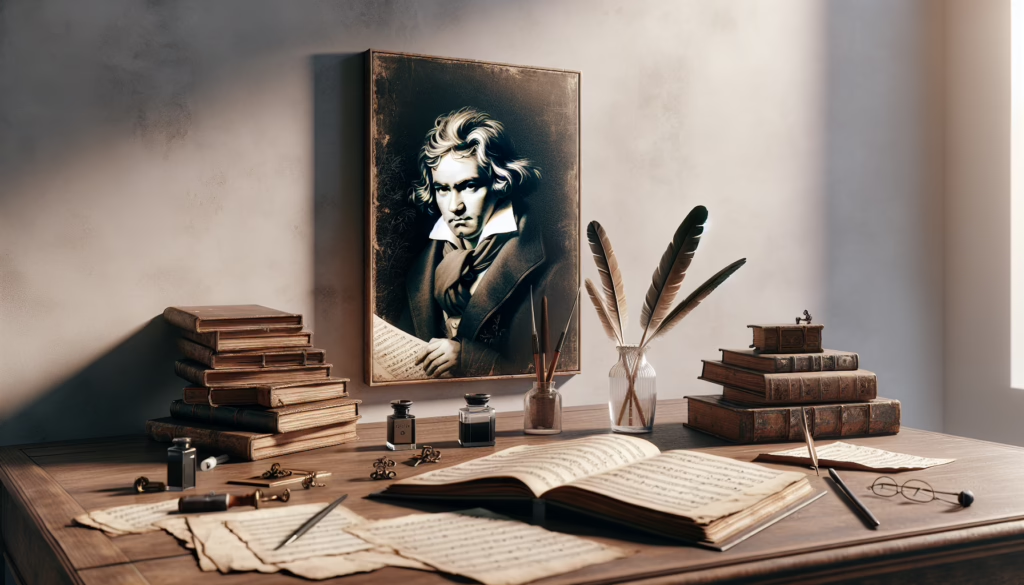
Beethoven’s Sketchbooks: What They Reveal
Beethoven’s sketchbooks are among the most revealing documents in Western music history because they preserve composition in motion rather than in polished final form. A sketchbook, in this context, is a notebook, gathering, loose bifolio, or bound volume in which Ludwig van Beethoven drafted motifs, tested harmonic plans, copied reminders, and sometimes mixed major ideas with trivial practical notes. For readers exploring Beethoven Collections, these sources matter because they connect manuscripts, autographs, conversation books, letters, and first editions into one living record of creative labor. I have worked repeatedly with digitized sources, thematic catalogs, and critical editions, and nothing closes the distance between composer and page more powerfully than seeing a famous passage emerge through crossings-out and compressed revisions. Sketchbooks show not only what Beethoven wrote, but how he thought, when he hesitated, and why certain solutions prevailed.
They also correct persistent myths. Beethoven was not simply a genius who heard complete masterpieces inwardly and wrote them down unchanged. The sketchbooks prove a more demanding truth: he was an obsessive reworker who generated alternatives, delayed decisions, and refined structure over long spans. Scholars usually distinguish between pocket sketchbooks, desk sketchbooks, and larger project books, though the categories can overlap because Beethoven reused paper and returned to abandoned plans. Miscellaneous material is especially important here. A single page may include a symphonic germ beside an exercise in counterpoint, a shopping note, a canon for friends, or a fragment later absorbed into another work. That mix is not accidental clutter. It reveals a studio practice in which artistic, social, and practical life shared the same paper economy.
As a hub topic within Beethoven Collections, sketchbooks belong at the center of the wider archive. They help date works with uncertain chronology, illuminate performance issues, and expose the transition from improvisation to notation. They also clarify Beethoven’s changing methods across his early, middle, and late periods. Since many leaves were dispersed, cut up, sold, or rebound after his death, modern research depends on reconstruction through watermarks, handwriting analysis, paper type, pagination, and concordance with surviving autographs. Institutions such as the Beethoven-Haus Bonn, the Berlin State Library, the Austrian National Library, and the British Library have transformed access through catalogs and digital facsimiles. For anyone asking what Beethoven’s sketchbooks reveal, the direct answer is this: they reveal process, chronology, ambition, revision, and the human scale of creation more vividly than almost any other source.
What Beethoven’s sketchbooks actually contain
Beethoven’s sketchbooks contain far more than rough drafts of famous themes. In practical terms, they preserve melodic cells, bass lines, rhythmic plans, harmonic progressions, contrapuntal studies, text underlay, orchestration cues, and reminders about form. On one page Beethoven might notate a short motive in several keys; on the next he may try different continuations, reject one by crossing it through, and retain another by rewriting it more clearly. This is crucial evidence because the final score often conceals struggle. The sketchbooks restore that struggle and show that Beethoven frequently developed music from tiny motivic particles rather than from fully formed periods. The opening ideas of the Eroica Symphony, the Fifth Symphony, and the late quartets all gain new meaning when seen at their sketch stage.
Just as important, these books preserve miscellaneous content that broadens our understanding of Beethoven’s working environment. Researchers find lists, addresses, accounts, snippets of text, and occasional nonmusical jottings interleaved with major compositional work. That mixture helps date pages and link them to places, patrons, copyists, or specific commissions. It also reveals the material constraints under which Beethoven worked. Paper was valuable, and he exploited every space. He wrote vertically, diagonally, over earlier attempts, and into margins. For modern readers, that density can appear chaotic; for scholars, it is evidence of intense concentration. The page became a workshop bench, not a display surface.
How scholars reconstruct the sketchbook record
The surviving sketchbook record is incomplete, and reconstruction is a major part of Beethoven research. After Beethoven’s death in 1827, many manuscripts were dispersed among heirs, dealers, collectors, and libraries. Some sketchbooks remained intact, but many were broken up so individual leaves could be sold. As a result, what appears today as a coherent notebook may actually be a later binding, while pages from one original source may be scattered across continents. Scholars reconstruct these materials by combining bibliography, codicology, and musical analysis. They compare ruling patterns, stitch holes, paper dimensions, handwriting habits, and especially watermarks, which can identify a paper batch or place a source within a time window.
Cataloging systems are essential. Gustav Nottebohm’s nineteenth-century work laid the foundation by transcribing and analyzing sketches, though later scholarship corrected some datings and expanded the corpus. Modern projects such as the Beethoven-Haus digital archive and the work of editors including Sieghard Brandenburg, Joseph Kerman, Lewis Lockwood, and Douglas Johnson have refined chronology and source relationships. In practice, reconstruction often works like detective labor. A leaf in Bonn may match a conjugate leaf in New York because the chain lines, fold pattern, and offset traces align. A motif sketched next to a dated note can anchor an entire cluster of pages. This is why miscellaneous material is not peripheral. A mundane memorandum can provide the chronological clue that turns fragmentary notation into a documented stage of composition.
What the sketchbooks reveal about Beethoven’s creative method
The most important revelation is methodological: Beethoven composed through iterative transformation. He rarely treated a first idea as final. Instead, he tested interval shapes, rhythmic stress, phrase length, tonal destination, and formal placement until a motive acquired structural force. In my own work with facsimiles, the recurring pattern is unmistakable. A short cell appears, then returns in compressed, expanded, inverted, or reharmonized form. This confirms what analysts describe as motivic development, but the sketchbooks show the labor behind the term. Beethoven did not merely decorate themes; he engineered them to generate entire movements.
This process also explains his reputation for inevitability. Passages that sound inevitable in finished works often came from deliberate comparison among several viable options. In sketches for the Fifth Symphony, for example, Beethoven explores rhythmic insistence and continuation strategies before arriving at the tightly controlled dramatic architecture listeners know today. In the late piano sonatas and string quartets, sketchbooks reveal even greater abstraction. He plans fugues, variation procedures, and long-range tonal balances with striking patience. The pages show that spontaneity and construction were not opposites in his practice. He improvised, captured fragments, then subjected them to relentless structural testing.
| Sketchbook type | Typical use | What it reveals |
|---|---|---|
| Pocket sketchbook | Portable capture of ideas during walks, travel, or social visits | Immediate motivic invention and short-form reminders |
| Desk sketchbook | Sustained work on larger compositions at home | Sequential development, formal planning, and revision layers |
| Loose leaves and miscellanies | Overflow material, reused paper, practical notes, detached bifolios | Chronology clues, abandoned projects, and links across genres |
Examples from major works and why they matter
Specific cases make the value of the sketchbooks clear. For the Third Symphony, scholars have traced Beethoven’s search for thematic profile and structural scale, showing that the work’s revolutionary breadth was built through cumulative planning rather than sudden inspiration. The Leonore and Fidelio materials demonstrate how Beethoven struggled repeatedly with dramatic pacing, overture function, and vocal declamation. In the sketchbooks for the Missa solemnis, one sees a composer balancing liturgical text, learned counterpoint, and monumental architecture on an almost unprecedented scale. The Ninth Symphony materials reveal not just the famous “Ode to Joy” theme but the long gestation of how voices would enter a symphonic finale. That decision was neither casual nor merely theatrical; it emerged from sustained experimentation.
Smaller works are equally instructive. Bagatelles, canons, dance fragments, and occasional pieces often appear beside major projects, proving that Beethoven’s workshop was not divided neatly by prestige. A tiny keyboard idea could become a testing ground for a larger harmonic move. A social canon might preserve a rhythmic joke later transformed into serious discourse. This is why a miscellaneous hub is useful within Beethoven Collections. Readers interested in symphonies, piano sonatas, quartets, sacred music, or unfinished works all benefit from sketchbook evidence because the notebooks cut across genre boundaries. They show Beethoven thinking in networks of ideas rather than isolated opus numbers.
Dating, deafness, and daily working habits
Many readers ask whether the sketchbooks reveal the effects of Beethoven’s deafness. They do, but indirectly. The pages do not provide a simple before-and-after line between hearing and nonhearing composition. Instead, they show increasing reliance on visual and conceptual control: intervallic planning, contrapuntal layout, registral balance, and formal mapping. As his hearing declined, Beethoven continued to compose at the highest level because his method was never dependent only on immediate acoustic feedback. The sketchbooks demonstrate that he thought through relationships on paper with extraordinary rigor. At the same time, they remind us that deafness was a practical burden. Communication difficulties, frustration, and social strain shaped the conditions in which this work occurred.
The notebooks also illuminate routine. Beethoven often carried portable materials, then transferred or expanded ideas in larger books. He reused pages, revisited old concepts, and allowed projects to overlap. This matters for chronology because a page’s date is not always the date of every notation on it. Scholars therefore distinguish between the date of paper use and the date of musical conception. They also compare sketches with letters, payment records, copyists’ manuscripts, and first editions to establish a reliable timeline. The result is a more realistic picture of composition as ongoing project management: gathering ideas, reserving possibilities, meeting commissions, and revising under pressure.
How to read sketchbooks responsibly in a collections context
Sketchbooks are powerful, but they must be interpreted carefully. A sketch is not automatically the first version of a passage, and an abandoned idea is not necessarily a failed one. Sometimes Beethoven copied a solution after deciding on it elsewhere; sometimes he wrote exploratory variants with no intention of using them. Modern readers can overdramatize crossings-out as signs of crisis when they may simply mark ordinary selection. The best approach is comparative. Read sketchbooks alongside autograph scores, early copies, thematic catalogs such as Kinsky-Halm, and critical reports from modern scholarly editions. When multiple sources align, the sketchbook becomes exceptionally strong evidence.
For collectors, students, and general readers building a path through Beethoven Collections, start with digitized holdings from Beethoven-Haus Bonn and then move to studies that explain source relationships in plain terms. Look for facsimiles with commentary rather than isolated images. Pay attention to paper format, sequence, and neighboring entries, not just the famous fragment highlighted in exhibitions. The reward is substantial. Beethoven’s sketchbooks reveal a composer who built greatness through revision, economy, and conceptual daring. They turn masterpieces back into acts of work, and that makes the music more impressive, not less. If you want to understand Beethoven beyond legend, follow the sketchbooks through the wider collection and read the pages as evidence of thinking made visible.
Frequently Asked Questions
What are Beethoven’s sketchbooks, and why are they so important?
Beethoven’s sketchbooks are working documents that show his music being invented step by step. Rather than presenting a finished score in clean, polished notation, they preserve fragments, revisions, crossed-out passages, rhythmic experiments, harmonic tests, reminders, and sometimes even unrelated practical notes. In this broad sense, a “sketchbook” can mean a bound notebook, a loose gathering of pages, a bifolio, or another draft source in which Beethoven recorded ideas as they emerged. That makes these materials unusually valuable for anyone trying to understand how he actually composed.
Their importance lies in the fact that they reveal composition in motion. Beethoven is often remembered as a towering genius, but the sketchbooks show that his major works were not simply written down in final form. He tried possibilities, rejected them, returned to earlier ideas, and reshaped material repeatedly. A motif that later sounds inevitable in a symphony, sonata, or quartet may appear first as a tiny cell, then as a rough outline, then as part of a larger structural plan. For scholars, performers, and readers interested in Beethoven Collections, these documents offer direct access to the workshop behind the masterpieces. They turn abstract admiration into something concrete: evidence of effort, decision-making, and musical imagination at work.
What do the sketchbooks reveal about Beethoven’s compositional process?
Above all, the sketchbooks reveal that Beethoven was a relentless reviser. He did not merely capture inspiration; he developed it through sustained experimentation. The pages often show him taking a small motif and testing how far it could be transformed rhythmically, harmonically, and structurally. He might alter interval patterns, shift accents, extend a phrase, compress a theme, or rethink a transition entirely. This is one reason the sketchbooks are so central to music history: they demonstrate that Beethoven’s originality was tied not only to invention, but also to refinement and recombination.
They also show how deeply he thought about large-scale form. The sketchbooks are not limited to isolated melodies. In many cases, Beethoven drafted plans for movements, explored tonal routes, worked out developmental passages, and mapped relationships between themes. This means the sources do more than reveal “first thoughts.” They document strategic thinking. Readers can see how an initial idea was expanded into a movement with tension, contrast, and resolution. In practical terms, the sketchbooks dismantle the myth of effortless genius and replace it with something even more compelling: a portrait of a composer who built greatness through concentration, persistence, and unusually rigorous musical problem-solving.
Do Beethoven’s sketchbooks contain only musical ideas, or do they include other kinds of notes as well?
No, they do not contain only musical material, and that is part of what makes them so fascinating. Alongside major compositional ideas, Beethoven’s sketch sources may include reminders, brief annotations, practical memoranda, financial references, names, addresses, and miscellaneous everyday notes. This mixture can seem surprising at first, especially to readers expecting a purely artistic document, but it gives the sketchbooks a strong sense of immediacy. They were tools of daily use, not ceremonial objects created for posterity.
This overlap between the monumental and the ordinary is historically revealing. A page might place the beginnings of a major musical idea next to something mundane, reminding us that Beethoven’s masterpieces emerged within the routines and interruptions of real life. For researchers, such juxtapositions can help establish chronology, clarify context, and illuminate habits of work. For general readers, they humanize Beethoven. The sketchbooks show not only the composer of epoch-making works, but also a person managing tasks, preserving reminders, and thinking through problems in a lived environment. That blend of artistic ambition and practical everyday life is one reason these documents remain so compelling in Beethoven Collections.
How do scholars use Beethoven’s sketchbooks to study his music?
Scholars use the sketchbooks to reconstruct the genesis of individual works and to trace how Beethoven’s ideas developed over time. By comparing sketches with surviving manuscripts, copies, and published editions, they can identify earlier versions of themes, reordered sections, abandoned concepts, and revisions in harmony, texture, or form. This kind of study helps establish not just what Beethoven wrote, but how he arrived there. It can clarify the chronology of a composition, reveal relationships between works, and show when an idea was deferred, recycled, or transformed into something more ambitious.
The sketchbooks are also crucial for broader interpretive questions. They allow musicologists to examine Beethoven’s working methods, his priorities in revision, and the balance he struck between local detail and overall structure. Performers and editors also benefit from this research. While a sketch is not a final authority in the same way as an authorized score, it can illuminate phrasing intentions, formal logic, and expressive emphasis. In the context of Beethoven Collections, these documents function as primary evidence: they anchor discussion in physical sources rather than later legend. That is why they remain indispensable for serious study of Beethoven’s creative life.
Why do Beethoven’s sketchbooks matter to modern readers and visitors exploring Beethoven Collections?
They matter because they make Beethoven’s achievement more intelligible, more human, and, in many ways, more impressive. Seeing the finished score of a famous work can inspire awe, but seeing the path toward that score creates a deeper connection. The sketchbooks reveal uncertainty, revision, persistence, and breakthrough. They show that artistic mastery is not just about inspiration appearing fully formed; it is also about labor, memory, experimentation, and the willingness to rethink an idea until it reaches its strongest form. For modern readers, that insight is powerful because it bridges the distance between a canonical figure and the creative process itself.
For visitors exploring Beethoven Collections, the sketchbooks are especially valuable because they provide tangible contact with the composer’s mind at work. These are not merely relics to be admired behind glass. They are evidence of thinking, hearing, and shaping in real time. They enrich exhibitions, archives, and digital collections by allowing audiences to move beyond biography into process. Instead of asking only what Beethoven composed, readers can ask how he composed, why he changed course, and what those changes reveal about his artistic values. In that sense, the sketchbooks do more than preserve documents; they preserve the drama of creation itself.