How Monuments Created the Public Image of Beethoven
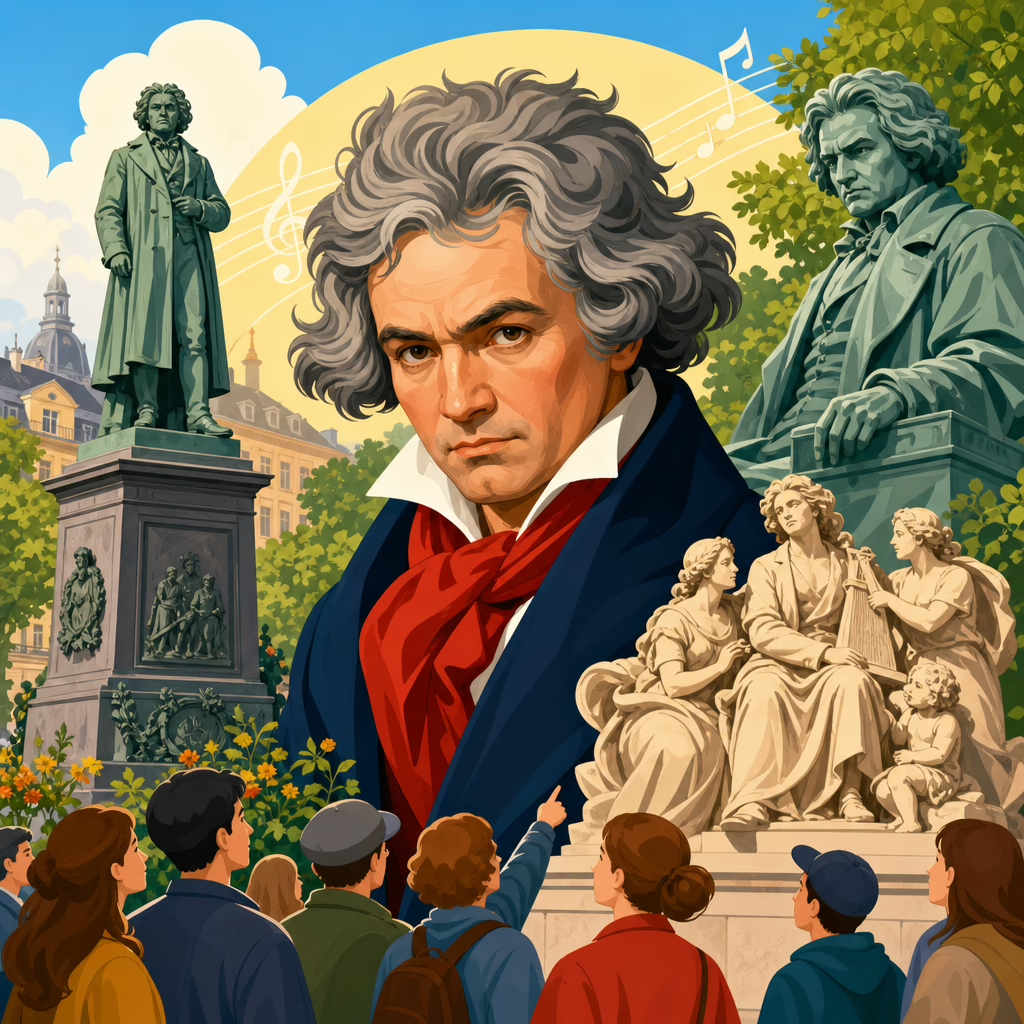
Beethoven’s public image was not formed by music alone. It was built in stone, bronze, and civic ritual through monuments that translated a complicated composer into a visible cultural hero. When people speak of “Beethoven” today, they often imagine not only the sound of the Fifth Symphony or the Ninth, but a stern face, wild hair, a fixed gaze, and a body posed as if wrestling with fate. That visual language did not emerge accidentally. It was shaped by nineteenth- and early twentieth-century monument culture, by city governments, donors, sculptors, publishers, and festival organizers who needed Beethoven to stand for something larger than one man’s life.
In this context, a monument means more than a statue in a square. It includes memorial sculpture, pedestal inscriptions, unveiling ceremonies, commemorative landscapes, and the printed images that circulated after those events. Public image means the shared, repeatable idea of Beethoven available to ordinary viewers, including people who never attended a concert or read a scholarly biography. I have worked through monument archives, festival reports, and sculptural programs tied to Beethoven commemorations, and one pattern is unmistakable: monuments simplified complexity. They selected certain biographical facts and visual cues, then repeated them until they became common sense.
This matters because monuments acted as mass media before photography and film reached full cultural saturation. A public monument stabilized reputation. It gave a city a claim on Beethoven, taught viewers how to remember him, and aligned his legacy with civic virtues such as genius, struggle, moral seriousness, national prestige, and artistic permanence. The best-known Beethoven monuments did not merely honor him after the fact. They actively produced the version of Beethoven that later generations inherited. To understand why Beethoven looks heroic, solitary, and almost prophetic in modern culture, it is necessary to study what monuments asked the public to see and why those choices proved so durable.
Why Beethoven was especially suited to monument culture
Beethoven became an ideal monument subject because his biography could be compressed into powerful symbols. By the mid-nineteenth century, several facts were already widely known: he had risen from Bonn, worked in Vienna, transformed major musical forms, and composed while losing his hearing. Those facts could be turned into a public script. The script presented Beethoven as a suffering genius who conquered adversity through inner strength. Monument designers favored exactly that kind of story because statues needed immediate legibility. A passerby could not absorb harmonic innovation in a glance, but could understand a furrowed brow, a clenched posture, and an inscription naming triumph over fate.
There was also a political reason. After the Napoleonic era, German-speaking lands increasingly used cultural figures to express collective identity. Beethoven was useful because he was prestigious, serious, and already admired beyond local boundaries. Unlike a military leader, he could symbolize national greatness without reopening every partisan conflict. Unlike a monarch, he could be presented as belonging to the people. Cities could claim him both as native son and universal genius. That flexibility made him perfect for memorial campaigns, especially in moments when civic elites wanted to display cultural legitimacy.
Another advantage was the abundance of recognizable source material. Portraits by Joseph Karl Stieler and others had already codified the intense, dark-clad Beethoven holding a manuscript. Death masks, life masks, anecdotal literature, and memoirs offered sculptors tangible reference points. Yet monuments were never neutral transfers from life to stone. They were selective reconstructions. Sculptors reduced anecdotal variety and emphasized durable traits: severity, concentration, inwardness, and defiance. In practical terms, the monument medium favored a Beethoven who appeared timeless rather than socially messy, less dependent on patrons, domestic frustrations, legal disputes, or everyday compromise.
The Bonn monument of 1845 made Beethoven visible to the nation
The decisive case is the Beethoven monument unveiled in Bonn on 12 August 1845. Designed by Ernst Julius Hähnel, funded through an international subscription, and celebrated during a major festival attended by dignitaries including Queen Victoria and Prince Albert, it transformed Beethoven remembrance into a public spectacle. This was not a local tribute hidden in a cemetery. It was an event engineered for broad attention, complete with speeches, music, press coverage, and souvenir culture. In effect, the monument launched Beethoven as a civic icon in a form that could be copied elsewhere.
Hähnel’s statue established several conventions that proved influential. Beethoven stands upright, dignified, heavily draped, and self-contained. The figure avoids theatrical movement. Instead, authority comes through composure and concentration. That choice matters. It told viewers that Beethoven’s power was spiritual and intellectual, not merely emotional. The monument did not present an eccentric bohemian. It presented a lawgiver of art. The pedestal and setting further elevated him from individual composer to public exemplar, a figure cities could place in squares alongside statesmen and scholars.
The unveiling festival amplified the image. Reports framed the event as a collective act of cultural gratitude, binding local pride to transnational recognition. Franz Liszt, who strongly supported the project, understood that monuments could reshape reception by attaching performance culture to physical commemoration. Once images of the Bonn statue circulated in engravings and illustrated journals, people who never traveled there encountered Beethoven through that visual template. The monument therefore worked on two levels: as a fixed object in Bonn and as a reproducible image in European media. For a broader account of how such symbols fed Beethoven’s wider fame, see the main guide why Beethoven became a global cultural icon.
| Monument element | Public message | Why it lasted |
|---|---|---|
| Upright standing pose | Authority, self-mastery, civic dignity | Easy to read in a public square |
| Serious facial expression | Moral depth and intellectual intensity | Matched published biographies and portraits |
| Formal drapery and coat | Timeless greatness rather than everyday life | Linked Beethoven to statesmen and sages |
| Festival unveiling | Collective cultural ownership | Generated press, souvenirs, and repeatable narratives |
| Pedestal inscriptions | Compressed biography into public lessons | Turned admiration into civic memory |
How sculptors turned biography into a heroic visual formula
Once the Bonn model succeeded, later monuments refined rather than reinvented Beethoven’s image. Sculptors faced a basic challenge: how do you represent a composer, whose true work is invisible sound, in a silent material? The answer was to embody inner hearing as visible concentration. That is why Beethoven monuments often show him thinking, holding a score, seated in stern reflection, or standing in a pose of controlled intensity. These are not casual portraits. They are arguments about creative power.
The heroic formula depended on a few recurring traits. First came hair, rendered turbulent enough to signal passion but ordered enough to avoid ridicule. Second came the brow and mouth, tightened to suggest effort. Third came the relation to the manuscript, which connected bodily struggle to compositional labor. I have seen this again and again in sculptural planning documents: artists and committees worried less about literal likeness than about whether the figure communicated genius. Accuracy mattered, but emblematic force mattered more. The public was being taught what genius looked like.
This visual formula also solved a reputational problem. Beethoven’s documented behavior could be abrasive, suspicious, and socially awkward. Monument culture filtered that evidence through idealization. Irritability became determination. Isolation became spiritual independence. Deafness became heroic transcendence rather than disability with daily frustrations. Such transformation was not simple falsification; it was commemorative editing. Monuments always edit. But in Beethoven’s case, the edit was unusually powerful because it aligned biography, romantic aesthetics, and the needs of civic commemoration so neatly.
Monuments linked Beethoven to cities, nations, and cultural authority
Every Beethoven monument made a territorial claim. Bonn used him to assert historical importance beyond its political size. Vienna presented him as one of the city’s supreme artistic residents, woven into its identity as a capital of music. Later monuments in parks, concert precincts, and memorial complexes declared that Beethoven belonged in the same symbolic register as emperors, philosophers, and national poets. Placement was therefore part of meaning. A statue near a concert hall taught one lesson about art; a statue in a civic square taught another about public virtue and collective memory.
This local anchoring supported broader national narratives. In the nineteenth century, especially around and after German unification in 1871, Beethoven could serve as evidence that German culture possessed world-historical depth. Yet the monuments usually avoided narrow propaganda. Their power came from combining national ownership with universal aspiration. Beethoven was shown as German, but also as a genius for humanity. That dual framing helped his image travel internationally. Foreign audiences could respect the monument’s national claim while still adopting Beethoven as a global master.
Ceremony reinforced the message. Unveilings, anniversary gatherings, wreath-layings, and festival concerts turned static objects into recurring civic theaters. Speeches interpreted the statue for the public, often stressing perseverance, idealism, freedom, or the ennobling force of art. Newspapers then repeated those interpretations. In archival coverage, the monument rarely appears alone; it is surrounded by language explaining what Beethoven should mean. The result was a feedback loop between object, event, and press. Public image hardened because it was repeatedly staged, not because the sculpture itself was magically self-explanatory.
What monuments left out, and why that omission mattered
Monuments made Beethoven legible, but they also narrowed him. They minimized his dependence on aristocratic patrons, his messy finances, his custody battle over Karl, his changing political attitudes, and the ordinary practical labor behind composition. They gave little space to collaboration with performers, publishers, copyists, and audiences. Above all, they downplayed contradiction. The public Beethoven of monuments appears singular, unified, and fully monumental in himself, whereas the historical Beethoven was often unstable, vulnerable, and entangled in social systems.
This omission mattered because later media inherited the monument’s simplifications. Illustrated textbooks, postcards, record covers, and even film posters frequently echoed the sculptural type: stern face, stormy hair, visionary solitude. Once installed in urban space, the monument became a reference image against which new depictions were judged. That is one reason the heroic Beethoven has been so resilient. It was not just narrated in words; it was spatialized and ritualized. People learned to encounter him as a monument before they encountered him as a historical problem.
There are tradeoffs here. Monumental simplification can distort, yet it can also preserve attention. Without nineteenth-century memorial campaigns, Beethoven might have remained more exclusively the property of musicians and educated readers. Monuments helped broaden access, giving non-specialists an entry point into his cultural importance. The cost was that entry came through mythic compression. For modern readers, the task is not to reject monuments outright, but to read them critically: as evidence of how societies wanted Beethoven to function in public life.
Why the monument-made Beethoven still shapes culture
The modern public image of Beethoven still bears the imprint of nineteenth-century monuments because those works established durable expectations about artistic greatness. They taught audiences to see the composer as morally serious, embattled, and larger than ordinary social life. That image fits concert programming, museum display, educational storytelling, and commemorative marketing, so institutions continue to reuse it. Even contemporary critiques of genius culture often start with the monumental Beethoven because he remains the clearest example of how art history personified cultural authority.
The key takeaway is straightforward. Monuments did not simply honor Beethoven after his death; they created the visual and civic framework through which millions came to know him. By selecting heroic traits, staging public ceremonies, and occupying prominent urban sites, they turned a historically complex composer into a recognizable symbol of genius. If you want to understand why Beethoven still appears as the severe prophet of music rather than as a more ordinary working artist, start with the monuments. Look at where they stood, how they were unveiled, what details they emphasized, and what they omitted. That is where public image became public memory, and where memory became cultural common sense. Explore the monuments themselves, and Beethoven’s modern face becomes easier to read.
Frequently Asked Questions
How did monuments help create Beethoven’s public image beyond his music?
Monuments gave Beethoven a stable, visible identity that music alone could not fully provide. Most people do not encounter a composer in person, and even those who know the music well often rely on visual cues to imagine the person behind it. Nineteenth-century monuments solved that problem by turning Beethoven into a public figure who could be seen, visited, and ceremonially honored. In bronze and stone, he became more than a composer of difficult, powerful works; he became a recognizable cultural hero with a fixed face, posture, and emotional character.
These monuments did important interpretive work. They selected which aspects of Beethoven to emphasize and which to soften or ignore. Instead of presenting him as socially awkward, financially stressed, chronically ill, or personally contradictory, they highlighted qualities that fit public ideals: seriousness, strength, genius, struggle, and moral elevation. A monument could suggest that Beethoven was not simply an individual artist but a national treasure, a guardian of high culture, or even a near-prophetic figure. Once those images appeared repeatedly in public spaces, they began to shape collective memory. People came to recognize “Beethoven” not just as a name in concert programs, but as a stern, heroic presence embodied in civic art.
In that sense, monuments did not merely reflect Beethoven’s reputation; they actively built it. They translated an invisible art form into a durable visual narrative. Through unveiling ceremonies, speeches, newspaper coverage, and repeated public viewing, monuments taught audiences how to look at Beethoven and, by extension, how to think about him.
Why is Beethoven so often shown with stern features, wild hair, and a dramatic pose?
That familiar visual formula emerged because monument makers wanted to communicate genius instantly and unmistakably. A composer’s sound cannot be carved directly into stone, so sculptors relied on symbolic features that audiences would read as signs of inner intensity. The stern face suggests seriousness and moral weight. The wild or unruly hair implies creative force and emotional turbulence. The fixed gaze signals inward concentration, vision, or defiance. A tense seated posture or forceful standing pose makes Beethoven appear as if he is confronting destiny itself, an idea strongly associated with Romantic interpretations of his music and life.
These choices were not neutral portrait details. They were part of a larger nineteenth-century language of hero-making. Public monuments often turned historical figures into types: the thinker, the warrior, the lawgiver, the poet-prophet. Beethoven became the musical equivalent of that heroic tradition. His likeness was shaped to embody struggle overcome by intellect and will. This aligned perfectly with stories already circulating about his deafness, his artistic independence, and the emotional power of works like the Fifth and Ninth Symphonies.
Over time, repetition made the image feel natural and inevitable. Once major monuments, busts, engravings, and commemorative objects established this stern and turbulent Beethoven, later generations inherited it as the “real” face of the composer. That is why many people today can picture Beethoven’s expression before they can name the sculptor or the monument that helped define it. The visual code became inseparable from the legend.
What role did nineteenth-century civic culture play in turning Beethoven into a public hero?
Nineteenth-century civic culture was essential because monuments were rarely isolated works of art. They were public events, statements of local pride, and instruments of cultural education. Cities, committees, patrons, musicians, and political leaders all participated in deciding who deserved monumental recognition and what that recognition should mean. When Beethoven received a monument, it signaled that he belonged not just to music lovers or specialists, but to the public itself. He was being placed into the visible civic landscape alongside statesmen, writers, and military figures.
Unveiling ceremonies amplified that message. Speeches, processions, concerts, press coverage, and commemorative publications framed Beethoven as a figure worthy of reverence and collective memory. These rituals taught audiences that honoring him was an act of cultural seriousness. They also linked him to broader identities, including urban prestige, German-speaking cultural tradition, and later forms of national heritage. In this setting, Beethoven’s monument was never only about one man; it was also about the values a city or nation wanted to project about itself.
This public framework mattered because it gave Beethoven’s image authority. A portrait in a private home has one kind of influence; a monument in a square or prominent civic site has another. It claims permanence, legitimacy, and broad social meaning. By embedding Beethoven in public ritual and urban space, nineteenth-century civic culture transformed him from admired composer into a monumental symbol of artistic greatness.
Did Beethoven monuments simplify or distort the real person?
Yes, in many ways they did, although that simplification was precisely how monuments worked. Public monuments are designed to condense a life into a clear, legible image. Beethoven’s actual life was complicated: he could be generous and abrasive, visionary and difficult, disciplined and chaotic. He lived through personal disappointments, family conflict, illness, financial concerns, and the profound challenge of deafness. Monumental art could not easily accommodate that full complexity, so it selected a more manageable story.
The story most often chosen was one of heroic struggle and transcendent genius. This interpretation was not invented out of nothing; it drew on real elements of Beethoven’s biography and on genuine responses to his music. But it sharpened some truths while muting others. The result was a public image that made Beethoven appear unusually unified, almost mythic. He became the embodiment of artistic seriousness and moral force rather than a contradictory human being moving through specific social and historical circumstances.
That does not mean the monuments were false in a simple sense. Rather, they were acts of cultural editing. They helped later audiences remember Beethoven in a form that served public memory, education, and celebration. The problem is that once such images become dominant, they can crowd out messier realities. We begin to think not of a historical composer but of “Beethoven” as an icon: stern, solitary, heroic, and eternally locked in struggle. The monuments were powerful because they made that edited version feel permanent.
Why do Beethoven monuments still matter for how people understand him today?
They still matter because visual culture has a long memory. Even if many people have never stood in front of a major Beethoven monument, the monument tradition shaped the images that continue to circulate in books, posters, album covers, school materials, museums, and digital media. The familiar Beethoven icon did not arise spontaneously in modern popular culture. It was built over generations through sculpture, portraiture, commemoration, and public display. In that sense, monuments still influence how audiences imagine his personality before they even hear a note of his music.
These monuments also continue to frame Beethoven as a figure of exceptional cultural authority. When audiences encounter his image as monumental, they are subtly encouraged to approach him with reverence. That can deepen appreciation, but it can also create distance, making him seem intimidating, untouchable, or locked inside a grand tradition. Understanding the role of monuments helps modern readers see that Beethoven’s image was historically constructed. What looks timeless is often the result of deliberate choices made by sculptors, patrons, critics, and civic institutions.
Most importantly, studying these monuments reminds us that reputation is never formed by art alone. Public image emerges through objects, spaces, ceremonies, and repeated acts of interpretation. Beethoven’s monuments are a vivid example of how culture turns a complex creator into a public symbol. Once we recognize that process, we gain a richer understanding not only of Beethoven, but of how artistic fame itself is built and maintained.