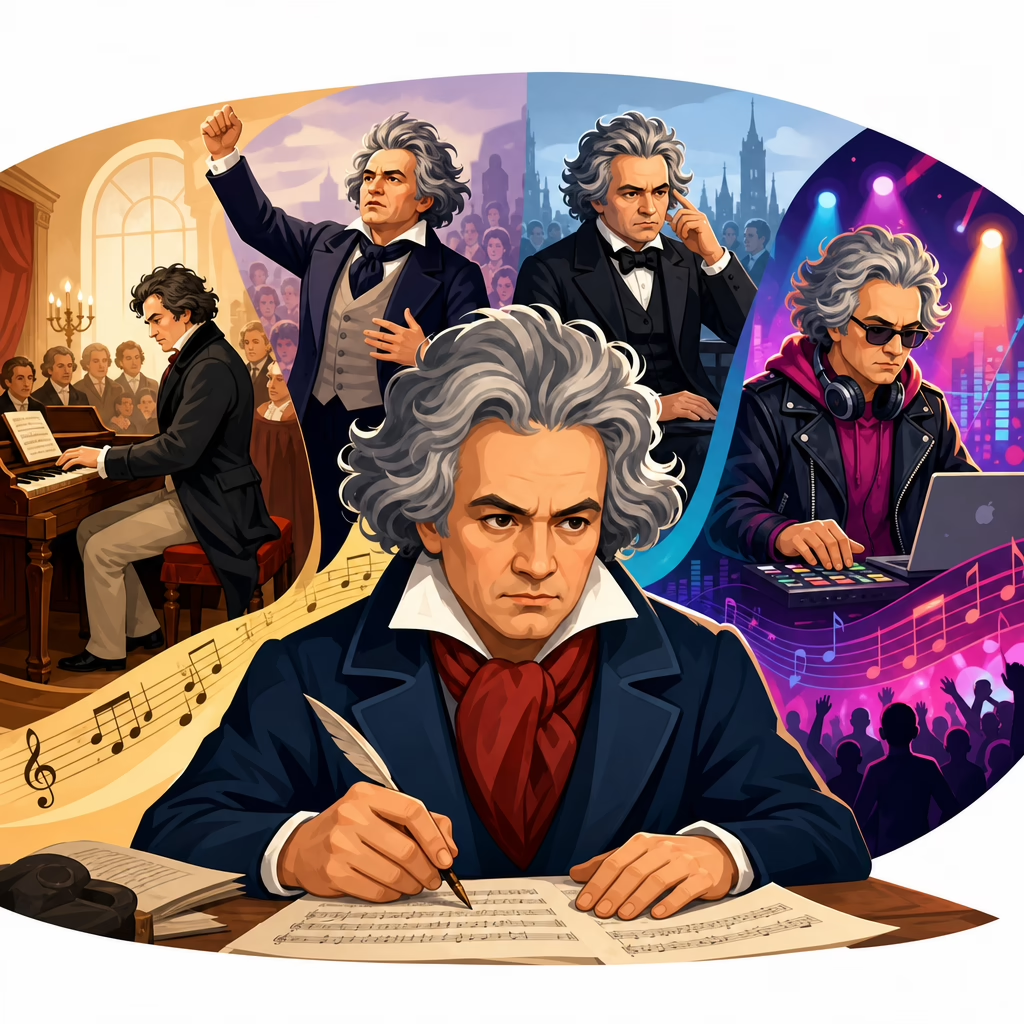
How Interpretations of Beethoven Have Changed Over Time
How interpretations of Beethoven have changed over time is really a history of changing ears. The notes on the page have remained stable, yet tempo, articulation, vibrato, orchestral size, piano design, recording practice, and cultural expectation have all shifted dramatically. In performance and recordings, “interpretation” means the practical set of choices performers make beyond the printed score: pacing, balance, phrasing, dynamics, pedaling, ornament, bowing, attack, rubato, and even the emotional stance taken toward the music. Beethoven matters especially because his works sit at the center of the repertory. Conductors build careers on the symphonies, pianists are judged by the sonatas and concertos, quartets return to the late works for artistic credibility, and listeners often use Beethoven as a benchmark for seriousness, intensity, and originality.
I have worked through Beethoven performances in archives, score study sessions, and listening comparisons for years, and one lesson keeps returning: there is no single “correct” Beethoven frozen outside history. There are informed, persuasive, and stylistically coherent Beethovens. There are also heavy traditions that later generations revise. Early twentieth-century performers often treated Beethoven as a monument of moral grandeur, broadening tempos and thickening sonority. Mid-century recordings emphasized structural sweep and orchestral discipline. Later historically informed performers asked a disruptive question: what if Beethoven sounded leaner, sharper, faster, and more dance-like than modern tradition had assumed?
This matters because interpretation changes what audiences think the music says. The opening of the Fifth Symphony can sound like fate knocking, a revolutionary gesture, or a tightly sprung rhythmic cell, depending on tempo and articulation. The “Moonlight” Sonata can drift as a nocturne or move with underlying pulse and harmonic tension. The Ninth can become a giant ceremonial statement or a dangerous, urgent drama. Understanding these shifts helps listeners hear performances more intelligently, choose recordings that match their taste, and connect related articles across the wider performance and recordings landscape.
From Beethoven’s World to the Romantic Beethoven
Beethoven wrote for instruments and ensembles different from those most listeners encountered in the twentieth century. Viennese pianos had lighter action, quicker decay, and clearer bass definition than later concert grands. Orchestras were generally smaller. String players used less continuous vibrato, wind instruments had different color and response, and timpani could speak with a startlingly hard edge. The scores themselves contain many clues: detailed dynamics, metronome marks for some works, accents, sfz markings, and abrupt contrasts that imply volatility rather than generalized grandeur.
Yet the nineteenth century gradually recast Beethoven through a Romantic lens. As concert halls grew larger and instrument technology changed, performers often expanded sonority and sustained line in ways that suited new spaces and expectations. Conductors increasingly treated the symphonies as civic monuments. Pianists brought singing tone and legato associated with Chopin and Liszt into Beethoven, sometimes at the expense of the music’s percussive bite. By the late nineteenth century, Beethoven was not just a composer; he was a cultural symbol of heroism, struggle, and transcendence. That symbolic burden encouraged interpretive breadth and rhetorical weight.
This shift was not simply distortion. It reflected genuine continuities. Beethoven did push instruments and forms past accepted limits. He did cultivate extremes of scale and intensity. But Romantic performance often amplified one side of him while muting another. The rough humor, rhythmic snap, dance inheritance, and startling transparency of his textures could disappear under rich string sonority and expansive pacing. The result was a Beethoven revered for spiritual depth, but sometimes detached from the physical energy embedded in the notation.
The Recording Era and the Rise of Tradition
Recordings made Beethoven interpretation comparable in a new way. Before records, memory and local custom shaped reception. Once listeners could replay the same Fifth Symphony or “Appassionata” Sonata repeatedly, traditions hardened. Early electrical recordings from conductors such as Arturo Toscanini, Wilhelm Furtwängler, Bruno Walter, and later Herbert von Karajan did not agree with each other, but together they established the idea that Beethoven interpretation carried enormous prestige and philosophical weight.
Toscanini represented one powerful line: taut rhythm, textual fidelity, driven tempos, and transparent orchestral execution. Furtwängler represented another: flexible tempo, long-breathed architecture, and intensely charged transitions. Hearing their recordings side by side remains one of the clearest ways to understand interpretive divergence. In Furtwängler’s wartime Ninth, tempo modification becomes part of the drama itself; in Toscanini, propulsion and discipline produce a different kind of inevitability. Neither approach is neutral. Each reveals different structural priorities within the same score.
On the piano side, performers such as Artur Schnabel, Wilhelm Kempff, Claudio Arrau, and later Alfred Brendel helped define the recorded Beethoven sonata tradition. Schnabel’s cycle, despite technical imperfections, became foundational because of its intellectual urgency and refusal to smooth over difficulty. Kempff emphasized lyric inwardness and spiritual flow. Arrau favored tonal depth and philosophical breadth. These artists shaped what listeners expected Beethoven to sound like for decades. Even when younger pianists resisted them, they were resisting an inherited standard preserved by records, radio, and conservatory teaching.
Recording technology also changed interpretation indirectly. Microphones rewarded detail but could also encourage balance decisions unlike those in the hall. Editing made precision more attainable and, eventually, more expected. Stereo intensified spatial clarity. As the industry marketed “complete cycles,” Beethoven became a repertory of benchmark recordings, inviting comparison not just work by work but across an artist’s entire conception.
Historically Informed Performance Changed the Conversation
The most important late twentieth-century shift was the spread of historically informed performance. Its central claim was simple: to understand Beethoven interpretation, performers should take seriously the instruments, playing techniques, ensemble sizes, notation habits, and rhetorical assumptions of his time. This did not mean antiquarian reconstruction for its own sake. At its best, it meant recovering options that modern tradition had obscured.
Conductors such as Roger Norrington, John Eliot Gardiner, Nikolaus Harnoncourt, Christopher Hogwood, and later François-Xavier Roth and others challenged mainstream Beethoven with sharper articulation, reduced vibrato, quicker tempos, more audible wind and brass lines, and timpani prominent enough to alter the music’s profile. Suddenly inner rhythms mattered differently. Repeated notes bit into the texture. Sforzandi stopped sounding like generalized emphasis and became local shocks. In the Seventh Symphony, for example, dance pulse and accent pattern emerged with unusual clarity. In the Eroica, funeral-march heaviness could give way to tensile motion.
Period pianos transformed the sonatas and concertos in parallel fashion. Performers such as Malcolm Bilson, Ronald Brautigam, and Andreas Staier demonstrated that Beethoven’s keyboard writing can sound less orchestral in the late Romantic sense and more speech-like, improvisatory, and rhythmically alive. Fast movements gained articulation because passagework did not blur under massive sustain. Slow movements acquired intimacy and fragility. Even famous pedaling problems look different on historical instruments, where resonance behaves unlike a modern Steinway or Bösendorfer.
Historically informed performance did not replace modern-instrument Beethoven, but it permanently changed the baseline. Today even traditional orchestras often play Beethoven with lighter textures, cleaner articulation, less portamento, and stronger attention to original tempo relationships than they did in the 1950s.
What Actually Changed in Performance Practice
When listeners ask how Beethoven interpretations have changed over time, the most useful answer is to identify the musical parameters that shifted.
| Parameter | Earlier mainstream tendency | More recent tendency | Effect on the listener |
|---|---|---|---|
| Tempo | Broader outer movements, expansive slow movements | Faster allegros, steadier pulse, closer attention to metronome debate | Greater urgency, dance character, clearer structure |
| Articulation | Smoother legato, blended orchestral mass | Shorter attacks, more separation, stronger accent profile | Rhythmic definition and sharper contrasts |
| Vibrato | Continuous string vibrato | Selective vibrato, more varied color | Transparency and clearer harmonic texture |
| Ensemble size | Larger orchestras and string sections | Leaner forces in many performances | More audible winds, brass, and timpani |
| Piano sound | Large modern grand, sustained sonority | Greater interest in fortepiano or lighter modern approach | Cleaner textures and less pedal saturation |
| Rubato | More elastic phrasing in some traditions | Stronger rhythmic discipline, localized flexibility | Form feels more cumulative and less rhetorical |
These changes are audible across genres. In string quartets, older ensembles often pursued blended warmth and continuous line, while more recent groups may highlight motivic exchange, contrast of bow stroke, and the grain of Beethoven’s writing. In piano concertos, the relation between soloist and orchestra has shifted from a grand Romantic solo vehicle toward a more conversational, chamber-like design. In overtures, brisker tempos can restore theatrical momentum often lost in concert-hall solemnity.
One caution is essential: newer is not automatically better. A fast tempo that ignores acoustic realities or ensemble capability can sound superficial. A period instrument does not guarantee insight. Conversely, a broad, modern performance can still be convincing if it clarifies structure and emotional logic. Interpretation succeeds when choices cohere and illuminate the score.
Case Studies: Symphonies, Sonatas, Quartets, and Concertos
The symphonies show the broadest public shift. Compare mid-century recordings of the Fifth or Ninth with later period-informed cycles and the differences are immediate. Brass and timpani project more aggressively now. Scherzos move with more lift. Repeats are more often observed, changing proportion. The Eighth Symphony, once treated as a genial interlude, is increasingly recognized as a compact experiment full of rhythmic wit and abrupt muscularity. The Pastoral, formerly wrapped in pastoral warmth, now often emphasizes peasant dance, storm violence, and precise instrumental color.
In the piano sonatas, the old image of Beethoven as a proto-Brahmsian titan has weakened. Performers now pay closer attention to abrupt character changes, humor, and the improvisatory qualities of transitions. The “Hammerklavier” remains a proving ground. Some pianists still favor monumental breadth in the Adagio and colossal sonority in the fugue, but many now seek transparency, speaking rhythm, and a tempo framework that binds the whole sonata into one argument. The late sonatas especially benefit from this rebalancing, because their visionary qualities emerge more strongly when the counterpoint stays clear.
String quartets have also moved away from generalized nobility. Ensembles such as the Alban Berg Quartet, Takács Quartet, Quatuor Mosaïques, Emerson String Quartet, and newer groups offer sharply different Beethovens, from luminous modern polish to historically informed grain and bite. In Op. 131 or the Grosse Fuge, modern listeners increasingly accept roughness, asymmetry, and strain as expressive values rather than defects to be smoothed away.
The concertos reveal another major change: Beethoven the dramatist has overtaken Beethoven the stately classicist. In the Fourth Piano Concerto, the opening solo is less often floated as abstract poetry and more often shaped as an intimate proposition answered by orchestral tension. In the Violin Concerto, lighter articulation and leaner accompaniment can restore buoyancy to a work long burdened by oversized Romantic rhetoric. Cadenzas, too, are chosen with greater historical curiosity, connecting performance to Beethoven’s own improvisatory world.
Why Interpretations Will Keep Changing
Beethoven interpretation will continue to change because performance is not a museum display. New editions clarify sources. Musicians hear more recordings from more traditions than any previous generation. Concert halls, instruments, audience attention spans, and institutional training continue to evolve. So do values. Today many performers are less interested in presenting Beethoven as an untouchable monument and more interested in showing his unpredictability, wit, violence, and formal daring. That shift has made the music feel younger, not older.
For listeners, the practical benefit is freedom. You do not need one definitive Beethoven cycle. You need a sense of the interpretive spectrum. Hear Furtwängler for elastic grandeur, Toscanini for propulsion, Karajan for sonic architecture, Gardiner for rhythmic clarity, Brautigam for fortepiano insight, Schnabel for intellectual urgency, and a fine contemporary quartet for the late works’ modernity. The more versions you compare, the more Beethoven’s scores open up.
The central takeaway is straightforward: interpretations of Beethoven have changed over time because musicians keep rediscovering what the notation can support. Romantic breadth, modernist discipline, and historically informed clarity each revealed something real. None exhausted the music. If you want to deepen your understanding of performance and recordings, use this hub as a starting point, then explore individual works, major conductors, landmark pianists, and quartet traditions through the related pages in this subtopic. Listening comparatively is the fastest way to hear history at work.
Frequently Asked Questions
What does “interpretation” mean in Beethoven performance, and why has it changed so much over time?
In Beethoven performance, “interpretation” refers to all the practical musical decisions that are not fully fixed by the printed notes alone. That includes tempo, articulation, phrasing, balance between instruments, dynamic shaping, pedaling at the piano, use of vibrato, bow strokes, rhythmic flexibility, emphasis, and even the emotional character projected in performance. Beethoven’s scores are rich in markings, but they do not function like audio recordings. Performers still have to decide how strongly to accent a phrase, how long to hold a silence, how sharply to articulate repeated notes, how much weight to give the bass line, or how broadly to shape a climax.
These choices have changed because listening habits, instruments, ensembles, and musical values have changed. A Beethoven symphony played in the 19th century would have sounded different from one performed by a large modern orchestra in the mid-20th century, and different again from a historically informed ensemble using period instruments today. Ears evolve with culture. Audiences in one era may prefer grandeur, sustained tone, and expressive rubato, while another era may value rhythmic tension, textual clarity, and leaner sonorities. Recording technology also played a major role, because it encouraged more precise repeatable interpretations and helped establish certain performance styles as “standard.” In that sense, the history of Beethoven interpretation is not a story of the notes changing, but of performers and listeners hearing those notes through different artistic assumptions.
How did 19th-century and early 20th-century musicians typically interpret Beethoven differently from many performers today?
In the 19th century and into the early 20th century, Beethoven was often treated as a monumental, emotionally expansive composer whose music invited a broad, weighty, and highly rhetorical style of performance. Conductors and pianists frequently used more flexible tempos, stronger rubato, fuller sonorities, and a more overtly romantic approach to phrasing. Orchestras grew larger over time, string sections became heavier, vibrato became more continuous, and the overall sound ideal moved toward richness and power. Performers often emphasized Beethoven as a prophetic hero of musical struggle, which encouraged interpretations that were dramatic, grand, and sometimes slower than what many musicians now consider practical or stylistically revealing.
Today, many performers aim for greater transparency and sharper definition. Influenced by musicological research and historically informed performance practice, they may favor quicker tempos, lighter articulation, cleaner textures, more audible inner voices, and less generalized vibrato. The goal is often to recover Beethoven’s energy, volatility, and rhythmic drive rather than to present him as simply massive and solemn. This does not mean modern interpretation is uniform. Some musicians still prefer a broad symphonic Beethoven, while others pursue a lean, urgent, highly articulated approach. But compared with many earlier traditions, current performances are often more attentive to period evidence, more alert to instrumental color, and more interested in the contrasts and unpredictability built into the music itself.
How have changes in instruments affected the way Beethoven is interpreted?
Changes in instrument design have had an enormous impact on Beethoven interpretation. The piano is one of the clearest examples. Beethoven composed for instruments that were lighter in action, quicker in response, and less sustaining than the modern concert grand. On those earlier pianos, articulation speaks differently, bass textures can sound less thick, and pedaling creates different colors from what listeners hear on a modern Steinway or similar instrument. As pianos became more powerful and resonant in the 19th and 20th centuries, performers naturally adapted their phrasing, dynamics, and pedaling. Passages that may have sounded crisp and transparent on an early fortepiano could become much more orchestral, blended, or thunderous on a modern piano.
The same is true in the orchestra. Period string instruments, gut strings, classical bows, natural horns, and older woodwinds produce different balances and attack patterns from their modern descendants. Natural brass can sound more raw and brilliant, timpani can cut through texture differently, and gut strings often invite a more varied articulation than continuous sustained weight. When performers use historical or historically modeled instruments, Beethoven’s orchestral writing can sound more transparent and more rhythmically volatile, with stronger contrasts between instrumental groups. By contrast, modern instruments often produce a broader dynamic range, a more even tone, and a more blended symphonic mass. Neither approach is automatically “right,” but each opens different interpretive possibilities and changes how listeners perceive the architecture and emotional force of the music.
What role has historically informed performance played in changing Beethoven interpretation?
Historically informed performance, often called HIP, has been one of the most important forces reshaping Beethoven interpretation in the last several decades. This movement encourages performers to study the musical practices, instruments, notation habits, and aesthetic assumptions of Beethoven’s own era rather than relying only on later performance traditions. For Beethoven, that has meant renewed attention to period instruments, articulation patterns, orchestral size, tempo relationships, accents, phrasing conventions, and the implications of Beethoven’s metronome markings. It has also led musicians to question long-established habits, such as very heavy string playing, constant vibrato, overly blended textures, or tempos slowed by romantic tradition.
One of HIP’s biggest contributions has been to reintroduce risk, edge, and contrast into Beethoven performance. Instead of treating the music as uniformly monumental, many historically informed performers present it as fiercely dramatic, sharply profiled, and full of sudden turns. Fast movements can feel more urgent and dance-like, slow movements more singing but less sentimentalized, and scherzos more biting and rhythmically alive. Even musicians who do not perform on period instruments have absorbed these lessons. As a result, historically informed performance has influenced mainstream Beethoven playing far beyond specialist circles. It has expanded the interpretive conversation by showing that Beethoven can be understood not only as a romantic monument, but also as a composer rooted in classical rhetoric, physical gesture, and bold experimental sonority.
Have recordings and modern audience expectations changed what listeners think Beethoven should sound like?
Yes, profoundly. Recording technology transformed Beethoven interpretation by making performances repeatable, comparable, and widely influential. Before recordings, interpretation was more localized and ephemeral. Audiences heard the Beethoven available in their concert life, and performance traditions could vary significantly from city to city or teacher to teacher. Once recordings became central to musical culture, certain conductors, pianists, and orchestras helped establish powerful interpretive models. Listeners came to know specific tempos, balances, expressive gestures, and overall sound ideals through repeated listening. In effect, recordings taught generations of audiences what “Beethoven” sounded like, even though those expectations often reflected a particular historical moment rather than timeless truth.
Modern audiences also bring different cultural expectations to Beethoven than earlier listeners did. Some expect heroic grandeur and symphonic weight; others expect textual fidelity, historical awareness, and leaner precision. Film, media, education, and the prestige of famous recorded cycles have all contributed to these assumptions. At the same time, high-quality recording and streaming have made details more audible than ever, which can encourage performers to prioritize clarity, control, and structural coherence. Yet live performance still allows room for individuality, and that remains essential. The most compelling Beethoven interpretations today often balance knowledge of historical style with the confidence to make vivid, personal choices. That is why Beethoven continues to feel contemporary: every era hears him anew, and every strong performance becomes part of that ongoing history of changing ears.