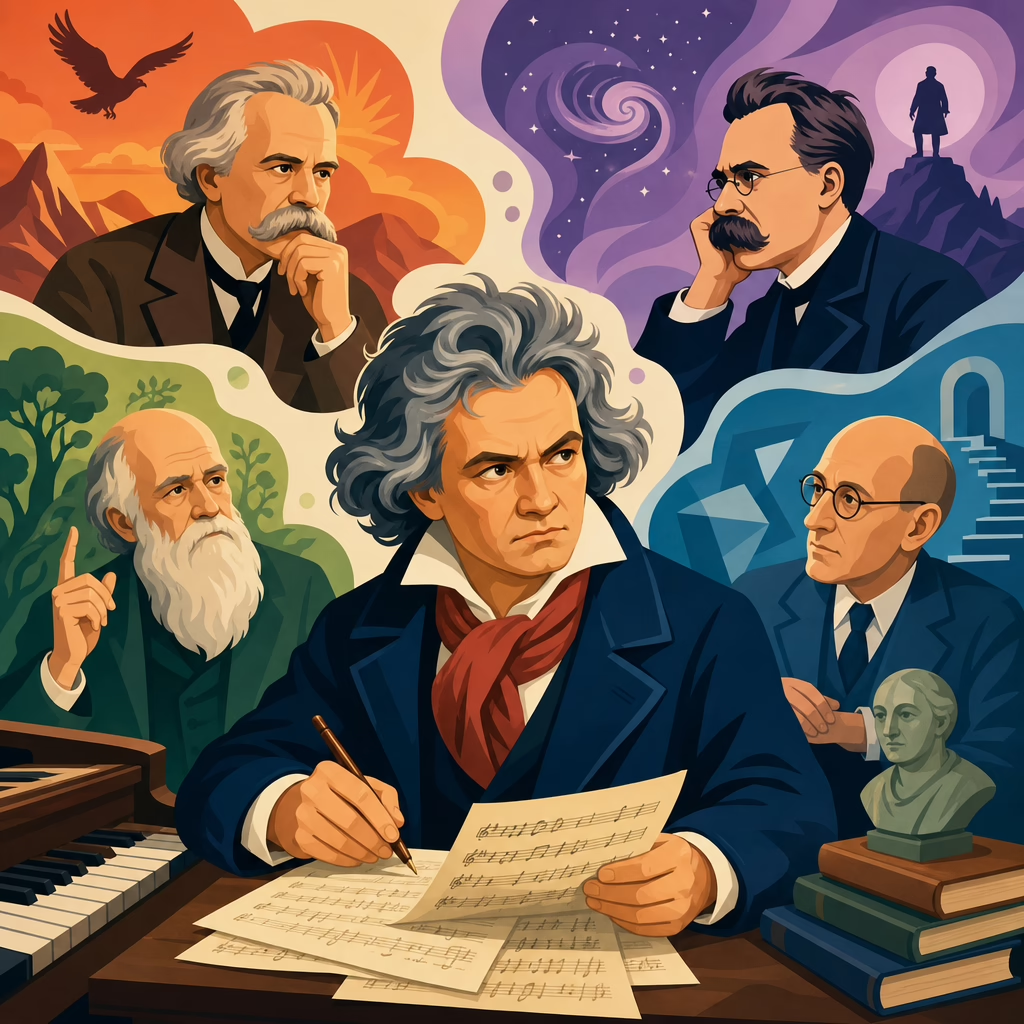
How Beethoven Was Interpreted by Later Philosophers
Ludwig van Beethoven became more than a composer within decades of his death; he became a philosophical test case for questions about genius, freedom, suffering, modernity, and the social purpose of art. When later philosophers interpreted Beethoven, they were rarely discussing music alone. They were using his works, his public image, and his biography to ask what human beings can express when language reaches its limit. In practice, that means Beethoven sits at the crossroads of aesthetics, ethics, metaphysics, and politics.
For readers exploring Beethoven’s inspirations and influence, this miscellaneous hub matters because philosophical interpretations help explain why the same symphonies and sonatas have been heard as heroic, tragic, revolutionary, spiritual, formally rigorous, and even politically dangerous. Key terms are worth defining at the start. By interpretation, philosophers mean more than personal opinion; they mean a reasoned account of what Beethoven’s music reveals about beauty, truth, history, consciousness, or society. By later philosophers, we usually mean thinkers writing after Beethoven’s mature career, especially from the nineteenth century onward, when his reputation had already begun to harden into cultural myth.
I have found, in working through both philosophical texts and the scores themselves, that Beethoven provokes unusually strong claims because his music combines structural discipline with emotional extremity. The Eroica Symphony, the Fifth Symphony, the late piano sonatas, the Missa solemnis, and the Ninth Symphony all invite arguments about whether music represents ideas, embodies freedom, resists domination, or points toward transcendence. This article maps the major lines of interpretation so readers can use it as a hub for deeper study across related pieces, periods, and debates.
Why Beethoven Became a Philosophical Figure
Beethoven attracted philosophers for three practical reasons. First, his career coincided with the aftermath of the Enlightenment, the French Revolution, and the rise of modern individualism. Second, his increasing deafness encouraged the image of the isolated creator wrestling with fate. Third, his music expanded established Classical forms so dramatically that listeners felt they were hearing not just elegant composition but a new claim about human interior life. By the early nineteenth century, critics were already treating instrumental music as a privileged art, and Beethoven became the central example.
E.T.A. Hoffmann, though primarily remembered as a writer and critic rather than a systematic philosopher, set the tone. His famous review of Beethoven’s Fifth cast instrumental music as the most romantic of arts because it opens the realm of the infinite. That formulation shaped later idealist and post-idealist thought. Beethoven’s music came to signify the capacity of art to disclose realities that concepts cannot fully capture. Once that claim took hold, philosophers could hardly ignore him.
German Idealism and the Question of Spirit
The broad climate of German Idealism did not produce a single official doctrine of Beethoven, but it created the framework through which he was heard. Thinkers influenced by Kant, Fichte, Schelling, and Hegel debated how art mediates sensibility and freedom, nature and spirit, individual feeling and universal form. Beethoven’s instrumental works seemed to enact those tensions in sound. He could move from terse motifs to large-scale coherence, making abstract form feel like a process of self-development.
Hegel himself did not leave an extended reading of Beethoven comparable to later commentators, yet Hegelian aesthetics shaped generations of interpretation. Within that orbit, Beethoven could be heard as demonstrating how subjective inwardness becomes objective structure. The sonata form movement, for example, was not merely a layout of themes and keys; it became, in philosophical ears, a drama of contradiction and reconciliation. That way of listening still influences concert notes today, especially in discussions of the Fifth Symphony and the late quartets.
Schopenhauer: Music as the Voice of the Will
Arthur Schopenhauer gave Beethoven one of the most consequential philosophical settings by arguing that music differs from all other arts. In The World as Will and Representation, he claimed painting and poetry represent appearances, while music speaks more directly from the underlying reality he called Will. Beethoven’s music fit this theory perfectly because it seemed less dependent on words or external images than opera, song, or program music. For Schopenhauer, a Beethoven symphony did not describe emotion from the outside; it objectified the inner striving of existence itself.
This matters because it elevated Beethoven from master craftsman to metaphysical witness. A slow movement could register resignation without needing a narrative. A development section could sound like conflict at the level of being, not character. Schopenhauer’s model influenced both listeners and composers, especially Richard Wagner, who treated Beethoven as the culmination of absolute music and the doorway to music drama. Even when modern scholars reject Schopenhauer’s metaphysics, they still reckon with his central insight: Beethoven encouraged listeners to hear instrumental music as philosophically serious in its own right.
Nietzsche: From Dionysian Energy to Cultural Diagnosis
Friedrich Nietzsche’s relationship to Beethoven was admiring, strategic, and unstable. In his early work, especially The Birth of Tragedy, Nietzsche inherited Schopenhauer’s high estimation of music but redirected it through the tension between Apollonian form and Dionysian intoxication. Beethoven could appear as a figure who harnessed primal force within disciplined musical architecture. The opening of the Fifth Symphony or the ecstatic propulsion of the Seventh invited exactly this kind of reading: form under pressure, energy given shape without being neutralized.
Later Nietzsche became more suspicious of German cultural self-celebration, and Beethoven could no longer function simply as a national saint. He was interpreted within a broader critique of Wagnerian excess, romantic seriousness, and the tendency to turn art into moral sermon. Even then, Nietzsche did not dismiss Beethoven. He treated him as evidence that great art emerges from struggle rather than comfort. The philosophical lesson was not that Beethoven delivers tidy redemption, but that art can transform suffering into style, and style into a form of strength.
Marxist and Critical Interpretations of Beethoven
Twentieth-century Marxist and critical theorists asked a harder question: what social truth is carried by Beethoven, and what ideological uses has his prestige served? The most important figure here is Theodor W. Adorno, whose writings on Beethoven remain indispensable. Adorno heard Beethoven as a composer whose forms are historical processes, not decorative containers. In pieces such as the Eroica, the Appassionata Sonata, and the late style works, he argued that musical material develops through tension, fracture, and negative labor. Beethoven’s greatness lay not in comforting unity but in making contradiction audible.
Adorno’s Beethoven is never just uplifting. He is modern because he shows the cost of reconciliation. The famous triumph in the Fifth Symphony gains force only because the music has passed through real conflict. The late works, especially Opp. 109-111 and the late quartets, fascinated Adorno because they refuse smooth closure. Their abrupt juxtapositions, fugues, and inward turns reveal an artist no longer interested in flattering the listener. That reading shaped later debates about autonomy, commodification, and resistance in art.
| Philosopher | Core idea about Beethoven | Representative emphasis |
|---|---|---|
| Schopenhauer | Music expresses underlying reality more directly than other arts | Metaphysical depth of instrumental music |
| Nietzsche | Beethoven transforms suffering into form and force | Struggle, vitality, and cultural critique |
| Adorno | Form carries historical contradiction and unresolved tension | Modernity, negativity, late style |
| Bloch | Music contains utopian longing and not-yet-realized possibility | Hope, futurity, human emancipation |
Ernst Bloch offered a related but distinct approach. Where Adorno stressed negativity, Bloch often heard Beethoven as carrying utopian surplus, especially in works that seem to project a future not yet achieved. The Ninth Symphony became central here, not as a simple anthem of brotherhood, but as a powerful instance of anticipatory consciousness. Bloch’s interpretation helps explain why Beethoven could inspire both political radicals and humanist idealists: his music sounds unfinished with respect to the world, as though reality has not yet caught up with its promise.
Existential, Phenomenological, and Hermeneutic Readings
Existential and phenomenological thinkers approached Beethoven less as a monument and more as an event in experience. The question shifted from “What doctrine does the music express?” to “How does it appear to consciousness, time, embodiment, and listening?” Roman Ingarden, for example, helped clarify that a musical work is neither identical with the score nor reducible to any single performance. This matters for Beethoven because philosophical claims about him often confuse composition, interpretation, and reception. A late quartet exists across notation, performance tradition, and attentive listening.
Hermeneutic thinkers such as Hans-Georg Gadamer treated major artworks as partners in historical dialogue. Beethoven’s music, in this frame, is not frozen in 1808 or 1824. It becomes meaningful through repeated acts of understanding shaped by tradition. That helps explain why the same Ninth Symphony could be used at solemn commemorations, democratic celebrations, and state spectacles. Philosophically, Beethoven demonstrates that meaning is not arbitrary, but neither is it exhausted by original intention. Every serious performance tests what in the work remains living.
Political Appropriations and Ethical Caution
No account of philosophical interpretations of Beethoven is complete without noting misuse. Because his music acquired prestige across Europe and beyond, rival ideologies claimed him. Liberal humanists celebrated the Ninth as a vision of universal fellowship. Nationalists treated Beethoven as proof of German cultural supremacy. Totalitarian regimes appropriated him for legitimacy, while postwar Europe reused him, through the “Ode to Joy,” as a symbol of shared civic aspiration. The same work supported sharply different narratives because philosophical symbols are powerful precisely when they exceed one fixed message.
This creates an ethical obligation in interpretation. Beethoven was not a blank slate, but neither does his music guarantee the values later attached to it. Serious philosophers therefore distinguish between what is structurally persuasive in the works and what is projected onto them. When I compare political readings of the Eroica and Ninth, the strongest arguments stay close to musical detail: tonal conflict, thematic transformation, formal expansion, choral entry, and rhetorical pacing. The weakest arguments use Beethoven as a mascot. That distinction is essential for anyone using this hub as a guide to further reading.
How Philosophers Read Specific Works
Philosophical interpretation becomes clearest when attached to individual compositions. The Eroica Symphony is usually read as a turning point in musical subjectivity: scale, dissonance, funeral march, and disruptive development create a model of heroic struggle that later writers linked to revolution, self-overcoming, and modern history. The Fifth Symphony attracts arguments about fate, teleology, and victory because its compact opening motive is transformed across movements into an overwhelming narrative of propulsion. Whether that narrative is truly triumphant remains debated, which is exactly why philosophers keep returning to it.
The late quartets and late piano sonatas often generate the deepest philosophical commentary. Their fugues, variations, asymmetries, and sudden contrasts resist easy emotional labeling. Some hear transcendence; others hear fragmentation. The Missa solemnis invites arguments about faith beyond dogma, while the Ninth Symphony raises questions about whether purely instrumental aspiration is fulfilled or interrupted by the entrance of text and chorus. In practical terms, these works function as crossroads for nearly every major debate in aesthetics: autonomy versus expression, form versus meaning, and universality versus historical context.
Why These Interpretations Still Matter
Later philosophers interpreted Beethoven because his music forced them to clarify what they believed art can do. Is music a window into metaphysical truth, a record of historical contradiction, an embodiment of freedom, a disciplined form of feeling, or a site where communities rehearse ideals they have not yet realized? Beethoven has been used to answer yes to all of these, though never without tension. That is precisely his philosophical importance. He invites strong claims, then complicates them.
For readers moving through the wider Beethoven’s inspirations and influence topic, this hub offers a map of the main philosophical pathways and the questions attached to them. Follow those pathways into studies of Schopenhauer and music, Nietzsche on tragedy, Adorno on late style, political readings of the Ninth, or performance philosophy around the quartets. The benefit of this approach is simple: you hear more when you know what generations of thinkers have heard at stake. Start with one work, one philosopher, and listen closely with the score or a trusted recording beside you.
Frequently Asked Questions
Why did later philosophers treat Beethoven as more than a composer?
Later philosophers often treated Beethoven as more than a composer because his life and works seemed to embody major philosophical problems in unusually concentrated form. He was not simply a successful musician who wrote admired pieces. He became a symbol of artistic autonomy, inner struggle, and the possibility that art could say something decisive about human freedom when ordinary language could not. His public image, especially after his death, encouraged this reading. The story of a composer confronting deafness, isolation, social tension, and enormous creative ambition made Beethoven appear to many thinkers as a test case for the meaning of genius itself.
Philosophers were also drawn to the fact that Beethoven stood at a historical turning point. He inherited classical forms, but he stretched them with an intensity that later generations heard as unmistakably modern. That made him useful for debates about whether art should preserve order, express subjectivity, challenge society, or point toward some higher truth. A symphony, sonata, or quartet by Beethoven could be interpreted not only as a musical achievement but as evidence in larger arguments about the self, history, morality, and community.
Just as important, Beethoven’s music invited philosophical interpretation because it seemed to exceed straightforward description. Listeners often felt that his work conveyed struggle, reconciliation, transcendence, rupture, and even ethical seriousness without reducing those experiences to concepts. For philosophers concerned with the limits of language, this was crucial. Beethoven appeared to show that human beings can think and communicate through form, tension, and sound in ways that are not easily paraphrased. That is one reason later philosophers repeatedly returned to him: he allowed them to ask what art can reveal when discursive reasoning reaches its boundary.
How did philosophers connect Beethoven to ideas about genius, freedom, and suffering?
Beethoven became central to philosophical discussions of genius because he seemed to unite originality, discipline, and necessity in a single figure. In many later interpretations, genius is not just talent or inspiration. It is the power to create forms that feel both unprecedented and inevitable. Beethoven’s music often gave listeners exactly that impression. Philosophers heard in his works a force that was highly personal yet not merely subjective, structured yet not mechanical, emotionally intense yet not chaotic. This made him an ideal example for thinkers who wanted to understand how genuine creativity can transform inherited tradition rather than simply reject it.
Freedom entered the picture in several ways. On one level, Beethoven represented artistic independence. He was often portrayed as someone who refused to serve convention passively, whether social, political, or musical. Philosophers used that image to discuss autonomy: what it means for a human being to shape form from within rather than merely obey external rules. On another level, freedom was heard inside the music itself. Many interpreters described Beethoven’s compositions as dramatizing conflict and resolution, constraint and release, fragmentation and unity. Even when those interpretations go beyond what can be proven from notes alone, they reflect a powerful intuition: Beethoven’s music seems to enact freedom as a process achieved through struggle, not given in advance.
Suffering was equally important because Beethoven’s biography made it impossible to separate the question of creation from the reality of pain. His deafness became especially symbolic. Later philosophers did not treat it simply as a medical fact; they read it as part of a larger drama about inwardness, limitation, resilience, and the cost of artistic vocation. Some saw Beethoven as proving that suffering can be transfigured into form. Others warned against romanticizing pain, but still acknowledged that his case raises hard questions about whether artistic greatness often emerges through confrontation with what cannot be overcome. In this way, genius, freedom, and suffering became inseparable themes in philosophical readings of Beethoven: the creator who turns necessity into expression and private affliction into works of enduring public meaning.
What did philosophers hear in Beethoven’s music that seemed to go beyond words?
Many philosophers believed Beethoven’s music demonstrated that some dimensions of human experience are intelligible without being fully conceptual. They heard in his compositions a kind of meaning that is real, structured, and communicable, yet not easily translated into prose. This is especially significant in philosophy because so much philosophical work depends on language, argument, and definition. Beethoven’s music challenged the assumption that what matters most can always be said directly. Instead, it suggested that form itself can think, that development, contrast, rhythm, and tonal movement can disclose truths about conflict, longing, joy, and historical existence.
For some thinkers, this made Beethoven a model of expressive depth. A slow movement, a dramatic opening, or a final choral affirmation could seem to articulate what the human voice cannot fully explain. The point was not always that the music had a fixed verbal message hidden inside it. Rather, philosophers were often interested in the way Beethoven’s works organize emotional and intellectual energies. The music can feel argumentative without using concepts, communal without relying on explicit doctrine, and spiritually ambitious without becoming simple religious instruction. That combination gave philosophers a rich object for reflection.
Beethoven also mattered because his music often seems to stage tension rather than erase it. Instead of presenting a smooth emotional surface, many of his works bring opposites into contact: order and disruption, intimacy and monumentality, grief and exaltation, solitude and collectivity. Philosophers saw in this a powerful account of human reality. Language often forces us to choose a single claim at a time, but music can hold contradictions in motion. That is why Beethoven was so often invoked when philosophers asked what art can express at the edge of the sayable. His music appeared to reveal a domain where meaning is not less rigorous than language, but differently rigorous.
How was Beethoven used in philosophical debates about modernity and the social purpose of art?
Beethoven became a major figure in debates about modernity because he seemed to stand between inherited order and emerging historical rupture. Philosophers interested in the modern world often ask whether art should preserve shared values, resist social fragmentation, expose contradiction, or imagine new forms of community. Beethoven’s works could plausibly support all of these interpretations, which is why he remained so useful. Some heard in him the fulfillment of a great classical tradition. Others heard the beginning of a more unstable, self-conscious, and historically burdened art. In that sense, Beethoven was not just an object of admiration; he was a battleground for competing theories of what modern art is supposed to do.
His music also played a role in arguments about whether art serves society directly or indirectly. On one side, Beethoven could be taken as evidence that art creates solidarity and elevates public life. The Ninth Symphony, especially, encouraged interpretations of music as a medium of collective aspiration, fraternity, and moral hope. On the other side, philosophers skeptical of easy cultural optimism pointed out that truly serious art does not simply affirm society as it exists. Beethoven’s intensity, formal difficulty, and refusal of mere entertainment suggested that art may serve the social whole precisely by resisting simplification and exposing unresolved tensions within modern life.
This is why Beethoven could be claimed by very different philosophical traditions. Idealist thinkers could regard him as revealing spirit in sensuous form. Critics of modern alienation could hear in his work the struggle of subjectivity against social damage. Defenders of artistic autonomy could cite him as proof that art must not be reduced to propaganda or utility. At the same time, politically minded interpreters could argue that his public significance shows art is never purely private. Beethoven thus became central to philosophical reflection on modernity because he made it difficult to separate aesthetic form from ethical life, historical change, and collective meaning.
Which later philosophers are most associated with interpreting Beethoven, and what did they emphasize?
Several major later philosophers are closely associated with influential interpretations of Beethoven, even when they approached him from very different angles. G.W.F. Hegel is an important background figure because his aesthetics helped shape the idea that art can embody spirit and historical development, even though he did not build a Beethoven-centered philosophy in the modern sense. Arthur Schopenhauer is also crucial because he elevated music as a uniquely direct expression of reality or will, and Beethoven naturally became one of the composers later readers placed within that framework. Friedrich Nietzsche complicated the picture by questioning moral and cultural assumptions around art while still treating music as a privileged site of profound human disclosure.
In the twentieth century, Theodor W. Adorno became one of the most important philosophical interpreters of Beethoven. Adorno did not treat Beethoven as a comforting icon of universal uplift. He emphasized formal tension, historical mediation, and the way Beethoven’s music could both crystallize and resist the contradictions of bourgeois modernity. For Adorno, Beethoven mattered not because he offered simple emotional nobility, but because the music thought through conflict in its very construction. This made Beethoven central to critical theory’s broader concerns with autonomy, society, and the truth-content of art.
Other philosophers and theorists also contributed significantly. Richard Wagner, though not primarily a philosopher, powerfully shaped the philosophical mythology of Beethoven by presenting him as a world-historical figure whose music pointed beyond conventional artistic limits. Later existential, hermeneutic, and phenomenological thinkers found in Beethoven questions about embodiment, inwardness, temporality, and interpretation itself. Across these traditions, the emphasis varies: some focus on genius, some on metaphysics, some on historical form, some on ethical seriousness, and some on the limits of language. What unites them is the sense that Beethoven cannot be