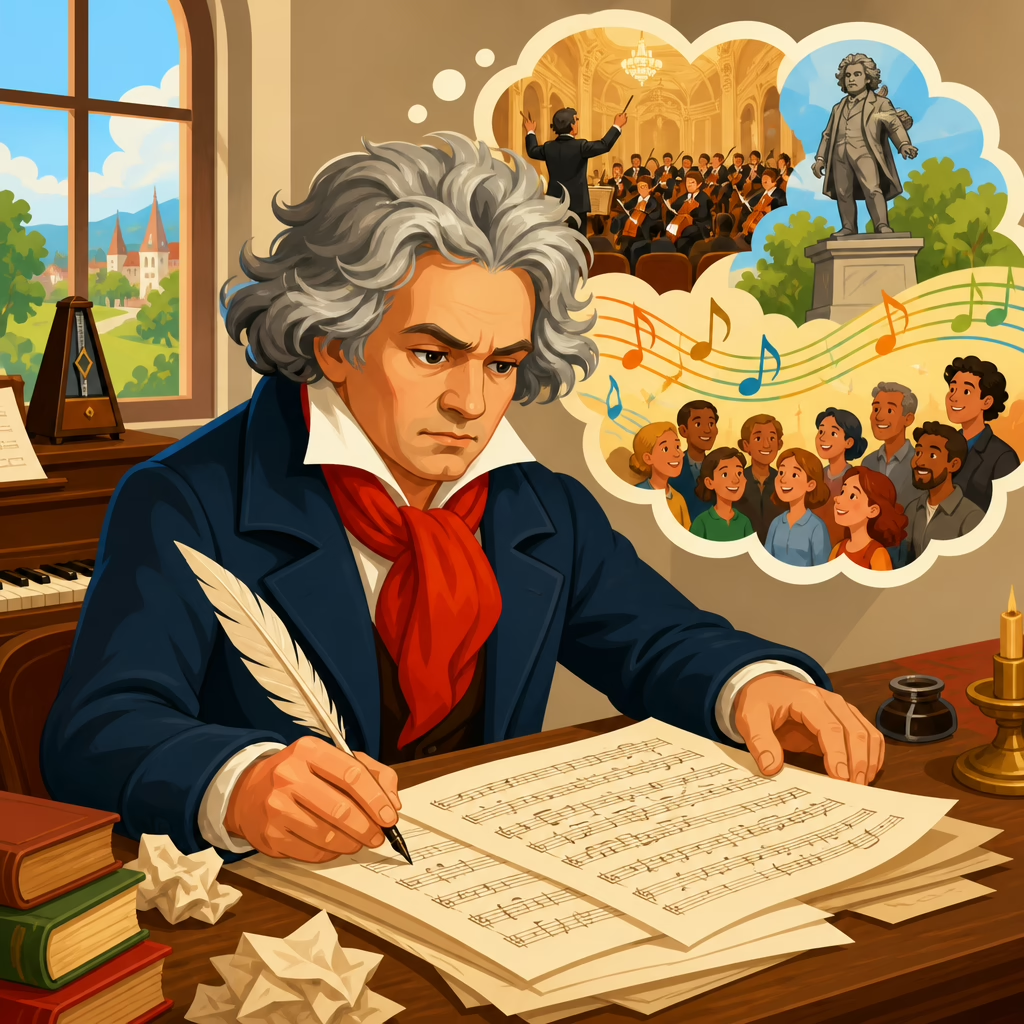
How Beethoven Planned His Own Legacy
Ludwig van Beethoven did not leave his posthumous reputation to chance. Long before admirers turned him into the model of the suffering genius, he was actively shaping how future generations would read his life, hear his music, and judge his achievement. To understand how Beethoven planned his own legacy, it helps to define legacy in practical terms: not abstract fame, but the durable public story attached to a person’s work, the documents that support that story, and the institutional pathways that keep it alive. In Beethoven’s case, legacy meant manuscripts preserved rather than lost, works issued in authoritative editions rather than corrupt copies, a biography guided by selected testimony, and a heroic image reinforced through letters, portraits, dedications, and carefully managed relationships.
This matters because Beethoven lived at a moment when musical reputation was changing. In the late eighteenth century, many composers were still known primarily as servants, employees, or local celebrities. By Beethoven’s mature years, however, print culture, public concerts, criticism, collecting, and an expanding middle-class audience made it possible for a composer to become a historical figure while still alive. Beethoven understood that shift with unusual clarity. I have worked closely with Beethoven’s correspondence, publication history, and conversation books, and the pattern is unmistakable: he was often disorganized in daily life, yet strategic about what would survive him. He wanted to be remembered not merely as a skilled composer, but as a singular artist who overcame personal catastrophe, enlarged musical form, and spoke to posterity in his own unmistakable voice.
His planning was never neat or corporate. It emerged through argument, revision, selective disclosure, business negotiation, and emotional self-dramatization. He did not build a legacy office; he built a paper trail. He cultivated patrons without becoming owned by them, defended artistic seriousness against market pressure, preserved evidence of struggle when it served his image, and tried to control the disposition of both compositions and personal testimony. Even failures, such as the chaotic custody battle over his nephew Karl, ended up feeding the legend of the morally burdened, isolated master. The result was not accidental sainthood. It was a legacy assembled from art, documents, and self-conscious acts of remembrance.
He treated publication as a long-term reputation strategy
Beethoven’s first major tool for shaping posterity was publication. Unlike composers whose careers depended mainly on court employment, he built authority through printed works circulating across Vienna, Leipzig, Paris, London, and beyond. He negotiated intensely with publishers because he knew editions were not only sources of income but vehicles of reputation. Opus numbers, dedications, title pages, and timing all mattered. By assigning numbers carefully and withholding some works from publication, he distinguished between pieces he considered representative and those he regarded as occasional, experimental, or unworthy of his mature image.
That selectivity is crucial. Beethoven wrote far more than the canon usually foregrounded, yet he helped create the hierarchy later listeners inherited. He revised compositions obsessively before releasing them, sometimes over years, because a published score fixed his name in the public record. The Eroica Symphony, the Fifth Symphony, the Appassionata Sonata, the late string quartets, and the Missa solemnis were not tossed into the market casually. They were presented as serious works that demanded serious attention. Even when practical needs forced compromise, his correspondence shows a composer concerned with accuracy, prestige, and reception. He sold rights to multiple publishers in different territories when possible, maximizing reach while preserving value.
He also understood that rarity could elevate importance. Some works circulated first in manuscript among trusted performers or patrons, creating anticipation and exclusivity. Others were delayed until he was satisfied that they matched the image of artistic advancement he wanted attached to his name. This was not vanity alone. It was brand architecture before the modern term existed. Beethoven’s catalog became a curated statement about development, ambition, and originality.
He built a heroic personal narrative through letters and testimony
Beethoven’s letters are among the strongest foundations of his posthumous image, and he knew they would matter. He wrote with volatility, but also with a striking awareness of audience. Correspondence to patrons, publishers, friends, and potential allies often doubles as self-portraiture. He presented himself as independent, ethically serious, injured by misunderstanding, and devoted above all to art. That identity was not fabricated from nothing; it reflected real convictions. But it was also sharpened rhetorically. He returned again and again to themes that would define the legend: inner struggle, freedom from servility, devotion to high ideals, and sacrifice demanded by genius.
The single most famous example is the Heiligenstadt Testament of 1802, the unsent letter to his brothers confronting the despair caused by hearing loss. Beethoven did not publish it, but he preserved it. That decision matters. A truly private document could have been destroyed. Instead, it survived among his papers and became a cornerstone of modern Beethoven biography. In it, he frames deafness not simply as medical misfortune but as an existential trial overcome for the sake of artistic mission. Posterity has read that text exactly as he effectively prepared it to be read: as evidence that he chose creation over surrender.
His conversation books from the last decade also contributed, even though their surviving form is partial and shaped by loss. Visitors wrote in them because Beethoven could not hear spoken replies; he sometimes answered aloud, sometimes in writing elsewhere. These books preserve fragments of daily life, business dealings, artistic concerns, health problems, and social networks. They humanize him, but they also reinforce the aura of the isolated master still commanding attention from musicians, patrons, and intellectuals. Later editors mined them heavily because Beethoven had already become the kind of figure whose every remark seemed historically valuable.
He used patrons and public honors without surrendering artistic independence
One of Beethoven’s most effective legacy decisions was to accept aristocratic support while resisting the role of obedient court composer. The annuity agreement of 1809 with Archduke Rudolf, Prince Kinsky, and Prince Lobkowitz is central here. It was designed to keep him in Vienna when he had a possible offer from Jérôme Bonaparte in Kassel. Symbolically, the arrangement announced that Beethoven was an artist important enough for nobles to subsidize on his own terms. That message outlived the unstable payments themselves.
He leveraged dedications strategically as well. Dedicating a work to a patron could secure money, access, and prestige, yet Beethoven often treated dedications as movable signs rather than acts of lifelong loyalty. The best-known case remains the Third Symphony, originally associated with Napoleon before Beethoven furiously withdrew the dedication when Napoleon crowned himself Emperor. Whether every anecdotal detail is polished by later retelling, the broad truth is solid: Beethoven recognized that political and moral symbolism attached to his works. He wanted the public to read him as a composer aligned with principle, not merely patronage.
Portraiture worked similarly. Images by Joseph Karl Stieler and others fixed the familiar look of Beethoven: intense gaze, unruly hair, manuscript in hand, stormy concentration. These were not candid snapshots. They were visual arguments about seriousness and genius. By sitting for portraits that emphasized intellectual force rather than courtly polish, Beethoven contributed to the durable iconography later reproduced in engravings, busts, schoolbooks, and concert halls. Legacy lives partly through pictures, and Beethoven gave posterity a face that matched the music’s reputation.
| Legacy tool | How Beethoven used it | Long-term effect |
|---|---|---|
| Published scores | Revised heavily, numbered selectively, negotiated multiple markets | Established a curated canon and broad European circulation |
| Private documents | Preserved letters and texts such as the Heiligenstadt Testament | Created firsthand evidence for the heroic biographical narrative |
| Patronage | Accepted support while insisting on unusual independence | Cast the composer as a public artist rather than household servant |
| Portraits and dedications | Managed symbols attached to his person and works | Fixed a recognizable image of moral and artistic authority |
He organized his papers and musical estate with posterity in mind
Beethoven’s household could be messy, but messy is not the same as indifferent. He saved drafts, sketchbooks, legal papers, letters, and memoranda on a scale that separates him from many predecessors. Those sketchbooks are especially important. They reveal composition as labor, not effortless inspiration, and that revelation magnified admiration after his death. Listeners could trace themes transformed across pages, false starts corrected, structures tested, and ideas expanded. The evidence supported a view of Beethoven as a monumental thinker wrestling music into being. Few legacy assets could have been more powerful.
He was also aware that documents proving identity, chronology, and circumstance would matter to future interpreters. Modern readers interested in the basic facts of his beginnings often start with the documentary record surrounding his family and baptism; a useful starting point is the main guide at what Beethoven’s birth record actually tells us. That wider habit of documentary attention mirrors Beethoven’s own world, where papers established status, rights, and narrative authority. He lived in documents, fought through documents, and was remembered through documents.
His will and estate arrangements were not perfectly orderly, but they show an awareness that manuscripts and property carried enduring value. After his death in 1827, Anton Schindler, Stephan von Breuning, and others became involved in sorting papers, recollections, and rights. That process was vulnerable to distortion, especially because Schindler later proved an unreliable witness who altered some conversation books. Yet the fact that there was so much material to contest demonstrates Beethoven’s instinct to preserve traces of authorship. He left behind enough evidence that later scholarship could correct myths rather than depend entirely on them.
He turned suffering into a framework for immortality
Beethoven’s deafness did not merely threaten his career; it became central to his lasting image because he framed it that way. Many composers suffered illness, disappointment, or financial uncertainty. Beethoven’s difference lies in how fully struggle became part of the meaning of the music. He did not market suffering sentimentally. Instead, he linked adversity to moral endurance and artistic transcendence. That framework shaped how audiences heard pieces from the middle period onward, especially works cast as journeys from conflict to resolution.
It is tempting to oversimplify this into the slogan of triumph over fate, but the reality is subtler. Not every work follows that arc, and Beethoven’s life remained full of frustration, rage, and instability. Still, he repeatedly invited listeners and readers to understand his career through ordeal. The famous opening motive of the Fifth Symphony was later burdened with programmatic interpretations, some reductive, some useful. What matters for legacy is that Beethoven’s public persona made such interpretations plausible. The creator who had confronted deafness, social awkwardness, romantic disappointment, and legal conflict could be heard as speaking in universally human terms.
The late works intensified this effect. The Ninth Symphony, the late piano sonatas, the Diabelli Variations, the Missa solemnis, and the final quartets all arrived from a composer increasingly cut off from ordinary conversation yet apparently writing beyond the limits of convention. Posterity loves that pattern: isolation followed by visionary output. Beethoven did not invent the audience’s hunger for it, but he supplied the documents, attitudes, and artistic evidence that made the pattern durable.
He influenced the first biographies that defined him for the nineteenth century
No artist controls biography completely, but Beethoven did more than most to shape the first versions. During his lifetime he spoke with visitors who would later publish reminiscences, supplied or withheld anecdotes, and allowed certain themes to circulate. After his death, early biographers such as Anton Schindler and Alexander Wheelock Thayer inherited a field already structured by Beethoven’s own papers and self-presentation. Schindler exploited proximity and helped cement many legends, though scholars now treat him cautiously because of embellishment and tampering. Thayer, by contrast, pursued documentary verification and corrected many stories. Both were responding to a legacy terrain Beethoven had made unusually rich.
What endured from those biographies was not every factual claim but the broad architecture Beethoven had helped establish: difficult childhood, early promise, move to Vienna, artistic self-assertion, deafness, moral seriousness, titanic creativity, lonely greatness. That template proved remarkably resilient because it aligns with surviving evidence and with the works themselves. It also served nineteenth-century culture, which increasingly celebrated originality and inward depth. Beethoven became the exemplary modern composer partly because he had already positioned himself to fill that role.
The final lesson is that Beethoven planned his own legacy by uniting art with evidence. He wrote music that demanded remembrance, but he also preserved the means by which remembrance could be organized, narrated, and defended. Published scores, sketchbooks, letters, portraits, patronage arrangements, and emblematic documents such as the Heiligenstadt Testament all worked together. Even where the record is imperfect, the pattern is clear: Beethoven did not simply hope for immortality; he prepared for it.
For readers interested in biography, that preparation offers a more useful picture than the usual myth of pure spontaneity. Beethoven was impulsive, contradictory, and often chaotic, yet he understood that history favors the artist who leaves durable traces. He left them in abundance. If you want to understand why Beethoven still feels vividly present two centuries after his death, start by looking not only at the masterpieces, but at the deliberate way he arranged the story around them. That is how great reputations survive. Follow the documents, and Beethoven’s legacy planning comes into focus.
Frequently Asked Questions
How did Beethoven actively shape the way future generations would remember him?
Beethoven did not simply compose great music and hope posterity would take care of the rest. He managed the materials that would define him. That included his manuscripts, letters, publication choices, dedications, public image, and relationships with publishers, patrons, and early biographers. In practical terms, he understood that legacy depends on evidence: scores that circulate, documents that survive, and stories that become attached to the work. By preserving and controlling these elements, he helped determine not only what people would hear, but also how they would interpret the meaning of what they heard.
He also cultivated a specific artistic identity. Beethoven increasingly presented himself as a serious, independent creator rather than a court servant producing music on demand. That mattered because it encouraged later audiences to see his works as expressions of artistic vision and moral depth. Even the struggles of his life, especially his deafness, became part of a larger narrative that he did not entirely resist. Through selective self-presentation, strategic correspondence, and careful dealings with the musical marketplace, Beethoven helped create the image of the composer as a heroic figure whose life and art belonged to history, not just to his own moment.
What role did Beethoven’s letters, notebooks, and personal documents play in building his legacy?
These documents were central to the legacy Beethoven left behind. Letters revealed his professional ambitions, his frustrations, his financial negotiations, and his ideas about art. Sketchbooks and notebooks showed the labor behind the music, making it possible for later generations to see genius not as effortless inspiration but as relentless craft. That distinction was important. It gave scholars, performers, and admirers a documentary basis for understanding his creative process, which in turn elevated his stature as a master whose works rewarded deep study.
Personal texts also helped construct the emotional and moral framework through which people came to read his life. The most famous example is the Heiligenstadt Testament, a private document in which Beethoven confronted his deafness, despair, and determination to continue living for his art. Though not published in his lifetime, its survival profoundly shaped later interpretations of him as a tragic yet triumphant figure. More broadly, the preservation of letters and papers gave biographers the raw material needed to tell a compelling story about him. In that sense, documents were not secondary to the music. They became part of the machinery of remembrance, supporting a durable public narrative that still influences how Beethoven is understood today.
Why was publication so important to Beethoven’s long-term reputation?
Publication was one of the main ways Beethoven transformed individual compositions into lasting cultural property. A manuscript in private hands could be admired by a few people; a printed edition could circulate across cities, countries, and generations. Beethoven was highly aware of this. He negotiated with publishers, sought favorable terms, tracked unauthorized editions, and treated the print marketplace as a serious arena in which reputation was made. He knew that widespread distribution was essential if his music was to outlive temporary fashion and reach audiences he would never meet.
Publication also affected how his works were organized and remembered. Titles, opus numbers, dedications, and edition history all contributed to the shape of his canon. Once pieces entered print in stable forms, they were easier to perform, collect, discuss, and rank. This process helped establish the idea of “major works” that later concert life and music history would reinforce. In other words, publication did more than spread the music. It created pathways for institutional memory. Conservatories, critics, performers, and publishers of later generations could return to printed works again and again, ensuring Beethoven’s presence in musical culture long after his death.
Did Beethoven intentionally create the image of the suffering genius?
Not in the simplistic sense of inventing a brand from nothing, but he did contribute to the conditions that made that image possible. Beethoven’s life contained genuine hardship: progressive deafness, chronic illness, family conflict, legal disputes, and recurring financial stress. Those realities were not theatrical inventions. However, he also understood that adversity could be framed as evidence of artistic seriousness and moral strength. His surviving writings often emphasize endurance, inner conviction, and dedication to art in the face of suffering. That language gave later readers a powerful interpretive lens.
At the same time, admirers and biographers after his death amplified this image, sometimes smoothing out contradictions to produce a more monumental figure. Beethoven’s own role was less about manufacturing a myth in modern publicity terms and more about leaving behind enough testimony, symbolism, and carefully preserved work to support a heroic reading. He did not control every aspect of what came later, but he clearly helped set the terms. As a result, posterity inherited not just music of immense force, but also a life story that seemed to embody struggle, independence, and transcendence.
What does Beethoven’s example show about how legacy is actually built?
Beethoven’s example shows that legacy is not merely a matter of talent or fame. It is built through a combination of artistic achievement, documentary survival, public circulation, and institutional adoption. Great works matter, of course, but they endure most powerfully when they are published, preserved, interpreted, and attached to a compelling narrative. Beethoven’s case makes this unusually clear. He created music of extraordinary ambition, but he also left behind the papers, relationships, and public signals that allowed later generations to classify that music as historically significant.
His story also demonstrates that legacy is partly an act of self-organization. By managing publications, preserving aspects of his personal record, and presenting himself as an autonomous artist, Beethoven helped future audiences understand him on terms favorable to permanence. Then institutions took over: biographers wrote his life, performers canonized his works, archives preserved his documents, and concert culture placed him at the center of the repertoire. So when people ask how Beethoven planned his own legacy, the most accurate answer is that he prepared the foundations. He did not control posterity completely, but he gave posterity the materials, the story, and the pathways it needed to remember him as one of the defining artists of Western music.