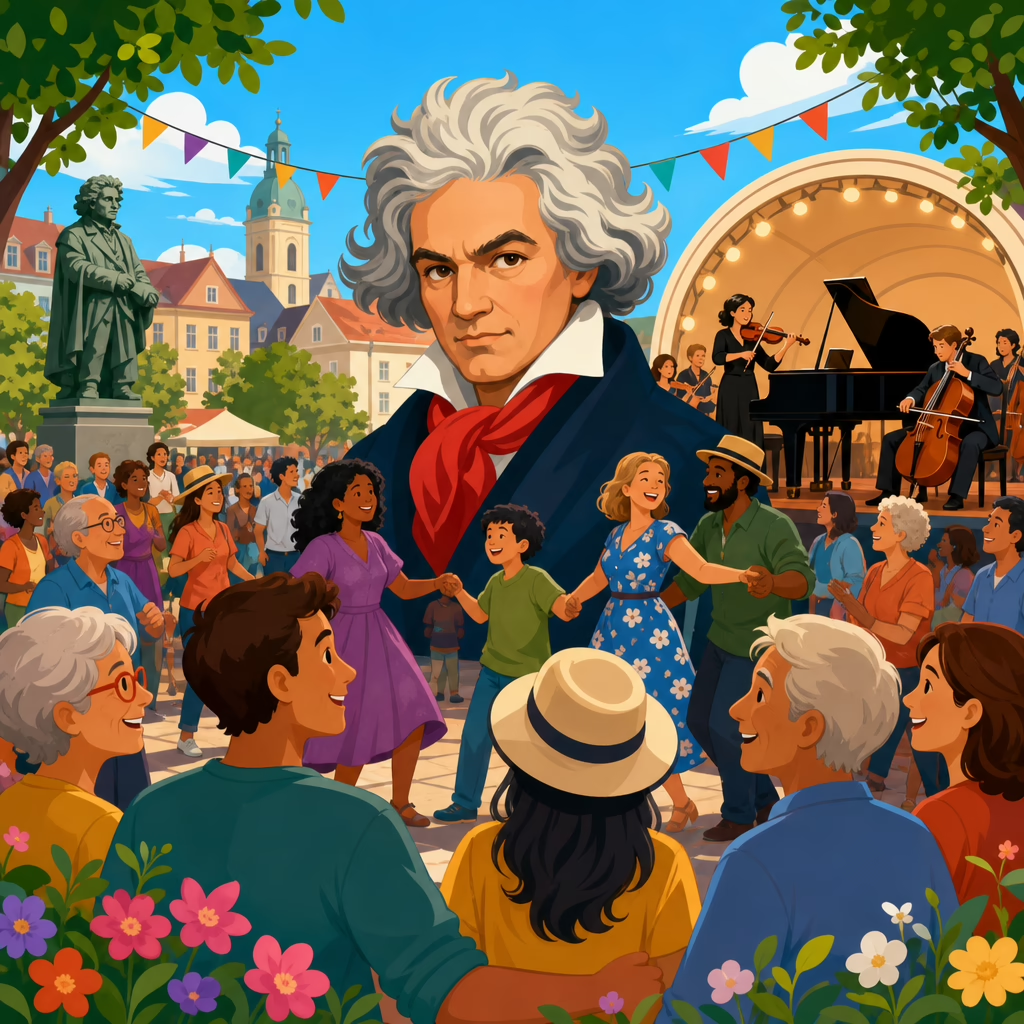
How Beethoven Festivals Bring Communities Together
How Beethoven festivals bring communities together is not a sentimental question; it is a practical one that I have seen answered in rehearsal halls, school gyms, church basements, and city squares. A Beethoven festival is a coordinated series of performances, educational programs, talks, exhibitions, and civic events built around the music, life, and influence of Ludwig van Beethoven. In community and education settings, these festivals do more than present symphonies and sonatas. They create shared rituals, attract residents who would not usually attend classical concerts, and give local organizations a common project with measurable social value. That is why this miscellaneous hub matters: it connects performance, outreach, tourism, youth learning, accessibility, volunteerism, and local identity into one clear picture.
Beethoven’s work is unusually effective for this purpose because it is familiar yet substantial. The Fifth Symphony, the “Ode to Joy,” the “Moonlight” Sonata, and the Ninth Symphony are recognized across generations, but the repertoire also reaches deep enough to support lectures, chamber events, school workshops, film programs, and amateur participation. In practice, a successful Beethoven festival usually combines flagship concerts with entry points for beginners: free family events, pre-concert talks, community singing, partnerships with libraries, and student performances. When those pieces are organized well, the festival becomes a civic platform. It can strengthen local arts ecosystems, widen access to music education, and create intergenerational contact that many communities are actively trying to rebuild.
Communities need these connecting structures. Many towns and cities face declining shared spaces, fragmented attention, and cultural programming split into narrow audiences. A Beethoven festival can counter that pattern because it brings together institutions that rarely collaborate closely: orchestras, schools, universities, museums, choirs, senior centers, neighborhood associations, disability advocates, hospitality businesses, and public agencies. I have worked on programs where the rehearsal schedule became the least important outcome; the larger result was that teachers discovered new classroom material, local sponsors saw a concrete public benefit, and first-time attendees returned for other arts events. The music supplied the anchor, but the community built the meaning.
Why Beethoven festivals work as community anchors
Beethoven festivals work because they combine strong artistic identity with broad public recognition. A festival centered on one composer creates coherence: audiences understand the theme, presenters can coordinate messaging, and educators can build lessons around a clear subject. Beethoven is especially useful because his biography touches on struggle, resilience, innovation, political change, and hearing loss. Those themes travel well across age groups and backgrounds. A middle school class can discuss rhythm in the Fifth Symphony, a university seminar can examine the Eroica and ideas of heroism, and a community choir can perform “Ode to Joy” as a multilingual sing-along. The same festival can accommodate all three without feeling diluted.
These festivals also create a dependable structure for partnership. In one regional series I helped advise, the orchestra handled marquee concerts, the public library hosted score displays and book talks, local cafés sponsored late-night chamber recitals, and a historical society mounted an exhibit on nineteenth-century Europe. None of those groups could have generated the same reach alone. Together they formed a cultural circuit that moved people through different spaces and price points. That matters because community connection is often built through repetition. Someone who first enters through a free lecture may later buy a ticket, join a choir, donate, or enroll a child in lessons.
Another reason they work is emotional range. Beethoven’s music supports celebration, reflection, mourning, triumph, and communal affirmation. Festivals need that breadth because communities are not monolithic. A neighborhood recovering from economic stress may respond to the collective force of the Seventh Symphony; a school program may focus on creativity and persistence through Beethoven’s sketchbooks; a civic ceremony may use the Ninth Symphony to symbolize solidarity. The repertoire meets audiences where they are, which is one reason Beethoven festivals remain relevant rather than merely commemorative.
Education, lifelong learning, and local participation
The strongest community impact usually comes from education. A Beethoven festival becomes durable when it is not limited to passive listening. Effective organizers build layered learning opportunities: classroom residencies, open rehearsals, instrument demonstrations, composer workshops, conducting clinics, lecture-recitals, and post-concert discussions. In my experience, open rehearsals are particularly powerful because they demystify the art form. Students hear a conductor stop the orchestra, isolate a phrase, discuss tempo, balance, articulation, or bowing, and then rebuild the passage. That process shows that music is made through problem-solving, not magic. It gives young people a model for disciplined creativity.
Lifelong learning matters just as much. Adults who feel intimidated by classical music often engage readily when festivals provide context. A short talk on sonata form, a printed listening guide, or a community book club reading about Beethoven can dramatically increase confidence. Libraries are valuable partners here because they offer trusted, low-pressure entry points. So do community colleges and adult education programs. When a festival gives residents practical ways to understand what they are hearing, attendance becomes less transactional and more relational. People do not feel that they are consuming a cultural product; they feel that they belong inside an ongoing conversation.
Participation should also extend beyond trained musicians. Community drumming workshops can explore rhythm from the Seventh Symphony, local dance schools can respond to Beethoven excerpts, and visual arts classes can create poster exhibitions inspired by the late quartets. These are not gimmicks when handled thoughtfully. They translate a major artistic legacy into forms local residents can enter directly. For schools with limited budgets, festivals can supply teaching artists, loan instruments, or ready-made curriculum packets aligned to national or state arts standards. That makes the event educationally useful, not just culturally impressive.
Inclusion, accessibility, and civic belonging
If a Beethoven festival truly brings communities together, inclusion cannot be an afterthought. Ticket pricing, venue design, transportation, scheduling, language access, and sensory considerations determine who can participate. I have seen festivals increase attendance substantially by mixing premium concerts with free outdoor performances, relaxed family events, and daytime programs for seniors. Accessibility tools such as captioning, large-print programs, hearing assistance systems, wheelchair seating, and clear wayfinding are basic requirements, not extras. Because Beethoven’s hearing loss is central to his life story, festivals have a special opportunity to address disability access with credibility and care.
Representation matters too. Communities connect more deeply when they see themselves in the festival’s performers, speakers, and partner organizations. That can include youth ensembles from different neighborhoods, gospel or community choirs joining an “Ode to Joy” finale, bilingual presenters, or collaborations with immigrant associations exploring how Beethoven’s music has been received globally. Inclusion does not mean lowering standards. It means designing multiple pathways into a high-standard artistic experience. The result is broader ownership. Residents begin to refer to the festival as something their town hosts, not something an arts institution imports.
Placemaking is another overlooked benefit. When parks, libraries, schools, transit stations, and main-street businesses become festival sites, the event changes the way people use public space. Temporary programming can reveal permanent possibilities. A lunchtime string quartet in a civic plaza may show city leaders that the area can support regular arts activity. A school concert tied to the festival may persuade administrators to protect music funding. In that sense, a Beethoven festival can serve as a pilot project for wider cultural policy and neighborhood investment.
Economic, social, and organizational benefits
Community benefit is not only cultural. Well-run festivals create economic spillover for restaurants, hotels, bookstores, parking operators, and retail districts. Destination festivals in places such as Bonn or regional heritage towns demonstrate this clearly, but the principle applies locally too. A weekend schedule that includes afternoon lectures, evening concerts, and nearby dining keeps visitors in the area longer. Sponsors are more likely to support festivals when organizers can explain this broader impact with credible attendance and spending data. Even modest events can generate value if they coordinate with chambers of commerce and tourism offices instead of operating in isolation.
Social capital is equally important. Festivals recruit volunteers, board members, student interns, and local donors into shared work. People who might never perform Beethoven can still usher, host artists, manage school check-ins, translate materials, or document oral histories from longtime music teachers. Those tasks build cross-sector relationships that often outlast the event itself. I have seen a festival partnership between a youth orchestra and a public library later expand into year-round literacy and arts programming. That kind of continuity is a strong sign that the festival has become community infrastructure rather than a one-off celebration.
| Festival element | Community benefit | Plain-language example |
|---|---|---|
| Free outdoor concert | Broad access and visibility | Families stop by after work and discover local arts groups |
| School residency | Hands-on music education | Students meet musicians and learn how motifs are built |
| Library partnership | Low-barrier learning | Residents borrow books, recordings, and attend talks without buying tickets |
| Community choir finale | Shared ownership | Amateur singers perform alongside professionals at the closing event |
| Accessible matinee | Wider participation | Seniors and disabled attendees attend with transport and caption support |
Organizationally, festivals encourage arts groups to think in ecosystems rather than silos. Marketing becomes easier when everyone reinforces the same message, and local media coverage improves when there is a sustained story to follow. Schools gain prestige from participation, sponsors receive clearer public association, and civic leaders can point to a visible example of culture serving education and economic development together. The tradeoff is complexity. Multi-partner festivals require disciplined project management, shared calendars, audience data practices, and realistic budgeting. When those fundamentals are weak, goodwill alone will not carry the work.
How to design a festival that serves the whole community
The best Beethoven festivals start with community mapping, not repertoire selection. Organizers should identify who already participates in local arts life, who is missing, which venues are trusted, what transportation barriers exist, and which partners can extend reach. Only then should programming be finalized. A balanced plan usually includes one major anchor performance, several small-format events, educational activity, and at least one free entry point. Marketing should use plain language, avoiding assumptions that audiences know terms like opus number or sonata-allegro. Clear framing works better: what people will hear, why it matters, and what they can expect.
Measurement is essential. Track ticket sales, free-event attendance, school participation, repeat visitation, accessibility usage, zip codes, partner referrals, and qualitative feedback. Surveys should ask what made attendance possible and what would improve the experience next time. This is how organizers move from anecdote to evidence. It also supports funding applications and internal planning. If family matinees outperform evening lectures, or if library events draw many first-time attendees, the next festival can adjust accordingly. Community-centered programming is not guesswork; it is iterative design informed by data and direct observation.
Finally, the festival should point beyond itself. A hub page on community and education should treat miscellaneous topics as connected pathways: youth learning, volunteering, public history, disability inclusion, neighborhood partnerships, amateur music-making, tourism, fundraising, and local business involvement. The most successful Beethoven festivals act as gateways to all of them. They spark curiosity, create repeat cultural habits, and leave behind stronger relationships than they found. That is the central benefit. When residents learn, perform, listen, and organize together around music of lasting depth, the festival becomes more than a tribute to Beethoven. It becomes a durable tool for civic connection. If your community is planning one, start with partners, design for access, and build a program people can truly share.
Frequently Asked Questions
How do Beethoven festivals actually bring communities together?
Beethoven festivals bring communities together by creating a shared cultural project that invites participation from many different groups, not just regular concertgoers. A well-planned festival usually includes performances, school programs, lectures, public rehearsals, exhibits, neighborhood events, and volunteer opportunities. That structure matters because it gives people multiple ways to take part. Some attend a symphony performance, others sing in a community chorus, others help organize events, and others encounter the music through libraries, museums, churches, schools, or outdoor gatherings in city squares. Instead of culture being limited to a single stage, the festival spreads across the life of a town or city.
What makes this especially effective is that Beethoven’s music carries both artistic prestige and broad public recognition. His work can anchor a high-level classical performance while also supporting community-based learning and participation. A festival may connect students with professional musicians, pair local historians with arts presenters, or unite civic organizations around a common calendar of events. In practical terms, these festivals create repeated opportunities for people to gather, collaborate, and talk to one another. Over time, that repeated contact strengthens local relationships, encourages civic pride, and gives residents a meaningful sense that they are contributing to something larger than themselves.
Why is Beethoven a strong focus for community festivals compared with other composers?
Beethoven is a strong focal point for community festivals because his music is widely respected, emotionally powerful, and flexible enough to serve many kinds of audiences and programs. His name is instantly recognizable, which helps festivals attract attention across generations and levels of musical experience. At the same time, his body of work is rich enough to support a full series of events, from orchestral concerts and chamber recitals to educational workshops, family programs, scholarly talks, and interdisciplinary exhibitions. That range allows organizers to build a festival that feels substantial rather than narrow.
There is also a practical reason Beethoven works so well in community settings: his story invites conversation. Themes such as perseverance, creativity, struggle, public ideals, and artistic independence resonate in schools, civic institutions, and neighborhood organizations. His music can be presented as concert repertoire, but it can also be used to spark broader discussions about history, leadership, resilience, accessibility, and the role of the arts in public life. Because of that, a Beethoven festival can appeal to serious music lovers while still welcoming people who are simply curious, attending for social reasons, or looking for educational opportunities for their families. That combination of artistic depth and public accessibility makes Beethoven especially effective as a unifying cultural centerpiece.
What kinds of community activities are usually included in a Beethoven festival?
A community-centered Beethoven festival usually extends far beyond formal concerts. Performances may include symphony orchestra programs, chamber music recitals, piano sonatas, choral works, youth ensemble appearances, and open-air events designed for broader public access. Around those performances, festivals often build educational and civic programming such as school visits, pre-concert talks, listening workshops, composer lectures, reading groups, art exhibits, film screenings, and panel discussions about Beethoven’s life, era, and legacy. These additions are important because they turn the festival into a learning environment as well as an entertainment series.
Many festivals also include participatory elements that make community involvement more direct. Examples include side-by-side rehearsals with students and professionals, community sing events, master classes, composition activities for young people, partnerships with libraries and historical societies, and outreach programs in senior centers, hospitals, or neighborhood venues. Some festivals collaborate with local businesses, faith communities, universities, and civic agencies to host events in nontraditional spaces such as school gyms, church basements, parks, and public plazas. That variety helps remove barriers to entry and allows more residents to encounter the festival in everyday settings. The result is a cultural event that feels woven into community life rather than isolated from it.
How do Beethoven festivals benefit schools, local organizations, and the wider local economy?
The benefits of a Beethoven festival often reach well beyond the concert hall. For schools, festivals can provide curriculum support, live performance experiences, artist visits, and opportunities for students to connect history, literature, music, and civic learning. Young musicians may gain coaching, performance opportunities, or inspiration from seeing professionals at work. Teachers can use the festival as a practical framework for interdisciplinary learning, especially when programs connect Beethoven’s music to broader themes such as innovation, perseverance, and cultural history. When students participate directly, the festival becomes more than a field trip; it becomes part of their educational environment.
Local organizations benefit because festivals encourage collaboration. Arts groups, community centers, libraries, churches, museums, universities, and businesses often work together in ways they might not otherwise do. Those partnerships can strengthen local networks and lead to future projects beyond the festival itself. Economically, a successful Beethoven festival can increase foot traffic for restaurants, hotels, shops, and nearby cultural venues, especially if it attracts regional visitors. It also gives a community a chance to present itself as active, creative, and welcoming. That kind of cultural visibility can support tourism, fundraising, and long-term investment in the arts. In short, the festival acts as both a cultural event and a civic development tool.
How can organizers make a Beethoven festival feel inclusive and relevant to the whole community?
To make a Beethoven festival inclusive and relevant, organizers need to think intentionally about access, representation, and participation from the beginning. That means offering events at different price points, including free programs; using multiple venues across the community rather than relying on a single elite setting; and designing activities for different age groups and experience levels. A festival becomes more welcoming when someone can encounter it in a public square, a school auditorium, a library meeting room, or a church basement as easily as in a formal concert hall. Accessibility also includes practical details such as transportation, scheduling, family-friendly programming, and clear communication for first-time attendees.
Relevance grows when the festival connects Beethoven’s music to local people and local concerns. Organizers can feature community ensembles alongside professionals, invite educators and neighborhood leaders into planning, and create programs that link the music to themes residents already care about, such as education, belonging, civic identity, and shared public life. It also helps to frame Beethoven not as a distant monument, but as a starting point for conversation, creativity, and collective experience. When people see themselves reflected in the festival through participation, partnerships, and accessible programming, the event stops feeling like something presented to the community and starts feeling like something created with the community. That shift is what turns a music festival into a genuine force for connection.