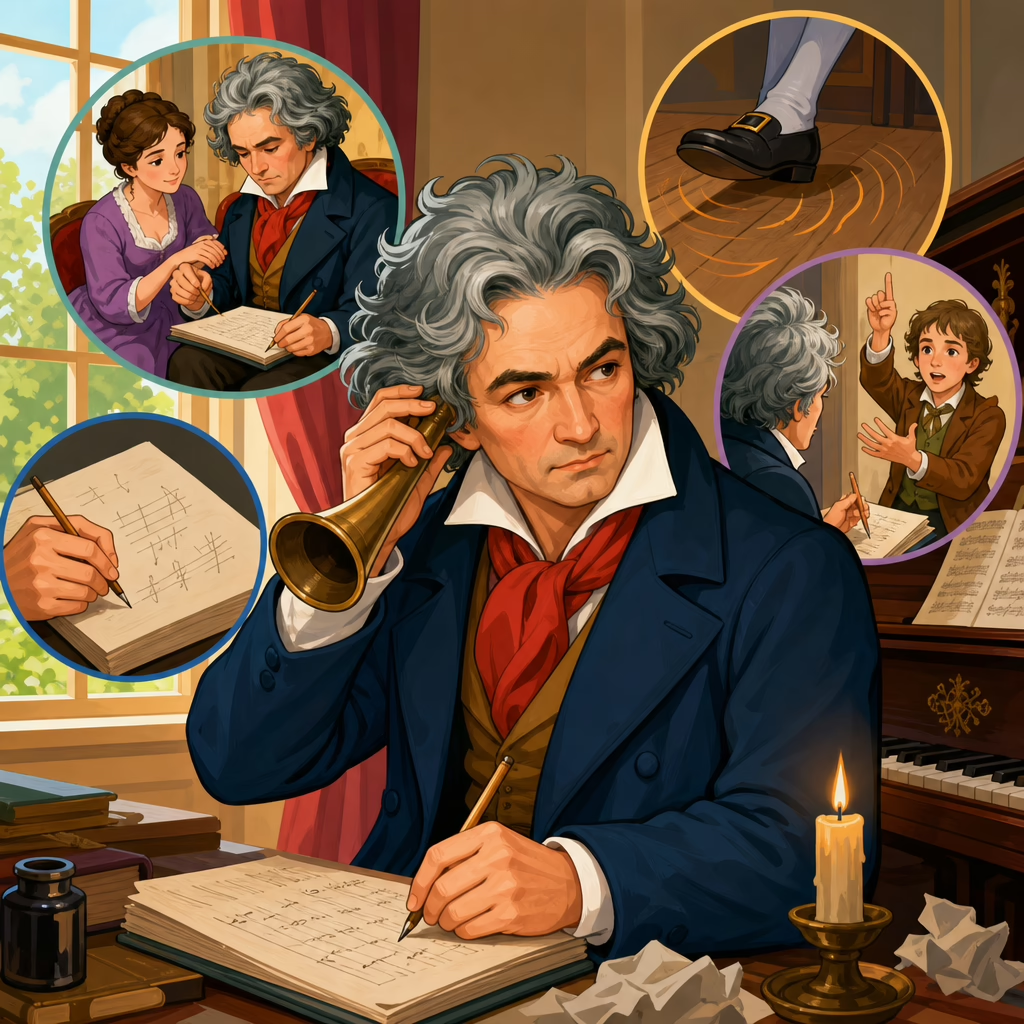
How Beethoven Communicated Without Hearing
How Beethoven communicated without hearing is one of the most revealing questions in music history because it forces us to look beyond the myth of the isolated genius and examine the practical systems he used every day. In this context, communication means far more than spoken conversation. It includes reading lips, writing in conversation books, conducting through gesture, negotiating with publishers by letter, composing through inner hearing, and maintaining relationships despite severe hearing loss. Beethoven’s deafness did not arrive all at once, and neither did his adaptations. From the late 1790s through the final decade of his life, he built a layered method of staying connected to family, patrons, performers, and audiences. That makes this topic central to understanding both Beethoven’s health and Beethoven’s working life.
When people ask how Beethoven communicated without hearing, they usually mean one of three things. First, how did he hold ordinary conversations when he could no longer hear speech clearly? Second, how did he continue to compose and rehearse music while his hearing deteriorated? Third, how did deafness alter his emotional life, public behavior, and professional reputation? These questions belong together because his solutions overlapped. A notebook used for a social exchange also reveals business decisions. A conducting disaster points to broader communication barriers. A letter about illness often explains a musical choice or a period of withdrawal.
I have worked through Beethoven letters, medical debates, and the surviving conversation books, and the pattern is consistent: he remained communicative, but the burden shifted from effortless listening to deliberate systems. Those systems mattered because Beethoven lived in a culture built on salons, patronage, rehearsals, and live performance. Vienna depended on personal contact. A composer had to persuade aristocrats, train musicians, correct copyists, and respond to publishers quickly. Deafness threatened every one of those functions. Yet Beethoven preserved a remarkable degree of agency by turning to visual, written, tactile, and memory-based methods. His example is not a sentimental story about overcoming adversity. It is a concrete case study in adaptation under medical limitation.
Understanding these methods also helps readers navigate the wider “Beethoven’s Health and Deafness” subtopic. Communication sits at the center of related issues such as the timeline of his hearing loss, the causes proposed by historians and physicians, his use of ear trumpets, his relationships with doctors, and the social consequences of disability in early nineteenth-century Europe. As a hub, this article connects those threads by showing the everyday mechanics of how Beethoven functioned when ordinary hearing was no longer available to him.
He relied on layered communication strategies, not a single solution
There was no magic device that restored Beethoven’s hearing. Instead, he assembled a toolkit that changed over time. In the earlier stages of hearing loss, he asked people to speak louder, repeat themselves, or move closer. He chose quieter settings when possible. He watched faces carefully and likely used partial lip-reading, though not in the modern formally trained sense. As the condition worsened, speech became harder to follow, especially in groups. At that point, writing became essential. Friends, visitors, students, and business associates would write remarks or questions in notebooks, and Beethoven would answer orally, in writing, or with a combination of both.
This matters because popular accounts sometimes imply that Beethoven lived in near-total silence and complete social isolation for years. The evidence is more nuanced. He certainly withdrew at times and suffered deeply from misunderstanding, embarrassment, and frustration. But he did not stop interacting. He changed the medium. In practical terms, that shift resembles how people today move from speech to text when audio quality fails. The method was slower, but it preserved precision. For legal disputes, publishing details, financial negotiations, and domestic arrangements, written exchange could even be more exact than speech.
His adaptation also varied by context. Private visitors could use notebooks. Long-distance contacts used letters. Rehearsals depended on visual cues and trusted intermediaries. Composition depended on internal auditory imagination rather than real-time acoustic feedback. Social gatherings often remained difficult because they were fast, overlapping, and noisy. The key point is direct: Beethoven communicated without hearing by matching the method to the situation and by relying increasingly on sight, writing, memory, and routine.
Conversation books became his most famous communication aid
The conversation books are the clearest surviving evidence of how Beethoven managed daily interaction during his later years. Beginning in a substantial way around 1818, visitors wrote their side of conversations in notebooks. Thousands of pages survive, though many were later lost or destroyed. These books record discussions about meals, rent, publishers, performances, medical care, servants, travel, family disputes, and musical ideas. Because Beethoven often replied aloud instead of writing, modern readers usually see only one side of the exchange. Even so, the notebooks reveal an active, complex social and professional life.
These books were not diaries. They were working tools. A friend might write a question about a rehearsal time, a nephew’s behavior, a payment, or a visitor at the door. Beethoven, already familiar with the subject, could respond verbally or with brief written notes. The format saved energy. It also reduced the humiliation of constant repetition. In my view, one reason the conversation books remain so valuable is that they show disability management in motion rather than in abstraction. Beethoven did not merely endure deafness; he operationalized around it.
| Method | How Beethoven Used It | Main Advantage | Main Limitation |
|---|---|---|---|
| Conversation books | Visitors wrote questions and comments during in-person meetings | Allowed detailed face-to-face exchange | Slow and often one-sided in surviving records |
| Letters | Handled publishing, patronage, and personal matters across distance | Precise and durable record | No immediate back-and-forth clarification |
| Lip-reading and visual cues | Used in quieter settings and familiar conversations | Fast when conditions were favorable | Poor in groups or noisy rooms |
| Ear trumpets | Tried mechanical hearing aids made for him, including devices linked to Johann Nepomuk Mälzel | Could slightly amplify sound | Limited benefit with severe hearing loss |
| Gestures in rehearsal | Directed tempo, entries, and expression visually | Useful with trained musicians | Risky when ensemble relied on hearing him |
For anyone studying Beethoven’s deafness, the conversation books also function as a gateway to related topics. They illuminate his medical complaints, social network, domestic routines, and the strain of the custody battle over his nephew Karl. They are therefore indispensable not just for understanding communication, but for the broader history of Beethoven’s health.
Letters allowed him to preserve authority, precision, and professional control
If the conversation books handled immediate encounters, letters handled structure. Beethoven was a prolific correspondent, and his letters show that deafness did not prevent him from negotiating contracts, rebuking publishers, requesting money, seeking lodgings, advising performers, or expressing affection and anger with unmistakable force. In an era before telephones, letters were already essential. For Beethoven, they became even more important because they reduced reliance on uncertain listening.
Written correspondence gave him control over wording. That was critical in business. Publishers in Vienna, Leipzig, London, and elsewhere needed exact terms concerning fees, rights, delivery dates, corrections, and dedications. Beethoven’s surviving correspondence shows a man intensely alert to status and compensation. Deafness may have hindered spontaneous discussion, but on paper he remained formidable. He could revise phrasing, restate demands, and preserve evidence of agreements. This written paper trail is one reason historians can reconstruct his career with such detail.
Letters also helped him maintain patronage networks. Aristocratic supporters such as Archduke Rudolph were not merely admirers; they were part of the infrastructure that enabled his work. Clear correspondence sustained those bonds. The same is true of domestic management. Servants, landlords, copyists, and legal officials all became part of a communication ecosystem in which writing reduced ambiguity. For modern readers, this demonstrates a crucial point: Beethoven’s deafness narrowed some channels, but it sharpened others.
He composed through inner hearing, musical memory, and theory
The most astonishing part of the story is not that Beethoven found ways to talk. It is that he continued to create large-scale music after severe hearing loss. This was possible because composing is not identical to hearing external sound in real time. Beethoven had exceptional inner hearing: the ability to imagine pitches, harmonies, textures, and formal development mentally. Trained composers develop this skill, but in Beethoven it reached extraordinary power. He knew how instruments behaved, how voices balanced, and how harmonic tension resolved. That knowledge allowed him to work from notation, keyboard habits, sketchbooks, and memory even when acoustic feedback was unreliable.
This does not mean deafness was irrelevant to composition. It changed his process. He used sketchbooks extensively, revising motifs, rhythms, and structures through written experimentation. He pressed on the piano to sense vibration, and he reportedly used physical contact with the instrument to register sound through touch. Accounts vary in detail, and some later anecdotes were romanticized, but the broader principle is solid: he used multiple sensory pathways and accumulated expertise to compensate for reduced auditory input.
Works from the late period, including the Missa solemnis, the Ninth Symphony, and the late string quartets, do not sound like the products of a diminished imagination. They sound like the products of a composer thinking structurally and hearing internally at the highest level. That fact often surprises readers, but it should not. Musicians do not create only with the ear; they create with trained cognition, memory, and embodied knowledge. Beethoven’s deafness made those capacities more visible.
Conducting and rehearsal became increasingly difficult
Communication in performance was much harder than communication on paper. Conducting requires rapid exchange: hearing ensemble balance, adjusting tempo, responding to mistakes, and coordinating entries in real time. As Beethoven’s deafness deepened, that became a serious problem. The famous 1824 premiere of the Ninth Symphony illustrates the issue. Sources differ in specifics, but the general account is accepted: Beethoven was present and involved, yet the practical musical direction depended heavily on others, especially Michael Umlauf, because Beethoven could not reliably hear the ensemble.
This was not simply a matter of pride. In rehearsal, a conductor must know instantly whether the woodwinds covered the singers, whether the tempo drifted, whether the strings matched articulation, and whether a cue was late. Visual gesture can initiate action, but it cannot replace auditory verification. Trained orchestras can follow a beat; they cannot depend on a leader who cannot hear the result. Beethoven’s authority as composer remained immense, but his ability to control execution in real time was limited.
That distinction explains why assistants, concertmasters, and trusted musicians became increasingly important. They translated his intentions into practical ensemble decisions. In modern terms, Beethoven remained the source of interpretation, but implementation required collaboration. This section links naturally to related articles on Beethoven’s late concerts, his relationships with performers, and the specific circumstances of the Ninth Symphony.
Devices, habits, and social workarounds helped, but none restored normal life
Beethoven did experiment with assistive technology, especially ear trumpets. Several were made for him, and some are associated with Johann Nepomuk Mälzel, better known for mechanical inventions such as the metronome. Ear trumpets could gather and direct sound into the ear, and they were among the best available devices of the period. Yet they offered only limited help, particularly if hearing loss involved distortion as well as reduced volume. Louder sound is not the same as clearer sound. Many people with severe hearing impairment experience speech as blurred, harsh, or fragmented, and historical descriptions suggest Beethoven struggled with exactly that problem.
He also developed habits that reduced communicative friction. He preferred one-on-one interaction to crowded rooms. He often relied on familiar contacts who understood his needs. He used notebooks, schedules, repeated routines, and written reminders. These are practical disability accommodations, even if nineteenth-century language did not frame them that way. Still, the limitations were severe. Social life became tiring. Misunderstandings multiplied. Emotional strain spilled into irritability, suspicion, and withdrawal.
That balance is important. Beethoven was resourceful, but he was not untouched by loss. The Heiligenstadt Testament of 1802 makes that clear. In this extraordinary document, he describes despair at the prospect of deafness and the shame of admitting his condition publicly. He feared being thought hostile or absent-minded when in fact he simply could not hear. Anyone trying to understand how Beethoven communicated without hearing must hold both truths at once: he built effective methods, and those methods never fully replaced ordinary listening.
Why this topic matters within Beethoven’s health and deafness
This “miscellaneous” hub matters because communication is where medical history becomes human history. Discussions of cause—otosclerosis, lead exposure, autoimmune disease, gastrointestinal illness, or other theories—are important, but they remain incomplete unless we ask how deafness changed daily action. Communication is the practical bridge between symptoms and biography. It shows how Beethoven managed appointments, legal conflicts, money, rehearsal, friendship, and artistic production.
It also helps unify the wider cluster of articles under “Beethoven’s Health and Deafness.” If you are exploring the timeline of his hearing loss, the conversation books show the late-stage consequences. If you are reading about treatments, ear trumpets reveal both medical hope and technological limits. If you are interested in his mental state, documents like the Heiligenstadt Testament explain the social pain behind his isolation. If you are studying late works, his inner hearing and sketch-based process show how composition continued when listening failed.
The key takeaway is simple. Beethoven communicated without hearing by replacing auditory dependence with written exchange, visual observation, trained memory, and trusted collaborators. Those adaptations allowed him to remain professionally effective and artistically groundbreaking, even as deafness reshaped his personal life. To understand Beethoven fully, follow the communication methods as closely as the masterpieces. They reveal not only how he survived deafness, but how he continued to work, lead, and create through it.
Frequently Asked Questions
How did Beethoven hold conversations after he became deaf?
Beethoven did not rely on a single method. As his hearing declined and then became profoundly impaired, he adapted by using a combination of lip-reading, face-to-face observation, writing, and carefully structured social habits. In earlier stages of hearing loss, he could still catch parts of speech if people spoke loudly, clearly, or close to him. Over time, however, ordinary conversation became increasingly difficult, especially in groups or noisy environments.
One of his most important tools was the conversation book. Visitors, friends, students, business associates, and family members would write their side of the exchange in these notebooks, and Beethoven would respond either aloud, in writing, or sometimes with brief notes. These books preserve a remarkable record of everyday communication: discussions about music, money, health, publishing, domestic matters, and personal relationships. They show that he was not cut off from the world, but actively managing communication through practical means.
He also watched people closely. Facial expression, gesture, and context mattered. Like many people dealing with hearing loss, Beethoven became skilled at extracting meaning from what he could see and from the situation itself. In quiet one-on-one settings, this could be surprisingly effective. In crowded salons or fast-moving conversations, it was far less reliable. The result is that his communication was often selective, effortful, and dependent on the setting, but it was by no means absent.
What were Beethoven’s conversation books, and why are they so important?
The conversation books were notebooks used primarily in the later years of Beethoven’s life, when spoken communication had become extremely difficult for him. People visiting him would write questions, comments, news, or requests in the book, allowing him to follow the exchange visually rather than aurally. In many cases, Beethoven answered verbally, which means that only one side of the conversation survives. Even so, these books are among the most valuable sources historians have for understanding his daily life.
They are important because they reveal Beethoven not as a distant legend, but as a working composer and complicated human being solving practical problems. Through them, we see him discussing rehearsals, commissions, contracts, living arrangements, medical concerns, meals, servants, family tensions, and artistic decisions. They document how communication continued even after hearing was largely gone. In that sense, they are evidence of adaptation rather than silence.
They also help explain how Beethoven maintained a career. He could still negotiate, give instructions, express opinions, and stay involved in professional networks. The books make clear that deafness changed the medium of communication, not the fact of communication itself. For scholars, they are indispensable because they show the mechanisms that connected Beethoven to the social and musical world around him.
How could Beethoven compose music if he could no longer hear it?
Beethoven’s ability to compose without functional hearing is best understood through the idea of inner hearing, sometimes called auditory imagination. Long before his deafness became severe, he had absorbed the language of music at an exceptionally deep level. He knew how harmonies moved, how instruments sounded, how themes developed, and how musical structures behaved. This knowledge was not dependent solely on real-time listening; it had become internalized through years of training, performance, and composition.
As a result, he could work with sound mentally. He could imagine intervals, chords, tonal tension, orchestral color, and formal architecture without needing to hear them externally in the moment. This does not make his deafness trivial. On the contrary, the loss was devastating, and it affected his social life, performance career, and likely parts of his compositional process. But it did not erase the musical world he carried in his mind.
His sketches also show that composition for him was not a magical instant of inspiration. It was labor-intensive, revision-heavy, and intellectually rigorous. He tested ideas, rewrote passages, reshaped themes, and refined structure again and again. In that sense, Beethoven communicated with music through notation, memory, theory, and imagination. He was no longer dependent on ordinary hearing in the same way a casual listener would be. He was thinking in music from the inside.
How did Beethoven communicate with musicians during rehearsals and performances?
Communication in musical settings depended heavily on gesture, prior preparation, written instructions, and the cooperation of performers who understood his condition. Beethoven had long experience as a pianist, conductor, and composer, so he was already used to expressing musical intention physically. Tempo, emphasis, entries, dynamics, and emotional character could be indicated through body language, eye contact, and conducting motion, even when verbal exchange was limited.
That said, rehearsals became more complicated as his deafness progressed. He could not reliably hear balance, ensemble issues, or spoken feedback in the normal way. This sometimes led to awkward or strained situations, especially in larger performance contexts. Musicians and assistants often had to mediate, clarify, or help translate between Beethoven’s intentions and the practical realities of performance. Written notes and discussions outside the immediate rehearsal moment also played a role.
A famous example often discussed is the premiere of the Ninth Symphony, where Beethoven’s presence carried enormous symbolic force, but others were crucial in managing the actual performance. This illustrates the broader pattern: he remained artistically central, but communication increasingly relied on visual cues and collaborative support. His deafness changed how authority was exercised in the room, yet it did not remove him from the musical process.
Did Beethoven’s deafness isolate him completely from friends, family, and professional life?
No, although it unquestionably made relationships harder. Beethoven’s deafness increased frustration, misunderstanding, fatigue, and emotional strain. Social gatherings could become exhausting because he could not easily follow rapid or overlapping conversation. Personal relationships suffered at times from his irritability, pride, sensitivity, and the constant burden of impaired communication. Deafness did not create all of these difficulties, but it intensified them.
Still, he remained connected to a network of patrons, publishers, copyists, students, servants, relatives, and friends. Letters were essential. Through correspondence, he handled commissions, discussed payments, corrected proofs, negotiated business matters, and maintained long-distance relationships. In person, he used conversation books and visual observation. In professional settings, he relied on notation and written instruction. In private life, he depended on routines and on people willing to meet him halfway.
So the more accurate picture is not total isolation, but selective and effortful connection. Beethoven’s world became harder to access through sound, yet he built alternative channels to stay engaged. That is one reason the question of how Beethoven communicated without hearing matters so much. It reveals not only the tragedy of his hearing loss, but also the ingenuity, discipline, and social systems that allowed him to keep creating, working, and participating in the world around him.