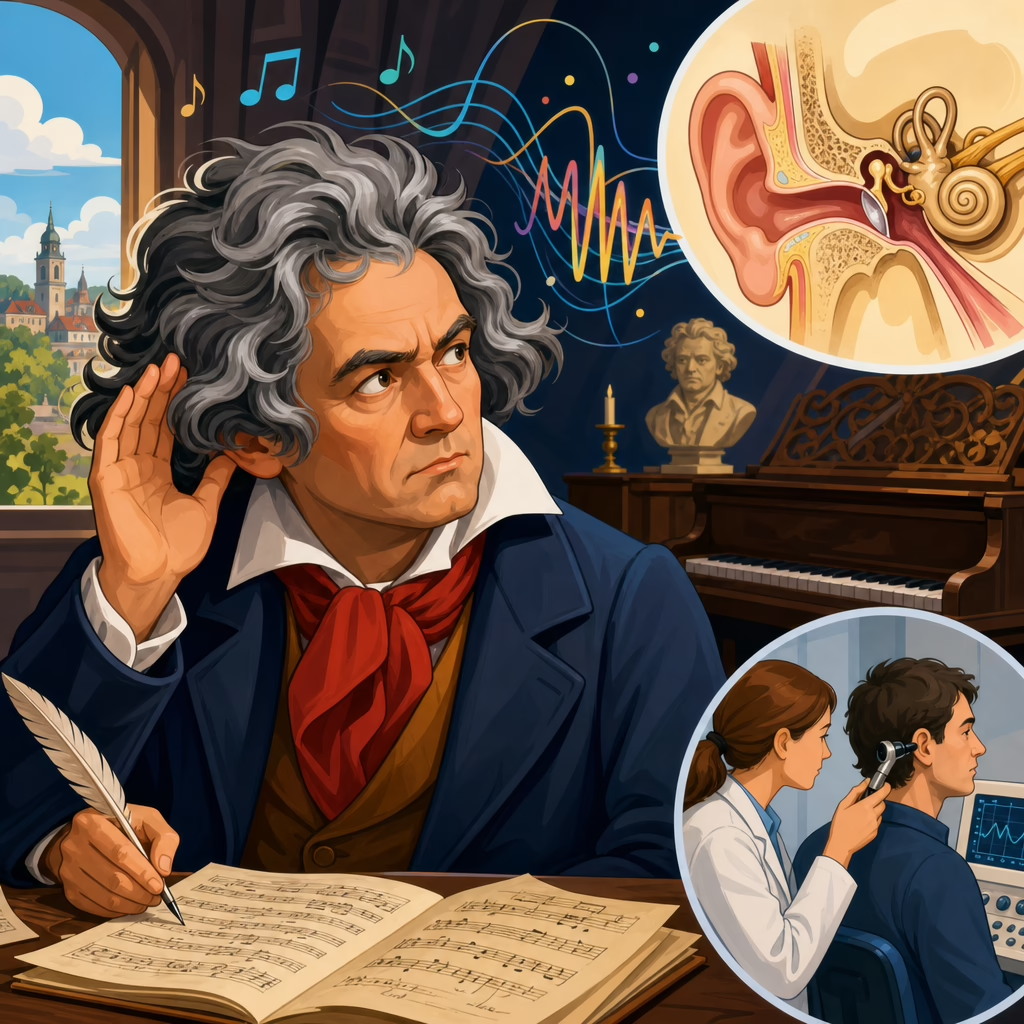
Could Beethoven Hear at All? Revisiting the Audiological Evidence
Few questions in music history attract as much fascination as whether Ludwig van Beethoven could hear at all during the years when he wrote his most revolutionary works. The question matters because it shapes how we understand creativity, disability, medical history, and the practical realities of composition in the late eighteenth and early nineteenth centuries. In modern terms, the issue is audiological evidence: the surviving signs, reports, and behaviors that can help reconstruct the degree, pattern, and progression of hearing loss.
When people ask whether Beethoven was deaf, they often imagine a simple yes-or-no answer. The historical record does not support that simplicity. Hearing exists on a spectrum, and clinicians distinguish among mild, moderate, severe, and profound loss; conductive, sensorineural, and mixed loss; unilateral and bilateral impairment; and fluctuating versus stable symptoms. Beethoven’s case appears progressive, bilateral, and probably mixed in its lived effects, even if the underlying pathology remains debated. That distinction is essential, because a person may be “deaf” in common language while still perceiving some low frequencies, vibrations, environmental sounds, or speech under ideal conditions.
I have found that the strongest way to approach Beethoven’s deafness is to separate myth from measurable indicators. Instead of repeating the dramatic image of a completely silent inner world, we should ask narrower questions. What did Beethoven report hearing? What did friends observe? What communication methods did he adopt? What can autopsy findings tell us, and what can they not tell us? How do modern audiologists interpret symptoms such as tinnitus, recruitment, distorted speech perception, and progressive difficulty in conversation? Once these questions are answered directly, the larger picture becomes clearer.
This article serves as a hub for the wider “Beethoven’s Health and Deafness” subtopic by gathering the miscellaneous evidence that often sits between biography, medicine, and musicology. It outlines the main categories of proof, explains where scholars agree, and highlights where uncertainty remains. Most important, it answers the central question plainly: Beethoven almost certainly retained some hearing for part of his decline, but by his final years his functional hearing for ordinary conversation was extremely poor, and he relied heavily on non-auditory strategies. He was not simply either hearing or non-hearing; he moved through stages of auditory loss that affected his daily life, his social behavior, and his working methods.
What the historical record actually shows
The documentary base begins with Beethoven’s own testimony. In letters from the late 1790s and early 1800s, he described worsening hearing, difficulty understanding speech, and a distressing inability to hear high-pitched sounds. In the 1802 Heiligenstadt Testament, he wrote that he had withdrawn from society because he could not tell people, “I am deaf.” That statement is powerful but should be read clinically as well as emotionally. It does not prove total hearing loss in 1802; it proves that his hearing had deteriorated enough to create social humiliation and functional impairment.
Reports from contemporaries reinforce this picture. Friends noted that Beethoven sometimes heard louder sounds or lower tones better than conversation. He struggled in noisy settings, misheard words, and increasingly avoided salons and public interactions where auditory demands were high. These are familiar patterns in progressive hearing loss. People often retain partial hearing yet fail badly in complex listening environments, especially when speech clarity, not mere loudness, is the problem. That distinction matters because many forms of inner-ear damage produce audibility without intelligibility.
Conversation books, used especially from 1818 onward, are among the strongest practical pieces of evidence. Visitors wrote questions and comments in notebooks so Beethoven could respond orally or in writing. Their existence does not prove absolute silence, because conversation books can also help someone with severe but incomplete hearing. Still, the routine use of this method shows that spontaneous speech comprehension had become unreliable enough to require accommodation. In modern audiological terms, his unaided communication function was severely compromised.
His use of ear trumpets points in the same direction. Beethoven owned and tried several hearing devices, including those associated with Johann Nepomuk Mälzel. Ear trumpets can help some conductive losses and provide limited benefit for certain listeners with residual hearing, but they are not useful to a person with no auditory input at all. Their mixed success suggests residual hearing remained for some time, though probably distorted and insufficient. The pattern many clinicians infer is not clean amplification failure but poor clarity, tinnitus burden, and reduced speech discrimination.
| Evidence type | What it suggests | Main limitation |
|---|---|---|
| Beethoven’s letters | Progressive loss, tinnitus, social withdrawal, trouble with speech | Subjective and emotionally charged |
| Heiligenstadt Testament | Serious impairment by 1802 | Not a clinical document; not proof of total deafness |
| Conversation books | Severe communication difficulty in later years | Use does not equal complete inability to hear any sound |
| Ear trumpets | Residual hearing likely persisted for a period | Benefit level is poorly documented |
| Contemporary observations | Variable hearing, especially poor speech understanding | Witnesses were inconsistent and untrained |
| Autopsy findings | Possible structural abnormalities of auditory pathways | Findings are nonspecific by modern standards |
Another crucial point is timeline. Beethoven did not become suddenly deaf in one dramatic event. Most scholars place the onset of symptoms in his late twenties, with progression over decades. By the middle period he was already significantly impaired; by the late period he was functionally dependent on writing for many interactions. This gradual decline helps explain why contradictory anecdotes exist. A witness from one year may describe some response to sound, while another from a later year reports near-total communicative deafness. Both can be true within a progressive disorder.
How modern audiology interprets Beethoven’s symptoms
If a patient presented today with Beethoven’s reported symptoms, an audiologist would ask about tinnitus, sound distortion, speech discrimination, frequency-specific loss, hyperacusis, and the pattern of progression. Beethoven complained not only of reduced hearing but also of noises in the ears, often interpreted as tinnitus. He reportedly heard buzzing or roaring, symptoms commonly associated with cochlear damage, Ménière-like syndromes, otosclerosis with inner-ear involvement, autoimmune processes, or other pathology. Tinnitus alone does not diagnose the cause, but paired with progressive bilateral loss it narrows the field.
His difficulty hearing high-frequency sounds has led many clinicians to suspect sensorineural hearing loss, because high-frequency impairment often appears early in cochlear disorders. Yet the evidence is not perfect. Some historical descriptions also suggest fluctuating function, pressure, and possible gastrointestinal or inflammatory associations, which have invited broader diagnostic theories. In practice, Beethoven may have experienced a combination of auditory deficits: reduced sensitivity, poor speech discrimination, intrusive tinnitus, and loudness distortion. For a musician, that combination can be far more disabling than a simple volume reduction.
The question “Could Beethoven hear music?” also needs precision. Hearing pure tones, sensing piano vibration through bone conduction and touch, perceiving low-frequency resonance, and understanding speech are different tasks. A person can fail badly at conversation yet still detect rhythm, bass energy, or some instrumental timbre. Beethoven reportedly used physical contact with the piano, including placing a rod between instrument and teeth in some accounts, to enhance vibrational feedback. Whether every anecdote is reliable, the broader principle is sound: musicians with hearing loss often exploit tactile and visual cues to supplement limited auditory information.
Functional hearing is the key concept. In clinic, a patient may have measurable residual hearing but still be effectively unable to communicate without accommodation. That appears close to Beethoven’s later reality. He may not have lived in total acoustic absence, but his hearing was so poor for daily human exchange that it shaped his behavior, mood, and work. This distinction resolves many false debates. The evidence does not require us to choose between “he heard normally enough” and “he heard nothing whatsoever.” It points instead to profound functional disability with uncertain islands of residual perception.
Competing medical explanations and their strengths
Several diagnoses have been proposed, none universally accepted. Otosclerosis has long been discussed because it can cause progressive hearing loss beginning in early adulthood and may become severe over time. Classic otosclerosis often starts as conductive loss due to stapes fixation, but cochlear otosclerosis can add sensorineural components, helping explain why simple amplification would not fully restore clarity. Supporters note the age of onset and progression. Critics argue that some symptom descriptions, especially tinnitus character and broader systemic complaints, do not fit neatly enough.
Paget disease, syphilis, lead exposure, autoimmune inner-ear disease, sarcoidosis, and other inflammatory or metabolic explanations have also appeared in the literature. The lead hypothesis gained attention from analyses of hair and bone samples suggesting elevated lead levels, though contamination and interpretation remain concerns. Even if lead exposure occurred, proving that it caused the hearing loss is much harder. Syphilis has been proposed in older scholarship more freely than current evidence justifies. Modern historians and physicians are generally more cautious, because retrospective diagnosis from incomplete records can quickly outpace the data.
The autopsy performed in 1827 is frequently cited but often overstated. Reports describe shrunken auditory nerves and changes in surrounding structures. To a modern clinician, those findings are intriguing yet nonspecific. Postmortem descriptions from the period lack the precision of contemporary otopathology, imaging, and histology. Auditory nerve atrophy could reflect longstanding sensory deprivation or another process, but it does not by itself settle the origin of the deafness. It is evidence of disease affecting the auditory system, not a final diagnosis.
On balance, the most defensible conclusion is that Beethoven had a real, progressive organic hearing disorder, probably involving the inner ear and possibly additional structures, with severe tinnitus and worsening speech understanding. Claims of malingering, exaggeration, or purely psychological deafness do not survive contact with the breadth of documentary and behavioral evidence. At the same time, certainty beyond that level is not possible. Good historical medicine recognizes both what the record supports and where the record stops.
What deafness meant for Beethoven’s work and daily life
Beethoven’s deafness changed how he navigated the world long before it ended his ability to compose. Social withdrawal is one of the clearest consequences. In restaurants, salons, and rehearsals, hearing loss creates repeated small failures: missed remarks, wrong replies, delayed reactions, and fatigue from constant concentration. Beethoven’s irritability, suspicion, and abrupt manner cannot be reduced to deafness alone, but hearing impairment clearly intensified them. Anyone who has worked with patients facing severe acquired hearing loss recognizes the pattern of embarrassment, avoidance, and anger at one’s own limitations.
His composing process also became more inward. That statement should not be romanticized into the false claim that deafness gave him genius. Rather, he increasingly relied on trained inner hearing, theoretical command, memory of instrumental sonority, keyboard experimentation, sketchbooks, and structural planning. Skilled composers do not require continuous normal hearing to imagine harmony, counterpoint, orchestration, and form. Beethoven had decades of sonic experience before his loss became extreme, and he possessed extraordinary working memory. Those assets did not eliminate the disability, but they explain how composition remained possible.
Performance was a different matter. Conducting and playing in public require rapid auditory feedback and coordination with others. As his hearing worsened, these activities became more difficult and less reliable. The famous 1824 Ninth Symphony premiere is often told as if Beethoven heard absolutely nothing and had to be turned around to see the applause. The core anecdote may capture his limited awareness in that moment, but it should not be inflated into a universal rule for every late-year experience. Historical episodes must be read case by case, not as theatrical proof of total silence at all times.
For readers exploring this hub further, the most useful next questions concern chronology, diagnosis, tinnitus, conversation books, ear trumpets, and the practical mechanics of composing while deaf. Those subtopics work best when connected, because no single source explains the whole story. Beethoven’s audiological history is cumulative. Letters reveal symptoms, devices reveal attempts at management, witnesses reveal function, and medical reports reveal possible pathology. Together they show a musician adapting, not a legend floating above biology.
The best answer to the central question
So, could Beethoven hear at all? Yes, for part of his illness he almost certainly could hear some sounds, and likely some musical material, though increasingly poorly and unevenly. No, by his later years he could not hear well enough for ordinary conversation without major assistance, and his practical hearing was profoundly impaired. That is the answer most consistent with the documentary record and with how hearing loss works in real patients.
The strongest misconception to avoid is binary thinking. Beethoven was neither a man with normal hearing who merely struggled a bit, nor a figure who lived for decades in total sensory silence while composing exactly as before. He experienced a progressive decline with changing capabilities over time. Residual hearing, tinnitus, distortion, and tactile compensation can coexist. Modern audiology makes that combination entirely plausible, and the historical evidence repeatedly points there.
For anyone studying Beethoven’s health and deafness, the benefit of revisiting the audiological evidence is clarity. It replaces myth with a more accurate and more human account of disability, adaptation, and artistic labor. Use this hub as a starting point for the deeper articles on causes, symptoms, devices, communication methods, and late-style composition, and read each source with the same question in mind: not simply whether Beethoven was deaf, but what he could still perceive, when, and at what cost.
Frequently Asked Questions
Could Beethoven hear anything at all when he composed his late masterpieces?
Probably yes, at least for part of the period in question. The strongest historical reading is not that Beethoven went abruptly from normal hearing to absolute silence, but that he experienced a long, uneven decline. By the time he wrote many of his late works, including the final piano sonatas, the Missa Solemnis, and the Ninth Symphony, his hearing was severely impaired and may have been functionally absent in ordinary conversation. Even so, historians and medical commentators usually avoid overly simple claims because “hearing nothing” can mean different things in audiological terms. A person may fail to understand speech yet still detect low-frequency vibrations, loud environmental sounds, or internal auditory sensations such as tinnitus.
The evidence suggests that Beethoven’s hearing loss became profound over time, especially in the years after 1815, but it is difficult to prove the exact threshold at which all external hearing ceased. Accounts from contemporaries, Beethoven’s own letters, and the later use of conversation books all point to extremely limited auditory function. At the same time, some reports imply that he may still have perceived certain sounds, especially when amplified or transmitted through contact, such as with ear trumpets or by feeling vibrations through the piano. So the most accurate answer is that Beethoven was not fully hearing in any normal practical sense during his late creative years, but the historical and audiological record does not support a neat binary of either perfect silence or meaningful hearing.
What kinds of audiological evidence do historians use to assess Beethoven’s hearing loss?
Researchers rely on a mix of first-person testimony, witness reports, behavioral evidence, medical descriptions, and physical artifacts. Beethoven’s letters are especially important because they document his own awareness of worsening hearing, his distress, and the social consequences of not being able to follow conversation. The famous Heiligenstadt Testament of 1802 is central here: it shows that relatively early in the process he already felt cut off from ordinary hearing and feared public misunderstanding of his condition. Later, the conversation books, in which visitors wrote down remarks for Beethoven to read and answer, offer practical evidence that spoken communication had become difficult enough to require accommodation.
In addition to these written sources, scholars examine reports from friends, students, physicians, and other contemporaries who described his speaking voice, his difficulty hearing performers, and his reliance on hearing devices. Ear trumpets associated with Beethoven, including examples connected to Johann Nepomuk Mälzel, indicate attempts to compensate for serious loss. Medical historians also study postmortem descriptions, although these are limited by the standards of nineteenth-century anatomy and the uncertainty of retrospective diagnosis. Finally, musicologists consider his working habits at the keyboard, his conducting difficulties, and his responses to applause or orchestral balance. None of these categories alone gives a modern audiogram, but together they allow a reasonably robust reconstruction of progressive, severe-to-profound hearing impairment.
Did Beethoven’s deafness prevent him from composing, or did he find ways to work around it?
It did not prevent him from composing, but it fundamentally changed how he worked. Beethoven was not composing by passively “hearing” sounds from the room in the way a listener hears a performance. Like many highly trained composers, he possessed deep internalized knowledge of harmony, voice leading, instrumental color, form, and keyboard layout. That meant he could imagine musical structures mentally and manipulate them on the page even as auditory feedback from the outside world became unreliable. In that sense, his late creativity does not require a miracle explanation; it reflects the extraordinary power of musical training, memory, imagination, and disciplined craft.
At the same time, workarounds mattered. Beethoven used keyboards, sketchbooks, revision, and likely the tactile experience of vibration to support composition. He reportedly experimented with hearing aids and methods such as clenching a rod between his teeth and connecting it to the piano to sense resonance through bone conduction or vibration, though the exact details and effectiveness are often simplified in popular retellings. His sketchbooks show that he built works through intense iterative labor rather than through effortless inspiration alone. That process may actually have been compatible with severe hearing loss, because so much of composition happened in conceptual, not merely acoustic, space. So deafness did not make composition impossible, but it almost certainly altered the sensory and practical conditions under which Beethoven created his music.
How certain are modern experts about the cause and severity of Beethoven’s hearing loss?
Experts are more confident about the broad pattern than about the precise diagnosis. The broad pattern is clear: Beethoven developed progressive bilateral hearing loss beginning relatively early in adulthood, accompanied by symptoms often described as tinnitus, reduced speech understanding, and growing social isolation. The severity appears to have advanced from troubling and noticeable to functionally devastating over two decades. Where certainty drops off is at the level of exact pathology. Because no modern audiometric testing exists, and because historical medical records are incomplete and medically dated, modern scholars can only infer likely mechanisms.
Several diagnoses have been proposed over the years, including otosclerosis, Paget disease, autoimmune or inflammatory conditions, lead exposure, syphilis, and other systemic disorders. Some theories have more support than others, but none has achieved universal acceptance. The postmortem evidence has been interpreted in different ways, and some reported anatomical details are too vague for modern certainty. Severity is also tricky to define because hearing is not one simple scale. Someone may lose clarity of speech before losing all sound detection; someone else may retain perception of low tones or vibration while being unable to communicate orally. For that reason, specialists tend to describe Beethoven’s condition in functional terms: by his later years, his hearing loss was so severe that ordinary conversation and public music-making were profoundly compromised, regardless of the unresolved medical debate about the underlying cause.
Why does the question of whether Beethoven could hear still matter today?
It matters because the answer shapes more than a biographical anecdote. At one level, the question affects how we interpret the late works themselves. If Beethoven was composing under conditions of severe or near-total auditory deprivation, then his music becomes a case study in internal hearing, cognitive musicianship, and the relationship between imagination and physical sensation. At another level, the topic speaks directly to disability history. It challenges simplistic narratives that either romanticize suffering as the source of genius or reduce disability to pure tragedy. Beethoven’s life shows instead a more complex reality: impairment can be devastating, socially isolating, and professionally disruptive, while a person’s skill, adaptation, and intellectual life can remain astonishingly powerful.
The question also matters because it encourages careful use of evidence. Popular culture often prefers the dramatic statement that Beethoven was “completely deaf” when he wrote everything important, but historical truth is usually more nuanced. Revisiting the audiological evidence reminds us to distinguish legend from documentation, symbolic storytelling from medical probability, and modern assumptions from period realities. For readers today, that makes Beethoven relevant not only as a composer but also as a figure through whom we can think about accessibility, communication technologies, chronic illness, and the resilience of creative work under changing bodily conditions. In other words, asking whether Beethoven could hear at all is really a way of asking how art, mind, and embodiment interact under pressure.