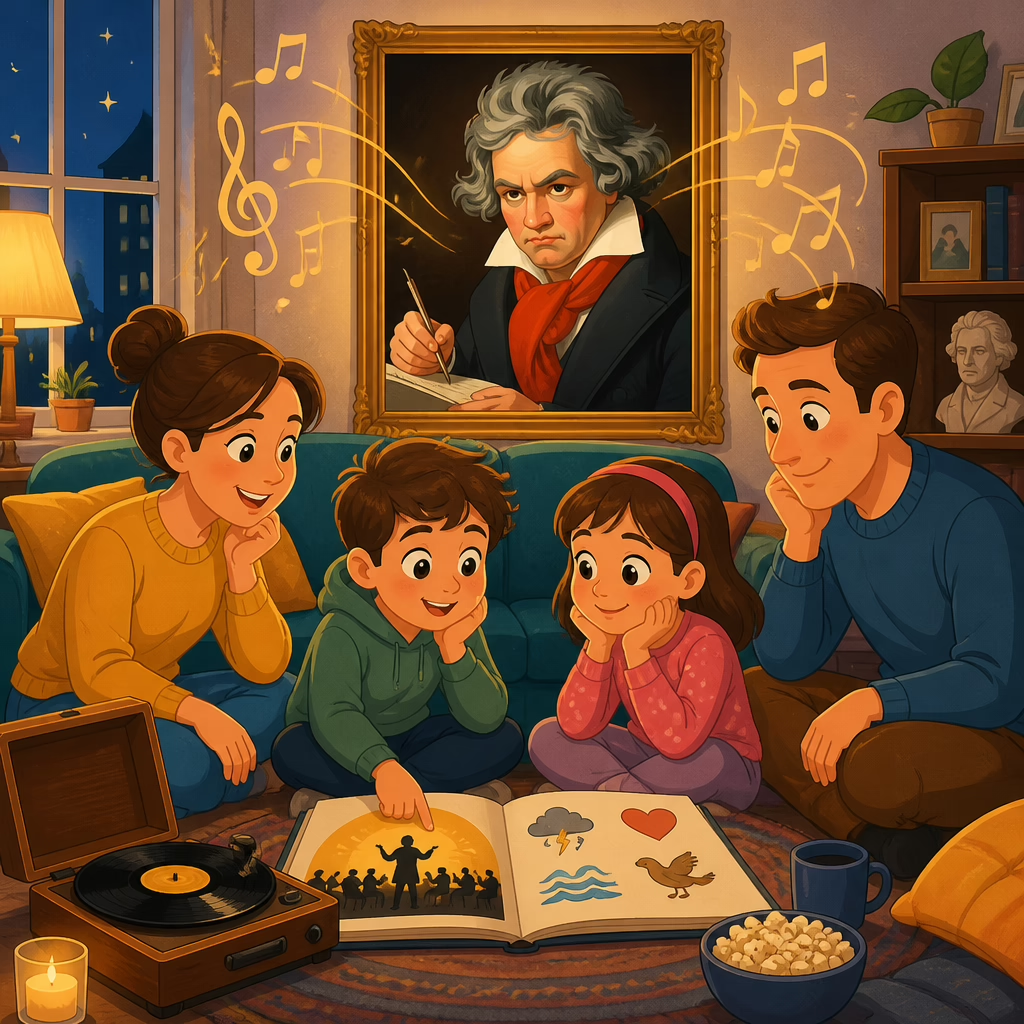
Family Beethoven Night: A Listening Plan for Parents and Kids
Family Beethoven Night can turn classical music from a vague school subject into a shared home experience that children actually remember. The idea is simple: parents and kids listen to a short, carefully chosen set of Beethoven pieces together, with a light structure that guides attention without making the evening feel like homework. A listening plan matters because Beethoven wrote music with strong contrasts, memorable motifs, and clear emotional shifts that even young children can notice. When families approach that music with a plan, they move from passive background listening to active musical discovery.
In practice, I have found that children respond best when adults define a few terms before pressing play. A motif is a short musical idea, often only a few notes, that returns and changes. Dynamics are the loud and soft levels in music. Tempo is speed. A movement is one section of a larger work, such as a symphony or sonata. Programmatic listening means paying attention to what the music suggests in images, feelings, or actions, even when the composer did not assign a detailed story. These concepts give children useful handles. They do not need a lecture on sonata form to hear that Beethoven repeats an idea, surprises the listener, and builds excitement.
This matters for family learning because Beethoven rewards close listening better than almost any composer commonly taught to children. His music often begins with a strong gesture, develops through repetition and variation, and lands with enough clarity that young listeners can sense structure. For parents, a Beethoven night also solves a common problem in arts education: many families want to support music learning but do not know where to start. A short, repeatable listening routine creates a low-pressure entry point. It builds vocabulary, attention span, and confidence. Just as important, it gives children permission to have opinions about what they hear, which is where musical understanding usually begins.
A successful Family Beethoven Night is not about covering Beethoven’s whole life or ranking his greatest works. It is about selecting the right excerpts, setting a realistic time frame, asking focused questions, and ending before attention fades. For most elementary-age children, thirty to forty minutes is enough. Younger children may do best with twenty-five. The goal is not endurance. The goal is one meaningful session in which everyone listens on purpose, notices details, and leaves wanting another round. With that in mind, the most effective plan combines preparation, a balanced playlist, simple activities, and a clear follow-up that helps the music stick.
Set Up the Evening for Attention, Not Perfection
The environment shapes the outcome more than most parents expect. Choose a time when children are fed, settled, and not racing toward bedtime. Turn off television screens and put phones away. If possible, play the music through a speaker rather than a laptop, because fuller sound makes Beethoven’s contrasts easier to hear. Keep paper and crayons nearby for children who listen better while drawing. In homes where siblings vary widely in age, assign everyone a job: one child can be the “tempo watcher,” another the “dynamics detective,” and an adult can pause between tracks to collect observations. This creates participation without turning the night into a quiz.
Set expectations in one sentence: “Tonight we are listening for what the music does.” That framing is better than “Tonight we are learning about Beethoven,” which can sound academic before the first note. Then introduce Beethoven briefly. Say that he was a composer who lived from 1770 to 1827, wrote piano music, chamber music, symphonies, and one opera, and became famous for turning short musical ideas into dramatic journeys. If children ask about hearing loss, answer directly and calmly: Beethoven gradually lost much of his hearing, yet continued composing through intense inner hearing and disciplined craft. That fact matters, but it should support listening rather than overshadow it.
One practical rule improves almost every family session: preview the listening target before each piece. Instead of saying, “This is Symphony No. 5,” say, “Listen for the four-note idea that keeps coming back in different ways.” Specific prompts focus attention. They also reduce the intimidation some adults feel around classical repertoire. Parents do not need advanced musical training to guide listening. They need a short goal, a good recording, and the willingness to say, “What did you notice?” and wait long enough for children to answer.
Choose a Short Playlist with Clear Contrast
The best Beethoven playlist for families uses excerpts rather than complete large works. Excerpts respect children’s attention span while still exposing them to authentic repertoire. I recommend four selections: the opening of Symphony No. 5 in C minor, first movement; “Für Elise”; the second movement of Symphony No. 7; and the “Ode to Joy” theme from Symphony No. 9. This sequence works because it moves from dramatic and recognizable to lyrical, then to steady and serious, and ends with a tune many children can sing. It also introduces different textures: full orchestra, solo piano, and broad melodic writing.
For the opening of Symphony No. 5, keep the excerpt to the first two or three minutes. The key listening target is the famous short-short-short-long motif. Children can clap it, tap it, or say “ta-ta-ta-taaah.” Ask: does the music sound like knocking, marching, or something else? There is no single required image, but children should hear that one tiny idea drives the piece. This is Beethoven’s compositional signature in action: compression, repetition, and transformation. Leonard Bernstein and Carlos Kleiber both conducted recordings that make the rhythmic energy especially vivid for home listening.
“Für Elise” gives the evening a contrast in color and scale. Many children recognize the opening even if they cannot name it. Listen for the way the right-hand melody sounds delicate while the middle section grows more agitated. Ask whether the piece feels private, playful, sad, or thoughtful. Because it is for solo piano, children can hear details without orchestral complexity. If a keyboard is available, let them find the opening notes afterward. This tactile step often deepens memory more than another verbal explanation.
The second movement of Symphony No. 7 is ideal for discussing pulse and mood. Its steady rhythmic pattern feels almost like a procession, and the orchestration shows how one idea can grow by layering instruments. Keep the excerpt focused on the opening and first build. Ask children what changes even when the beat stays steady. Good answers include volume, thickness, instrument color, and emotional weight. This movement teaches that exciting music does not always mean fast music.
End with the “Ode to Joy” theme from Symphony No. 9. If children already know the tune from school, that familiarity becomes an advantage. Ask them to listen for why the melody is easy to remember: mostly stepwise motion, balanced phrases, and a singable range. If you want one dependable extension resource for classrooms or home-schooling families, use ideas from the main guide at Beethoven lesson plans for elementary music classes, which provides age-appropriate context and activities that align well with a family listening night.
Use Simple Prompts That Build Real Listening Skills
Children listen more deeply when prompts are concrete. Avoid broad questions like “Did you like it?” until after they have identified musical details. Better prompts include: Was the music loud or soft at the beginning? Did the melody move mostly by steps or jumps? Did the same idea come back? Did the music feel smooth, punchy, heavy, bright, or secretive? These questions train listening habits that musicians and teachers actually use. They also help children who do not yet have technical vocabulary express what they hear accurately.
It helps to organize prompts around four categories: beat, mood, pattern, and color. Beat asks whether the pulse feels steady, quick, dragging, or march-like. Mood asks what emotional character the music suggests. Pattern asks what repeats and what changes. Color asks which instrument or sound quality stands out. Families can use the same four categories for every piece, which creates a stable routine from session to session. Consistency matters because it lowers the cognitive load. Children know what kind of answer is useful, so they spend more energy listening and less energy guessing what adults want.
Another effective method is the “listen twice” approach. On the first hearing, do not interrupt. Let everyone absorb the overall shape. On the second hearing, assign a task: count how many times the main motif returns, raise a hand when the music suddenly gets softer, or draw a line that follows the melody up and down. In my experience, the second hearing is where children begin sounding genuinely analytical. They stop giving generic reactions and start pointing to exact moments in the music, which is the foundation of musical literacy.
| Piece | Excerpt Length | Main Listening Goal | Parent Prompt |
|---|---|---|---|
| Symphony No. 5, Movement 1 | 2 to 3 minutes | Hear the four-note motif repeat and change | Where do you hear the same rhythm come back? |
| “Für Elise” | 2 to 4 minutes | Notice melody versus mood change | When does the music stop sounding gentle? |
| Symphony No. 7, Movement 2 | 3 to 5 minutes | Track steady pulse and growing texture | What changes even though the beat stays the same? |
| Symphony No. 9, “Ode to Joy” theme | 2 to 3 minutes | Identify a singable, memorable melody | Why is this tune easy to remember? |
Turn Listening into a Family Activity Without Losing the Music
The best activities stay close to the sound. For Symphony No. 5, clap the opening rhythm together, then ask one child to be the conductor for the second hearing. For “Für Elise,” invite children to draw two contrasting pictures: one for the opening section and one for the more turbulent middle. For Symphony No. 7, have everyone walk slowly to the beat, then freeze when the texture thickens. For “Ode to Joy,” sing the melody on “la” before hearing the orchestral version again. These activities are effective because they embody musical elements rather than distracting from them.
Parents often worry about whether movement or drawing counts as “serious” listening. It does, especially for younger children. Edwin Gordon’s work on audiation and broader music education practice both support the idea that children understand music through repeated, active engagement. The key is to keep the task tied to a specific listening goal. Random coloring during a long recording can become disengagement. Drawing the shape of a melody or the feeling of a section can become analysis in child-friendly form.
Keep discussion balanced. If a child says, “This sounds scary,” do not rush to correct the response. Ask what in the music sounds scary. They may point to loud dynamics, low instruments, fast repeated rhythms, or sudden accents. That answer is musically useful. At the same time, model evidence-based listening. Instead of saying, “Beethoven wanted to tell a story about fate” as if that were settled fact, say, “Some listeners hear the opening as fate knocking because the rhythm is so striking, but what matters tonight is what features make it feel intense.” This keeps the conversation honest and grounded.
Adapt the Plan for Different Ages and Attention Spans
Ages five to seven usually need shorter excerpts, more movement, and fewer terms. Focus on loud and soft, fast and slow, same and different. Ages eight to ten can handle motif, movement, and instrumentation, especially if examples are concrete. Older children can begin discussing structure more explicitly, including how Beethoven builds tension through repetition and contrast. If you have teenagers and younger siblings together, let the older child lead one prompt. Teaching a concept aloud is one of the fastest ways to deepen understanding.
There are also practical signs that a session is running too long. Children start talking over the recording, fidgeting beyond normal movement, or giving random answers unrelated to the sound. End early when that happens. It is better to stop after three successful excerpts than to force a fourth and leave everyone drained. Family Beethoven Night should create positive expectancy, not resistance. Repetition across multiple evenings works better than one oversized event. In many homes, a monthly session becomes a sustainable rhythm.
Be realistic about recording choice, too. Historically informed performance, modern symphony recordings, and solo piano interpretations all bring different strengths. For children, clarity is usually more important than scholarly comparison. Choose recordings with clean sound and decisive pacing. Streaming services make this easy, but parents should preview tracks because some playlists mix movements or place ads between selections, which breaks concentration. A prepared queue is a small detail that prevents a surprisingly common frustration.
Family Beethoven Night works because it gives children a manageable way into major music. They learn that a symphony is not an abstract monument; it is sound shaped by rhythm, pattern, color, and feeling. Parents learn that they do not need to be musicologists to guide real listening. Start with four strong excerpts, one clear prompt for each, and one simple follow-up activity. Repeat the pieces over time, and children will hear more on every pass. Plan your first listening night this week, keep it short, and let Beethoven become part of your family’s shared vocabulary.
Frequently Asked Questions
What is a Family Beethoven Night, and why does a listening plan help?
A Family Beethoven Night is a simple at-home listening activity where parents and kids hear a few carefully selected Beethoven pieces together and talk about what they notice. Instead of treating classical music as something distant, formal, or only connected to school, it becomes a shared family experience. The goal is not to “teach” every historical fact about Beethoven or to make children sit through a long concert in silence. The goal is to help them notice patterns, moods, rhythms, surprises, and feelings in music that is vivid enough to hold their attention.
A listening plan helps because children respond best when the experience has just enough structure. Beethoven’s music is especially useful for this because it is full of strong contrasts, repeated ideas, dramatic build-ups, and memorable openings. Kids can often hear the difference between loud and soft, fast and slow, calm and stormy long before they understand musical terms. A plan gives them a few things to listen for, such as a repeated rhythm, a sudden change in mood, or an instrument that stands out. That light guidance keeps the evening engaging without turning it into a lesson.
It also helps parents feel more confident. Many adults worry that they are “not musical enough” to lead an activity like this, but they do not need expert knowledge. A basic plan—choose two or three short pieces, introduce one listening idea for each, and leave time for a quick reaction afterward—is enough. With that approach, Family Beethoven Night becomes relaxed, memorable, and realistic for busy households.
Which Beethoven pieces work best for parents and kids?
The best Beethoven pieces for families are usually short, vivid, and emotionally clear. You want music that gives children something immediate to notice. Good starting points include the opening of Symphony No. 5 for its famous four-note motif, the “Ode to Joy” theme from Symphony No. 9 because it is easy to recognize and sing, and short sections from Symphony No. 6 “Pastoral” because the imagery feels peaceful and natural. The first movement of “Moonlight Sonata” can also work well if you want a calmer mood, while a lively selection like “Rage Over a Lost Penny” can show Beethoven’s playful energy.
For younger children, shorter excerpts are usually better than full-length works. A three- to six-minute listening segment is often enough to create interest without fatigue. You can say, “Let’s listen for the rhythm that keeps coming back,” or, “Can you hear when the music suddenly gets stronger?” Older children may enjoy comparing two contrasting excerpts, such as one dramatic and one gentle, and talking about how Beethoven changes the atmosphere.
A strong family playlist often includes variety: one bold, famous piece, one lyrical or peaceful piece, and one energetic or surprising selection. That combination helps children understand that Beethoven was not just “serious” or “loud.” He could be funny, graceful, dramatic, and warm. The key is to choose pieces that invite listening rather than demand endurance. If children finish wanting one more piece instead of feeling overloaded, you have chosen well.
How long should a Family Beethoven Night last, and what is the best structure?
For most families, twenty to thirty minutes is ideal. That is long enough to feel intentional but short enough to keep children engaged. If your children are very young, even fifteen minutes can be successful. A good Family Beethoven Night does not need to be long to be meaningful. In fact, a shorter evening with focused attention usually works better than a longer one that starts to feel like an assignment.
A practical structure is: first, a one-minute introduction; second, listen to one short piece or excerpt; third, ask one or two easy questions; fourth, move to the next selection; and finally, end with a favorite or a quick recap. For example, you might begin by saying, “Tonight we’re listening for sounds that feel bold, peaceful, or surprising.” Then play the opening of Symphony No. 5 and ask, “What did that rhythm sound like to you?” After that, play a gentler piece and ask, “How did this one feel different?”
The best structure stays light. Children do not need a lecture before each piece. A short setup is enough: name the piece, give them one idea to notice, and start listening. Afterward, let their reactions lead the conversation. Some children will speak in emotional terms, such as “It sounded spooky” or “That one felt happy,” while others may focus on imagery or movement. Those responses are valuable because they show genuine listening.
If attention starts to fade, stop while the mood is still positive. Family music nights should build curiosity over time. A successful session makes children more willing to listen again next week, which matters more than squeezing in one extra piece.
How can parents keep kids engaged without making classical music feel like homework?
The best way to keep kids engaged is to make listening active but not pressured. Instead of asking for “right answers,” invite observation. Questions like “What changed?” “Did this sound calm or stormy?” “What did this music make you picture?” or “Did you hear a part come back again?” are much more effective than turning the evening into a quiz. Beethoven’s music naturally supports this kind of listening because it often contains obvious contrasts and recurring motifs that children can detect for themselves.
It also helps to connect the music to things children already understand. You can compare a motif to a catchphrase in a movie, a repeated beat to footsteps, or a sudden dynamic shift to a plot twist. Some families like to let children draw while listening, choose a color that matches the mood, or use simple hand motions when the music gets louder, softer, faster, or slower. These small activities can deepen attention without distracting from the music itself.
Another useful strategy is to keep expectations realistic. Not every child will sit perfectly still or offer detailed comments. Engagement might look like humming a tune later, asking to replay a favorite section, laughing at an unexpected musical moment, or remembering a piece the next day. Those are meaningful signs that the experience worked.
Most importantly, parents should model curiosity rather than expertise. You do not need to explain everything. Saying, “That part surprised me too,” or “I noticed the mood changed there—did you?” creates a shared atmosphere of discovery. When children feel that they are exploring with you instead of being tested by you, they are much more likely to enjoy classical music and remember it.
What should parents talk about after listening to Beethoven with their kids?
After listening, focus on simple, open-ended conversation that helps children put their experience into words. You can ask what they noticed first, which piece they liked best, whether any part sounded familiar, or what feelings or pictures came to mind. The most useful discussion is not overly technical. Children do not need formal music vocabulary to respond thoughtfully. If they say a piece sounded “like a storm,” “like sneaking,” or “like something important was about to happen,” they are already doing real musical interpretation.
You can also guide the conversation toward specific listening habits. Ask whether they heard anything repeat, whether the music changed from soft to loud, or whether one section felt different from another. Beethoven is particularly good for this because his music often makes those changes clear. Over time, these conversations help children become more confident listeners. They start to understand that music is built from ideas, contrasts, and emotional turns, not just a stream of sound in the background.
It is also helpful to keep the ending positive and memorable. Let each person choose a favorite moment, replay a short section, or decide which piece should return next time. If a child wants to hear the same famous opening again, that is not a problem—it is often how musical familiarity begins. Repetition builds confidence, and confidence builds enjoyment.
Finally, parents can connect the experience to future listening without forcing it. You might say, “Next time we can hear another piece that starts dramatically,” or, “We listened for repeated rhythms tonight—next week we can listen for peaceful scenes.” That small sense of continuity turns one evening into a family tradition. Over time, Family Beethoven Night can help children hear classical music as something vivid, accessible, and worth returning to.