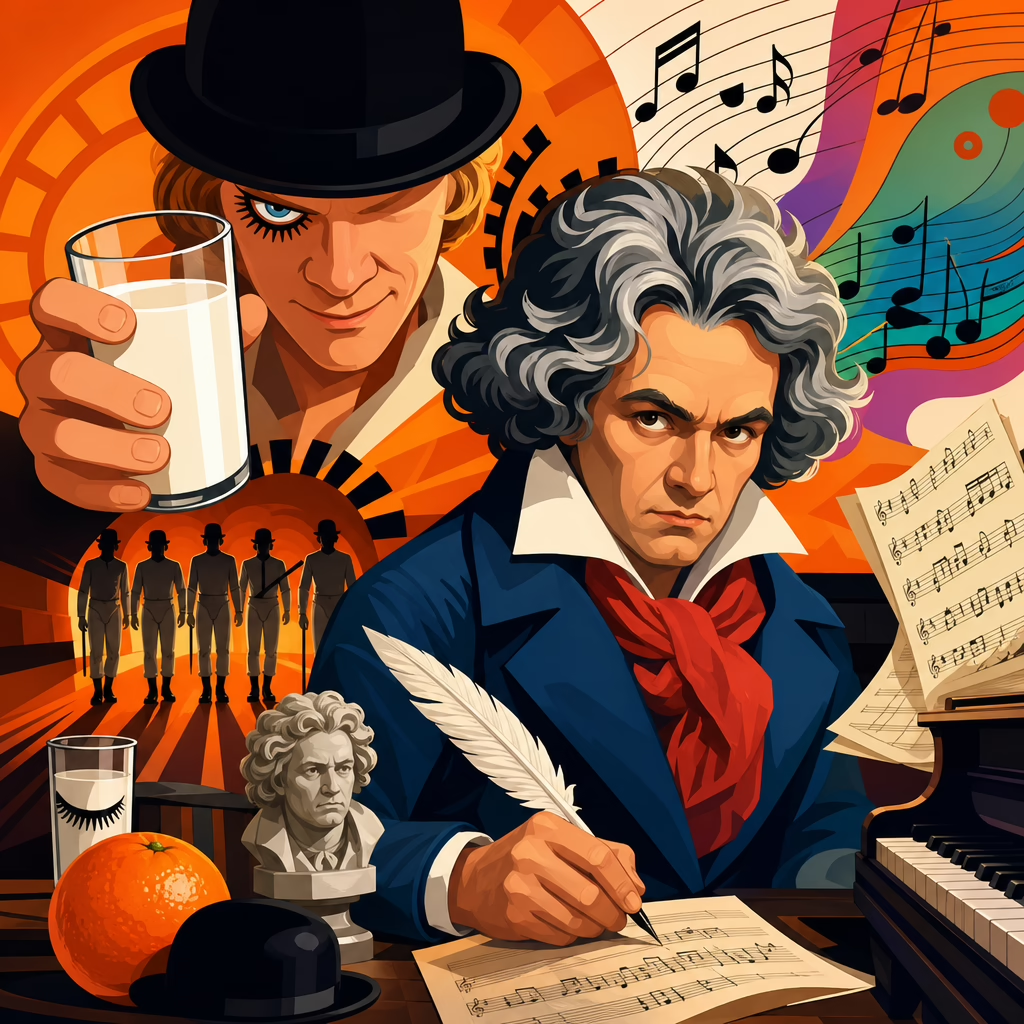
Cultural Impact of “A Clockwork Orange” on Perceptions of Beethoven
Stanley Kubrick’s A Clockwork Orange permanently altered how many people hear Beethoven, turning music that once signified moral elevation, artistic genius, and European high culture into a soundtrack also associated with irony, violence, and psychological disturbance. In discussions of Beethoven in pop culture, this film sits at the center of the “Miscellaneous” category because its influence reaches beyond one scene, one symphony, or even one decade. It reshaped audience perception, influenced later filmmakers and advertisers, provoked ethical debates about using canonical music in disturbing contexts, and created a durable shorthand in which Beethoven could signal both transcendence and menace. That cultural shift matters because pop culture does not simply borrow classical music; it teaches audiences how to interpret it. When a major film recontextualizes Beethoven so powerfully, it changes listening habits, visual associations, and even the emotional assumptions viewers bring to the composer’s work.
By “perceptions of Beethoven,” I mean the network of ideas ordinary listeners attach to his music: nobility, struggle, triumph, sophistication, emotional intensity, and humanistic aspiration. Before Kubrick’s adaptation of Anthony Burgess’s novel reached theaters in 1971, Beethoven in mass media was often framed as the emblem of greatness or uplift. His Fifth Symphony suggested fate and determination. His Ninth represented brotherhood and civilization, especially through the “Ode to Joy.” His music already appeared in cartoons, war films, concert films, and educational programming, but usually within recognizable cultural hierarchies that reinforced the composer’s prestige. A Clockwork Orange did not erase those meanings. It complicated them. In practical terms, it made Beethoven available for darker readings, and that shift has echoed through film, television, criticism, and audience memory ever since.
How the film fused Beethoven with Alex’s inner life
The film’s central innovation is not merely that it uses Beethoven on the soundtrack; it binds Beethoven to the subjectivity of Alex DeLarge, a charismatic, violent delinquent whose love of “Ludwig Van” is sincere. That detail matters. Kubrick does not present Beethoven as background refinement pasted onto brutal imagery for cheap contrast. He presents the music as part of Alex’s eroticized imagination, his craving for domination, and his ecstatic sense of self. I have found that when people recall the film years later, they often remember Beethoven less as concert music and more as “Alex’s music,” which shows how completely character framing can overwrite prior assumptions.
In the film, the second movement of Beethoven’s Ninth Symphony becomes especially significant. Alex listens rapturously, experiencing fantasies of destruction and grandeur. The sequence is not subtle, and that is why it worked culturally. Kubrick gives viewers a lesson in association: Beethoven can now score the interior world of someone both aesthetically sensitive and morally monstrous. This does not imply that Beethoven causes violence; the film is too formally sophisticated for that simplistic reading. Instead, it argues that great art is morally noncompliant. It can intensify whatever psyche receives it. For audiences accustomed to linking classical music with refinement and ethical seriousness, that was a profound dislocation.
The film also amplified this effect through Wendy Carlos’s electronic arrangements, especially the synthesized treatment of Beethoven. Those versions matter historically because they translated the composer into a modern, technologically altered sound world. Rather than presenting Beethoven as museum culture, the score made him immediate, strange, and futuristic. For many younger viewers, especially those encountering the music outside formal concert settings, this was a gateway experience. They did not first meet Beethoven through a symphony hall or classroom. They met him through cinema, sensation, and cultural controversy.
Why the juxtaposition shocked audiences and critics
The reason A Clockwork Orange had such force is that it exploited a long-standing cultural expectation: serious classical music was supposed to elevate. Kubrick violated that expectation with precision. The scenes of assault, the detached visual style, and the exuberant use of Beethoven created what critics often describe as dissonance between sound and image. But the effect is stronger than ordinary contrast. The film weaponizes prestige. It uses Beethoven’s cultural status to destabilize viewers, asking whether beauty remains beautiful when attached to cruelty. That question entered mainstream culture in part because the film was so widely discussed, censored, debated, and imitated.
Contemporary critical responses often focused on this moral unease. Some reviewers saw the Beethoven material as proof of Kubrick’s audacity; others saw it as evidence of cold manipulation. Either way, the association stuck. In the years after the release, references to Beethoven in violent or satirical contexts increasingly invited comparison to Kubrick’s film. This is how cultural impact works at scale: one work becomes the reference point through which later uses are filtered. A viewer no longer hears Beethoven in isolation. A layer of cinematic memory intervenes.
That memory was strengthened by the film’s notoriety. Because A Clockwork Orange was linked to censorship battles and public anxiety about copycat violence, every element of it acquired extra symbolic charge. Beethoven became part of the controversy, not because the composer was controversial, but because the film made his music complicit in a larger conversation about media effects. Even people who had never seen the full film absorbed fragments of that debate through journalism, parody, and word of mouth. In cultural terms, Beethoven was no longer only the composer of the heroic tradition. He was also part of a disturbing modern myth.
The main ways perceptions of Beethoven changed in popular culture
After the film, Beethoven carried a more unstable and flexible meaning in mass media. That change can be summarized through four recurring shifts that appeared across later decades in film, television, advertising, and casual audience recognition.
| Shift in perception | Before the film | After the film |
|---|---|---|
| Emotional coding | Primarily noble, tragic, triumphant, uplifting | Also ironic, threatening, manic, psychologically charged |
| Character association | Linked to genius, education, respectability | Could also mark instability, performative sophistication, or villainy |
| Media usage | Concert scenes, prestige dramas, educational contexts | Dark satire, violent montage, dystopian storytelling, stylized contrast |
| Audience response | Recognition of canonical importance | Recognition mixed with Kubrickian unease or black humor |
The first shift is emotional coding. Beethoven did not lose his established meanings, but new meanings attached themselves. A passage from the Ninth could still suggest grandeur, yet it could now also suggest a disturbed mind reaching for grandeur. The second shift is character association. Filmmakers learned that Beethoven could characterize someone who wants to appear cultivated while remaining dangerous or morally split. The third shift is media usage. Editors and directors saw that canonical music could intensify violence precisely because it resists the expected emotional cueing of conventional thriller scores. The fourth shift is audience response. Even when no direct homage is intended, viewers with film literacy may bring Kubrick’s shadow with them.
Effects on later films, television, and advertising
One of the clearest signs of the film’s impact is how often later media deploys Beethoven, or classical music generally, in ways that presume audience familiarity with ironic juxtaposition. Not every later example is a direct lift from Kubrick, but the grammar became widely usable after A Clockwork Orange. Directors could place exalted music over ugly behavior and trust audiences to understand the cultural friction. That became a staple of modern audiovisual storytelling.
In crime films and psychological dramas, Beethoven increasingly functioned as a marker of cultivated menace. A villain listening to a sonata no longer simply signaled taste; it could signal compartmentalization, narcissism, or emotional excess. Television adopted the same shorthand. Commercials and trailers also learned to exploit classical prestige while bending it toward humor or shock. Once a canonical composer can carry irony at scale, advertisers notice. Beethoven became useful because he was instantly recognizable and symbolically rich.
This influence also spread beyond Beethoven specifically. Kubrick helped normalize the broader practice of setting elegant, historically prestigious music against modern brutality. Later filmmakers applied the technique to Rossini, Strauss, Mozart, and others. Yet Beethoven remained especially potent because his public image had been so strongly tied to seriousness and moral struggle. Disturbing that image generated more charge than disturbing a lighter or more decorative composer’s image would have done. In that sense, Kubrick selected his material with exact cultural intelligence.
What the film did not change about Beethoven
It is important not to overstate the case. A Clockwork Orange did not redefine Beethoven for everyone, and it certainly did not eclipse centuries of reception history. In concert culture, music education, and public commemorations, Beethoven remained the monumental composer of the symphonic canon. The Ninth Symphony still anchors major civic performances. The Fifth still appears in contexts of struggle and victory. Musicologists, conductors, and committed listeners did not suddenly reinterpret the composer through Alex DeLarge alone.
What changed was the default media literacy around Beethoven in popular culture, especially among viewers whose strongest point of contact with classical music came from film and television. In audience research and informal conversation, this distinction matters. Dedicated classical audiences often maintain multiple frames at once, hearing the Ninth as a masterpiece with historical, formal, and philosophical dimensions. Casual viewers are more likely to rely on dominant media memories. Kubrick gave them one of the strongest such memories in twentieth-century cinema.
There is also a generational factor. For some listeners, the film served as an introduction that led them deeper into Beethoven’s catalog. I have seen this pattern repeatedly: a viewer becomes fascinated by the soundtrack context, then seeks out full symphonic recordings, performance histories, and the composer’s biography. The association begins in shock but ends in genuine musical curiosity. That is one reason the film’s impact is culturally complex rather than purely corrosive.
Ethical debate: does using Beethoven this way degrade the music?
The ethical debate has never disappeared. One position holds that attaching Beethoven to scenes of cruelty cheapens or contaminates the music, especially for viewers without enough prior context to separate composition from cinematic framing. Another position argues that great art is not diminished by difficult reuse; if anything, recontextualization proves its resilience and expressive breadth. Kubrick clearly leaned toward the second view. He trusted that Beethoven could survive collision with modern barbarism and emerge even more unsettlingly powerful.
There is a practical middle ground. Context shapes reception, and repeated media framing does affect public meaning. Anyone working with classical music in visual storytelling knows this from experience. Place a piece under a funeral scene, and audiences carry grief into the next encounter. Place the same piece under satire or violence often enough, and that residue accumulates. So the concern about distortion is not naïve. It reflects how cultural memory actually works. At the same time, restricting canonical music to reverent settings would reduce its interpretive life and ignore the fact that composers themselves often wrote music of conflict, tension, and disruption.
Beethoven is especially suited to this debate because his music already contains struggle, rupture, and overwhelming force. Kubrick did not invent intensity inside Beethoven. He redirected it. The controversy lies in whether that redirection illuminated something latent or imposed something alien. Serious listeners can reasonably disagree, but the debate itself proves the film’s lasting role in shaping perceptions of Beethoven.
Why this article matters within Beethoven in pop culture
As a hub topic within “Beethoven in Pop Culture,” this subject connects many smaller articles that might otherwise seem unrelated: Beethoven in dystopian cinema, classical music and villain coding, the Ninth Symphony in modern media, Wendy Carlos and synthesized classical adaptation, censorship controversies, and the use of elite culture in satire. A Clockwork Orange is not just another example of Beethoven on screen. It is a crossroads where music history, film history, audience psychology, and media ethics meet.
Understanding that crossroads helps explain why Beethoven remains so usable in popular culture. He carries instant recognition, emotional magnitude, and symbolic prestige. Kubrick demonstrated that those qualities can be inverted without losing their power. Since then, creators across media have treated Beethoven as culturally double-coded: a composer of sublime aspiration and a tool for exposing the instability beneath civilized surfaces. That dual coding is now part of the composer’s pop-cultural afterlife.
The lasting lesson is simple. A Clockwork Orange did not replace Beethoven’s traditional image, but it decisively expanded it. For millions of viewers, Beethoven became not only the voice of heroism and human dignity, but also the sound of unsettling contradiction: beauty bound to violence, genius entangled with pathology, culture unable to guarantee morality. If you are mapping Beethoven in pop culture, this is one of the essential reference points. Use it as a starting hub, then explore the connected topics that show how one film changed the way modern audiences hear an immortal composer.
Frequently Asked Questions
How did A Clockwork Orange change the way audiences perceive Beethoven?
A Clockwork Orange dramatically altered the cultural meaning of Beethoven for many viewers by placing his music inside a disturbing moral and psychological framework. Before the film, Beethoven was widely treated in popular imagination as a symbol of artistic greatness, emotional depth, human struggle, and the highest ideals of European classical culture. Kubrick did not erase those associations, but he complicated them. By linking Beethoven so strongly with Alex, a charismatic yet deeply violent protagonist, the film encouraged audiences to hear familiar music in a new and unsettling way. Pieces that might once have suggested transcendence, heroism, or spiritual intensity now also carried connotations of menace, irony, and emotional instability.
This shift was powerful because the film did not use Beethoven merely as background decoration. The music becomes part of Alex’s inner life, part of his pleasure, imagination, and identity. That creates a disturbing contradiction: one of the greatest composers in Western tradition is fused with scenes and themes of cruelty, manipulation, and moral confusion. As a result, the audience is pushed away from the comforting idea that refined taste automatically signals refined character. One of the film’s lasting cultural effects is precisely this challenge to old assumptions about “high art” as a marker of virtue.
Over time, that reframing spread far beyond the film itself. References to Beethoven in later media often carry at least a trace of Kubrick’s influence, especially when directors, writers, or advertisers want to suggest something psychologically charged or darkly ironic. For many people, hearing certain Beethoven passages after seeing the film is no longer a purely musical experience; it is also a cinematic and cultural memory. That is why the movie remains central to discussions of Beethoven in pop culture: it changed not just one scene or one composition, but an entire pattern of listening.
Why is Beethoven’s music in the film considered so culturally significant?
The use of Beethoven in A Clockwork Orange is culturally significant because it creates a collision between artistic prestige and social breakdown. Kubrick could have chosen music that simply matched violence with aggression, but instead he turned to a composer associated with monumental achievement, emotional grandeur, and civilizational seriousness. That choice gave the film a deeper intellectual charge. Beethoven’s music does not just accompany the story; it raises questions about the relationship between beauty and brutality, freedom and control, pleasure and ethics. In other words, the soundtrack helps make the film’s philosophical concerns audible.
The significance also lies in how the film exposed a tension that had long existed but was not always openly discussed: appreciation of great art does not guarantee moral goodness. Alex loves Beethoven passionately, yet he is capable of extreme cruelty. That combination shocked audiences because it cut against the comforting belief that culture civilizes the individual. Kubrick used Beethoven to show that aesthetic sensitivity can coexist with violence, narcissism, and sadism. This was not just provocative storytelling; it became a broader cultural statement that influenced how people think about art, class, refinement, and human nature.
In addition, the film helped move Beethoven from the concert hall into a more unstable zone of mass-media meaning. After A Clockwork Orange, Beethoven in popular culture could no longer be assumed to signify only greatness, dignity, or universal human uplift. He could also signify theatrical excess, emotional distortion, or a chilling contrast between sonic beauty and visual horror. That new layer of meaning proved durable. It has affected film scoring, parody, cultural criticism, and even casual audience reactions. The soundtrack’s significance comes from this long afterlife: it permanently widened the interpretive range of Beethoven in modern culture.
Did the film damage Beethoven’s reputation, or did it deepen public engagement with his music?
In most serious assessments, the film did not damage Beethoven’s reputation so much as transform and expand the cultural conversation around him. Beethoven remained, and remains, one of the most revered composers in music history. A Clockwork Orange did not diminish his artistic standing. What it changed was the emotional and symbolic framework through which many non-specialist audiences encountered his work. For some viewers, the film introduced a note of discomfort into pieces they had previously heard as noble or uplifting. For others, it made Beethoven newly vivid, intense, and relevant. That kind of response is less about reputational decline than about interpretive complication.
There is a strong argument that the film actually deepened public engagement, even while unsettling it. By attaching Beethoven to such unforgettable imagery, Kubrick ensured that the music would remain active in popular memory. Viewers who might never have thought much about classical music were suddenly confronted with its power, its volatility, and its psychological force. Some became curious about the works behind the soundtrack and sought them out independently. In that sense, the film functioned as a strange but effective gateway, drawing new audiences toward Beethoven through controversy and emotional intensity rather than through traditional educational or concert-hall channels.
At the same time, the film undeniably burdened certain listeners with associations they cannot easily separate from the music. That is especially true for audiences who first encountered Beethoven through Kubrick’s imagery rather than through performance, study, or historical context. So the most accurate answer is that the film did both: it complicated public perception and broadened engagement. It did not weaken Beethoven’s importance, but it ensured that in modern pop-cultural consciousness, his music could be heard not only as exalted art, but also as something haunted by irony, violence, and unease.
Why does the film remain so important in discussions of Beethoven in pop culture?
The film remains essential because its impact was unusually broad, durable, and conceptually rich. Many works of popular culture borrow classical music for a memorable scene, but A Clockwork Orange went further by reengineering the cultural meaning of Beethoven across generations. Its influence was not confined to one famous cue or one isolated visual moment. Instead, it established a lasting template for how Beethoven could function in modern media: as a symbol not only of genius and grandeur, but also of contradiction, psychological extremity, and dark satire. That broad symbolic shift is why the film occupies such a central place in discussions of Beethoven’s pop-cultural afterlife.
Another reason is that the movie sits at the intersection of several major cultural conversations. It touches on violence in media, the politics of taste, youth rebellion, the authority of high culture, and the ethics of state control. Beethoven becomes entangled with all of those themes. As a result, the film is regularly cited not just by music historians or film scholars, but also by critics interested in cultural studies, media theory, and the sociology of art. It has become a case study in how a canonical composer can be repurposed by cinema and then reabsorbed into popular consciousness with altered meaning.
The film’s importance also endures because later creators continue to work in its shadow. Whenever Beethoven appears in a context of irony, menace, stylized violence, or emotional derangement, there is often an implicit or explicit echo of Kubrick. Even when modern audiences have not seen the film, they may still be receiving its legacy indirectly through decades of imitation, homage, parody, or critical reaction. That ripple effect keeps the movie relevant. It is no longer just a film that used Beethoven memorably; it is one of the key events that shaped how Beethoven is heard in contemporary visual culture.
What broader cultural themes explain the lasting connection between A Clockwork Orange and Beethoven?
The lasting connection is rooted in the film’s confrontation with one of Western culture’s deepest assumptions: that great art elevates human beings. Beethoven has long been a powerful emblem of that ideal. His music is frequently associated with struggle transformed into triumph, with individuality, with moral seriousness, and with the highest aspirations of civilization. A Clockwork Orange takes that cultural symbolism and places it in the hands of someone who is intelligent, sensuous, and aesthetically responsive, yet also vicious and predatory. That juxtaposition is so provocative because it suggests that culture and cruelty are not opposites in any simple way.
The film also speaks to modern anxieties about interpretation and control. Beethoven’s music in the movie is not stable in meaning; it becomes contested territory. For Alex, it represents ecstatic pleasure and personal intensity. For the audience, it can represent beauty contaminated by violence. Within the film’s larger narrative about conditioning and free will, the music also becomes entangled with questions about whether emotional response can be manipulated by institutions. That complexity helps explain why the Beethoven connection has endured. It is not merely memorable; it is intellectually and emotionally unresolved, which gives it continuing cultural life.
Finally, the connection lasts because it captures a distinctly modern collapse of boundaries between “high” and “low” culture. Kubrick took one of the central figures of classical tradition and inserted him into a provocative, mass-mediated, controversial cinematic world. In doing so, he showed that canonical art could be repurposed, reframed, and circulated in ways that were both democratizing and disturbing. Beethoven did not lose prestige, but his image became more unstable, more contested, and more available for reinterpretation. That instability is exactly what keeps the association alive. The film turned Beethoven into not just a composer to be admired, but a cultural symbol to be debated.