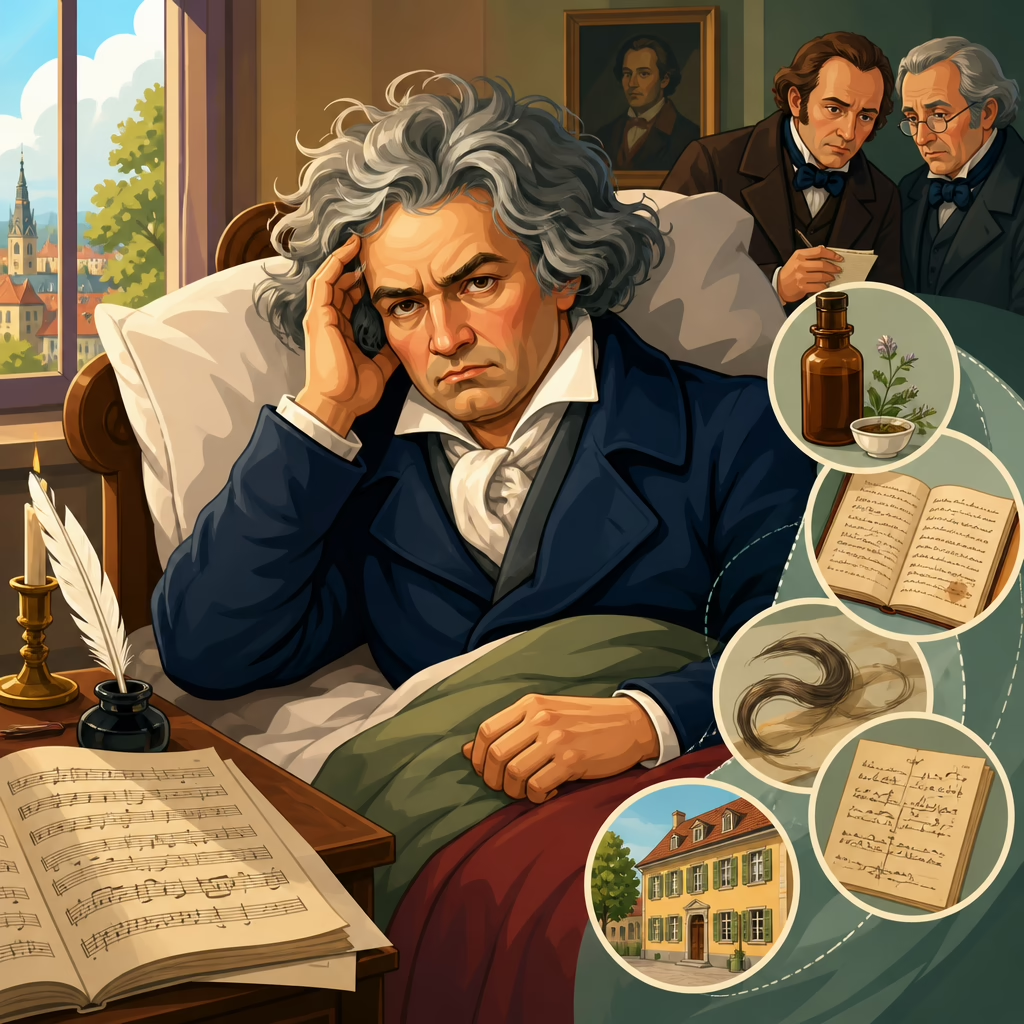
Beethoven’s Last Illness and the Evidence We Have
Ludwig van Beethoven’s final illness has attracted unusual scrutiny because it sits at the intersection of biography, medical history, and forensic science, yet the surviving evidence is fragmentary enough to invite debate. When historians ask what killed Beethoven, they are really asking a cluster of narrower questions: what symptoms he experienced in his last months, what chronic conditions preceded the collapse of 1826–1827, what his physicians observed, what the autopsy actually reported, and how modern laboratory studies of authenticated remains should be weighed against nineteenth-century testimony. That distinction matters. A single dramatic cause of death is appealing, but the evidence points instead to a complex, declining patient whose liver, gastrointestinal system, kidneys, and overall resilience were all under strain. I have found that the strongest accounts are the ones that separate documented facts from later legend and read the record the way a clinician and archivist both would.
Beethoven died in Vienna on 26 March 1827 at age fifty-six. By then he was already famous, profoundly deaf, physically exhausted, and repeatedly ill. His “last illness” usually refers to the final sequence beginning in late 1826, when he returned to Vienna after a difficult journey from his brother Johann’s estate at Gneixendorf. But that terminal phase cannot be understood without the longer arc of symptoms recorded over years: recurrent abdominal pain, diarrhea, inflammatory episodes, heavy alcohol consumption by some accounts, and signs consistent with chronic liver disease before the final decompensation. The evidence we have comes from letters, conversation books, recollections by friends such as Anton Schindler and Anselm Hüttenbrenner, reports by physicians including Andreas Wawruch and Johann Wagner, and the postmortem examination carried out the day after death. More recently, chemical and genomic analysis of hair samples has added another layer, though only some locks are now considered reliably authentic.
Why does this still matter? Because Beethoven’s case shows how historical medical claims are built. A famous diagnosis can rest on mistranscribed notes, contaminated artifacts, or assumptions imported from modern medicine. In Beethoven’s case, stories about poisoning, syphilis, and a single neat explanation for every symptom have repeatedly outrun the evidence. The more careful view is also the more interesting one: his final illness is one of the best documented deaths of a major composer before modern hospital medicine, and the surviving record lets us test competing explanations against direct observations. That makes Beethoven not just a biographical subject but a case study in how to evaluate historical evidence responsibly.
The final decline in late 1826 and early 1827
The terminal phase began after Beethoven’s stay at Gneixendorf in the autumn of 1826. During the return trip to Vienna in December, he traveled in cold, wet weather in an open carriage, a detail repeated in early accounts because contemporaries believed the exposure triggered the fatal decline. Soon afterward he developed what was described as pneumonia or a severe chest inflammation, with fever and weakness. The precise diagnosis is uncertain, but there is little doubt that the journey coincided with a major downturn. In my reading of the sources, this episode looks less like an isolated cause of death than a precipitating stressor in a patient already chronically ill.
Once back in Vienna, Beethoven came under medical care and was confined for long periods. The dominant feature of the final months was not simply respiratory infection but progressive abdominal distention caused by ascites, the accumulation of fluid in the abdomen. Ascites is a classic sign of advanced liver failure, especially cirrhosis with portal hypertension. Contemporary reports describe repeated procedures to drain the fluid, each bringing temporary relief. Beethoven endured four paracenteses between December 1826 and March 1827. Such repeated drainage strongly indicates severe, persistent fluid overload rather than a minor inflammatory illness.
His general condition worsened despite treatment. Accounts mention jaundice, swelling, weakness, poor appetite, and episodes of diarrhea. He was vulnerable to infection after abdominal punctures, and nineteenth-century antiseptic technique was limited. By the end he was emaciated, bedridden, and intermittently lucid. Witnesses describe a storm on the afternoon of his death and the famous image of Beethoven raising his fist, though that dramatic scene belongs more to memorial tradition than secure medical evidence. What is secure is that he died after months of decompensated disease marked by liver failure physiology and systemic collapse.
What the autopsy reported
The autopsy is the single most important piece of evidence. It was performed on 27 March 1827 by Johann Wagner, with notes later circulated in published form. The report described the body as cachectic and the abdomen as containing a large amount of turbid fluid. The liver was shrunken, hard, and nodular, a description highly compatible with cirrhosis. The spleen was enlarged, another finding that fits portal hypertension. The pancreas was described as large and hard. The kidneys reportedly had calcareous concretions in every cup, suggesting chronic kidney disease or papillary injury. The auditory nerves were said to be shrunken, and the skull was noted as unusually thick, observations that later fed theories about his deafness but are secondary to the question of his death.
For the last illness, the liver findings dominate the interpretation. A small, hard, hobnail liver is exactly what nineteenth-century pathologists often saw in cirrhosis. Combined with ascites, this makes advanced chronic liver disease the central diagnosis, not a speculative side issue. The enlarged spleen reinforces that conclusion because portal hypertension commonly produces splenomegaly. The autopsy therefore does not merely suggest poor health in a general sense; it identifies a structural disease process severe enough to explain the fluid accumulation and downward spiral of his final months.
At the same time, the report has limits. Histology did not exist in modern form, laboratory chemistry was rudimentary, and terminology was not standardized. “Pneumonia” in retrospective discussions may refer to physician reports rather than direct autopsy confirmation. Likewise, the kidney findings are real but not diagnostically precise by current standards. Still, historians should not flatten the autopsy into ambiguity. Some findings are stronger than others, and the evidence for cirrhosis is much firmer than the evidence for many later theories that achieved popular attention.
How modern researchers interpret the evidence
Modern interpretations usually sort into several main possibilities: alcohol-associated cirrhosis, viral hepatitis, autoimmune or cholestatic liver disease, medication-related injury, and toxic exposure such as lead. The best current approach does not insist on only one factor. Chronic liver disease often has mixed causes, and Beethoven’s case likely did as well. His social world included regular wine drinking, sometimes in substantial quantities, though the exact amount is impossible to quantify with confidence. Heavy alcohol use can cause cirrhosis, but historians should avoid pretending the documentary record provides a clean consumption log.
Another line of inquiry concerns hepatitis B. In 2023, genomic analysis of authenticated locks of Beethoven’s hair identified hepatitis B virus DNA in at least one sample, along with genetic risk factors for liver disease. That finding mattered because it provided direct biological evidence that Beethoven had a hepatitis B infection near the end of life. On its own, hepatitis B does not prove it single-handedly caused his death, but when combined with the autopsy evidence of cirrhosis and the historical reports of alcohol use, it creates a medically coherent picture: Beethoven may have died from end-stage liver disease arising from multiple interacting insults.
Lead exposure remains part of the discussion, but it has been reshaped by authentication work. For years, a famous hair sample known as the Hiller lock was cited as evidence of severe lead poisoning. Later DNA testing showed that lock did not belong to Beethoven, which removed a cornerstone of the poisoning narrative. Other authenticated hair samples still suggest he was exposed to lead at levels not unusual for nineteenth-century Europeans, who encountered lead through wine sweetening, cookware, medicines, and water systems. That exposure may have contributed to chronic symptoms, especially gastrointestinal ones, but the strongest recent evidence does not support lead poisoning as the sole or primary cause of death.
| Evidence source | What it shows | How strong it is |
|---|---|---|
| Physicians’ reports, 1826–1827 | Ascites, repeated abdominal taps, weakness, fever, progressive decline | Strong for terminal symptoms, weaker for precise diagnosis |
| Autopsy, 1827 | Shrunken nodular liver, enlarged spleen, abdominal fluid, kidney abnormalities | Very strong for advanced cirrhosis and systemic disease |
| Authenticated hair DNA studies | Hepatitis B infection near death, genetic liver risk factors | Strong but complementary, not a standalone explanation |
| Earlier hair lead studies | Claimed severe lead burden | Weakened because key lock was misattributed |
Symptoms before the last illness and why they matter
Beethoven’s last illness did not emerge from nowhere. Long before 1826, he had recurrent gastrointestinal complaints, especially abdominal pain and diarrhea, documented in letters and recollections. These symptoms have been used to argue for everything from irritable bowel syndrome to inflammatory bowel disease to chronic pancreatitis. Some possibilities remain plausible, but the key point is narrower: he was medically fragile for years, and his digestive symptoms fit a chronic multisystem burden rather than a sudden catastrophic illness in otherwise normal health.
His physicians also treated inflammatory eye disease and other episodic ailments, showing that his health record was varied and not reducible to one diagnosis. That complexity helps explain why retrospective certainty is dangerous. A person can have chronic bowel symptoms, intermittent infections, kidney pathology, and terminal cirrhosis without every complaint sharing a single elegant cause. In practice, historical cases are often overunified by later writers. Beethoven’s record resists that simplification.
One frequent confusion is the attempt to fold his deafness into the final illness. Deafness was of course central to Beethoven’s life, but it was not the cause of death. The autopsy observations on the auditory apparatus are important to the history of his hearing loss, yet they should not distract from the terminal evidence. When readers want the broader documentary foundation for his life chronology, including how records are interpreted carefully, the best companion piece is the main guide at https://lvbeethoven.com/what-beethovens-birth-record-actually-tells-us/. For the final illness specifically, the medically significant through line is progressive liver failure with complicating factors, not a grand unified theory explaining every lifelong symptom.
Myths, weak theories, and what can actually be said
Several popular theories do not hold up well. The strongest example is the claim that Beethoven was definitively killed by lead poisoning. Lead exposure is plausible and perhaps contributory, but the famous evidence base was damaged when a key hair sample proved inauthentic. Another weak theory is syphilis as the master diagnosis. Syphilis was common in nineteenth-century Europe, and mercury treatment was common too, but no surviving evidence demonstrates that Beethoven had syphilis, much less that it caused the terminal liver findings. Similarly, the dramatic winter carriage ride did not by itself “cause” his death; it likely precipitated decline in a seriously ill man.
What can be said with confidence is more modest and more persuasive. Beethoven died after months of decompensated illness characterized by ascites and systemic deterioration. The autopsy demonstrates advanced cirrhosis. Modern testing indicates hepatitis B infection near the end of life and supports a multifactorial explanation for liver disease, likely including alcohol use and possibly other contributors. Kidney abnormalities and chronic gastrointestinal complaints were part of the broader health picture. That conclusion is strong because it relies on converging evidence rather than on a single sensational clue.
Beethoven’s last illness is best understood as end-stage liver disease unfolding in real time, not as a mystery solved by one dramatic revelation. The record shows a man weakened over years, then pushed into terminal decline in late 1826, with massive ascites, repeated drainage procedures, and an autopsy that clearly documented a cirrhotic liver and enlarged spleen. Modern science has sharpened that picture rather than overturned it. Authenticated hair studies point to hepatitis B infection and genetic susceptibility, while the collapse of the old misattributed hair evidence has made simple lead-poisoning stories far less credible.
The most responsible conclusion is therefore a layered one: Beethoven probably died from complications of advanced cirrhosis, with infection, kidney stress, and chronic ill health contributing to the end. That answer respects both the nineteenth-century witnesses and the modern laboratory record. If you want to understand Beethoven accurately, follow the evidence hierarchy: primary documents first, autopsy next, then later recollections and modern testing interpreted cautiously. Read the surviving sources closely, compare claims against what was actually observed, and you will see that the real story is stronger than the myths.
Frequently Asked Questions
What do historians and medical researchers actually mean when they ask, “What killed Beethoven”?
That question sounds simple, but in practice it breaks into several different historical and medical problems. Researchers are not only asking for a single cause of death; they are also trying to reconstruct Beethoven’s symptoms in the final months of 1826 and early 1827, identify any long-term illnesses that weakened him beforehand, evaluate what his doctors observed at the bedside, and compare all of that with the postmortem findings recorded after his death. In other words, the debate is not just about a verdict. It is about how much confidence we can place in each kind of surviving evidence.
Beethoven’s last illness attracts unusual attention because the evidence comes from multiple layers: letters, reminiscences by friends, physicians’ notes, the autopsy report, and later scientific testing of alleged hair samples and other remains. Each category has strengths and limits. Witnesses could exaggerate, misunderstand, or remember events imperfectly. Doctors worked within the medical vocabulary of the early nineteenth century, which does not always map neatly onto modern diagnoses. Autopsy descriptions can be valuable, but they are only as precise as the examiner’s observations and terminology. Modern forensic studies can add new clues, yet they depend heavily on whether the tested material is authentic and whether the results can be interpreted in a medically meaningful way.
That is why modern discussions usually avoid claiming absolute certainty. A more careful formulation is that Beethoven likely died after severe liver disease complicated by fluid buildup, repeated abdominal procedures, infection risk, and profound overall decline. But even that broad summary leaves room for debate about the exact mechanism of death and about the role played by alcohol use, chronic gastrointestinal problems, possible hepatitis, pancreatic disease, or other conditions. The real historical question is not simply “What was the one cause?” but “Which explanation best fits the total body of evidence we still possess?”
What symptoms did Beethoven experience in his final illness, and why do they matter so much?
The surviving accounts suggest that Beethoven’s final illness involved dramatic swelling of the abdomen, serious weakness, and a long, exhausting decline rather than a sudden collapse. In late 1826, after returning from his brother Johann’s estate, he became seriously ill. Reports describe fever and chest symptoms at one stage, often interpreted as a respiratory illness or pneumonia early in the terminal sequence. As the illness progressed, the most striking feature appears to have been ascites, the accumulation of fluid in the abdomen. This matters because ascites is strongly associated with advanced liver disease, though it can also arise from other serious disorders.
Doctors reportedly had to perform repeated abdominal tapping procedures, known as paracentesis, to drain the fluid. The need for multiple drainages is one of the strongest pieces of evidence that Beethoven was suffering from a severe chronic internal disease rather than a brief acute infection alone. Such procedures in that era carried major risks, including infection, fluid imbalance, and further physical weakening. Contemporary descriptions also mention jaundice-like features in some reconstructions, though the evidence is not uniform enough to make every symptom equally certain. His final months appear to have included pain, reduced resilience, inability to recover normal strength, and the progressive failure of major bodily systems.
These symptoms matter because they help narrow the list of plausible diagnoses. Ascites, wasting, and prolonged deterioration point many scholars toward cirrhosis or another advanced liver condition. At the same time, historians have to be cautious. Nineteenth-century witnesses did not observe patients with modern laboratory tests, imaging, or standardized charts. Even a symptom as important as abdominal swelling must be interpreted through indirect reports. Still, taken together, the pattern of repeated fluid accumulation and general decline is one of the clearest reasons why liver disease has become central to most serious reconstructions of Beethoven’s death.
What did Beethoven’s autopsy report say, and how reliable is it as evidence?
The autopsy is one of the most important documents in the entire debate because it provides direct postmortem observations rather than secondhand memory alone. The report is generally understood to describe significant abnormalities in the liver, which was said to be shrunken, hard, and nodular in a way often interpreted as cirrhosis. It also noted abdominal fluid and other signs of severe chronic disease. These findings align reasonably well with the reports of ascites during Beethoven’s final months and help explain why liver failure has been so prominent in modern explanations of his death.
The autopsy also included observations about other organs, and those details have fueled additional theories. Some readers have connected the report to possible pancreatic or splenic involvement, while others have revisited the kidney findings and older concerns about Beethoven’s lifelong health problems, including digestive complaints and deafness. But the strongest and most widely cited element remains the liver description. It is the piece of evidence that most directly links the symptoms observed before death with an underlying pathological condition visible after death.
Even so, the autopsy is not infallible. It was performed in 1827, long before modern pathology, histology, microbiology, or biochemical testing. Terminology was less standardized, and doctors described what they saw with the naked eye. That means the report is highly valuable, but not infinitely precise. It can strongly suggest advanced liver disease, yet it cannot tell us with certainty whether the underlying cause was alcoholic cirrhosis, viral hepatitis, mixed liver injury, or some other process. Historians therefore treat the autopsy as a cornerstone source, but one that still requires careful interpretation rather than unquestioned acceptance.
Was alcohol the main cause of Beethoven’s death, or is that too simple?
Alcohol is a major part of the discussion, but reducing Beethoven’s death to “he drank too much” is probably too simplistic for the evidence we have. There is substantial historical reason to think he drank wine regularly and perhaps heavily by modern standards, especially in social and domestic settings where wine consumption was common. Because cirrhosis is strongly associated with long-term alcohol use, many writers have treated drinking as the obvious explanation. The autopsy’s description of the liver certainly makes that interpretation plausible.
However, plausible is not the same as proven. Historians and physicians alike have pointed out that advanced liver disease can have multiple contributing causes. Nutritional stress, chronic infection, genetic susceptibility, and possible viral hepatitis all remain relevant possibilities. Some modern analyses have suggested that Beethoven may have had risk factors consistent with liver vulnerability beyond alcohol alone. There is also the broader problem that surviving biographical evidence rarely gives us the kind of quantified drinking history a modern clinician would want. We do not know exactly how much he drank over time, how strong the wine was, or how his body responded to it compared with others.
So the most responsible answer is that alcohol may well have contributed significantly to the liver disease seen at autopsy, but it should not automatically be treated as the sole explanation for his death. The best-supported position is usually a multifactorial one: Beethoven likely died with severe liver disease, and alcohol may have been one important factor among several. That view better reflects the fragmentary nature of the evidence and avoids turning a complex medical history into a simplistic moral narrative.
How has modern forensic science changed the debate about Beethoven’s last illness?
Modern forensic science has added fascinating clues, but it has not completely settled the question. For many years, alleged locks of Beethoven’s hair were analyzed in hopes of identifying toxins, nutritional deficiencies, or metal exposure. One of the most publicized claims involved high lead levels, which encouraged theories that lead poisoning contributed to his chronic illnesses or even to his death. That idea gained wide attention because lead exposure in the nineteenth century was entirely possible, whether through medical treatments, wine contamination, or household materials.
Later work, however, made the picture more complicated by raising questions about the authenticity of some hair samples long believed to be Beethoven’s. If a tested lock did not actually come from Beethoven, then any toxicology result based on it tells us nothing about his body. More recent genetic and forensic studies have therefore focused not just on test results, but on verifying provenance first. That methodological shift is important. In historical medicine, the chain of custody can matter just as much as the laboratory technique.
Recent DNA-based research has been especially useful in reframing the discussion. Instead of promising a dramatic single-cause solution, it has tended to support a more nuanced view of Beethoven’s health, including possible genetic predispositions relevant to liver disease and evidence consistent with infection by hepatitis B near the end of his life. Findings like these do not erase older evidence from letters, physicians, and the autopsy; rather, they help contextualize it. The overall result is not a final, universally accepted diagnosis, but a stronger case that Beethoven’s death likely involved serious liver disease shaped by more than one factor. In that sense, forensic science has improved the debate by making it more evidence-based, but also more cautious.