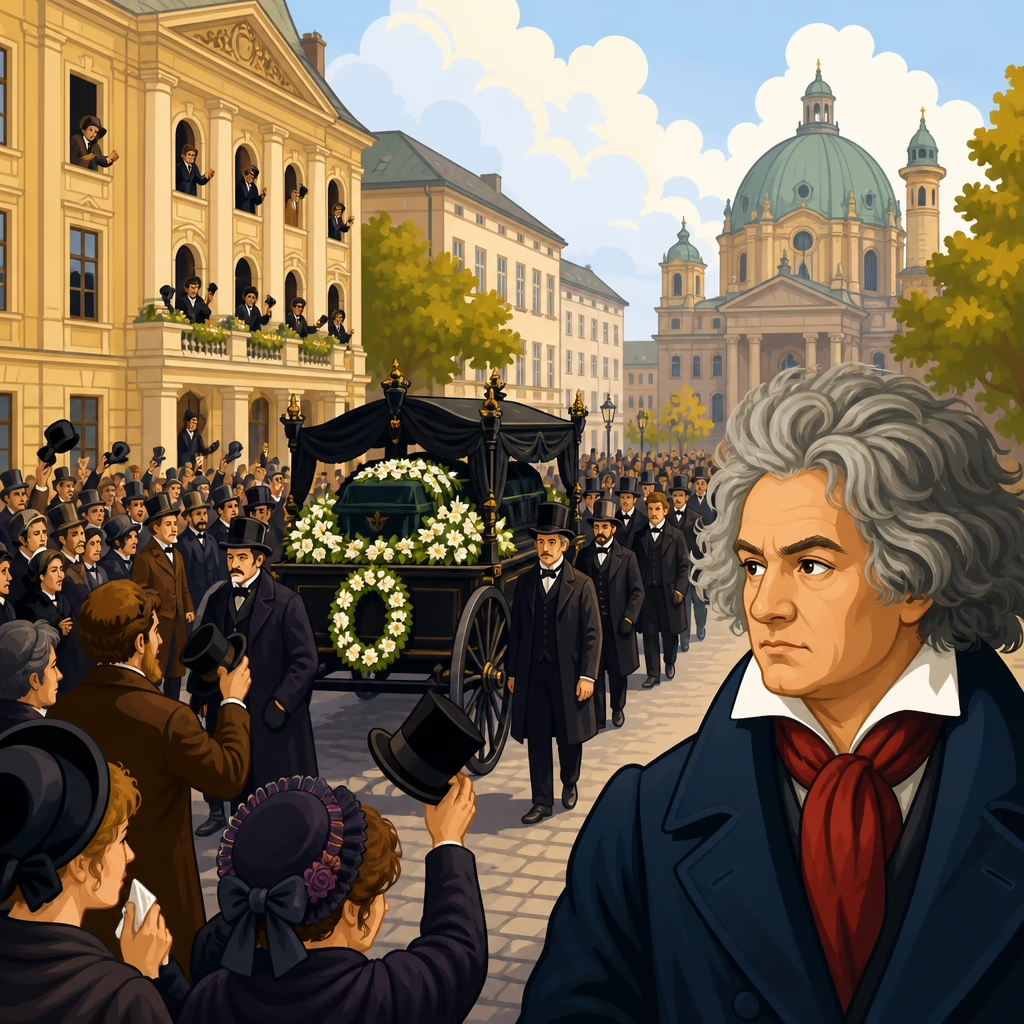
Beethoven’s Funeral Route and Public Mourning
Beethoven’s funeral route and public mourning reveal more than the final journey of a celebrated composer; they show how early nineteenth-century Vienna transformed private grief into a civic ritual. When Ludwig van Beethoven died on 26 March 1827, he was already revered across Europe, but the scale of response in the days before his burial made something unmistakable clear: he belonged not only to patrons, publishers, and concert audiences, but to the wider public. In practical terms, the funeral route was the path taken by the cortege through Vienna to the Währing cemetery on 29 March 1827. In historical terms, it was a carefully managed procession through urban space, watched by thousands, structured by custom, and amplified by political and cultural symbolism.
Public mourning, in this context, means the visible, collective expression of grief outside the home and church. It included viewing the body, attending memorial rites, joining or observing the procession, wearing mourning dress, printing poems and notices, and recounting the event in newspapers and memoirs. I have worked through the surviving reports, memoir evidence, and standard Beethoven biographies often enough to know that small details matter here. The exact streets are debated in some retellings, the size of the crowd is often rounded, and later romantic accounts can blur logistics with legend. Even so, the broad outline is secure, and it matters because Beethoven’s funeral became one of the defining public commemorations of an artist in modern Europe.
The event also helps explain Beethoven’s place in cultural memory. A funeral route can seem like a narrow topic, yet it exposes the relationship between celebrity, city life, policing, liturgy, class, and national feeling. Vienna in 1827 was a capital shaped by censorship and court ceremonial, but Beethoven’s burial showed another kind of authority: moral and artistic prestige recognized by ordinary citizens. Understanding where the procession went, who walked in it, and why crowds gathered in such numbers gives a sharper picture of how Beethoven was mourned at the moment his legacy passed from living reputation into historical monument.
Beethoven’s death, the laying out of the body, and the first wave of mourning
Beethoven died in his Schwarzspanierhaus apartment after months of severe illness marked by liver disease, abdominal swelling, repeated operations to drain fluid, and increasing weakness. Those final months were closely watched by friends, former patrons, and admirers. His death therefore did not reach the city as an obscure domestic loss. News moved quickly through Vienna’s musical and social circles, and the apartment soon became a site of visitation. This first phase matters because the funeral route began emotionally before it began physically. Public mourning formed around the dead composer’s body while it was still indoors.
Accounts describe Beethoven laid out with deliberate dignity, dressed and arranged for viewing. Visitors included friends, musicians, students, and curious admirers. The room itself became part of the ritual: objects associated with his labor and suffering stood near the body, reinforcing the image of the genius who had worked despite deafness and illness. This framing was not accidental. Nineteenth-century death culture valued edifying final scenes, and Beethoven’s circle understood that the city would read his death as the end of an era.
Obituaries and notices quickly emphasized both his fame and the pathos of his final years. They did not treat him as a court servant, even though he had aristocratic supporters. They treated him as a great artist whose loss belonged to the public. This distinction helps explain why the coming procession drew such crowds. In effect, Vienna was being invited to mourn not a functionary, but a figure of shared cultural ownership. For readers seeking a biographical anchor earlier in his life, the main guide at what Beethoven’s birth record actually tells us offers a useful point of reference before returning to this final chapter.
The funeral route through Vienna: what is known and why the route mattered
Beethoven’s funeral took place on 29 March 1827. The procession departed from the Schwarzspanierhaus in the Alsergrund district and moved toward the parish church rites associated with the Holy Trinity church of the Minorites before continuing outward to the Währing cemetery, then outside the city center. Exact turn-by-turn reconstruction is complicated by variations in eyewitness testimony and later summaries, but the essential geography is clear. The cortege moved from Beethoven’s residence through significant urban corridors where large numbers of Viennese could witness it, then proceeded toward burial ground beyond the denser core of the city.
This route mattered because funerals in Vienna were public performances of status, piety, and belonging. Processions passed through streets where hierarchy could be seen. Clergy, pallbearers, torchbearers, schoolboys, musicians, officials, and friends all had visible places. In Beethoven’s case, the route effectively linked three identities: the private man who died at home, the public artist honored in the city, and the mortal Christian committed to consecrated ground. A funeral confined quietly to church and grave would not have produced the same social meaning. The movement through the streets made his fame legible.
Contemporary reports consistently stress the crowd. Estimates vary, but around ten thousand to twenty thousand people are often cited in biographies, with many scholars treating roughly ten thousand as a cautious figure for those lining the route and taking part at different stages. For Vienna in 1827, that was enormous. Streets were crowded enough that authorities had reason to manage flow and order. The fact that so many residents came out in late March weather for a composer says a great deal about Beethoven’s standing. Opera stars and noble funerals drew attention, but this response to an instrumental composer was exceptional.
Who walked in the procession and how the ceremony was organized
One reason Beethoven’s funeral became so memorable is that its organization combined formal Catholic rites with a distinctly artistic guard of honor. Friends and associates arranged the event carefully. Among the torchbearers and participants were leading musicians and cultural figures of Vienna. Franz Schubert, then only thirty and not yet canonized in the modern sense, was present as a torchbearer, a detail often repeated because it symbolizes one composer saluting another at the edge of history. Other notable names connected with the arrangements and observances included Anton Schindler, Stephan von Breuning, and performers from Vienna’s musical life.
The actor Heinrich Anschütz read the funeral oration written by the poet Franz Grillparzer at the cemetery, because Grillparzer himself did not deliver it. That text became central to the public memory of the event. It framed Beethoven as a man who had withdrawn from the world through deafness but had given the world incomparable riches. The language was elevated, but the message was plain enough for listeners and later readers: genius had suffered, labored, and triumphed. The procession therefore did more than transport a coffin. It staged an interpretation of Beethoven’s life.
| Element | Function in the funeral | Why it mattered publicly |
|---|---|---|
| Torchbearers | Escorted the coffin and marked ceremonial dignity | Signaled honor usually reserved for the eminent |
| Clergy and church rites | Placed the burial within accepted Catholic practice | Gave legitimacy and solemn structure |
| Musicians and artists | Represented Beethoven’s professional community | Showed that the arts claimed him collectively |
| Grillparzer’s oration | Interpreted Beethoven’s life for the crowd | Turned mourning into cultural memory |
| Large crowd | Observed, followed, and validated the event | Made grief visibly civic rather than merely private |
The details of etiquette also mattered. Processions were ranked, timed, and visually coded. Black dress, torches, church music, and the measured pace all contributed to solemnity. What I find most telling is how successfully Beethoven’s circle balanced official order with genuine popular participation. This was not a spontaneous mob scene, yet neither was it a closed elite observance. It was a public funeral in the fullest sense, and that balance explains why later generations remembered it as both disciplined and heartfelt.
Why Vienna mourned so intensely
Public mourning for Beethoven drew strength from several overlapping causes. First was the music itself. By 1827, works such as the Eroica Symphony, the Fifth Symphony, Fidelio, the Missa solemnis, and the Ninth Symphony had established Beethoven as a creator of unusual seriousness and force. Even listeners who did not know every score knew that he represented the highest ambitions of instrumental music. Second was biography. His deafness had become part of his legend during his lifetime. Viennese mourners could understand suffering even if they could not analyze sonata form. Third was timing. Beethoven died after a prolonged decline that had been observed by the public, allowing anticipation and emotion to build.
There was also a specifically urban reason. Vienna in the Biedermeier period valued domestic culture, salon music, theater, and public ceremony. Beethoven fit awkwardly into polite society when alive, yet in death he became an ideal civic figure: serious, apolitical in the immediate ceremonial sense, morally elevated, and internationally admired. Mourning him allowed the city to honor artistic greatness while also honoring itself as the place that had housed that greatness. Cities do this repeatedly with major figures. The funeral route becomes a map of local pride.
Another factor was scarcity. Truly public mourning for composers was not yet routine at this scale. Mozart’s burial in 1791 had been much more modest, shaped by different finances, customs, and circumstances. By Beethoven’s death, the cultural rank of the autonomous composer had risen. His funeral therefore marked a change in how musical genius was publicly valued. In practical terms, Vienna was rehearsing the modern idea that artists can deserve civic rites once associated mainly with nobles, generals, and statesmen.
The cemetery, Grillparzer’s oration, and the making of a legend
At the Währing cemetery, the final phase of mourning fixed Beethoven’s reputation in words that traveled far beyond the graveside. Grillparzer’s oration is still quoted because it distilled how contemporaries wanted to remember him. It presented Beethoven as a solitary titan whose inner hearing surpassed ordinary sound. That formulation was historically selective, but effective. It linked his deafness to transcendence and gave mourners a language equal to the emotional scale of the occasion.
The burial site itself also mattered. Währing was then a suburban cemetery, removed enough from the center to give the journey a sense of passage from city fame to eternal rest. Later, in 1888, Beethoven’s remains were transferred to Vienna’s Zentralfriedhof, where he lies today near Schubert and other musical luminaries. That later reburial should not blur the original significance of Währing. In 1827, the distance to the cemetery was part of the experience. Participants did not simply attend a service; they accompanied Beethoven outward, physically enacting separation.
What happened after the burial is just as important as what happened during it. Memoirs, newspaper reports, engravings, and biographies repeated the image of immense crowds and solemn honors. Some details hardened into legend, others shifted, but the core story remained stable because it matched what observers needed Beethoven to mean. He was no longer just a difficult, brilliant, often isolated composer. He had become a public ancestor of serious music. The funeral route and the mourning around it accomplished that transformation with remarkable speed.
How historians separate documented fact from later embellishment
Any focused study of Beethoven’s funeral route has to address evidence critically. Eyewitnesses remembered the event through emotion, and later writers often amplified scale for dramatic effect. Crowd numbers are the clearest example. Figures above twenty thousand appear in some retellings, but historians usually prefer caution because exact counting did not occur in a modern statistical sense. The same applies to route details. We can identify the starting point, ceremonial stages, and destination with confidence, but street-by-street precision is not always recoverable from surviving sources.
Schindler presents another challenge. He remains important because he preserved anecdotes and materials, yet his reliability is uneven and his editorial interventions elsewhere in Beethoven documentation are well known. That does not make every statement false, but it requires comparison with independent testimony. Serious Beethoven scholarship therefore cross-checks memoir evidence against newspapers, parish records, correspondence, and later critical editions. This method does not strip the funeral of emotion. It protects the event from distortion.
The strongest conclusion is also the simplest. Even after discounting romantic inflation, Beethoven’s funeral was one of the largest and most symbolically charged artistic funerals of its century. The route through Vienna, the mass attendance, the visible presence of fellow musicians, and Grillparzer’s graveside words all point in the same direction. Public mourning was not a decorative afterthought. It was the mechanism by which Vienna declared Beethoven indispensable.
Beethoven’s funeral route and public mourning still matter because they show exactly when admiration became collective memory. The procession from the Schwarzspanierhaus through Vienna and onward to Währing was not merely a burial transfer. It was a civic statement that a composer’s work could command the streets, gather the classes, and claim ritual honor at a scale once reserved for political power. That is why the event remains central to Beethoven biography.
The key facts are firm. Beethoven died on 26 March 1827, was buried on 29 March, drew a huge public crowd, and was honored by musicians, clergy, writers, and ordinary Viennese along a route that turned urban space into a mourning stage. Grillparzer’s oration gave language to the grief, while the procession itself gave it form. Together they created the enduring image of Beethoven as both suffering individual and shared cultural monument.
If you want to understand Beethoven not only as a composer on the page but as a figure claimed by the public, study this funeral closely. Follow the route, read the oration, and compare the sources. Few events show more clearly how a life in music became history.
Frequently Asked Questions
Why is Beethoven’s funeral route considered so historically significant?
Beethoven’s funeral route matters because it was far more than a practical path from the place where he died to his burial site. It became a highly visible public stage on which Vienna expressed collective grief, admiration, and civic identity. By the time of his death on 26 March 1827, Beethoven was already recognized as one of Europe’s great composers, but the procession through the city demonstrated that his importance had moved beyond elite musical circles. He was no longer simply a composer supported by aristocrats, publishers, and connoisseurs; he had become a cultural figure claimed by the broader urban public.
In early nineteenth-century Vienna, funerals could carry social and symbolic meaning, but Beethoven’s burial was exceptional in scale and attention. The route itself allowed large numbers of residents to gather, watch, and participate emotionally in the event. Streets became spaces of remembrance, and the movement of the coffin through the city transformed mourning into a civic ritual. This is one reason historians see the funeral as a revealing moment in the history of public culture: it showed how celebrity, art, and urban life could converge in a deeply ceremonial form.
The route is also significant because it helps us understand how Beethoven’s legacy was constructed almost immediately after his death. Public mourning did not merely reflect his fame; it actively reinforced it. The procession announced that Beethoven belonged to Vienna and, symbolically, to Europe’s shared cultural heritage. In that sense, the funeral route was both an ending and a beginning: the end of Beethoven’s life, and the beginning of his enduring public afterlife as a monumental cultural figure.
How did public mourning for Beethoven reflect the culture of Vienna in the early nineteenth century?
Public mourning for Beethoven reveals a great deal about Vienna at the time, especially the way the city negotiated the relationship between private feeling and public display. Early nineteenth-century Vienna was a capital shaped by court culture, Catholic ritual, and an increasingly active urban public. Music occupied a central place in the city’s identity, and Beethoven’s death offered an occasion for these different strands to come together. Grief for him was not confined to family members or close friends. Instead, it spread outward into the streets, where mourning could be seen, shared, and collectively performed.
This was a period in which public ceremonies often carried political and social weight, even when they were not explicitly political events. A funeral procession could express hierarchy, reverence, and communal values all at once. In Beethoven’s case, the size of the crowd and the intensity of response suggested that artistic achievement could command a level of public honor once more commonly associated with noble or official figures. That shift is important. It indicates a broader cultural change in which creative genius was becoming a source of civic pride and collective identity.
Vienna’s response also reflected the city’s growing awareness of cultural celebrity. Beethoven had lived in relative physical isolation because of his deafness and difficult personal circumstances, yet his death produced an unusually public response. The contrast is telling. It shows that the image of Beethoven circulating in public memory had become larger than the private man himself. In mourning him, Viennese society was also affirming its own status as a musical capital capable of recognizing and ceremonially honoring greatness.
What do historians know about the scale and atmosphere of Beethoven’s funeral procession?
Historians consistently describe Beethoven’s funeral as one of the most remarkable public mourning events in nineteenth-century Vienna. Contemporary reports emphasize the sheer size of the crowd, with thousands of people said to have attended or lined the route. While exact numbers in historical accounts should always be treated carefully, there is no serious doubt that the turnout was extraordinary. The event attracted not only musicians, friends, and cultural figures, but also ordinary citizens who wanted to witness the passing of a man already widely regarded as a genius.
The atmosphere appears to have combined solemn ritual with intense emotional resonance. This was not a festive civic parade; it was a ceremony marked by dignity, religious structure, and public reverence. Yet the public presence gave it unusual emotional force. People were not merely observing an official burial from a distance. They were participating in a shared act of mourning that made Beethoven’s status visibly undeniable. The streets themselves became part of the emotional language of the ceremony, turning movement through the city into a process of communal farewell.
Another important feature of the atmosphere was the presence of notable cultural participants, including musicians and literary figures, which reinforced the sense that Beethoven’s death was a major event in the intellectual and artistic life of the city. At the same time, the prominence of the crowd meant that the funeral was not limited to cultural insiders. That mix of formal ceremonial order and broad public involvement is precisely what makes the procession so historically meaningful. It embodied both respect for the individual and a collective declaration of what Beethoven meant to society.
Why did Beethoven’s funeral become a civic ritual rather than a purely private burial?
Beethoven’s funeral became a civic ritual because his identity at the time of his death extended far beyond the personal sphere. Although every funeral begins with the fact of individual loss, not every death invites a citywide response. Beethoven’s did because he had come to represent something larger than himself: artistic genius, musical innovation, and Vienna’s place at the center of European culture. Once a person occupies that kind of symbolic role, mourning naturally becomes public as well as private.
There were also practical and cultural reasons for this transformation. Public processions in the period were established forms through which communities expressed collective values. They gave shape to grief, provided visible structure to remembrance, and allowed large numbers of people to participate in a meaningful way. In Beethoven’s case, the funeral route created an opportunity for citizens to witness the ceremony and to affirm, by their presence, that his life had public significance. The event therefore became a ritual of civic recognition, not just familial farewell.
Equally important is the fact that Beethoven’s funeral occurred at a moment when the public status of artists was changing. In earlier generations, composers often depended heavily on court or church institutions and were honored largely within those frameworks. Beethoven, however, was part of a new model of cultural authority: the artist as autonomous genius, admired by a broad public. His funeral reflected that transition. The city did not simply bury a composer; it ceremonially honored a figure whose work had helped define an era. That is why the burial resonated as a civic event and why it continues to be discussed as a landmark in the history of public mourning.
What does Beethoven’s funeral route tell us about his legacy today?
Beethoven’s funeral route tells us that his legacy was not created only by later generations of scholars, performers, and institutions. It was already being powerfully shaped at the moment of his death. The public procession through Vienna showed that many people understood him, in real time, as someone whose life and work mattered on a collective level. That immediate response helps explain why Beethoven became not merely an admired composer, but a near-mythic cultural figure in modern history.
The route also reminds us that legacy is inseparable from public memory. Music alone made Beethoven famous, but ritual helped make him monumental. The funeral translated admiration into a visible social act. Crowds, ceremony, and the geography of the city all contributed to the impression that Beethoven’s passing was an event of historic consequence. In this way, the procession becomes part of the story of how cultural greatness is recognized and preserved. People did not simply remember Beethoven afterward; they enacted that remembrance in a shared public setting.
For readers today, the funeral route offers a powerful lens through which to view Beethoven not just as a composer of masterworks, but as a figure whose death helped redefine the public place of art and artists. It reveals a moment when a city collectively claimed an artist as its own and turned mourning into memory with lasting force. That is why discussions of Beethoven’s funeral remain important. They show how the final journey of one man became a defining episode in the history of cultural commemoration, public emotion, and the making of artistic legacy.