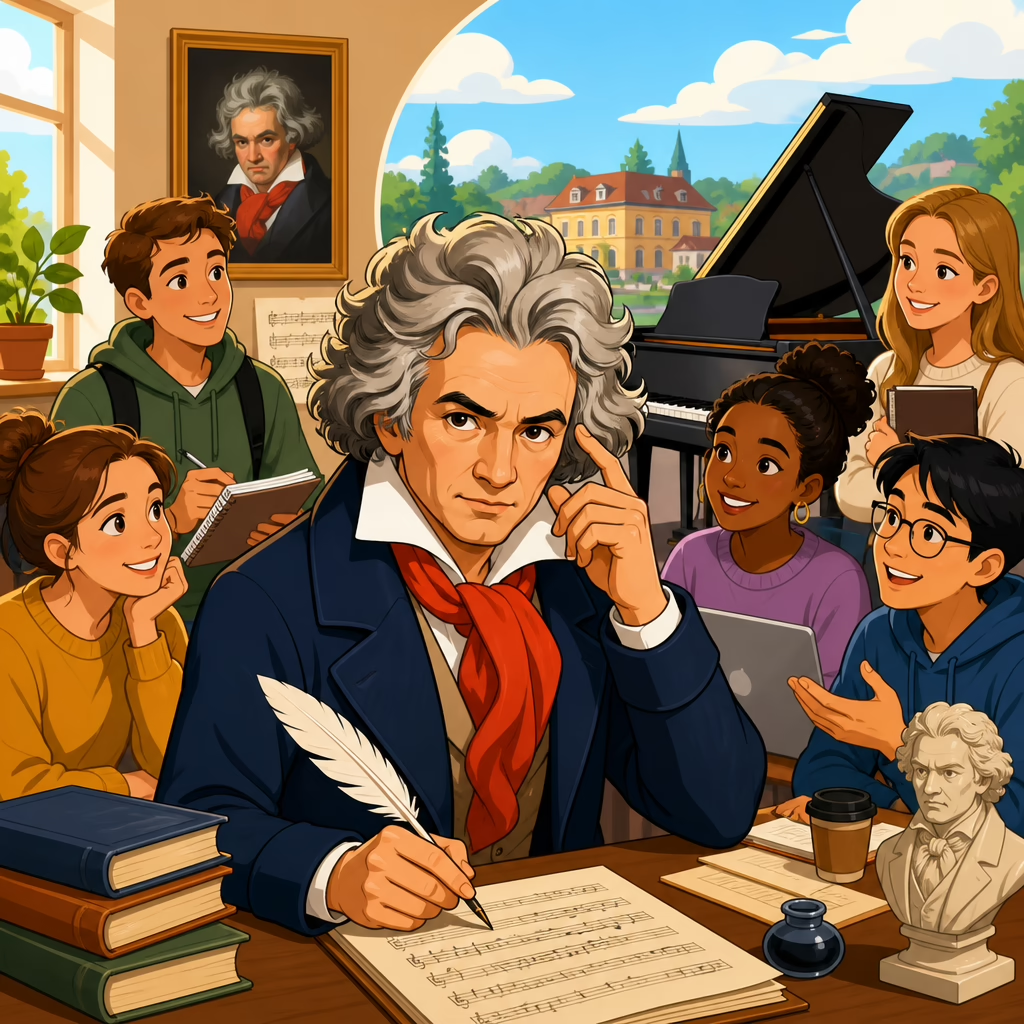
Beethoven Presentation Topics for College Freshmen
Choosing strong Beethoven presentation topics for college freshmen can turn a routine class assignment into a clear, memorable talk about music, history, and culture. Beethoven remains one of the most useful composers for first-year college presentations because his life and work sit at the intersection of classical style, personal struggle, political change, and artistic innovation. For freshmen who may be new to music history, a good topic needs enough depth for analysis but enough structure to stay manageable within a short presentation.
When I have helped students shape introductory music talks, the biggest challenge is rarely finding information. It is narrowing the subject. “Beethoven” is too broad for a five- or ten-minute classroom presentation, but focused Beethoven presentation topics for college freshmen are highly workable. A presentation topic is a specific angle or research question, such as Beethoven’s hearing loss, the “Eroica” Symphony, his influence on Romanticism, or how the Fifth Symphony became a cultural symbol. The best topics allow students to explain a central claim, support it with evidence, and connect the music to bigger ideas their classmates already understand.
This matters in community and education settings because college freshmen are often learning basic academic skills at the same time they are learning content. Beethoven gives them a practical entry point into research, source evaluation, close listening, and public speaking. He also rewards interdisciplinary thinking. A freshman can approach him through music theory, biography, disability studies, European history, philosophy, literature, or media studies. That flexibility makes Beethoven especially valuable for general education courses, first-year seminars, and introductory arts classes.
Another reason this topic works so well is familiarity. Many students have heard Beethoven’s Fifth Symphony, “Für Elise,” or the “Ode to Joy” theme even if they cannot name them at first. Familiar sound creates confidence, and confidence improves classroom delivery. At the same time, Beethoven’s reputation is so large that students must move beyond clichés. A successful presentation should not stop at “he was a genius” or “he wrote great symphonies.” It should explain what changed in his music, why audiences responded so strongly, and how his life shaped the way people still interpret his work.
What makes a Beethoven topic freshman-friendly
The most effective Beethoven presentation topics for college freshmen share four traits. First, they are narrow. “Beethoven’s life” is unmanageable, but “how the Heiligenstadt Testament changed Beethoven’s artistic direction” is focused. Second, they include accessible evidence. Freshmen need scores, recordings, letters, or scholarly commentary they can actually understand. Third, they support a clear thesis. Instead of simply reporting facts, students should be able to argue something specific, such as “Beethoven used the Fifth Symphony’s four-note motive to create unity and dramatic tension.” Fourth, they connect to broader themes, because college instructors often reward presentations that relate individual works to politics, identity, culture, or historical change.
In practice, I have found that students do best when they combine one major work, one life event, and one historical question. For example, a presentation on the “Eroica” Symphony can link Beethoven’s changing view of Napoleon to the rise of the heroic artist. A talk on the Moonlight Sonata can connect piano style, audience reception, and the problem of nicknames in classical music marketing. This structure prevents the common freshman mistake of piling up facts without a controlling idea.
Students should also choose a topic that matches the assignment format. If the presentation is short, one composition often works better than a whole period. If the class expects discussion, controversial or interpretive topics are stronger. If visuals are required, manuscripts, portraiture, concert halls, or premiere history can support the talk. For broader teaching ideas that connect Beethoven to classroom planning, students and educators can also refer to the main guide on Beethoven lesson plans for elementary music classes, which shows how focused musical themes can be organized for learning objectives across levels.
Best presentation topic categories and examples
A useful way to select Beethoven presentation topics for college freshmen is to group them into categories. Biography topics work well because they feel concrete: Beethoven’s hearing loss, his move from Bonn to Vienna, his difficult family life, or the legal battle over his nephew Karl. Music analysis topics suit students comfortable with listening examples: the opening of the Fifth Symphony, the choral finale of the Ninth, or sonata form in the “Pathétique” Sonata. Historical topics include Beethoven and the French Revolution, Vienna’s patronage system, and the role of public concerts in the early nineteenth century. Cultural legacy topics can examine Beethoven in film, political ceremony, advertising, or modern popular culture.
Not every category is equally easy. Detailed harmonic analysis can become too technical for freshmen unless the course is specifically about theory. By contrast, a topic like “Why Beethoven’s Ninth Symphony became a global anthem” allows students to combine musical evidence with clear social examples, including its use in the European Union and public celebrations in Japan. The strongest freshman topics let students explain sophisticated ideas in plain language without losing accuracy.
| Topic | Central question | Why it works for freshmen |
|---|---|---|
| Beethoven’s hearing loss | How did deafness affect his career and compositions? | Strong human story, clear documents, broad relevance |
| The “Eroica” Symphony | Why was Symphony No. 3 considered revolutionary? | Links music, politics, and artistic ambition |
| Beethoven’s Fifth Symphony | How did one motive shape an entire symphony? | Easy listening hook and clear analytical focus |
| Moonlight Sonata | Why is this sonata famous, and what is misunderstood about it? | Recognizable piece with room for myth-busting |
| The Ninth Symphony | Why did Beethoven add a chorus to a symphony? | Combines innovation, text, and cultural legacy |
| Beethoven and Romanticism | How did he bridge the Classical and Romantic eras? | Great for introductory survey courses |
Topic ideas that lead to stronger arguments
Some Beethoven presentation topics for college freshmen are better than others because they naturally produce an argument instead of a summary. Consider hearing loss. A weak version is “Beethoven went deaf.” A stronger version is “Beethoven’s hearing loss changed the public image of the composer from skilled craftsman to heroic individual.” That claim can be supported with the Heiligenstadt Testament, reports from contemporaries, and the reception of late works. It also invites students to discuss how biography shapes interpretation.
The “Eroica” Symphony is another excellent example. Students can argue that the symphony broke expectations through scale, emotional range, and political context. The famous story about Beethoven removing Napoleon’s name from the title page gives the presentation a narrative arc, but the student still needs musical substance: longer development sections, unprecedented intensity, and the funeral march as a public statement. This topic teaches freshmen how to move from anecdote to evidence.
For students who prefer cultural analysis, the Fifth Symphony offers a direct question: why has this piece become shorthand for fate, struggle, or triumph? The answer involves more than the opening rhythm. During World War II, the motif was associated with the Morse code letter V for victory. In film and television, the same music often signals seriousness and inevitability. A freshman can use those examples to show how meanings accumulate over time, even when they exceed the composer’s original intentions.
Another strong option is Beethoven’s Ninth Symphony and the “Ode to Joy.” Here, students can argue that the work became globally influential because it combines musical innovation with a message of universal brotherhood. They should also acknowledge complexity. Friedrich Schiller’s text reflects Enlightenment ideals, but performances of the Ninth have appeared in very different political settings, from democratic celebrations to authoritarian spectacles. That tension makes the topic richer and more college-level.
How to research Beethoven without getting lost
Freshmen often struggle not because the subject is hard, but because the available material is overwhelming. Beethoven has generated an enormous scholarship, from biographies by Maynard Solomon and Jan Swafford to specialized studies of sketchbooks, performance practice, and reception history. The key is to start with a precise question and gather three kinds of sources: a reliable biography, one or two focused scholarly articles, and primary materials such as letters, early reviews, or score excerpts.
Students should prioritize trustworthy databases and reference tools. JSTOR, Oxford Music Online, and library catalog subject guides are usually better starting points than random search results. For recordings, compare interpretations by respected conductors or performers rather than relying on a single upload. Listening to Carlos Kleiber’s Beethoven Fifth beside Wilhelm Furtwängler or Herbert von Karajan, for instance, can help students hear how tempo, articulation, and orchestral balance shape meaning. Even in a short presentation, one comparison like this adds depth.
It is also important to separate verified fact from legend. Beethoven’s life attracts myths, especially around “Für Elise,” the Moonlight Sonata, and his relationships. Students should check whether a claim appears in scholarly sources or only in popular summaries. Instructors notice the difference. A careful presenter will say, “Scholars debate the identity of Elise,” rather than presenting speculation as certainty. That habit strengthens credibility and models good academic judgment.
Presentation structure that works in class
Once students choose among Beethoven presentation topics for college freshmen, they need a structure that keeps the audience engaged. I recommend a simple sequence: hook, thesis, context, evidence, takeaway. The hook can be a short audio clip, a surprising fact, or a question. For example: “Why would a composer premiere a symphony with a choir when symphonies were supposed to be instrumental?” That leads naturally into the Ninth Symphony. The thesis should come early and in direct language. Freshman audiences do not benefit from suspense; they benefit from clarity.
Context should be brief but meaningful. If presenting on the “Eroica,” explain Vienna in the Napoleonic era and Beethoven’s early admiration for revolutionary ideals. Then move to evidence. In music topics, evidence can include a motive, formal design, instrumentation, premiere reaction, or documented statement by the composer. Students should never play a long clip without telling classmates what to listen for. A ten-second excerpt of the Fifth Symphony’s opening is more useful than a two-minute passage with no guidance.
Visuals should serve the argument, not decorate it. A portrait by Joseph Karl Stieler, a facsimile of a manuscript page, or a timeline of major works can be effective if the speaker explains what the image proves. Slides crowded with text usually weaken delivery. So do vague conclusions. The best ending returns to the thesis and tells the audience why the topic matters now. A presentation on hearing loss, for instance, can close by reflecting on disability, adaptation, and the ethics of turning suffering into legend.
Common mistakes and how to avoid them
The most common mistake with Beethoven presentation topics for college freshmen is choosing a subject that is too broad. “Beethoven’s influence on music” sounds impressive but usually collapses into a list. Narrowing the scope produces stronger analysis. Another common problem is replacing music with biography. Beethoven’s life is compelling, but a college presentation should connect life events to actual works, techniques, or reception. Otherwise the topic becomes a general historical speech rather than a focused arts presentation.
Students also underestimate terminology. They do not need advanced theory, but they should use basic terms correctly: symphony, sonata, motif, variation, coda, premiere, patronage. Misused vocabulary undermines authority. At the same time, too much jargon can alienate classmates. The goal is precise language explained in ordinary words. Saying that Beethoven expands a motive through repetition, sequencing, and dynamic contrast is better than either oversimplifying or drowning the audience in unexplained analysis.
Finally, students should rehearse with timing in mind. Beethoven topics invite digression, especially when a student discovers fascinating side stories. A strong freshman presentation makes one clear point, supports it well, and stops on time. That discipline often earns better results than ambitious but unfocused coverage.
Beethoven presentation topics for college freshmen work best when they balance focus, evidence, and relevance. The ideal topic is narrow enough to manage, rich enough to support a real claim, and familiar enough to keep classmates interested. Whether the subject is hearing loss, the “Eroica,” the Fifth Symphony, the Ninth, or Beethoven’s role between Classical and Romantic style, students succeed when they move beyond legend and explain how music, history, and meaning fit together.
The main benefit of choosing Beethoven is not just that he is famous. It is that his work teaches freshmen how to think. A good presentation on Beethoven asks a clear question, tests evidence, uses listening intelligently, and connects one composer to larger human concerns. That is exactly the kind of academic practice first-year students need across community and education contexts.
If you are preparing a class talk, pick one focused angle, build one strong thesis, and support it with a few reliable sources and short musical examples. Done well, a Beethoven presentation does more than fill assignment time; it shows that serious ideas can be explained clearly and remembered long after the class ends.
Frequently Asked Questions
What makes a good Beethoven presentation topic for college freshmen?
A good Beethoven presentation topic for college freshmen should be specific enough to organize into a short class talk, but broad enough to support analysis, examples, and discussion. Many first-year students make the mistake of choosing a topic that is too wide, such as “the life of Beethoven” or “Beethoven’s music,” which often leads to a rushed presentation with very little depth. A stronger approach is to focus on one clear angle, such as Beethoven’s hearing loss, the political meaning of the “Eroica” Symphony, the impact of the Fifth Symphony, or the transition from Classical to Romantic style in his work. These narrower topics help students build a presentation with a clear beginning, middle, and end.
Another important feature of a strong topic is accessibility. Freshmen may not yet have advanced training in music theory, so the best topics allow students to explain Beethoven in ways that are understandable to a general classroom audience. For example, comparing Mozart and Beethoven, discussing Beethoven’s image as a cultural hero, or analyzing how his personal struggles shaped public perception can be easier to present than a highly technical study of harmonic structure. A good topic should also give the student opportunities to include audio clips, historical context, and a few memorable facts. When a presentation combines biography, music, and larger historical meaning, it usually feels more engaging and more complete.
Which Beethoven presentation topics are easiest for freshmen to research and present clearly?
The easiest Beethoven presentation topics for freshmen are usually the ones supported by abundant reliable sources and familiar musical examples. Topics such as Beethoven’s deafness, the story of Symphony No. 5, the background of Symphony No. 9, Beethoven’s influence on Romantic music, and the significance of the “Moonlight Sonata” are often ideal because they are widely discussed in textbooks, library databases, documentaries, and music education resources. These subjects also tend to have a built-in narrative, which makes them easier to explain to classmates. Instead of forcing a complicated argument, the student can guide the audience through a clear sequence of events, ideas, and musical outcomes.
Another reason these topics work well is that they allow students to connect big ideas to recognizable works. A freshman giving a talk on Beethoven’s hearing loss, for instance, can discuss the Heiligenstadt Testament, explain how deafness affected his life, and then connect that struggle to the emotional force people often hear in his later music. A student presenting on Symphony No. 9 can discuss its revolutionary use of chorus, its message of unity, and its later cultural influence. These topics make it easier to create a balanced presentation because the student can combine biography, historical context, and music examples without needing specialized knowledge beyond an introductory level.
How can freshmen make a Beethoven presentation more interesting instead of just listing facts?
The best way to make a Beethoven presentation interesting is to build it around a central question or argument rather than treating it like a timeline of facts. Instead of simply stating when Beethoven was born, what he composed, and when he died, students should ask something more engaging, such as: Why is Beethoven often seen as a bridge between the Classical and Romantic eras? How did his deafness change the way people think about artistic genius? Why did the “Eroica” Symphony matter politically? A focused question gives the presentation direction and helps the audience understand why the topic matters. It also encourages analysis, which is usually what college instructors want to hear.
Freshmen can also improve interest by using short listening examples and explaining what the audience should notice. A brief excerpt from the opening of Symphony No. 5, for example, becomes much more memorable when the speaker points out its dramatic rhythm and explains why it has become one of the most recognizable motifs in Western music. Visuals can help as well, especially portraits of Beethoven, images of Vienna, manuscript pages, or a simple timeline of major works. Most importantly, students should connect Beethoven to larger themes such as resilience, revolution, artistic identity, or cultural legacy. When listeners see that the presentation is not just about one composer but also about ideas that still matter, the talk becomes much more compelling.
Should a freshman focus more on Beethoven’s life, his music, or his historical context?
For most college freshmen, the strongest presentation will balance all three: Beethoven’s life, his music, and his historical context. Focusing only on biography can turn the presentation into a basic life summary, while focusing only on musical details can become too technical for a general audience. Historical context by itself can also feel disconnected if the speaker does not show how events shaped Beethoven’s work. A well-rounded presentation usually begins with a brief explanation of who Beethoven was, then places him within the political and cultural world of late eighteenth- and early nineteenth-century Europe, and finally shows how those circumstances influenced specific compositions.
That said, the exact balance should depend on the topic. If the presentation is about Beethoven’s deafness, biography may take the lead, but it should still include musical examples and discussion of public reception. If the topic is Beethoven and the French Revolution, historical context may be more prominent, but the speaker should still connect those ideas to works like the “Eroica” Symphony. If the topic is Beethoven’s influence on later composers, the musical and cultural legacy may deserve the most attention. The key is integration. Professors are usually more impressed when a student can show how Beethoven’s personal struggles, artistic choices, and historical environment interact, rather than treating each one as a separate category.
How do you choose a Beethoven topic that is original but still manageable for a freshman presentation?
Choosing an original but manageable Beethoven topic starts with taking a familiar subject and narrowing it into a more distinctive angle. Instead of choosing a very common topic like “Beethoven’s life,” a freshman might choose “How Beethoven’s public image helped create the modern idea of the musical genius” or “Why Beethoven’s middle-period works changed expectations for the symphony.” These topics still rely on well-documented material, but they feel more thoughtful and less generic. Another useful strategy is to connect Beethoven to one specific issue, such as disability, heroism, politics, patronage, performance culture, or the development of the piano. This creates a topic with both focus and originality.
Students should also think practically about time limits and source availability. An original topic is only helpful if it can be explained clearly in a five- to ten-minute presentation and supported by credible sources. Before finalizing a topic, it is smart to check whether there are enough books, articles, recordings, or academic summaries available. A manageable topic usually centers on one work, one period of Beethoven’s life, one major theme, or one comparison. For example, comparing Beethoven’s compositional style to Mozart’s, exploring the meaning of the Ninth Symphony’s choral finale, or examining how Beethoven’s struggles shaped his reputation can all feel fresh without becoming overwhelming. In general, the best topic is one that lets a freshman say something specific, supported, and memorable rather than trying to cover every part of Beethoven’s career at once.