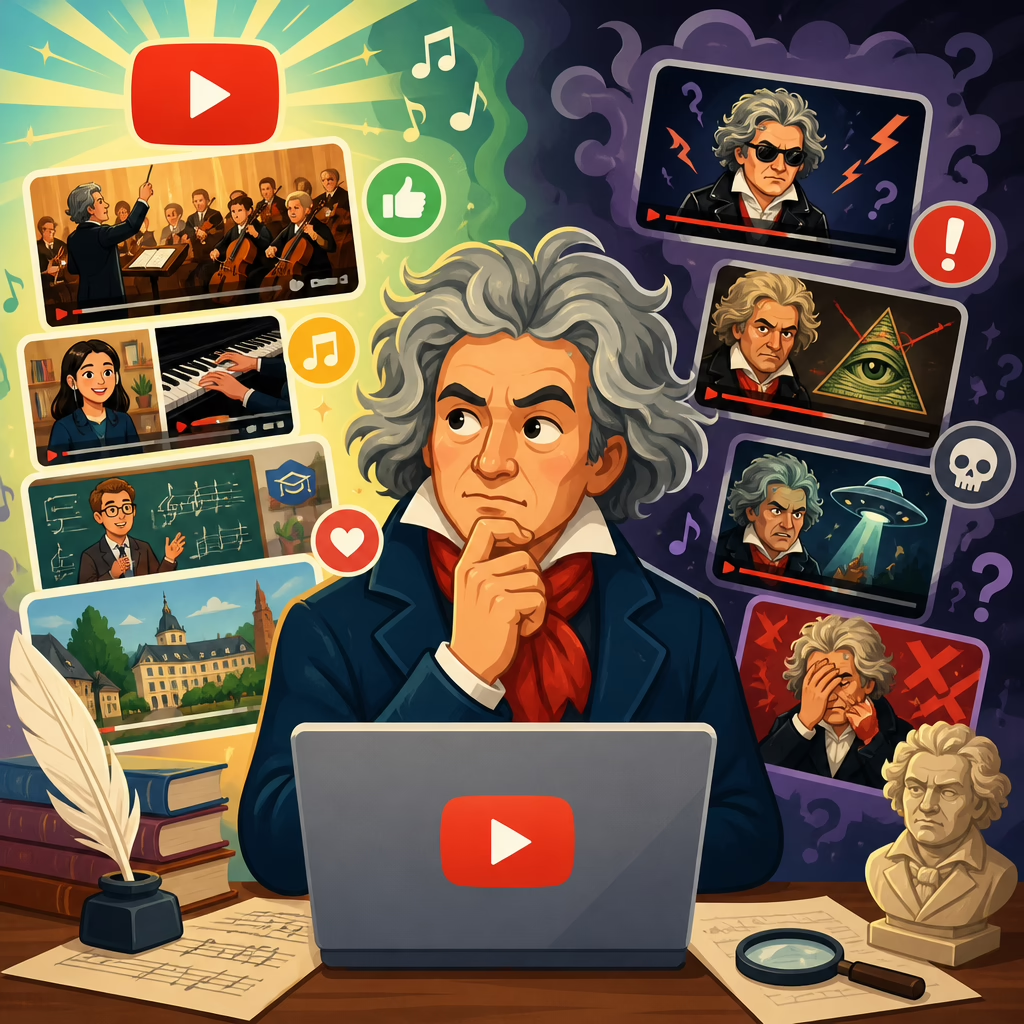
Beethoven on YouTube: Discovery Quality and Misinformation
Beethoven on YouTube sits at the intersection of music discovery, cultural memory, and platform design, which makes it a revealing case study in how great art is found, framed, and sometimes distorted online. Discovery quality refers to how well a platform helps listeners reach authoritative, relevant, and rewarding recordings, performances, and explanations. Misinformation, in this context, includes wrong opus numbers, fabricated biographies, AI-generated summaries with factual errors, mislabeled movements, altered upload dates, and misleading thumbnails or titles that overpromise “definitive” versions. I have spent years comparing Beethoven uploads across official label channels, performer pages, score videos, classroom explainers, and anonymous reposts, and the pattern is consistent: YouTube is excellent at broad exposure but uneven at accuracy. That matters because many listeners now encounter Beethoven there before they ever open a liner note, attend a concert, or consult a scholarly source. If discovery steers people toward low-quality metadata and misinformation, the platform shapes not only taste but understanding. If discovery works well, YouTube becomes a powerful gateway to historically informed performances, score study, and contextual learning that can deepen long-term engagement.
The issue is not simply whether Beethoven is available on YouTube; he is available in overwhelming abundance. The real question is whether users can distinguish a 1963 studio recording from a modern remaster, a complete sonata from an excerpt, a genuine scholarly explanation from a confident mistake, or a legitimate public-domain score from a badly synchronized visual overlay. Beethoven’s catalog invites confusion because titles are inconsistent across languages, numbering systems can be incomplete without opus or WoO references, and famous nicknames such as “Moonlight,” “Pathétique,” and “Emperor” often replace formal work identifiers. Add recommendation systems optimized for watch time, reuse-heavy channels that copy metadata from one another, and a flood of autogenerated captions, and even careful listeners can absorb false information. Understanding discovery quality and misinformation on YouTube therefore requires looking at search behavior, metadata practices, rights structures, educational formats, and audience signals together rather than in isolation.
How YouTube shapes Beethoven discovery
YouTube discovery begins with search, recommendations, homepage personalization, and external embeds. For Beethoven, search intent usually falls into a few recurring categories: a user wants a famous piece, a specific performer, a study aid with score, a background listening stream, or an explanation of a work’s meaning. The platform handles broad intent well. Type “Beethoven 5” and users quickly find multiple performances of the Fifth Symphony. Type “Beethoven Moonlight Sonata” and the first screen usually surfaces polished piano videos, score videos, and educational clips. The weakness appears when intent becomes precise. Searching “Op. 111 Arietta variation analysis” or “String Quartet Op. 131 movement order” often mixes authoritative material with loosely tagged content because YouTube depends heavily on titles, descriptions, engagement history, and creator optimization rather than structured musicological data.
In practice, channels with disciplined metadata outperform channels with better scholarship but weaker packaging. An official orchestra upload titled with composer, work, key, opus, conductor, orchestra, movement, and recording date gives both users and the platform strong signals. By contrast, a valuable lecture labeled “Late Beethoven masterclass” may remain hard to find if the description omits the exact quartet or sonata number. I have repeatedly seen excellent conservatory material buried under compilations called “Best Beethoven for Studying,” not because the lecture lacks value, but because the compilation uses broader search terms and accumulates more watch time. This is a discovery quality problem, not merely a popularity problem, because it rewards generic framing over precise retrieval.
Recommendation systems add a second layer. Once a user watches one high-performing Beethoven upload, YouTube tends to suggest adjacent content: other symphonies, “relaxing classical” playlists, reaction videos, or algorithmically assembled mixes. Sometimes this is useful. A listener who starts with the Seventh Symphony may discover Carlos Kleiber, historically informed recordings, or chamber reductions. But recommendations also flatten distinctions. A serious score-following video can be followed by a sentimental montage with incorrect dates or an AI-voiced biography that repeats myths. Because visual authority on YouTube often comes from polished thumbnails and calm narration rather than evidence, misinformation can inherit credibility from the viewing context itself.
Where misinformation appears in Beethoven videos
Misinformation about Beethoven on YouTube usually emerges through metadata, narration, visuals, and comment reinforcement. Metadata errors are the most common. Works are mislabeled by key, opus, movement number, instrumentation, or performer. Uploaders often copy text from another channel without verifying it against a catalog or score. A movement from Piano Sonata No. 14 might be labeled simply “Moonlight Sonata 3rd movement” with no opus number, while a score video for a bagatelle may incorrectly attribute a posthumous title or use a nickname Beethoven never assigned. These errors seem minor, but they hinder search precision and teach audiences imprecise habits.
Narrative misinformation is more consequential because it frames interpretation. The old story that Beethoven wrote the “Moonlight” Sonata as a direct response to heartbreak is routinely presented as settled fact, though the nickname itself came later from critic Ludwig Rellstab. Claims that specific symphonies were “banned,” “coded political manifestos,” or “scientifically proven to increase IQ” spread because they fit YouTube’s preference for emotionally charged simplification. I also encounter videos that collapse deafness into a melodramatic turning point and ignore the gradual timeline documented in letters such as the Heiligenstadt Testament. These distortions turn a complex life into a click-friendly narrative arc.
Visual misinformation appears in score videos and image-heavy explainers. Public-domain scores from IMSLP are invaluable, but some uploads pair the wrong edition with the audio, misalign repeats, or display simplified arrangements while claiming to show the full original. Portraits are misdated, manuscripts are presented without source context, and subtitles confidently identify themes that are not actually on screen. Comment sections can worsen the issue. Once a top comment asserts, for example, that a piece was Beethoven’s “last composition” when it was not, later viewers repeat it as if community consensus proves accuracy. On YouTube, repetition often functions as evidence even when no source is cited.
| Common problem | Typical example on YouTube | Why it matters | Best verification method |
|---|---|---|---|
| Mislabeled work | Wrong opus or movement number in title | Breaks search accuracy and study use | Check a standard catalog and published score |
| False nickname history | Claiming Beethoven coined “Moonlight” | Misleads interpretation and context | Compare with recognized music history references |
| Incorrect performer data | Attributing a recording to the wrong pianist | Distorts listening comparisons | Match against label, venue, and release notes |
| Bad score synchronization | Displayed notation does not fit the audio | Confuses students and analysts | Follow the measure count in a trusted edition |
| AI summary errors | Invented composition dates or dedications | Spreads confident falsehoods at scale | Cross-check with multiple authoritative sources |
Why Beethoven is especially vulnerable to platform distortion
Beethoven attracts distortion on YouTube for structural reasons. First, he is globally famous, which guarantees a constant supply of casual traffic from users who know a nickname but not a catalog number. Second, his works exist in many public-domain editions and recordings with varying metadata quality. Third, his biography has long been mythologized. Romantic-era storytelling already turned him into a symbol of genius, struggle, heroism, and transcendence. Platform incentives simply modernize those myths into clickable content. A title like “The terrifying message hidden in Beethoven’s Ninth” will often outperform “Formal innovations in Op. 125 finale fugato passages,” even though the second is more accurate and useful.
His catalog also includes multiple numbering systems that non-specialists handle poorly. Opus numbers cover many canonical works, but not all of them. WoO designations, Hess numbers, movement-level titles, and common nicknames all circulate together. The result is a high risk of partial identification. A user may know “Für Elise” but not WoO 59, or “Appassionata” but not Op. 57. In my own reviews of Beethoven channels, the best ones include both the popular title and the formal identifier, helping discovery while preserving accuracy. The weaker ones choose one or the other and lose either reach or precision.
Another vulnerability is the gap between performance culture and scholarship. Many uploads are made by passionate listeners, pianists, or visualizers, not trained catalogers. Their enthusiasm is genuine, and some create excellent access points. But if a channel’s workflow prioritizes frequent posting over source checking, small mistakes become permanent infrastructure. Other channels use AI voiceovers or text generation to produce “composer facts” at scale. Those systems are fast, but they often blend true information with plausible inventions. Anyone studying Beethoven analytically should pair listening on YouTube with grounded resources such as scores, critical notes, and specialized guides. For readers interested in connecting listening with close score work, the main pillar guide on analysis tools is useful: How AI Tools Can Help Analyze Beethoven Scores.
Signals of high-quality Beethoven content
Reliable Beethoven videos usually reveal their quality before you press play. Start with naming conventions. Strong uploads identify composer, full work title, key, opus or WoO number, movement, performers, ensemble, conductor if relevant, venue or label, and recording date when known. Official channels from labels, orchestras, conservatories, and established artists typically maintain these standards because they already work from release metadata. Next, inspect the description. Good descriptions cite movement timings, edition information, source scores, translation notes, and sometimes historical context. Weak descriptions rely on generic tags, inspirational language, or copied biography fragments.
Audio quality and score alignment are also practical trust signals. When I evaluate a Beethoven score video, I check whether repeats are respected, whether ornament realization matches the displayed notation, and whether cuts are disclosed. If the upload combines one edition on screen with a heavily edited recording underneath, educational value drops sharply. Credible explainers avoid certainty where the scholarship is unsettled. For example, they may say that a dedication changed, that a nickname was applied later, or that tempo debates remain active. That kind of nuance is not indecision; it is evidence that the creator understands the field.
Channel history matters too. A single correct upload can happen by accident, but a reliable channel shows consistency across works. It uses accurate playlists, separates complete performances from excerpts, corrects mistakes publicly, and responds to viewers with evidence rather than defensiveness. Some of the best channels also pin comments with source clarifications, manuscript references, or updated links to revised descriptions. These are simple practices, yet they dramatically improve discovery quality because they give both humans and machine systems cleaner information to index and reuse.
How creators, educators, and listeners can reduce errors
Improving Beethoven on YouTube does not require eliminating openness; it requires better habits. Creators should treat metadata as part of the scholarship. Before uploading, verify the work against a recognized catalog, match the recording to an authoritative release listing, and state clearly whether the video presents a full work, a movement, an arrangement, or an excerpt. If a score is shown, name the edition and disclose any synchronization limitations. Educators should write descriptions as miniature reference entries, not promotional blurbs. A precise first sentence can answer the user’s main question immediately and greatly improve retrieval.
Listeners can protect themselves with a fast verification routine. Check whether the title includes the formal identifier. Compare performer names across at least two sources. Be cautious when a dramatic claim appears in the thumbnail but not in the description. Use comments for community tips, not proof. If a video teaches a historical claim, look for supporting references in the description or channel about page. Over time, these habits train users to separate convenience from authority. They also reward the channels doing careful work, which is how platform incentives slowly change.
The central benefit of getting Beethoven discovery right on YouTube is not just cleaner metadata. It is better listening. When the right recording, score, context, and explanation meet in one place, users hear structure more clearly, compare interpretations more intelligently, and carry fewer myths into study or performance. Beethoven deserves that level of care, and so do the listeners meeting him through a search bar. Audit the channels you rely on, verify the details that matter, and choose uploads that respect both the music and the record behind it.
Frequently Asked Questions
Why is Beethoven on YouTube such a useful case study for discovery quality and misinformation?
Beethoven is an unusually revealing example because his music is globally recognized, heavily searched, widely recorded, and constantly re-uploaded in different formats. That means YouTube becomes more than a video platform; it becomes a public-facing archive, recommendation engine, and informal classroom all at once. A listener may arrive looking for a famous symphony, a piano sonata, or a short explanation of Beethoven’s life, and the platform immediately starts shaping what that person believes is important, authentic, or historically accurate. In practice, that makes Beethoven a strong test of discovery quality: does the platform guide users toward reliable performances, correct work titles, accurate opus numbers, trustworthy commentary, and meaningful context, or does it reward whatever is most clickable, emotionally packaged, or algorithmically sticky?
He is also especially vulnerable to misinformation because so much surrounding metadata can go wrong. Videos may misname movements, confuse arrangements with original works, assign the wrong key or opus number, use misleading thumbnail quotes, or attach grand claims about “secret meanings” and “banned versions” that have no basis in scholarship. Even when the audio itself is legitimate, the framing can be distorted. A mislabeled “Moonlight Sonata” upload, for example, might omit the sonata number, mishandle the movement structure, or falsely describe the work’s historical context. In that sense, Beethoven on YouTube captures a larger cultural problem: online audiences often encounter major art through platform incentives first and expert curation second.
What does “discovery quality” actually mean when someone is searching for Beethoven on YouTube?
Discovery quality refers to how effectively YouTube helps a user find content that is relevant, accurate, enriching, and satisfying. For Beethoven, that includes obvious things such as locating the right recording of the Fifth Symphony or a respected performance of the late string quartets, but it also includes subtler forms of guidance. High discovery quality means a user can distinguish between complete works and excerpts, studio recordings and live performances, original compositions and later arrangements, introductory explainers and speculative commentary, and historically grounded material versus attention-seeking misinformation.
In practical terms, discovery quality has several dimensions. First is search precision: if someone types “Beethoven Op. 27 No. 2,” the platform should surface content that correctly identifies the Piano Sonata No. 14 rather than loosely related piano compilations. Second is contextual usefulness: strong videos and channels explain what the listener is hearing, identify performers and ensembles, and provide movement divisions, score references, dates, and source information. Third is recommendation quality: after watching one Beethoven performance, the system ideally suggests adjacent high-value material such as another authoritative interpretation, an educational lecture, or a historically informed performance, rather than drifting quickly into low-credibility content. Finally, there is trust quality, which depends on metadata, uploader reputation, citations, and consistency with accepted musicological knowledge. Good discovery is not just about finding Beethoven quickly; it is about finding Beethoven well.
What kinds of misinformation about Beethoven are most common on YouTube?
The most common problems are usually not dramatic hoaxes but accumulations of small factual errors that reshape understanding over time. Mislabeling is especially widespread. Videos may list the wrong opus number, attach the wrong nickname, confuse a movement with the complete work, or present an arrangement as if it were Beethoven’s original composition. Biographical shortcuts are another recurring issue: oversimplified claims about his deafness, personality, politics, or compositional intent are often repeated because they are memorable and emotionally effective, even when they flatten the historical record.
There are also newer forms of platform-native misinformation. AI-generated summaries and auto-written descriptions can sound polished while containing basic errors about dates, forms, or historical background. Quote graphics and thumbnails sometimes invent inspirational lines and attribute them to Beethoven without evidence. Compilation videos may combine legitimate audio with fabricated narration. Some channels use famous titles like “Beethoven’s Darkest Masterpiece” or “The Hidden Meaning of Fur Elise” to imply discoveries that do not exist in serious scholarship. Even comments can contribute to misinformation, especially when confident users repeat false stories about who a piece was written for, what event inspired it, or whether a work was “forbidden” or “secret.” None of this means YouTube is uniquely unreliable, but it does mean listeners need to evaluate claims about Beethoven with more care than a high view count might suggest.
How can listeners tell whether a Beethoven video on YouTube is trustworthy?
A good first step is to examine the metadata closely. Trustworthy uploads usually identify the exact work title, key, opus or catalog information where applicable, movement names, performers, conductor or ensemble, recording source, and sometimes the edition or score used. If a video simply says “Best Beethoven Ever” or relies on vague labels without performer details, that is a warning sign. The channel itself matters too. Established orchestras, conservatories, public broadcasters, record labels, libraries, score channels with transparent sourcing, and educators with a clear record of accuracy are generally more reliable than anonymous accounts that post large quantities of sensationally titled content.
It also helps to listen for and look for signs of responsible framing. Reliable educational videos tend to distinguish fact from interpretation, avoid exaggerated historical myths, and explain uncertainty where scholars disagree. If a claim sounds unusually dramatic, such as a hidden code in a symphony or a definitive emotional program for a piano sonata, it is worth checking whether the uploader cites a source or whether the statement is simply being asserted for effect. Comparing multiple uploads can be surprisingly effective: if one video gives a work a different opus number, a different date, or a different dedicatee than several reputable sources do, the outlier deserves scrutiny. In short, trustworthiness on YouTube is built from identifiable performers, precise labeling, source transparency, and intellectual modesty.
How can creators, educators, and platforms improve the quality of Beethoven-related content on YouTube?
Creators can improve quality immediately by treating metadata as part of the educational work rather than an afterthought. Accurate titles, complete work information, performer credits, movement timestamps, composer context, and links to reliable references make an enormous difference. Educational channels should clearly separate established facts from interpretive commentary and avoid using false certainty to make content more dramatic. Even small improvements, such as correcting a nickname, noting that a title is unofficial, or distinguishing a transcription from the original score, help audiences build better musical literacy. For Beethoven in particular, where many listeners arrive through famous pieces and cultural myths, careful framing matters almost as much as the performance itself.
Platforms also have a role. Better discovery systems could reward authoritative metadata, verified performer identities, and citation-rich descriptions. Search and recommendations could elevate uploads from institutions, expert educators, and rights holders when users appear to be seeking canonical works or historical explanations. Misinformation reporting tools could be more nuanced for arts content, allowing users to flag systematic mislabeling and fabricated biographical claims, not just obvious spam. A healthier Beethoven ecosystem on YouTube would not require removing interpretation or enthusiasm; it would require building stronger bridges between accessibility and accuracy. The goal is not to make discovery sterile, but to ensure that curiosity leads listeners toward great performances and sound information rather than confusion dressed up as authority.