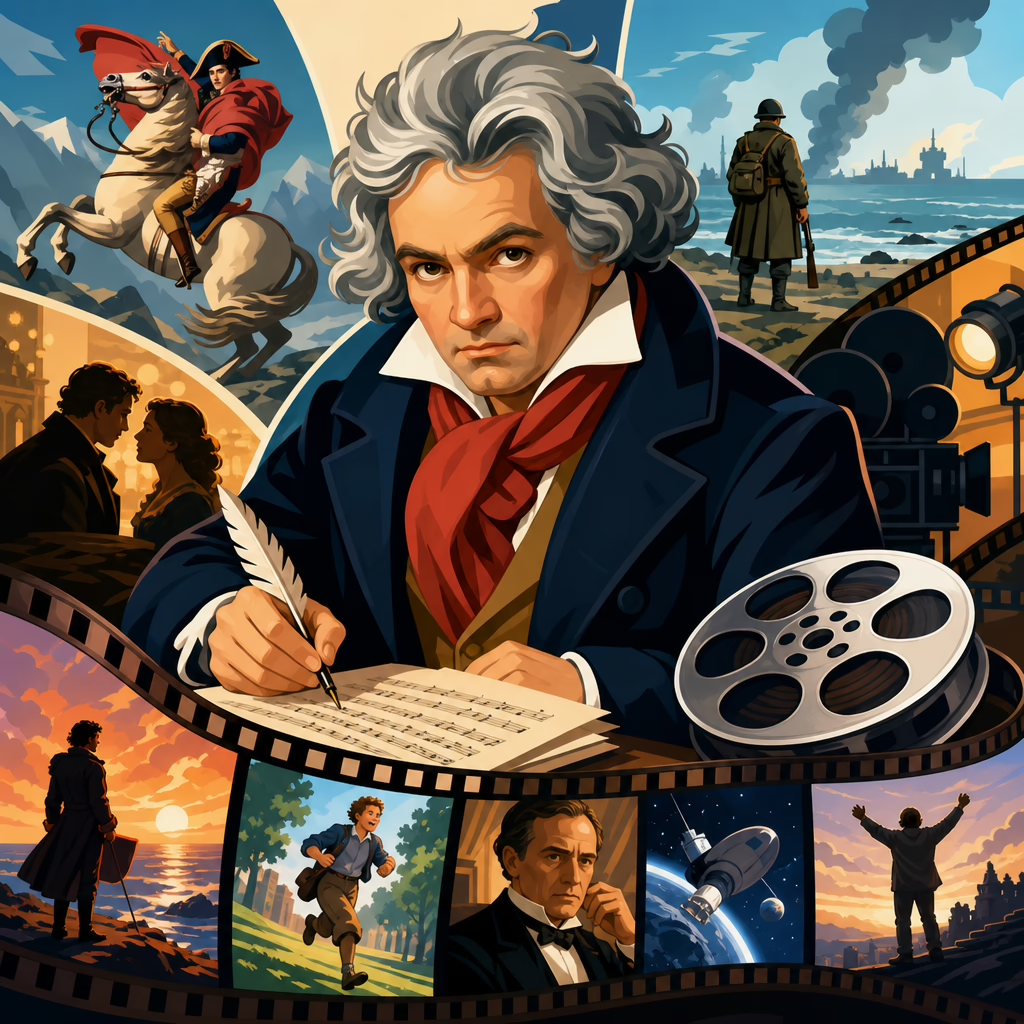
Beethoven on Film: Great Soundtrack Inclusions
Beethoven’s music has long been one of cinema’s most reliable shortcuts to emotional scale, moral gravity, and unforgettable contrast, which is why the subject of great soundtrack inclusions deserves more than a casual list of familiar cues. In film, an inclusion is not simply a piece placed under a scene; it is a deliberate pairing of image, rhythm, cultural memory, and audience expectation. Beethoven on film matters because his works carry unusually strong associations even before a note sounds: heroism in the “Eroica,” fate in the Fifth Symphony, ecstatic release in the Ninth, intimacy in the late piano sonatas, and disciplined elegance in chamber music. Directors and music supervisors use those associations to sharpen storytelling quickly, but the best results go deeper than shorthand. A smart Beethoven needle drop can create irony, elevate suspense, expose a character’s psychology, or connect private emotion to public history. Across studio dramas, war films, animation, prestige biopics, and darkly comic genre pictures, his music keeps reappearing because it remains structurally clear, emotionally legible, and dramatically adaptable.
This hub page surveys that broad miscellaneous territory within performance and recordings by focusing on how Beethoven’s music functions when it leaves the concert hall and enters narrative cinema. The central question is simple: what makes a Beethoven soundtrack inclusion great? In my experience evaluating film scores, licensed cues, and soundtrack albums, the strongest examples usually satisfy three tests. First, the chosen performance must fit the scene’s dramatic temperature; tempo, articulation, recording style, and orchestral weight all matter. Second, the cue must interact meaningfully with the edit, dialogue, and sound design rather than merely decorate them. Third, the piece should unlock something uniquely cinematic about Beethoven himself: his gift for tension and release, his architectural control, his volatility, and his capacity to sound both civilized and dangerous. Because this is a hub article, it also points toward the wider subtopic: performance practice, recording choices, iconic licensed tracks, soundtrack album curation, and the difference between using Beethoven as cultural symbol and using him as active narrative engine.
Why Beethoven Works So Well in Movies
Beethoven translates to film unusually well because his music is built on strong motifs, sharp dynamic contrasts, and clear long-range dramatic arcs. Those traits help scenes read instantly. A director can cut against the opening motif of Symphony No. 5 and tap into collective recognition within seconds. Just as importantly, Beethoven often develops simple cells into large emotional structures, which makes his music useful for montage, pursuit, revelation, or psychological escalation. Editors like music with obvious internal propulsion, and Beethoven supplies it in abundance. Even works not originally written for programmatic effect can sound cinematic because they move with purpose: themes collide, tension accumulates, cadences delay, and climaxes feel earned.
There is also a practical reason. Beethoven exists in many recordings, from historically informed performances using lighter articulation and brisker tempos to large modern symphonic interpretations with saturated strings and monumental brass. That range gives filmmakers options. A period-instrument reading of the Seventh Symphony can feel dancing, tensile, and transparent; a mid-century big-orchestra account can sound massive and fateful. The same composition can therefore support very different storytelling aims. This is one reason Beethoven appears in so many miscellaneous soundtrack contexts: not only prestige historical dramas, but thrillers, science-fiction films, satire, family films, and auteur cinema where directors want cultural familiarity without emotional vagueness.
Iconic Beethoven Film Uses That Still Define the Field
No discussion can begin anywhere but A Clockwork Orange. Stanley Kubrick’s use of Beethoven, especially the Ninth Symphony, is one of the defining examples of classical music in film because it fuses character psychology, irony, and cultural shock. Alex’s ecstatic attachment to Beethoven turns supposedly ennobling music into part of a deeply disturbing sonic identity. Kubrick understood that the Ninth was already burdened with ideals of brotherhood, transcendence, and historical prestige. By tying that music to ultraviolence and state conditioning, he did not merely borrow greatness; he weaponized cultural expectation. The inclusion works because it is conceptually exact, not because the piece is famous.
Die Hard offers another landmark, though in a very different register. The use of “Ode to Joy” during Hans Gruber’s apparent triumph is witty, grand, and instantly legible. Here Beethoven functions as a marker of criminal sophistication and inflated self-image. The cue is not subtle, but it is brilliantly timed. It enlarges the heist while telling the audience that the villains see themselves as connoisseurs staging a masterpiece. In action cinema, that kind of musical self-awareness can flatten into parody; in Die Hard, it lands because the film’s tone already balances tension, elegance, and dark humor.
The King’s Speech demonstrates a more earnest deployment through the second movement of Symphony No. 7 during the wartime broadcast climax. That movement’s inexorable pulse and grave nobility support the king’s effort without drowning it in sentimentality. Crucially, the cue’s success depends on performance style and mix. The music enters as structure, not syrup, giving the speech rhythmic backbone. In practical terms, this is a model example of Beethoven as narrative scaffolding: the scene borrows not only emotion but pacing from the composition.
Performance Choices Change the Meaning of the Same Piece
One of the biggest mistakes in discussing Beethoven on film is treating compositions as fixed dramatic objects. They are not. Recordings matter enormously. I have seen editors temp the same scene with two versions of the same movement and completely alter its emotional message. Take the Allegretto from Symphony No. 7. A lean performance in the style associated with Nikolaus Harnoncourt or John Eliot Gardiner can feel urgent, processional, even unsettlingly mobile. A broader modern-symphony version in the tradition of Herbert von Karajan can feel tragic, enveloping, and ceremonial. To a viewer, both may register simply as Beethoven, but the scene’s moral contour changes.
This is where soundtrack inclusion overlaps directly with performance and recordings. Film teams choose among different orchestras, conductors, remasterings, and licensing conditions. Some productions commission new recordings to control timing and synchronization; others license canonical commercial masters because the recording itself carries authority or nostalgia. A Glenn Gould piano recording would signal something very different from a Maurizio Pollini one, even before questions of repertoire enter. In Beethoven, articulation, pedal use, vibrato, microphone placement, and dynamic range all shape whether a cue feels intimate, historical, severe, romantic, or modernist. Great soundtrack use therefore requires musical judgment at the recording level, not just title recognition.
| Film | Beethoven work | Why the inclusion works |
|---|---|---|
| A Clockwork Orange | Symphony No. 9 | Creates violent irony by reversing the music’s expected moral uplift |
| Die Hard | “Ode to Joy” from Symphony No. 9 | Signals triumphant villainy with wit, scale, and instant recognizability |
| The King’s Speech | Symphony No. 7, Allegretto | Provides rhythmic support and emotional gravity without melodramatic excess |
| Immortal Beloved | Multiple works including Symphony No. 9 | Uses Beethoven biographically, though with dramatized liberties |
| Saturday Night Fever | Symphony No. 5 motif reference culture | Shows how Beethoven can function as social aspiration and comic contrast |
Biopics, Dramas, and the Problem of Prestige
Films about composers or elite culture often lean on Beethoven as an instant badge of seriousness, and that can produce mixed results. Immortal Beloved remains a useful case. It introduced many viewers to Beethoven’s music through lush cinematic framing and emotionally direct excerpts, and that exposure should not be dismissed. Yet its dramatic liberties also show the danger of turning Beethoven into pure myth. Great inclusion in this kind of film requires discipline: the music should illuminate character and historical environment, not merely certify importance. When the cue choice is too obvious or overmixed, prestige becomes wallpaper.
More interesting are dramas where Beethoven appears briefly but decisively. In those films, one sonata movement heard in rehearsal, one quartet passage in a drawing room, or one symphonic excerpt on a radio can reveal class, education, ambition, or emotional repression. Because Beethoven sits at the crossroads of public monument and private struggle, he can do social work inside a story very efficiently. A family that plays a string quartet badly tells us one thing; a character who listens alone to the Op. 111 Arietta tells us another. The best filmmakers understand that Beethoven is never neutral cultural furniture.
How Genre Films Use Beethoven for Irony, Tension, and Character
Outside prestige drama, Beethoven often appears where contrast does the heavy lifting. Crime films and thrillers use him to make violence feel choreographed, coldly intelligent, or perversely elevated. Horror and psychological cinema use him to destabilize trust by pairing formal beauty with emotional rupture. Science-fiction films exploit his reputation for monumentality and human striving, especially when stories address civilization, technology, or control. In these settings, Beethoven can function as a double signal: reassuringly canonical on the surface, but emotionally volatile underneath. That instability is dramatically useful.
Comedy can also benefit from Beethoven when the joke depends on disproportion. A pompous character choosing Beethoven to display taste, a chaotic scene unfolding under impeccable chamber music, or an action beat inflated by symphonic grandeur all rely on the audience recognizing the gap between music and behavior. The humor works best when the filmmakers respect the music’s force rather than treating it as a dead cultural prop. Beethoven is funny on film when characters misuse him, misunderstand him, or hide behind him, not when the movie itself condescends to the score.
What to Listen for When Evaluating a Beethoven Soundtrack Inclusion
If you want to judge whether a Beethoven inclusion is genuinely effective, listen beyond recognition. Start with placement. Does the cue begin at a musically meaningful point, or was it chopped into the scene arbitrarily? Then evaluate synchronization. Are edits, gestures, or camera movements aligned with phrase structure and cadence, or does the scene fight the music? Next, consider perspective: is the track diegetic, heard by the characters within the story world, or nondiegetic, supplied for the audience? That distinction changes meaning. A character choosing Beethoven reveals identity; a director imposing Beethoven on a scene reveals interpretation.
Finally, ask whether the recording choice serves the film’s sonic world. Older analog masters may bring grain, prestige, and a sense of discovery; new digital recordings can deliver precision and impact. Dynamic compression, reverb matching, and orchestral color all affect believability. On soundtrack albums, sequencing matters too. A Beethoven excerpt pulled from a film can feel powerful in context yet unsatisfying in isolation if the album ignores key transitions. This is why the miscellaneous corner of performance and recordings is so rich: it includes licensing strategy, editorial craft, album presentation, and the afterlife of a film cue once listeners seek out the full work.
Beethoven on Film as a Gateway to Recordings and Repertoire
One of the most valuable outcomes of great soundtrack inclusions is that they send audiences back to the source. Many listeners first encounter the Seventh Symphony, the “Moonlight” Sonata, or the Ninth through cinema rather than the concert hall. That pathway matters. A well-used cue can prompt someone to compare Carlos Kleiber with Karajan, or to discover why historically informed Beethoven sounds lighter and more rhythmically dangerous than older mainstream versions. In that sense, film does not dilute Beethoven; at its best, it recruits new listeners into deeper engagement with performance history and recorded interpretation.
As a hub for miscellaneous coverage within performance and recordings, this topic connects several related article paths: the best licensed Beethoven tracks, films built around single major works, soundtrack albums worth owning, scenes transformed by conductor or orchestra choice, and adaptations that misuse Beethoven despite good intentions. The main takeaway is clear. Great Beethoven soundtrack inclusions succeed when filmmakers choose the right work, the right performance, and the right dramatic function. They do not rely on prestige alone. They use Beethoven as active storytelling material. Revisit the standout films, compare the recordings they use, and let those listening choices lead you deeper into Beethoven on screen and on record.
Frequently Asked Questions
Why is Beethoven used so often in films compared with other classical composers?
Beethoven appears so often in film because his music arrives with emotional force, cultural familiarity, and dramatic flexibility all at once. Directors, editors, and music supervisors return to him because his work can instantly enlarge a scene without needing much explanation. Even viewers who cannot name a specific symphony or sonata often recognize the emotional language: triumph, struggle, dread, tenderness, resolve, or overwhelming scale. That built-in recognition makes Beethoven especially useful in cinema, where time is limited and storytelling has to move quickly.
Another reason is contrast. Beethoven’s music can support the obvious reading of a scene, but it can also create irony or tension when paired against the image. A noble orchestral passage can make violence feel more disturbing, a familiar melody can add humanity to a morally ambiguous character, and a quiet piano movement can reveal vulnerability where dialogue would feel too direct. His work is structurally strong, rhythmically clear, and emotionally legible, which gives filmmakers reliable material to shape around edits, montages, and turning points.
There is also the issue of cultural memory. Beethoven is not just a composer in the abstract; he represents genius, seriousness, artistic struggle, and a kind of universal ambition. When his music is included in a soundtrack, the film often borrows some of those associations. That does not mean every use is pretentious or monumental. Sometimes the inclusion works precisely because it brings that larger cultural weight into an intimate or unexpected setting. In short, Beethoven is used so often because his music does more than sound beautiful: it carries meaning before the scene has even fully unfolded.
What makes a Beethoven soundtrack inclusion truly great rather than merely recognizable?
A great Beethoven inclusion is not defined by fame alone. Simply dropping in a well-known passage does not automatically create a memorable cinematic moment. What separates a truly great inclusion from a generic one is precision: the right piece, at the right moment, framed in the right way. The music should feel as though it is revealing something essential about the scene rather than decorating it. It might deepen the emotional stakes, expose a contradiction in the action, connect a character to a larger idea, or reshape the viewer’s interpretation of what is happening.
Editing and timing are also crucial. Beethoven’s music often has strong internal architecture, with clear developments, surges, pauses, and resolutions. A great film inclusion understands that shape and works with it instead of treating the piece like interchangeable background sound. When the cut, camera movement, or dramatic escalation aligns with the music’s own momentum, the result feels inevitable. The audience may not consciously analyze why it works, but they feel the union of image and sound as something complete and persuasive.
Context matters just as much as craft. A great inclusion uses Beethoven in a way that respects both the music’s identity and the film’s own voice. Sometimes that means embracing grandeur; other times it means using a familiar piece in a startlingly intimate, comic, or unsettling context. The best examples are memorable because they create a new association without erasing the old one. Afterward, audiences do not just remember hearing Beethoven in the film; they remember that this particular scene and this particular music now belong together.
Which qualities of Beethoven’s music make it especially effective for emotional scale and moral gravity on screen?
Beethoven’s music is exceptionally effective on screen because it combines clarity with intensity. His themes are often direct and memorable, but they are developed with tremendous dramatic pressure. That means a filmmaker can use his music to communicate both immediate feeling and larger significance. A single phrase can sound personal, while the orchestral or harmonic expansion around it can suggest fate, history, conflict, or transcendence. Few composers are as capable of sounding intimate and monumental within the same piece.
His music also excels at conveying struggle. Beethoven frequently builds tension through repetition, rhythmic insistence, dynamic contrast, and the sense that an idea is pushing against resistance. In cinema, that quality translates beautifully to scenes involving moral choice, psychological conflict, perseverance, or transformation. The audience does not just hear emotion; they hear motion within emotion. The music feels as though it is wrestling with something, which naturally supports stories about human will, consequence, and change.
Just as important is his ability to balance darkness and release. Beethoven can sound stern, lyrical, explosive, serene, or exultant, often within a single movement. That range gives filmmakers rich expressive territory. A director looking for moral gravity may turn to Beethoven not only because the music sounds “serious,” but because it dramatizes the path toward seriousness: uncertainty becoming conviction, fragility becoming resolve, chaos becoming order, or order collapsing into instability. Those emotional trajectories are deeply cinematic, which is why his work continues to be such a powerful resource for film storytelling.
How do filmmakers use Beethoven to create contrast, irony, or unexpected meaning in a scene?
One of the most sophisticated uses of Beethoven in film involves playing against audience expectation. Because his music is so culturally loaded, it can do more than reinforce what viewers already see. Filmmakers often use it to create distance, unease, or irony. For example, a majestic or spiritually elevated piece placed over disturbing imagery can make the scene more unsettling than a conventional suspense score would. The music does not soften the action; it complicates it. It asks the audience to process beauty and discomfort at the same time.
Beethoven can also be used to reveal character. If a morally compromised, eccentric, or emotionally repressed character is associated with Beethoven, the choice can suggest refinement, longing, delusion, control, or a private inner life that the surface narrative has not yet exposed. In that sense, the inclusion becomes part of characterization rather than just atmosphere. The audience starts to interpret the scene through the gap between what the music traditionally signifies and what the character actually does.
This is where soundtrack inclusion becomes a deliberate art rather than a matter of prestige. A filmmaker may choose Beethoven precisely because the audience brings assumptions to it. Those assumptions can then be confirmed, redirected, or overturned. In comic scenes, the grandness of the music can exaggerate the absurdity of ordinary action. In tragic scenes, a familiar Beethoven passage can make loss feel not just personal but universal. In violent or chaotic sequences, the order and discipline of the composition can create an eerie counterpoint. When used this way, Beethoven does not simply accompany the image; he argues with it, expands it, and sometimes unsettles it in ways original scoring might not.
Why does Beethoven on film still resonate with modern audiences despite changing soundtrack trends?
Beethoven remains effective for modern audiences because the core strengths of his music have not become outdated. Film trends change, genres evolve, and popular scoring styles shift, but audiences still respond to strong melody, structural momentum, emotional urgency, and a sense of consequence. Beethoven offers all of that in concentrated form. Even in an era dominated by hybrid scores, electronic textures, and highly curated song placements, his music still cuts through because it feels deliberate and unmistakable. When it enters a film, it often changes the perceived scale of the moment immediately.
His continued resonance also comes from the way filmgoers experience cultural memory. Many viewers encounter Beethoven first through movies, television, advertising, or public ceremony rather than concert halls, yet the music still retains a special authority. It can signal seriousness without explanation, but it can also feel freshly discovered when a filmmaker uses it in an inventive setting. That adaptability keeps Beethoven relevant. He can serve historical dramas, psychological thrillers, satirical films, intimate character studies, and large-scale epics without seeming confined to a single cinematic function.
Most importantly, Beethoven persists because great soundtrack inclusion is about more than period taste. It is about the relationship between image and inherited meaning. His music arrives with emotional history, but each film has the chance to reshape that history through context. A modern audience may not hear Beethoven exactly as a nineteenth-century audience did, yet they still recognize his intensity, his grandeur, and his capacity for conflict and release. That makes him endlessly useful to filmmakers and endlessly compelling to viewers. When Beethoven is used well on screen, the result does not feel old-fashioned; it feels definitive.