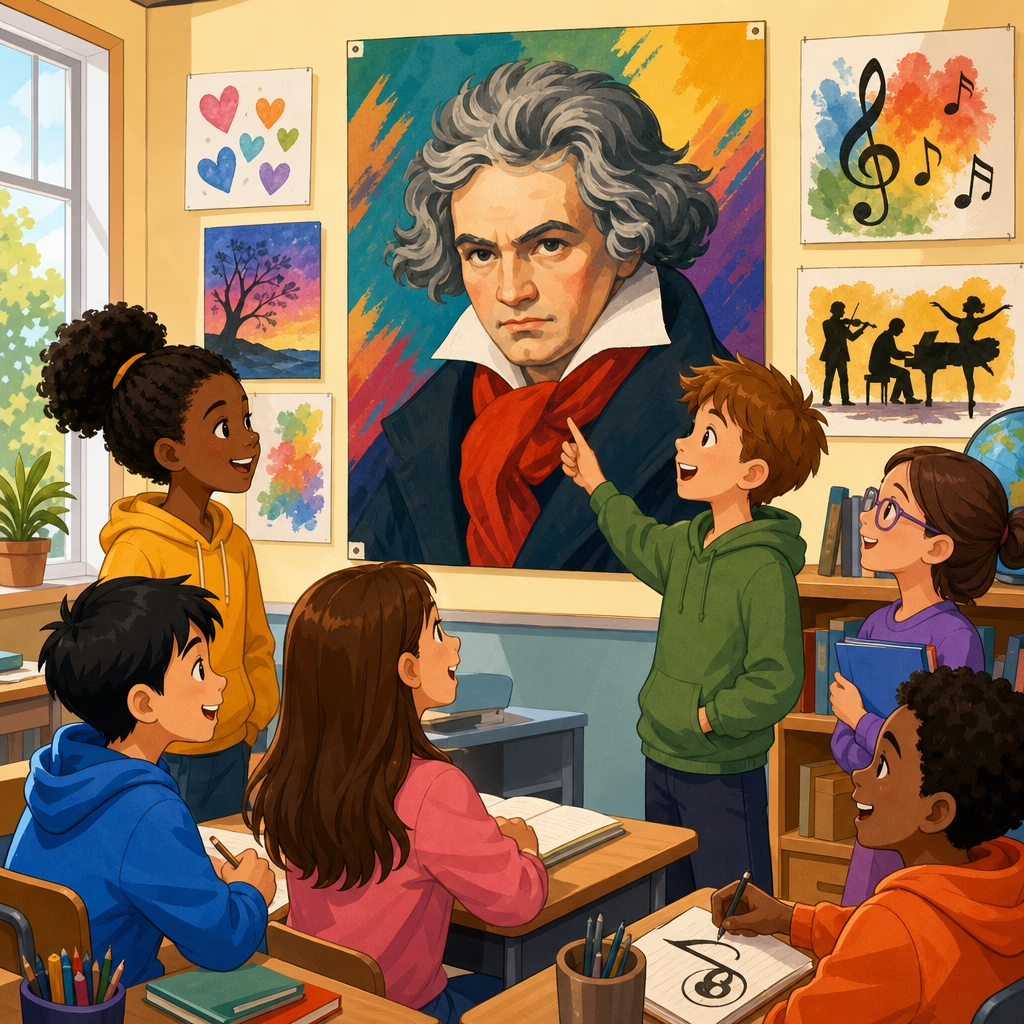
Beethoven in School Walls Posters and Classroom Culture
Beethoven in school walls posters and classroom culture reveals how a single composer’s image can shape the atmosphere, values, and daily habits of learning spaces. In many schools, Beethoven appears not only in music rooms but also in hallways, language arts classrooms, libraries, and counseling offices, where his portrait stands for discipline, creativity, resilience, and intellectual ambition. A school walls poster is more than decoration; it is a visual teaching tool that signals what a community honors, remembers, and expects. Classroom culture refers to the shared norms, routines, symbols, and emotional climate that influence how students behave and how teachers frame learning. When Beethoven is used thoughtfully, his presence can support historical literacy, artistic inquiry, perseverance, and cross-curricular discussion. When used carelessly, it can become background wallpaper with little meaning, or worse, a simplistic symbol of “genius” that ignores context, struggle, and the collaborative nature of culture. I have seen both outcomes in real classrooms: one where a faded portrait gathered dust above a piano no student touched, and another where a teacher used the same image to launch conversations about hearing loss, revision, civic upheaval, and the work behind mastery. The difference was not the poster itself but the culture built around it. Understanding that difference matters for teachers, curriculum leaders, and school designers who want visual materials to reinforce learning rather than merely fill blank walls.
Why Beethoven posters appear so often in schools
Beethoven posters are common in schools because they combine instant recognizability with rich educational meaning. His face, especially the stern late-life portrait with wild hair and intense gaze, reads immediately as “serious music” even for students who cannot name a single symphony. That visual familiarity makes him useful to teachers seeking symbols that communicate high expectations and artistic purpose without lengthy explanation. In practice, schools also inherit poster traditions from older music education models that centered Western classical canon figures such as Bach, Mozart, and Beethoven. Vendors for classroom décor, from general teacher suppliers to specialist music catalogs, still package these figures as foundational icons because they align with standard survey curricula, concert repertoire, and exam-based music history units.
There is another reason Beethoven endures on school walls: his life story fits educational narratives about effort and adversity. Teachers regularly use concise biographical details—strict training, difficult family life, growing deafness, continued composition—to illustrate persistence. That makes Beethoven especially adaptable in motivational contexts, where a poster may carry a short quotation or simply rely on association with determination. Yet the educational value is strongest when schools move beyond myth. Beethoven was not a detached miracle worker. He revised extensively, navigated patronage networks, responded to political change, and built his reputation in a specific European cultural world. Presenting him this way helps students see achievement as historically grounded work, not mystical talent.
How posters influence classroom culture beyond decoration
Visual environments affect behavior and attention. Research on classroom design consistently shows that walls can either support cognition or create overstimulation, depending on density, relevance, and use. A Beethoven poster contributes positively when it is tied to routines, discussion, and curriculum. For example, in a middle school general music room, a portrait placed beside a timeline of the French Revolution, the Napoleonic era, and the premiere dates of major works gives students a quick reference point. In a humanities classroom, the same image beside excerpts from the “Heiligenstadt Testament” can frame writing prompts on identity and struggle. The poster then acts as an anchor for memory, not visual clutter.
Classroom culture is built from repeated signals. If Beethoven’s image is paired with listening journals, student questions, and critical discussion, students learn that the room values sustained attention and interpretation. If it is paired only with commands such as “practice makes perfect,” the culture can slip into cliché. I have watched students engage more deeply when teachers ask concrete questions linked to the poster: Why was Beethoven first admired as a pianist? What changed after his hearing declined? Why does one portrait dominate public memory while earlier likenesses are less famous? Questions like these make the wall part of the lesson. They also help students understand that culture is constructed through images, choices, and repetition.
Using Beethoven responsibly in music, history, and language arts
The most effective school use of Beethoven posters is interdisciplinary. In music classes, the poster can support listening analysis of motif development, sonata form, orchestration, and the expansion of symphonic scale. In history classes, it can introduce discussion of Vienna, aristocratic patronage, Enlightenment thought, Napoleon, and the social status of artists around 1800. In language arts, teachers can use letters, notebook excerpts, and contemporary criticism to teach voice, audience, and revision. Students often respond well when they realize Beethoven was not only a composer but also a writer of messy, urgent personal documents.
Responsible use also means avoiding hero worship. Beethoven should not be presented as proof that suffering automatically produces greatness, or as the sole representative of musical excellence. A poster can open a door, but the room should include context and comparison. Teachers might place Beethoven alongside contemporaries, later interpreters, and overlooked composers to show that cultural memory is selective. For a focused overview of why his image became so durable across societies, one useful reference is this main guide on Beethoven as a global cultural icon. Within school culture, that durability matters because students are not just learning music; they are learning which faces institutions repeatedly elevate and why.
Practical models for poster placement and classroom use
Placement determines whether a Beethoven poster functions as instruction, ambiance, or distraction. Near the board, it can support direct teaching if teachers regularly point to it during lessons. Near a listening station or practice corner, it can mark a zone of concentrated work. In hallways outside performing arts spaces, it can contribute to departmental identity, especially when paired with student performance photos. The least effective placement is usually high, isolated, and unreferenced, where the image becomes invisible through familiarity. Good classroom design treats wall space as limited instructional real estate.
Based on classroom observations, the strongest implementations share several features.
| Setting | Poster Use | Culture Effect | Best Practice |
|---|---|---|---|
| Elementary music room | Portrait with simple timeline and listening prompts | Builds curiosity without overload | Link image to one short weekly routine |
| Middle school ensemble room | Poster near rehearsal goals and repertoire notes | Connects discipline to artistic purpose | Reference it during score study, not only concerts |
| High school history class | Poster with political and social context | Shows art as part of public life | Compare with other revolutionary-era figures |
| Hallway display | Large image with student-created captions | Increases ownership and interpretation | Rotate captions each term |
These models work because they make the visual active. Students should do something with the image: annotate it, question it, connect it to repertoire, or challenge what it seems to represent. That interaction turns a poster into a cultural artifact inside the school rather than a stock image imported from outside.
What students actually learn from Beethoven on the wall
Students absorb at least four lessons from Beethoven posters, whether teachers intend them or not. First, they learn what kinds of achievement schools admire. A prominent poster implies that artistic accomplishment deserves public honor, which can be valuable in systems otherwise dominated by test scores. Second, they learn how institutions narrate excellence. If the poster is framed only around genius, students may infer that talent is innate and distant. If it is framed around drafts, performance practice, and historical struggle, they see excellence as developed and contested. Third, they learn whose culture appears official. Because Beethoven represents one lineage of European art music, his presence should invite discussion of inclusion, canon formation, and what remains off the wall. Fourth, they learn whether symbols in the room carry substance. Students quickly notice when posters are decorative veneers rather than tools for thinking.
This is why quotations attributed to Beethoven should be used carefully. Many classroom posters rely on sayings that are paraphrased, decontextualized, or falsely assigned. Inaccurate quotations weaken trust and teach sloppy source habits. Better practice is to use documented language from letters or conversation books, with a date and brief explanation. That simple shift models academic integrity. It also helps students understand that historical figures are not vending machines for motivational slogans. They were people embedded in conflicts, ambitions, and changing circumstances.
Common mistakes schools make with Beethoven imagery
The first mistake is overloading walls with disconnected icons. When Beethoven is one face among dozens with no curricular thread, students tune everything out. The second is reducing him to a stereotype: angry hair, suffering genius, deaf composer. Each element contains some truth, but none is adequate alone. The third mistake is isolating the poster in the music department while expecting the symbol to carry schoolwide cultural value. If administrators want the arts to be central, the visual language of the building should reflect that across shared spaces. The fourth mistake is ignoring age level. Young students benefit from clear, minimal supports and one memorable idea, while older students can handle nuance about class, patronage, nationalism, and canon debates.
A final mistake is failing to refresh interpretation. A poster that never changes functionally disappears. The best schools treat visual materials as living curriculum. They rotate prompts, add student responses, and connect wall displays to performances, essays, or assemblies. I have seen a high school orchestra room transform a standard Beethoven portrait by surrounding it with rehearsal annotations from students preparing the Fifth Symphony. That small change shifted the image from distant monument to working reference point. Students began asking not “Who is that?” but “Why does this rhythm keep returning?” That is exactly what school visuals should do.
Building a healthier classroom culture around Beethoven
A healthy classroom culture uses Beethoven not to enforce reverence but to invite disciplined curiosity. Teachers can start with three moves. First, give the image context: date, place, and purpose. Second, tie it to an observable practice such as close listening, revision, or historical comparison. Third, create room for critique by asking what the poster leaves out. This approach keeps the classroom intellectually honest while still honoring Beethoven’s significance. It also aligns visual culture with deeper educational goals: interpretation, evidence, perspective, and reflection.
Beethoven in school walls posters and classroom culture works best when schools treat the image as a doorway, not a shrine. A well-used poster can support memory, strengthen arts identity, and connect students to enduring questions about effort, creativity, and public meaning. A poorly used poster becomes invisible or simplistic. Audit the walls in your school, choose images with intention, and make every visual earn its place through teaching.
Frequently Asked Questions
Why do Beethoven posters appear in so many different places around a school, not just in the music room?
Beethoven posters often appear across a school because his image has come to represent more than classical music alone. In a classroom culture context, he symbolizes persistence, intellectual seriousness, creativity under pressure, and the idea that meaningful work requires discipline. Those qualities connect naturally to many parts of school life, which is why educators may place his portrait in hallways, libraries, English classrooms, counseling spaces, and study centers as well as music rooms. A Beethoven poster can quietly communicate that the school values depth of thought, artistic achievement, and the ability to overcome difficulty.
Schools also use recognizable historical figures as visual anchors for shared values. Beethoven is especially effective because his life story supports multiple educational themes at once. Teachers may reference his dedication to craft, his willingness to challenge convention, and his continued composing despite hearing loss. That gives the poster cross-curricular meaning. In a language arts classroom, it can support discussions about biography, perseverance, and voice. In a counseling office, it can reinforce messages about resilience and self-belief. In a library, it can signal that knowledge and imagination belong together. In that sense, the poster functions as a cultural cue that helps define what kind of learning community the school is trying to build.
How can a Beethoven school walls poster actually influence classroom culture?
A poster influences classroom culture by shaping the visual environment students experience every day. Classroom culture is not created by speeches alone; it is built through routines, expectations, symbols, and repeated messages. When Beethoven’s image is displayed intentionally, it can reinforce ideas such as focus, endurance, high standards, and respect for creative effort. Over time, those visual messages become part of the room’s identity. Students may begin to associate the space with concentration, artistic ambition, and thoughtful work, even if they are not consciously analyzing the poster each day.
The strongest influence happens when the poster is connected to teaching practice. For example, a teacher might reference Beethoven during discussions about revision, reminding students that great work often emerges through struggle and persistence. A music teacher may use the image to frame conversations about listening deeply and practicing consistently. An English teacher might connect Beethoven’s legacy to themes of character, adversity, and expression. In these cases, the poster is not just background decoration. It becomes a visual teaching tool that supports the values the teacher wants students to absorb. That is how a single image can contribute to a culture of seriousness, curiosity, and resilience within a school setting.
What does Beethoven symbolize in a school environment beyond musical talent?
In schools, Beethoven commonly symbolizes a broader set of educational ideals that extend far beyond technical musical ability. He often stands for disciplined effort, emotional depth, independent thinking, and the pursuit of excellence despite hardship. These are qualities schools want students to recognize in themselves and in others. His public image, especially the familiar intense portrait, reinforces the idea of concentrated effort and deep engagement with important work. For educators, that makes him a powerful symbol of the academic and personal habits that support meaningful learning.
His life story adds even more weight to that symbolism. Beethoven is frequently associated with resilience because he continued to compose while facing profound hearing loss, a challenge that students can understand as a model of perseverance through adversity. He also represents creative courage, since his work pushed boundaries and helped reshape the musical tradition he inherited. In a school context, that can support messages about innovation, critical thinking, and the value of developing one’s own voice. As a result, a Beethoven poster can embody a school’s belief that achievement is not simply about talent. It is about persistence, reflection, courage, and commitment to growth.
How should teachers use Beethoven posters so they feel meaningful rather than purely decorative?
Teachers should use Beethoven posters with clear purpose and context. The most effective educational displays are tied to learning goals, class discussions, and school values rather than being placed on the wall without explanation. A teacher can make a Beethoven poster meaningful by introducing who he was, why his image is present, and what qualities students can learn from his example. Even a brief conversation can transform the poster from visual filler into a shared cultural reference point. Students are more likely to engage with classroom visuals when they understand their relevance.
It also helps to connect the poster to ongoing routines. Teachers might refer to Beethoven when discussing perseverance during difficult assignments, creative risk-taking in student projects, or the importance of revision and practice. In interdisciplinary settings, his portrait can support lessons on history, biography, disability, artistic movements, and the relationship between emotion and expression. Placement matters as well. A poster near a reading corner, writing center, piano, or reflection space can signal a specific expectation for that area, whether it is concentration, imagination, or thoughtful effort. When used this way, the poster becomes part of the lived culture of the classroom. It reinforces values repeatedly and naturally, which is exactly what strong educational environments do.
What should schools consider when choosing or displaying Beethoven posters for students?
Schools should think carefully about both message and context when selecting Beethoven posters. The first consideration is what the image is meant to communicate. A poster should support the school’s broader educational mission, whether that involves creativity, resilience, academic excellence, or respect for cultural history. Schools may choose a formal portrait for a more traditional academic atmosphere or a design with quotes, timelines, or interpretive graphics for a more instructional purpose. The visual style should match the age group, the location, and the intended use of the display.
Accessibility and inclusion are also important. Students benefit most when the poster is part of a broader, diverse visual environment rather than the only figure being highlighted repeatedly. Beethoven can be powerful, but he should be presented as one meaningful contributor within a richer cultural and intellectual conversation. Schools should also ensure that the display includes enough context for students to understand why he matters. A caption, short biography, or connection to classroom themes can make the image far more effective. Finally, placement should be intentional. In a music room, the poster might reinforce practice and artistry. In a hallway, it may signal school-wide values. In a counseling office, it can support conversations about determination and overcoming obstacles. Thoughtful display choices help ensure the poster contributes positively to classroom culture rather than fading into the background.