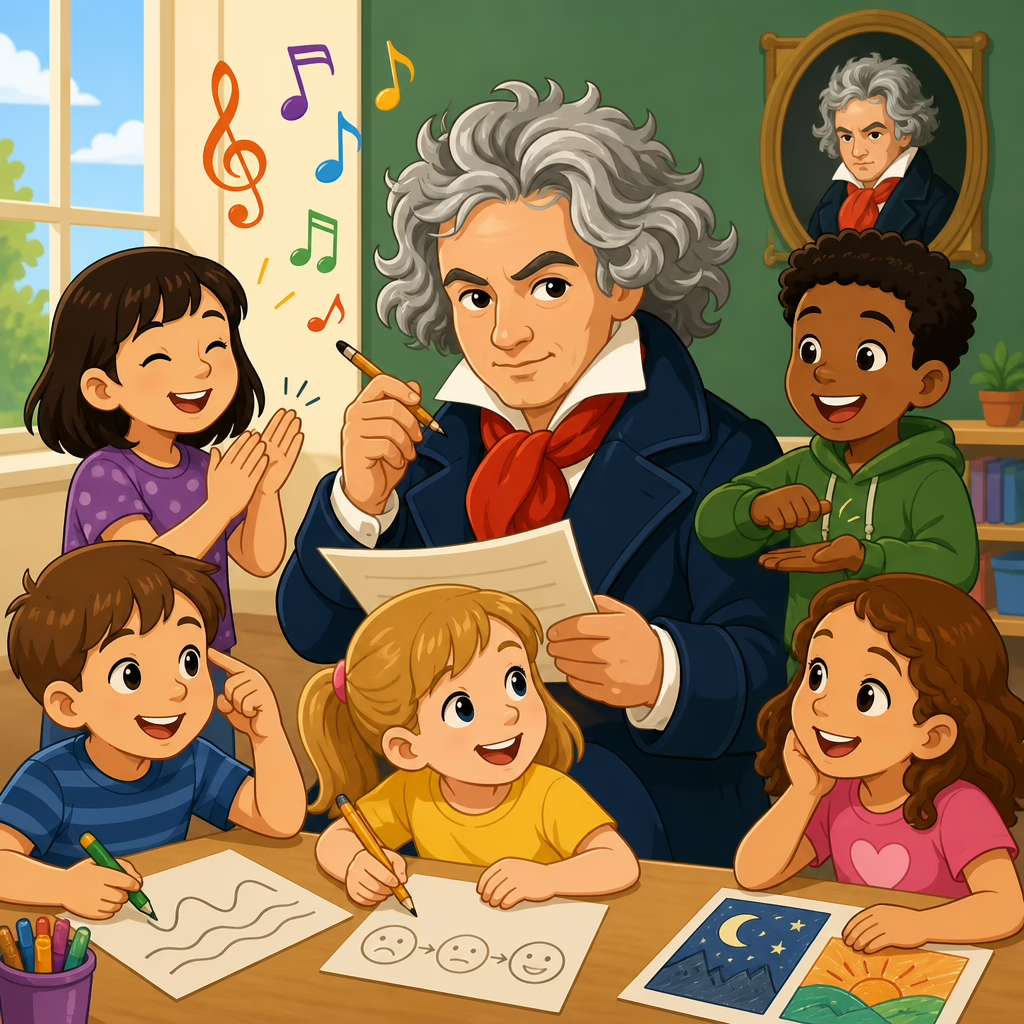
Beethoven Classroom Activities That Do Not Require Instruments
Beethoven classroom activities that do not require instruments give teachers a practical way to teach listening, form, emotion, rhythm, history, and creativity without needing a music room full of equipment. In this context, “do not require instruments” means students learn through movement, speaking, drawing, writing, discussion, and close listening rather than through playing recorders, xylophones, or percussion. That matters in elementary settings because many classrooms have limited budgets, shared spaces, mixed grade levels, and uneven access to materials. I have taught Beethoven units in general music, homerooms, and after-school programs, and the most successful lessons were often the simplest: one recording, a clear question, and an activity that turned passive listening into visible thinking. Beethoven is especially useful because his music contains strong contrasts, memorable motives, dramatic dynamics, and stories students can feel even before they can explain them. Well-designed non-instrument activities also support literacy, social-emotional learning, and classroom management. When students map a crescendo with their arms, sequence the events of Beethoven’s life, or debate the mood of the “Moonlight” Sonata, they are practicing focused attention and interpretation. For teachers who want meaningful music instruction without specialized gear, these activities are reliable, flexible, and academically rich.
Start with active listening that gives students a job
The best Beethoven lesson without instruments usually begins with active listening. Students need a concrete task while the music plays, or the lesson quickly becomes background noise. A strong example is a listening map for the opening of Symphony No. 5. Before pressing play, teach the famous four-note motive as “short-short-short-long” and have students whisper it back. Then ask them to raise one finger every time they hear the motive return. This turns recognition into a measurable skill. In classrooms where I used this approach, even first graders could identify repetition and notice when the orchestra changed volume or texture.
Another effective listening task is contrast tracking. Beethoven’s music often shifts suddenly between loud and soft, full ensemble and solo line, tension and release. Give students two cards, one marked “same” and one marked “change.” While listening to excerpts from Symphony No. 6 or the “Ode to Joy,” they hold up the card that matches what they hear. The language stays simple, but the thinking is real: students are analyzing form. If you want a deeper extension, pause after the excerpt and ask, “What changed first: dynamics, tempo, or instrumentation?” They may not know every technical term yet, but repeated exposure builds vocabulary accurately.
Short excerpts work better than full movements for younger grades. A ninety-second segment is enough to teach steady beat, mood, or recurring pattern. For older elementary students, add evidence-based discussion. Instead of asking whether they liked the music, ask, “What in the music made it sound triumphant?” Students might cite the brass, louder dynamics, or repeated rhythm. That shift from opinion to evidence makes listening accountable and prepares them for stronger written responses later. If you need a broader framework for sequencing lessons, this Beethoven lesson plans for elementary music classes guide helps connect single activities into a coherent unit.
Use movement to teach form, beat, and musical character
Movement is one of the most effective no-instrument strategies because it externalizes what students hear. For Beethoven, begin with beat-based locomotor movement. In “Ode to Joy,” students can walk the steady beat around the room, freeze at phrase endings, and change direction when the melody repeats. This teaches pulse and phrase structure without a single piece of equipment. The room setup matters: define boundaries, model personal space, and rehearse what freezing looks like before the music starts. Clear routines make movement academic instead of chaotic.
For stronger contrasts, use statue movement. In an excerpt from Symphony No. 5, students stand tall for loud passages and crouch for soft ones. They can also show ascending pitch by lifting their hands and descending pitch by lowering them. I have found that this works especially well for students who struggle with verbal participation because it gives them a nonverbal entry point into analysis. The teacher can assess in real time by watching whether students react to the right musical cues.
Character movement adds interpretation. Ask students to move as if the music is marching, sneaking, celebrating, or grieving. Then discuss why a classmate chose “marching” for one section and “celebrating” for another. Beethoven’s overt dynamic contrasts make these choices easier to justify. This is especially effective with excerpts from Egmont Overture or Symphony No. 7, where rhythmic drive strongly suggests mood and action. The key is not to treat movement as free dance with no purpose. Give one listening focus per round: beat, phrase, dynamics, or character. Repeated short listens with changing prompts produce far more learning than one long listen with vague instructions.
Build literacy through Beethoven writing and speaking tasks
Beethoven lessons fit naturally into reading and writing because his life and music invite narrative, description, and argument. A simple and effective activity is the “composer’s evidence paragraph.” After listening to an excerpt, students complete the frame: “This music sounds ___ because ___.” Younger students can fill in one adjective and one reason, while older students write a full paragraph citing tempo, dynamics, articulation, and repetition. This structure teaches students to support claims with evidence, a skill shared across subjects.
Biography-based writing also works well when it stays focused. Rather than assigning a broad report on Beethoven’s entire life, ask students to respond to one specific question: “How might Beethoven’s hearing loss have changed the way people understood him?” This opens discussion about disability, persistence, and historical context without drifting into mythmaking. Be careful here: students often hear oversimplified stories that present Beethoven as a lone genius who simply “overcame everything.” A better classroom conversation acknowledges that hearing loss created real professional and personal obstacles, and that he adapted through notebooks, memory, theory knowledge, and deep internal hearing.
Speaking tasks can be just as rigorous. Try a short partner debate on whether Symphony No. 5 sounds more determined or more fearful. Each student must give one musical reason. For younger classes, use sentence stems such as “I heard ___ when ___ happened.” For upper elementary, assign roles like conductor, historian, and critic, then ask each student to comment from that perspective. These activities strengthen academic language and listening discipline while keeping the focus on Beethoven’s music rather than generic composer trivia.
Teach rhythm and motif through body percussion and speech
Activities without instruments can still teach core musical elements, especially rhythm and motif. Beethoven’s Fifth Symphony is ideal because the opening motive is concise and unforgettable. Start by having students say “short-short-short-long” in rhythm. Next, transfer it to body percussion: three knee pats and one clap, or three claps and a held hand pose for the longer note. Students are not merely copying a famous pattern; they are learning duration, repetition, and musical identity. Once the class can perform the motive accurately, ask them to spot it in the recording and perform along when it appears.
Call-and-response rhythm reading also works well. The teacher chants a pattern derived from Beethoven themes, and the class echoes it using syllables or neutral sounds. If students are ready, notate the pattern on the board with quarter notes and eighth notes. This bridges aural recognition to visual literacy. In mixed-ability classrooms, keep one group on speech while another adds coordinated body percussion. Everyone participates at an appropriate level, and no one is excluded for lack of instrumental technique.
| Activity | Beethoven excerpt | Skill taught | Best grade span |
|---|---|---|---|
| Finger tally for recurring motive | Symphony No. 5, first movement opening | Motivic recognition and repetition | K–5 |
| Walk and freeze by phrase | “Ode to Joy” | Steady beat and phrase awareness | K–3 |
| Same or change cards | Symphony No. 6 excerpt | Form and contrast | 1–5 |
| Evidence paragraph | “Moonlight” Sonata or Symphony No. 7 | Descriptive writing with musical evidence | 3–5 |
| Body percussion motive | Symphony No. 5 | Rhythm, duration, ensemble response | 1–5 |
One caution: body percussion can become performance-first if the pattern is too complex. Keep the goal conceptual. If the class loses the beat while trying to remember a long sequence, simplify. Beethoven activities work best when students can connect what they do physically to what they hear musically.
Connect music to art, history, and emotion without losing rigor
Cross-curricular Beethoven activities are most useful when they stay anchored to a listening objective. Drawing is a good example. Instead of telling students to “draw what you hear,” give them one target such as line, color, or shape. During a hearing of the “Moonlight” Sonata, students might draw only lines that match the contour and flow of the music. During a louder excerpt from Symphony No. 5, they might use angular shapes and stronger pressure. Afterward, ask them to explain two artistic choices using musical vocabulary. This keeps the task analytical rather than decorative.
History connections should be selective and age-appropriate. Students do not need a graduate lecture on Napoleonic Europe, but they should know Beethoven lived during a period of political upheaval and social change. A brief timeline activity can show that he bridged the Classical and Romantic eras, expanding the emotional and structural possibilities of the symphony. If you mention the Eroica Symphony, explain that Beethoven originally admired Napoleon as a symbol of republican ideals and later withdrew that dedication. Even simplified, that story helps students see composers as people responding to events, not names floating outside history.
Emotion-based lessons are powerful when teachers avoid treating feelings as random. Ask, “Which musical feature made this section sound tense?” rather than “How did it make you feel?” Students learn that emotional response in music is often linked to tempo, minor mode, register, repetition, and dynamic intensity. This is especially important in community and education settings where music can support reflection and social-emotional growth. Beethoven’s music gives students a safe way to discuss struggle, hope, and release while grounding those ideas in observable sound.
Plan for different ages, limited time, and inclusive participation
A Beethoven activity succeeds when it fits the actual classroom conditions. In kindergarten and first grade, keep directions short and use immediate responses such as moving, pointing, or choosing between two cards. In grades two and three, add simple vocabulary like forte, piano, phrase, and pattern. In grades four and five, expect students to cite evidence, compare excerpts, and write brief responses using correct terms. The same piece can serve all levels if the task changes. “Ode to Joy” can teach beat to younger students and phrase structure or theme-and-variation ideas to older ones.
Time constraints matter too. Many teachers have only twenty to thirty minutes. A reliable structure is hook, listen, respond, discuss, relisten. For example: introduce the four-note motive in thirty seconds, play a one-minute excerpt, have students show finger tallies, discuss what they noticed, then replay the excerpt with a new focus on dynamics. This sequence keeps students active and avoids losing momentum. It also works in classrooms without a dedicated music setup, since all you need is audio playback and prepared prompts.
Inclusion should be planned, not assumed. Non-instrument Beethoven activities are especially helpful for students with limited fine-motor control, students new to English, and students who may feel anxious about performance. Offer multiple response modes: speaking, pointing, drawing, moving, or writing. Preview key vocabulary visually. Let students remain seated for movement tasks if needed and respond with upper-body gestures instead. For students with sensory sensitivities, lower the volume, shorten excerpts, and preview loud moments. Good music teaching is not about forcing one uniform response; it is about designing access to the same core concept.
Beethoven classroom activities that do not require instruments work because they focus on what students can perceive, explain, and remember. With thoughtful listening prompts, movement routines, writing frames, body percussion, and cross-curricular connections, teachers can deliver serious music learning in ordinary classrooms. Students do not need violins or drums to recognize a motive, trace a phrase, describe a dynamic shift, or connect a composer’s life to his art. They need structure, repetition, and tasks that make listening visible.
The strongest approach is also the most practical: choose short Beethoven excerpts, define one clear objective, and give students an action tied directly to the sound. That might be a freeze, a tally, a sentence stem, a drawing choice, or a rhythm echo. Each response turns abstract music into something observable and assessable. Over time, those small routines build real understanding of form, mood, rhythm, history, and expressive intent.
If you are planning a Beethoven unit for community or elementary education settings, start with one excerpt and one response method this week. Refine what works, then layer in discussion and writing. Simple, well-targeted Beethoven activities can create deep musical learning without requiring a single instrument.
Frequently Asked Questions
What are the best Beethoven classroom activities that do not require instruments?
The best Beethoven classroom activities without instruments are the ones that help students actively respond to music through listening, movement, speaking, drawing, writing, and discussion. A strong starting point is guided listening. Teachers can play a short excerpt from a well-known Beethoven work, such as the opening of Symphony No. 5 or a section of “Ode to Joy,” and ask students to identify what they hear: loud versus soft dynamics, fast versus slow tempo, repeated patterns, or mood changes. This turns listening into a purposeful skill instead of passive background sound.
Movement-based activities also work extremely well. Students can walk the steady beat, freeze when the music stops, raise their arms when the melody rises, or show contrasting sections with different motions. These activities help children feel musical structure in their bodies, which is especially useful in elementary classrooms. Another highly effective option is music mapping. Students listen to a Beethoven excerpt and draw lines, shapes, colors, or symbols to represent what they hear. This builds listening comprehension while supporting creative expression and cross-curricular connections with art.
Teachers can also use rhythm chants based on famous Beethoven motifs. For example, the short-short-short-long rhythm from Symphony No. 5 can be clapped, spoken with words, or tapped on desks without requiring formal instruments. In addition, short writing prompts can deepen understanding. Students might write about how a piece makes them feel, imagine a story that matches the music, or compare two Beethoven excerpts. Finally, simple historical role-play or classroom discussion about Beethoven’s life, including his hearing loss and persistence as a composer, can make lessons more meaningful. Together, these activities create a rich music experience even in classrooms with limited supplies.
How can teachers teach Beethoven to elementary students if they do not have a music room or classroom instruments?
Teachers can successfully teach Beethoven in a regular elementary classroom by focusing on response-based learning rather than performance-based learning. In other words, students do not need instruments to understand core musical ideas. They can learn by listening carefully, talking about what they hear, moving to the beat, creating visual representations, and connecting music to stories and emotions. This approach is practical for general classrooms because it requires very little setup and can be done with a speaker, a screen, or even just a teacher’s voice and simple printed materials.
One of the most effective strategies is to keep lessons structured and interactive. A teacher might begin with a very short introduction to Beethoven, using age-appropriate facts such as when he lived, why he is famous, and how he kept composing even after losing much of his hearing. Then students can listen to a brief excerpt and answer a few focused questions: Does the music sound strong or gentle? Do you hear repetition? Does it sound like a march, a dance, or a story? These simple listening tasks make classical music more accessible and less intimidating.
From there, teachers can build lessons around musical concepts. Form can be taught by having students identify when one section changes to another. Emotion can be explored by asking students to choose words, colors, or facial expressions that match the music. Rhythm can be practiced through clapping or chanting famous motifs. Creativity can be developed through drawing scenes inspired by the music or writing short narratives based on what students imagine. Even without a dedicated music room, this kind of lesson design gives students meaningful exposure to Beethoven while reinforcing broader academic skills such as attention, vocabulary, sequencing, and interpretation.
Why are no-instrument Beethoven activities valuable in elementary classrooms?
No-instrument Beethoven activities are valuable because they remove common barriers and make music learning more accessible for every classroom. Many elementary teachers work with limited budgets, shared materials, tight schedules, and spaces that are not designed for music instruction. When lessons rely on movement, listening, speaking, drawing, and writing instead of recorders, keyboards, or percussion sets, teachers can still offer strong arts instruction without waiting for special equipment. That flexibility makes music more realistic to include in daily or weekly classroom routines.
These activities are also educationally powerful because they emphasize foundational musical understanding. Before students ever play an instrument, they benefit from learning how to hear patterns, notice contrasts, recognize mood, follow form, and respond to rhythm. Beethoven’s music is especially useful for this because it often contains clear themes, dramatic changes, memorable motifs, and strong emotional character. Students can identify repetition in Symphony No. 5, explore lyrical melody in “Ode to Joy,” or respond to dynamic shifts in his orchestral works, all without touching an instrument.
Another major benefit is inclusivity. Not all students are immediately comfortable performing, but many are willing to move, draw, speak, or imagine. No-instrument activities provide multiple entry points, which supports different learning styles and classroom needs. They also encourage cross-curricular learning. A Beethoven lesson can involve history, social-emotional learning, descriptive writing, visual art, and even basic critical thinking. In that sense, these activities do more than fill time; they help students build listening skills, creativity, and cultural understanding in a way that is manageable, engaging, and developmentally appropriate.
How can Beethoven lessons without instruments still teach important music concepts like rhythm, form, and expression?
Beethoven lessons without instruments can teach major music concepts very effectively because students do not need to perform music in order to understand how music works. Rhythm, form, and expression can all be taught through active listening and physical or verbal response. For rhythm, teachers can use body percussion, clapping, snapping, patting knees, or spoken syllables to echo patterns heard in Beethoven’s music. The famous four-note opening of Symphony No. 5 is an ideal example because students can immediately hear and reproduce its rhythm through speech or movement.
Form can be introduced by helping students track changes in the music. A teacher might ask students to listen for an A section and a B section, then show each one with a different hand motion, color, or shape on paper. As students hear recurring themes and contrasts, they begin to understand musical organization. This kind of listening map makes abstract ideas more concrete, especially for younger learners. Over time, students can compare sections, predict returns, and talk about how composers create variety and unity.
Expression is often one of the easiest concepts to teach without instruments because it connects naturally to emotions and imagination. Students can describe whether a passage sounds bold, mysterious, joyful, tense, peaceful, or dramatic. They can match music to facial expressions, illustrations, stories, or movement qualities. Teachers can also guide students to listen for dynamics, tempo changes, and articulation, then discuss how those elements shape the emotional effect of the piece. In a Beethoven lesson, this is especially rewarding because his music often communicates strong character and contrast. By responding with words, art, or motion, students learn that expression is not just something musicians perform; it is something listeners can identify, interpret, and understand.
What are some simple ways to assess student learning during Beethoven classroom activities that do not require instruments?
Assessment in no-instrument Beethoven activities can be simple, meaningful, and easy to manage during regular classroom instruction. Teachers do not need formal performance tests to measure understanding. Instead, they can assess whether students are listening carefully, identifying musical elements, and making thoughtful connections. One practical method is observation. During movement or rhythm activities, teachers can watch for whether students keep a steady beat, respond to changes in tempo or dynamics, and recognize repeated patterns. These quick observations provide real-time information about student comprehension.
Another effective strategy is discussion-based assessment. After listening to a Beethoven excerpt, teachers can ask students to describe the mood, identify contrasting sections, or explain what musical detail stood out to them. Strong answers show not only engagement but also growing musical vocabulary and awareness. Exit tickets are also useful. Students can write one thing they noticed in the music, one feeling the piece conveyed, or one way Beethoven used repetition or contrast. Even a short written response can reveal whether students are understanding the lesson objective.
Creative assessments work particularly well in elementary settings. A student’s listening map, drawing, or short story inspired by Beethoven can demonstrate close attention to musical changes and expressive qualities. Teachers can also use simple checklists with goals such as “identified beat,” “noticed loud/soft contrast,” “described emotion,” or “recognized repeated theme.” These low-pressure assessments align naturally with no-instrument instruction and keep the focus on musical thinking rather than technical performance. As a result, teachers can document learning clearly while maintaining an enjoyable, accessible classroom experience.