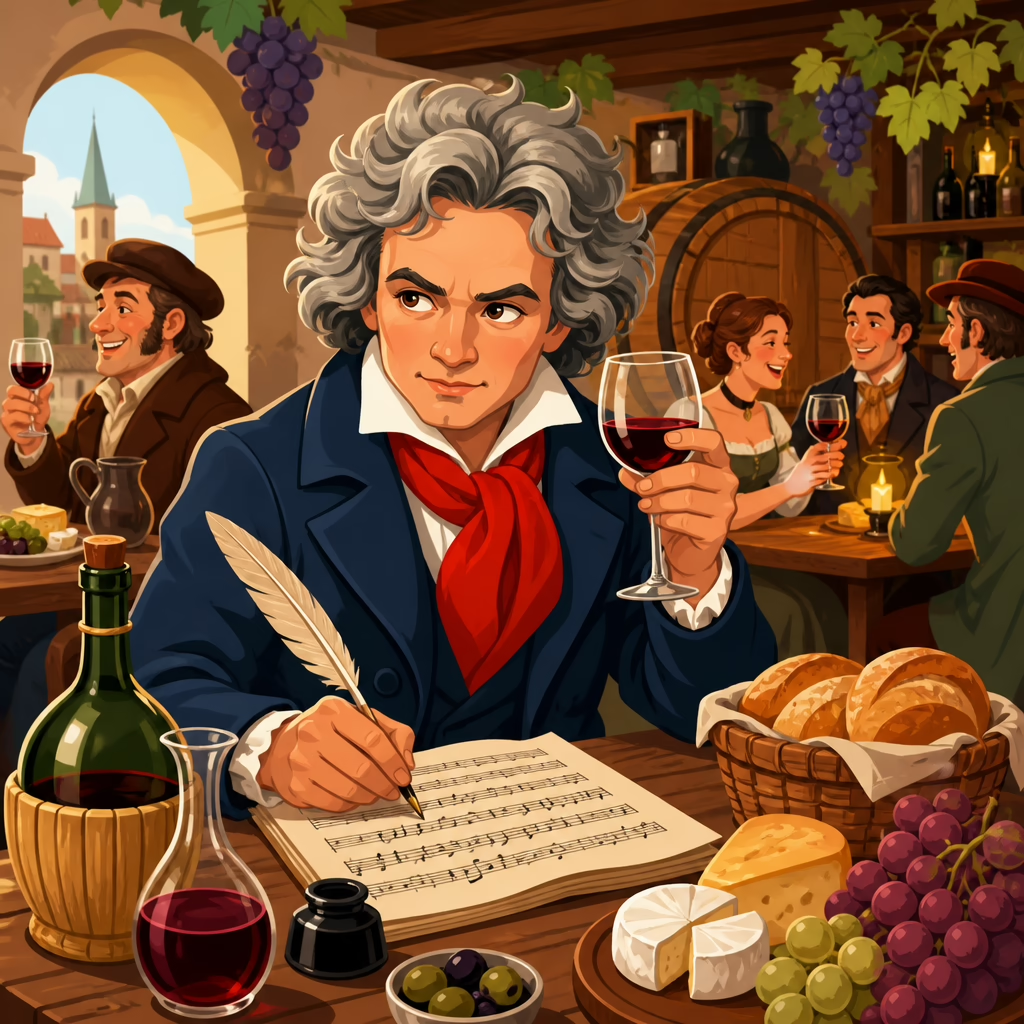
Beethoven and Wine Taverns and Table Culture
Beethoven’s relationship with wine taverns and table culture reveals a practical, social, and artistic side of his life that formal concert histories often miss. In Vienna around 1800, the tavern was not merely a place to drink. It was a working social institution where composers negotiated commissions, publishers courted talent, friends argued politics, and regulars measured one another by wit, manners, and stamina. Table culture, in this setting, meant the customs surrounding shared meals, wine service, toasts, conversation, seating, and the rhythms of sociability that shaped daily urban life. To understand Beethoven in this environment is to see how he moved through the ordinary spaces that supported extraordinary work.
This focus matters because biography can become abstract when it stays inside manuscripts and monuments. I have found, when tracing musicians through account books, letters, conversation notebooks, and Viennese urban history, that taverns often explain what formal biographies leave underdeveloped: how reputations circulated, how alliances formed, and how temperament appeared in public. Beethoven’s famously difficult manners, his love of routine, his irregular housekeeping, and his dependence on patrons all become easier to interpret when placed at the dinner table rather than the pedestal. Tavern life also clarifies class dynamics. He was not an aristocrat, yet he regularly crossed into elite society; not a bohemian stereotype, yet often careless in dress and domestic order; not a recluse, though periods of isolation did intensify with deafness.
Wine itself carried meaning. In Beethoven’s Vienna, local and regional wines from places such as the Wienerberg, Gumpoldskirchen, and the broader Lower Austrian trade were part of everyday consumption, while imported wines signaled rank, expense, and cultivated taste. Taverns ranged from modest establishments serving basic fare to more polished rooms where educated conversation and professional networking mattered as much as the bottle. Table culture likewise encoded hierarchy. Who invited, who paid, who sat where, and who controlled the tempo of conversation all reflected standing. Beethoven participated in these rituals, resisted some of them, and depended on them more than legend sometimes admits.
His surviving letters do not present him as a gourmand in the modern sense, nor as a tavern chronicler on the model of a memoirist. Yet they show a man deeply embedded in the food-and-drink economy of the city: arranging dinners, thanking hosts, complaining about servants, discussing health, and maintaining social contact through shared meals. The point is not to romanticize him as a genial café artist. It is to observe that taverns and table manners formed part of the infrastructure of his career and the theater of his character.
Viennese taverns as Beethoven’s working social world
For Beethoven, taverns and dining rooms functioned as extensions of the studio. Vienna’s music culture relied on face-to-face contact, and much of that contact happened over food and wine. A composer needed patrons, publishers, performers, copyists, instrument makers, and informed listeners. Taverns offered neutral ground where these worlds overlapped. Unlike courtly salons, they were less tightly choreographed, and unlike private apartments, they allowed informal meetings to happen quickly. In practical terms, this mattered to Beethoven, whose finances depended on unstable combinations of fees, annuities, gifts, subscriptions, and teaching.
Several circles around him used dining culture as a professional habit. Aristocratic supporters such as Prince Lichnowsky and later Archduke Rudolph entertained musicians at table. Publishers and middle-class admirers hosted meals where music and business mixed freely. Performers exchanged news about venues, personnel, and repertoire in exactly these settings. From long experience with cultural biography, I would stress that such meals were not decorative episodes. They were how a city without modern media sustained a creative marketplace. A dinner invitation could lead to a commission; a slight at table could close a door.
Beethoven’s behavior in these environments was memorable because it combined brilliance with unpredictability. Contemporary accounts repeatedly describe him as intense, abrupt, and capable of violating polished convention, especially when irritated. Yet people continued inviting him because his conversation could be compelling and because his artistic authority was already apparent. Table society tolerated difficult genius up to a point, particularly when influential hosts wished to display proximity to it. That tolerance was not unlimited. His impatience with servants, his tendency to become absorbed in his own thoughts, and his indifference to superficial etiquette could strain hospitality.
The urban setting also matters. Vienna supported varied forms of public dining, from simple wine houses to establishments closer to restaurants and hotels. The line between tavern, inn, coffeehouse, and private entertaining was porous. Beethoven moved among these spaces according to means, company, and purpose. Looking closely at this pattern helps correct an old distortion: the image of the composer as existing outside ordinary city life. He was, in fact, embedded in it.
What Beethoven ate, drank, and noticed at table
Evidence for Beethoven’s exact preferences is uneven, but enough survives to sketch habits rather than fantasies. He enjoyed wine and expected decent quality when circumstances allowed. In Vienna, ordinary table wine was safer and more common than modern readers sometimes assume, and diluted consumption was not unusual. Better households and higher-level entertaining expanded the range. Local white wines circulated widely, while Hungarian and Rhine wines carried stronger connotations of distinction. Beethoven knew the difference between basic sustenance and cultivated hospitality, and he responded to both.
Food in these settings was generally substantial rather than luxurious by modern standards. Meat broths, roasts, dumplings, fish in season, pastries, and bread formed the backbone of respectable dining. Table service was shaped by late eighteenth- and early nineteenth-century European practice, including multi-course presentation in wealthier homes. This meant conversation developed in waves, with pauses for serving, carving, and pouring. For a figure like Beethoven, whose conversation could swing from warm engagement to inward distraction, this format could either support sociability or expose tension.
Health concerns shadowed his eating and drinking. He suffered recurrent gastrointestinal trouble, and later medical discussions of his liver disease have naturally drawn attention to alcohol. Serious scholarship remains cautious here. Wine consumption belonged to ordinary social life, and retrospective diagnosis should not turn him into a caricatured drinker. The better view is balanced: he drank within a culture where wine was normal, he likely overtaxed his body in multiple ways, and his health was affected by a complex mix of stress, diet, medical treatment, and long-term illness.
His standards at table could be exacting in unexpected ways. He noticed quality, order, and value. He also reacted strongly when he felt cheated, neglected, or served badly. This aligns with broader patterns in his life. He could endure hardship in work but become furious over practical incompetence. At table, as elsewhere, small material details often triggered larger emotional responses because they touched dignity, autonomy, and respect.
| Aspect | What it meant in Beethoven’s Vienna | How it affected Beethoven |
|---|---|---|
| Local wine | Everyday social staple, widely available in taverns | Supported routine meetings and informal sociability |
| Formal dinners | Sites of patronage, rank, and controlled etiquette | Opened doors professionally but tested his manners |
| Shared tables | Conversation drove reputation and news exchange | Spread his fame and his reputation for bluntness |
| Service quality | Sign of competence, respect, and household status | Often prompted praise or irritation out of proportion to the moment |
| Health and diet | Food and drink were tied to medical thinking of the era | Complicated by chronic illness and uneven self-care |
Table manners, class friction, and Beethoven’s public character
One of the clearest insights gained from tavern and table culture is how Beethoven managed class friction. He insisted on personal dignity with unusual force for a musician dependent on aristocratic support. In a stratified society, meals exposed status instantly. Hosts signaled rank through menu, silver, servants, wines, guest lists, and conversational codes. Beethoven accepted patronage but resisted subservience. That resistance could look admirable or abrasive depending on the witness.
Stories about his manners must be handled critically because later generations loved anecdotes that dramatized heroic independence. Even so, the pattern is consistent enough to trust in outline. He disliked being treated as hired entertainment at table. He expected intellectual equality even where social equality did not exist. When hosts recognized this and treated him as a serious guest, relationships could flourish. When they expected decorative obedience, conflict followed. This helps explain why some aristocrats remained loyal while others found him exhausting.
Table culture sharpened these tensions because it forced everyone into visible ritual. Seating arrangements alone could imply deference or esteem. Toasts required participation in a social script. Conversation demanded quick judgment about politics, art, religion, and personality. Beethoven, especially as deafness advanced, could not navigate these scripts smoothly. Misunderstandings increased. His use of conversation books later in life changed the mechanics of dining exchanges, making spontaneity harder and sometimes amplifying awkwardness. Yet those notebooks also preserved evidence of continued sociability rather than total withdrawal.
This is why tavern history belongs inside biography. It shows character under pressure in ordinary circumstances. Anyone studying his life in depth should also consult the broader documentary discussion at the main pillar guide on Beethoven’s birth record, because the same careful method applies here: separate myth from document, then rebuild the human setting around the surviving evidence.
Conversation, creativity, and the role of convivial spaces
Did taverns shape Beethoven’s music directly? Not in the simplistic sense that a bottle produced a masterpiece. The influence was social and cognitive. Convivial spaces fed the flow of ideas, anecdotes, political impressions, and human observation that any dramatist of instrumental character could absorb. Beethoven’s music is not tavern music in essence, but he lived among the speech rhythms, jokes, arguments, dances, and ceremonial habits of shared dining. These formed part of the acoustic and behavioral world from which his imagination drew.
There is also a practical link between sociability and compositional opportunity. Public reputation does not emerge from private labor alone. Works are performed because people trust, admire, or promote the composer. Dinners and tavern meetings helped maintain those networks. A patron deciding whether to continue support, a violinist considering a new sonata, or a publisher judging market interest all formed impressions in conversation as much as on the page. Beethoven could inspire intense loyalty because, despite his roughness, others sensed seriousness and artistic necessity in him.
Examples from his middle and late years show that shared meals remained important even as hearing loss deepened. He continued visiting friends, receiving invitations, and moving through a social circuit shaped by hospitality. The famous image of total isolation is therefore misleading. Deafness transformed communication, but it did not erase the table as a site of exchange. If anything, dining could provide structure when other forms of interaction became harder. People gathered, poured wine, wrote comments, repeated jokes, and sustained a communal framework in which Beethoven still participated.
At the same time, we should resist idealization. Taverns did not solve his loneliness, and table society could magnify exclusion. Group conversation is difficult enough with partial hearing, let alone severe deafness. The emotional cost must have been real. That tension between belonging and estrangement is one reason the subject matters. It gives biography texture that dates and premieres alone cannot provide.
Why wine taverns illuminate Beethoven better than legend does
The strongest reason to study Beethoven through taverns and table culture is that these settings expose the scale at which life is actually lived. Monumental biography tends to jump from symphony to crisis to triumph. Taverns return us to the hourly world: where he met people, how he was served, what annoyed him, when he relaxed, and how others tested or protected his dignity. In that world, genius does not become smaller. It becomes more credible.
Wine taverns also reveal Vienna as a living ecosystem rather than a decorative backdrop. Music depended on urban habits of meeting, eating, drinking, and talking. Beethoven belonged to that system while constantly pushing against its social limits. He benefited from hospitality but refused to disappear into courtesy. He could enjoy convivial company yet remain difficult. He valued good wine and competent service without turning into a connoisseur stereotype. He used the table for friendship, business, and argument, exactly as ambitious professionals did across the city.
For readers of biography, this perspective offers a practical gain. It trains attention on evidence that is modest but reliable: letters arranging meals, reminiscences about behavior, household details, medical context, and the social uses of hospitality. When these fragments are assembled carefully, they produce a portrait more durable than anecdotal myth. Beethoven at table is recognizably human—proud, vulnerable, sociable, impatient, observant, and dependent on others in ways he did not always like to admit.
The key takeaway is simple. To understand Beethoven’s public character and working life, follow him into the tavern and to the dinner table. Those spaces explain how he navigated class, maintained networks, and embodied the contradictions that still make him compelling. If you are exploring his biography seriously, keep asking where he ate, drank, met, and argued, because the answer often leads closer to the man than the monument does.
Frequently Asked Questions
Why do wine taverns matter in understanding Beethoven’s life?
Wine taverns matter because they place Beethoven inside the everyday social world of Vienna rather than on a pedestal reserved only for concert halls, manuscript desks, and aristocratic salons. Around 1800, the tavern was a practical meeting ground where musicians, publishers, patrons, civil servants, students, and political talkers all crossed paths. For Beethoven, such spaces were useful because they allowed business, friendship, performance culture, and reputation-making to overlap. A composer did not need a formal appointment in order to be seen, heard about, introduced, or discussed; a great deal could happen over a meal, a bottle, and a crowded table.
These taverns also help explain the texture of Beethoven’s social life. He was famously complex in manner: intense, proud, often difficult, but also capable of warmth, humor, and loyalty. In tavern settings, those traits would have been tested in real time through conversation, argument, hospitality, and ritualized sociability. The culture of the table rewarded quick wit, strong opinions, memory, and presence, all qualities strongly associated with Beethoven. Looking at taverns therefore reveals not only where he might have gone, but how he functioned among others in a city where personal networks shaped artistic opportunity.
Just as importantly, taverns remind us that music history was built in informal settings as much as formal ones. The idea of Beethoven as a solitary genius is only part of the picture. He lived in a city where careers depended on conversation, recommendation, negotiation, and visibility. The tavern scene helps recover that practical reality. It shows Beethoven not merely composing masterpieces in isolation, but moving through a lively social ecosystem in which food, drink, manners, and public presence all mattered.
What did “table culture” mean in Vienna during Beethoven’s time?
“Table culture” in Beethoven’s Vienna meant much more than eating and drinking. It referred to the customs, expectations, and social performances that unfolded around shared meals. Who invited whom, where people sat, how long they lingered, what was poured, what topics were acceptable, who paid, who entertained, and who dominated conversation were all part of the language of the table. In that sense, table culture was a form of social literacy. It signaled class, education, confidence, generosity, restraint, and belonging.
In a wine tavern or dining room, the table created a semi-public stage. People displayed character through appetite, manners, wit, memory, and conversational timing. A guest who could sustain lively discussion without becoming boorish, who could drink without losing control, and who could handle disagreement with style gained social credit. This was especially important in Vienna, where artistic and intellectual circles were tightly interwoven. A meal could become an audition of personality as much as a social pleasure.
For someone like Beethoven, table culture would have been deeply relevant because it shaped how professional and personal relations developed. Publishers courted composers, patrons observed behavior, and friends measured loyalty and temperament through repeated shared evenings. Such settings also had their own rituals of exchange: toasts, storytelling, disputation, musical references, political allusions, and the subtle balancing of intimacy and hierarchy. Understanding table culture helps modern readers see how much of cultural life in Beethoven’s world happened not only in theaters and palaces, but around the table, where social intelligence and artistic identity were constantly being negotiated.
Did Beethoven use taverns for professional networking as well as socializing?
Yes, and that dual function is one of the most important reasons taverns belong in any fuller portrait of his life. In Vienna around 1800, strict separation between social life and professional life was far less common than modern readers often assume. Taverns and dining spaces were ideal places for informal networking because they offered repeated, low-barrier contact. One might discuss a new composition, complain about a rival, seek an introduction to a patron, revisit a publishing agreement, or test the mood of a cultural circle, all within the flow of a meal.
For a composer of Beethoven’s stature and ambition, these environments would have had practical value. Music careers depended on alliances with publishers, performers, patrons, copyists, and well-connected admirers. Formal correspondence and scheduled visits mattered, of course, but the tavern allowed for something equally powerful: the accumulation of reputation through presence. People could observe temperament, intelligence, and confidence firsthand. News circulated quickly in such places, and artists who remained visible within urban sociability often strengthened their position.
At the same time, tavern networking should not be imagined as crude self-promotion alone. In Beethoven’s world, artistic authority was inseparable from personality. A composer’s conversation could shape how his work was received. His forcefulness, seriousness, humor, or volatility all became part of his legend. So when Beethoven appeared in convivial settings, he was not merely relaxing after work; he was participating in the living infrastructure of cultural life. Taverns could support friendship, debate, patronage, and commerce all at once, making them especially significant to an artist navigating Vienna’s competitive and talkative musical scene.
What do tavern culture and shared meals reveal about Beethoven’s personality?
They reveal a Beethoven who was more socially embedded, more practical, and more human than the monumental image of the isolated genius often suggests. Shared meals and tavern encounters place him among other people in situations where mood, manners, appetite, and conversation mattered. In those spaces, Beethoven would not have been judged only by his music, but by how he listened, argued, joked, responded to insult, expressed generosity, or handled disagreement. That perspective brings out the lived complexity of his character.
Beethoven’s reputation includes strong will, impatience, intensity, and emotional volatility, yet those traits make even more sense when viewed within the competitive table culture of Vienna. Taverns were places where forceful personalities collided. Sharp debate was common, and conversation itself could become a kind of contest. In such environments, Beethoven’s assertiveness would have been visible and memorable. But tavern culture also points to capacities often overshadowed by dramatic anecdotes: loyalty to friends, interest in companionship, responsiveness to convivial ritual, and a clear understanding that social belonging had material and emotional value.
There is also a practical side to this picture. Taverns were places where one learned who was trustworthy, who had influence, who admired one’s work, and who could be useful or troublesome. A figure as alert to independence as Beethoven would likely have approached such settings with both appetite and caution. That combination is revealing. It suggests a man who sought company but guarded dignity, who needed networks but resisted being controlled by them. In that balance between sociability and self-assertion, tavern and table culture help us see Beethoven not as a marble bust, but as a living participant in the difficult, witty, and often strategic social world of Vienna.
How does focusing on taverns and table culture change the way we read Beethoven’s legacy?
It changes the scale of the story. Instead of encountering Beethoven only through masterpieces, heroic struggle, and landmark performances, we begin to see the social conditions that surrounded artistic creation. Taverns and table culture bring the everyday machinery of cultural life into view: conversation, patronage, persuasion, reputation, hospitality, and recurring face-to-face contact. This does not diminish Beethoven’s genius. Rather, it anchors that genius in a real urban environment where music was discussed, valued, bought, argued over, and remembered by communities of listeners and participants.
This perspective also complicates the old contrast between “high art” and ordinary life. In Beethoven’s Vienna, serious artistic culture did not exist apart from dining rooms, taverns, coffeehouses, salons, and private gatherings. These spaces fed one another. A theme heard in a concert might be debated over wine; a patron’s interest might begin at table before becoming financial support; an artistic alliance might grow from repeated social encounters rather than a single formal introduction. Seen this way, tavern culture was not marginal to art history. It was one of the settings in which art history was made.
Finally, paying attention to table culture makes Beethoven more legible as a historical person. It invites us to ask not only what he composed, but how he moved through society, how he built and strained relationships, and how his public identity formed in shared spaces. That broader lens produces a richer legacy: Beethoven as creator, negotiator, guest, conversationalist, observer, and participant in the social rituals of his city. The result is a more grounded and more vivid understanding of his world, one in which the tavern table becomes an important site of cultural history rather than a footnote to it.