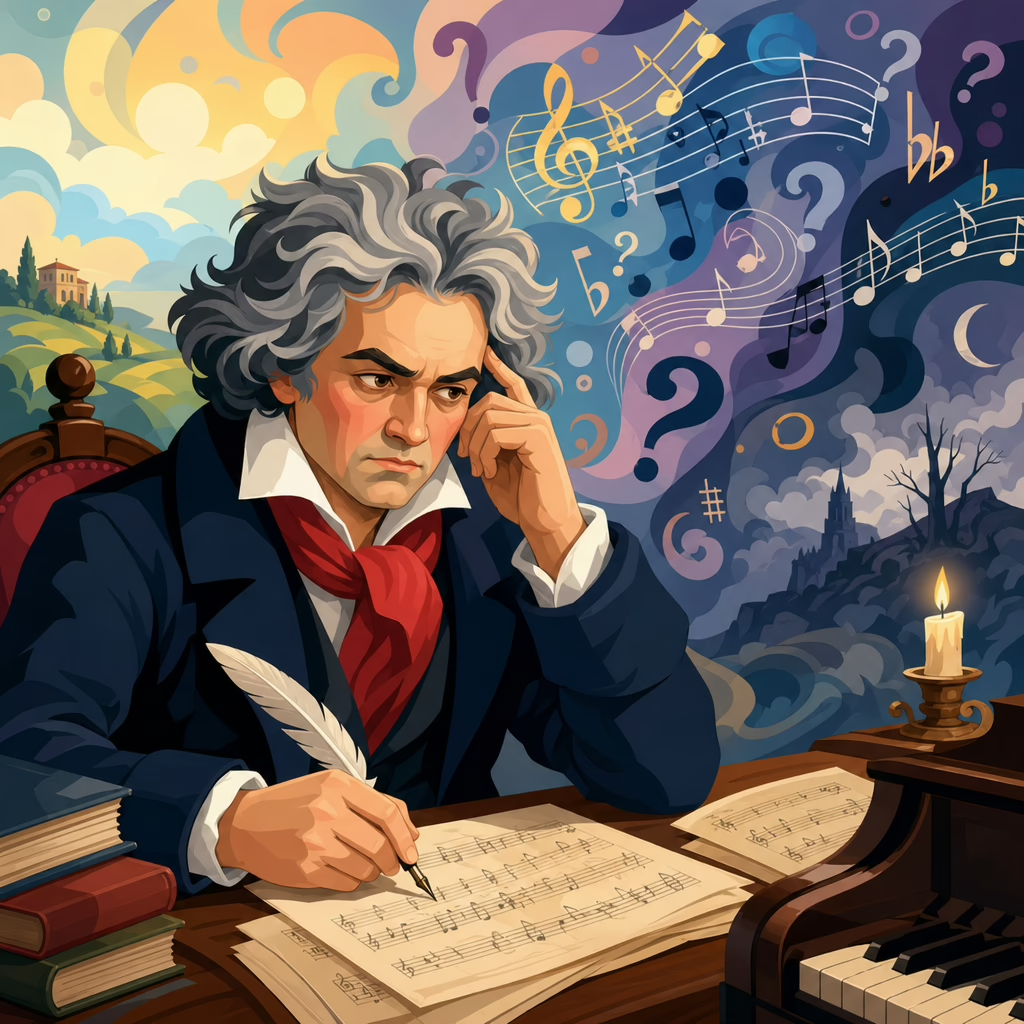
Beethoven and Tonal Ambiguity in the Late Period
Beethoven’s late music is where tonal certainty starts to bend without breaking, and that tension is a large part of why these works still sound modern. In practical terms, tonal ambiguity means music that points toward a key yet delays, weakens, or complicates the listener’s sense of harmonic home. In Beethoven’s late period—usually dated from roughly 1816 to his death in 1827—that ambiguity appears in opening gestures, transitions, codas, fugal episodes, recitative-like interruptions, and startling key relations that would have seemed unusually bold to many early nineteenth-century listeners. For anyone studying Beethoven music, this “miscellaneous” territory matters because it links the piano sonatas, late string quartets, Diabelli Variations, Missa solemnis, and Ninth Symphony into one coherent artistic problem: how can a composer preserve structural logic while loosening the immediate clarity of tonality?
I have found, both in score study and in rehearsal rooms, that late Beethoven rarely abandons tonal control. Instead, he creates zones of uncertainty through registral displacement, pedal points, enharmonic reinterpretation, chromatic voice-leading, and formal interruption. Those techniques can make a passage feel suspended, searching, or spiritually estranged even when the long-range tonal plan remains rigorous. This is why the subject deserves hub-level treatment. Readers looking for one entry point into Beethoven and tonal ambiguity need more than a list of famous pieces. They need definitions, examples, recurring devices, listening strategies, and clear connections across genres. Once those links are visible, the late style stops sounding merely eccentric and starts sounding deliberate, disciplined, and deeply expressive.
Late Beethoven also sits at a crucial historical threshold. Haydn and Mozart had already expanded harmonic rhetoric, and Schubert would intensify remote key relations in new directions, but Beethoven’s late works make ambiguity itself a central expressive resource. In these scores, uncertainty can signal introspection, rupture, transcendence, comedy, liturgical awe, or sheer contrapuntal complexity. The same composer who can affirm a tonic with massive force can withhold that affirmation for pages, or undermine it immediately after stating it. That duality is the key to this hub. What follows surveys the main ways tonal ambiguity operates across Beethoven’s late output, why it matters for performers and listeners, and which works best illustrate the phenomenon.
What tonal ambiguity means in late Beethoven
Tonal ambiguity is not simple chromaticism, and it is not the absence of key. In Beethoven’s late period, it usually means that several tonal readings compete before one becomes decisive. A listener may hear an opening sonority that could belong to more than one key, a dominant that never resolves as expected, or a melody whose scale degrees suggest conflicting harmonic destinations. Beethoven intensifies that uncertainty by controlling rhythm, texture, and register. Sparse textures can hide harmonic function. Sudden silences can postpone orientation. A bass note sustained under changing upper parts can blur whether the harmony is stable or in transition.
A clear example appears in the opening movement of the Piano Sonata in A-flat major, Op. 110. The work begins lyrically, yet the harmonic motion slips past straightforward tonic confirmation. Likewise, the C-sharp minor String Quartet, Op. 131, opens with a fugue whose contrapuntal density and modal inflection create a grave, searching field rather than an instantly settled key picture. In performance, these openings demand restraint. If a pianist or quartet over-accentuates local arrival points, the larger ambiguity disappears. When shaped carefully, the music feels as though it is discovering its tonal path in real time.
This matters because Beethoven uses tonal ambiguity as form, not decoration. It can delay exposition stability, destabilize recapitulatory return, or transform a coda into a second development. Analysts often discuss sonata deformation, modal mixture, common-tone modulation, and enharmonic pivoting in this repertory because standard textbook labels alone do not capture what is happening. The listener is not just hearing chords move; the listener is hearing tonal knowledge tested.
Why the late period sounds different from the middle period
The middle-period Beethoven of the Eroica Symphony, the Appassionata Sonata, and the Razumovsky Quartets often dramatizes conflict through kinetic drive, motivic concentration, and large-scale tonal opposition. The late Beethoven of Opp. 109-111, Opp. 127-135, the Diabelli Variations, Missa solemnis, and the Ninth Symphony retains those strengths but adds fragmentation, retrospective forms, fugue, variation chains, and abrupt expressive contrasts. Tonal ambiguity expands because form itself becomes less predictable. A movement may proceed through aria, recitative, chorale, fugue, and dance-derived writing without the clean tonal signposts expected in earlier classical rhetoric.
One reason is Beethoven’s deepening interest in counterpoint. Strict and free fugue can thicken tonal meaning because each line projects its own momentum. Another reason is his treatment of cadence. In earlier works, cadences often articulate sections with overt rhetorical force. In the late works, cadences may dissolve into introspection or generate fresh instability. The Hammerklavier Sonata, Op. 106, already points this way, but the later works make the practice habitual. As a result, hearing the late style as simply “more chromatic” misses the point. The difference lies in how harmony, counterpoint, and form jointly postpone certainty.
From a historical standpoint, these choices influenced later composers in distinct ways. Wagner inherited Beethoven’s willingness to defer resolution over long spans. Brahms absorbed the art of dense motivic and harmonic implication. Even twentieth-century modernists admired the late quartets for showing that structural rigor and local uncertainty can coexist. Beethoven did not discard tonality; he taught later composers how elastic it could be.
Core techniques Beethoven uses to create tonal uncertainty
Across the late works, several recurring devices generate tonal ambiguity. They are worth naming because they recur in different genres and make cross-reading easier for anyone exploring this Beethoven music subtopic.
| Technique | How it works | Late Beethoven example |
|---|---|---|
| Delayed tonic confirmation | The opening avoids a full, stable arrival on the home key | Op. 110 first movement |
| Enharmonic reinterpretation | A pitch or chord is respelled to pivot toward a remote area | Late sonata transitions and variation movements |
| Pedal point ambiguity | A sustained bass supports changing harmonies that resist one reading | Missa solemnis contemplative passages |
| Modal mixture | Borrowed tones from parallel major or minor cloud tonal identity | Op. 131 fugue writing |
| Fugal saturation | Contrapuntal lines obscure immediate harmonic hierarchy | |
| Recitative interruption | Speech-like breaks suspend metric and tonal continuity | Op. 110 Arioso sections |
In rehearsal, I often reduce these passages to bass line plus outer-voice motion first. That quickly reveals whether Beethoven is actually vague or only making the surface complex. More often than not, the long-range design is exact. The ambiguity lies in timing: when does the ear know enough to commit to a key? Beethoven controls that moment with extraordinary precision.
Another crucial technique is registral misdirection. A chord voiced high and thin may sound less grounded than the same harmony in a fuller register. Beethoven exploits this constantly. He also uses rests strategically. Silence can sever the listener’s memory of a harmonic function and make the next entry feel recontextualized. These are not incidental details. They are compositional tools as important as modulation itself.
Key works that define the topic
If a reader wants the essential late Beethoven map for tonal ambiguity, start with five works: Piano Sonata Op. 110, Piano Sonata Op. 111, String Quartet Op. 131, Diabelli Variations Op. 120, and Grosse Fuge Op. 133. Each shows a different face of the problem. Op. 110 combines lyricism, lament, and fugue, with tonal instability tied to spiritual recovery. Op. 111 sets dramatic C minor rhetoric against a finale whose variations seem to suspend conventional tonal gravity. Op. 131 links seven movements without pause, making tonal orientation cumulative rather than sectional. The Diabelli Variations repeatedly reframe a banal waltz through remote harmonic and textural transformations. Grosse Fuge pushes contrapuntal density to a point where tonal clarity must be actively reconstructed by the listener.
The Missa solemnis belongs in this group as well, especially in movements where liturgical solemnity meets daring harmonic expansion. The Benedictus, with its elevated violin writing, can feel almost disembodied because tonal arrival is intertwined with texture and line rather than simple cadential grounding. The Ninth Symphony is less consistently ambiguous than the late quartets, but the finale’s interruptions, recollections, and tonal resets make the issue impossible to ignore. Beethoven stages tonal and formal memory as drama.
For piano-focused readers, Op. 109 and Op. 111 are especially revealing. Their variation finales show how repeated harmonic frameworks can become less, not more, predictable as rhythm, ornament, register, and phrase articulation evolve. For quartet-focused readers, Opp. 130-132 provide the richest field. The “Heiliger Dankgesang” in Op. 132, with its modal turns and alternating sections, presents ambiguity as devotional distance rather than conflict. That emotional range is central to understanding the late style.
How performers and listeners can hear ambiguity more clearly
The most useful listening question is simple: when do I know where home is? In late Beethoven, the answer is often “later than expected.” To hear that delay, follow the bass, not just the melody. Notice whether a dominant actually resolves, whether a cadence is complete or evaded, and whether a new theme clarifies the key or further clouds it. Recordings by ensembles such as the Busch Quartet, Alban Berg Quartet, Takács Quartet, and pianists including Maurizio Pollini, Mitsuko Uchida, and András Schiff reveal different solutions to this problem. Some prioritize line and architecture; others emphasize rupture and instability.
For performers, pedaling, articulation, and tempo are decisive. Excess pedal can smear meaningful dissonance into mere blur. Too little pedal can make remote harmonic links sound dry rather than uncanny. Tempo choices also matter. If transitions move too quickly, ambiguity becomes superficial surprise. If they move too slowly, structure sags and the destination becomes obvious too soon. In coaching late Beethoven, I usually ask players to mark three things in every unstable passage: the bass goal, the first unambiguous cadence, and the point where texture changes the harmonic meaning. That method consistently sharpens interpretation.
Score readers can also compare Urtext editions from publishers such as Henle and Bärenreiter, since articulation and slur decisions affect tonal perception. Harmonic analysis helps, but singing inner voices helps more. Beethoven often places the real tonal argument in an alto or tenor strand while the surface texture distracts the ear. Once you hear those strands, the music’s ambiguity feels crafted rather than opaque.
Connections across the miscellaneous late-style hub
As a hub topic within Beethoven music, “miscellaneous” should gather the threads that individual articles can explore in depth. Tonal ambiguity connects naturally to late Beethoven counterpoint, cyclical form, variation technique, sacred style, humor, and performance practice. It also links to questions about deafness and communication, though those links must be handled carefully. Beethoven’s hearing loss did not automatically produce harmonic daring; the scores show deliberate technical choices, not accidental estrangement. Better articles in this cluster will examine manuscripts, sketch studies, and revision patterns alongside close listening.
Useful companion topics include Beethoven and fugue, Beethoven’s late piano sonatas, the formal innovations of the late quartets, harmonic rhetoric in the Missa solemnis, and the problem of endings in Opp. 109-135. Another strong angle is reception history. Early critics often found these works difficult, obscure, or bizarre, while later generations canonized them as prophetic. That shift tells us something important: tonal ambiguity can sound like failure to one era and mastery to another, depending on listening habits.
The main takeaway is that Beethoven’s late-period tonal ambiguity is neither random nor merely “advanced.” It is a disciplined expressive language that lets certainty emerge through struggle, memory, and transformation. Study the openings, transitions, fugues, and codas of Op. 110, Op. 111, Op. 131, Op. 132, the Diabelli Variations, Missa solemnis, and Grosse Fuge, and the pattern becomes unmistakable. Beethoven stretches tonal expectation to enlarge meaning, not to escape structure. That is why these works continue to challenge performers, reward analysts, and move listeners so deeply. If you are building a serious understanding of Beethoven music, use this hub as your starting point, then follow each linked work and technique into focused study. The late style will sound less forbidding and far more human.
Frequently Asked Questions
What does tonal ambiguity mean in Beethoven’s late period?
Tonal ambiguity in Beethoven’s late music refers to passages that suggest a tonal center without confirming it in the usual, immediate way. Rather than clearly stating a key and then proceeding with stable harmonic logic, Beethoven often delays cadences, clouds the function of important chords, begins with harmonies that can be heard in more than one way, or moves through textures that suspend the listener’s sense of tonal arrival. The result is not the abandonment of tonality, but a purposeful stretching of it. The music still belongs to a tonal world, yet it often makes that world feel provisional, uncertain, or dramatically withheld.
In practical listening terms, this means the ear is constantly being invited to ask where “home” really is. A movement may open with material that appears stable on the surface but turns out to be harmonically elusive. A transition may avoid the expected dominant preparation. A coda may continue to question what earlier sections seemed to settle. Fugue, variation, recitative-like interruption, and abrupt contrasts in register or texture all become ways of complicating tonal orientation. Beethoven’s late style is therefore modern-sounding not because it rejects tonal logic, but because it reveals how fragile and negotiable tonal certainty can be.
Why do Beethoven’s late works still sound so modern to many listeners?
One major reason is that Beethoven’s late-period music often behaves in ways listeners associate with later musical experimentation. It resists straightforward tonal confirmation, fragments continuity, interrupts itself, and allows contrasting musical ideas to coexist without immediate reconciliation. Even when the harmonic language remains fundamentally tonal, the experience of listening can feel exploratory and destabilized. This creates a sense of open-endedness that sounds strikingly fresh, especially in works from the final decade of his life.
That modernity also comes from how Beethoven treats form. In earlier Classical practice, tonal plans often support a strong feeling of directional clarity: departure, conflict, return, and resolution. In the late works, those patterns still matter, but they are often complicated by introductions that obscure the main key, middle sections that become unusually searching, and codas that feel less like simple closure than final acts of interpretation. Beethoven can make a return sound transformed, troubled, or hard-won rather than inevitable. That makes the listener feel not merely guided through a form, but drawn into a process of questioning and reorientation.
There is also an expressive dimension to this modern quality. The late works frequently sound inward, speculative, and self-aware. Instead of presenting a polished surface of certainty, they dramatize hesitation, rupture, memory, and renewal. This is especially evident in the late piano sonatas, string quartets, and monumental works such as the Missa solemnis and Ninth Symphony, where tonal ambiguity often serves expressive depth rather than technical display alone. For modern ears, that combination of structural rigor and emotional instability can feel uncannily contemporary.
Where does tonal ambiguity appear most clearly in Beethoven’s late music?
It appears in several recurring places, and recognizing them helps explain why Beethoven’s late style feels so distinctive. One important location is the opening of a movement. Rather than using a cleanly grounded tonic statement, Beethoven may begin with a gesture whose harmonic meaning is not fully clear until later. This creates an immediate atmosphere of suspense and forces the listener to assemble tonal identity over time rather than receiving it all at once.
Transitions are another crucial site. In Classical forms, transitions often have a clear tonal job: they move the music away from the home key and prepare a new goal. Beethoven’s late transitions can become unusually unstable, circling around expected destinations, introducing chromatic intensification, or fragmenting motivic material in ways that weaken tonal confidence. Instead of simply connecting formal landmarks, these passages can become arenas of tonal uncertainty in their own right.
Codas also play a major role. In Beethoven’s earlier music, codas already tend to be substantial, but in the late period they often become places where tonal issues are revisited rather than merely sealed off. A coda may reinforce the tonic, but it may also expose how contested that tonic has been. Likewise, fugal sections often generate ambiguity because contrapuntal density can make harmonic function less immediately transparent. Recitative-like interruptions can suspend forward motion altogether, creating moments in which tonal grounding gives way to rhetorical questioning. Variation movements, too, can drift far from a clear tonal center before gradually reassembling orientation. In short, tonal ambiguity in the late works is not confined to one technique; it permeates openings, middles, and endings alike.
Does Beethoven’s tonal ambiguity mean he was moving beyond tonality altogether?
No. It is more accurate to say that Beethoven was testing the limits of tonal coherence rather than abandoning the tonal system itself. His late music often weakens, delays, or complicates tonal confirmation, but that tension depends on the listener still recognizing tonal expectations in the first place. If the music had no relationship to tonal gravity, the ambiguity would lose much of its power. What makes these works so compelling is precisely the balance between instability and underlying order.
Beethoven’s late style shows how a composer can preserve tonal logic while making it dramatically problematic. He may postpone a cadence, reinterpret a chord, destabilize a formal return, or place contrapuntal and rhetorical pressures on harmonic clarity. Yet these gestures usually operate within larger frameworks that still acknowledge key relationships, points of arrival, and structural hierarchy. Even the most searching passages often gain their expressive intensity from how far they stretch the listener’s expectations without severing them completely.
This distinction matters historically. Beethoven’s late music strongly influenced later composers because it revealed that tonality could be made far more flexible, psychologically charged, and structurally complex than many earlier models suggested. He did not write atonal music, but he expanded the expressive and formal possibilities of tonal writing in ways that helped prepare the ground for later nineteenth-century chromaticism and, more distantly, the breakdown of common-practice tonality. In that sense, his late works are prophetic without ceasing to be tonal.
How should listeners approach Beethoven’s late-period tonal ambiguity when hearing these works for the first time?
A helpful approach is to listen less for immediate certainty and more for evolving relationships. In Beethoven’s late music, the key is often something the piece reveals gradually rather than declares at once. Instead of expecting every section to confirm where you are, notice when the music seems to hover, when it postpones resolution, or when a familiar tonal area returns in a changed emotional light. This shift in listening perspective makes ambiguity feel expressive and purposeful rather than confusing.
It can also be useful to pay attention to formal landmarks without assuming they will behave conventionally. An opening may be introductory in spirit even if it sounds thematically important. A transition may become the psychological center of a movement. A fugue may clarify structure while simultaneously obscuring harmonic immediacy. A coda may not simply end the piece, but reinterpret everything that came before. Listening for these functions as dynamic processes rather than fixed textbook categories can make late Beethoven much more legible.
Above all, listeners should allow contradiction to remain part of the experience. Beethoven’s late works often derive their force from holding opposing states together: motion and suspension, faith and doubt, rigor and freedom, arrival and incompletion. Tonal ambiguity is one of the main tools through which he creates that tension. If you hear a passage and feel that it belongs somewhere but refuses to settle there fully, you are hearing a central feature of the late style. That unresolved pull is not a flaw to be overcome; it is part of the music’s enduring depth, and one reason these works continue to challenge and move listeners today.