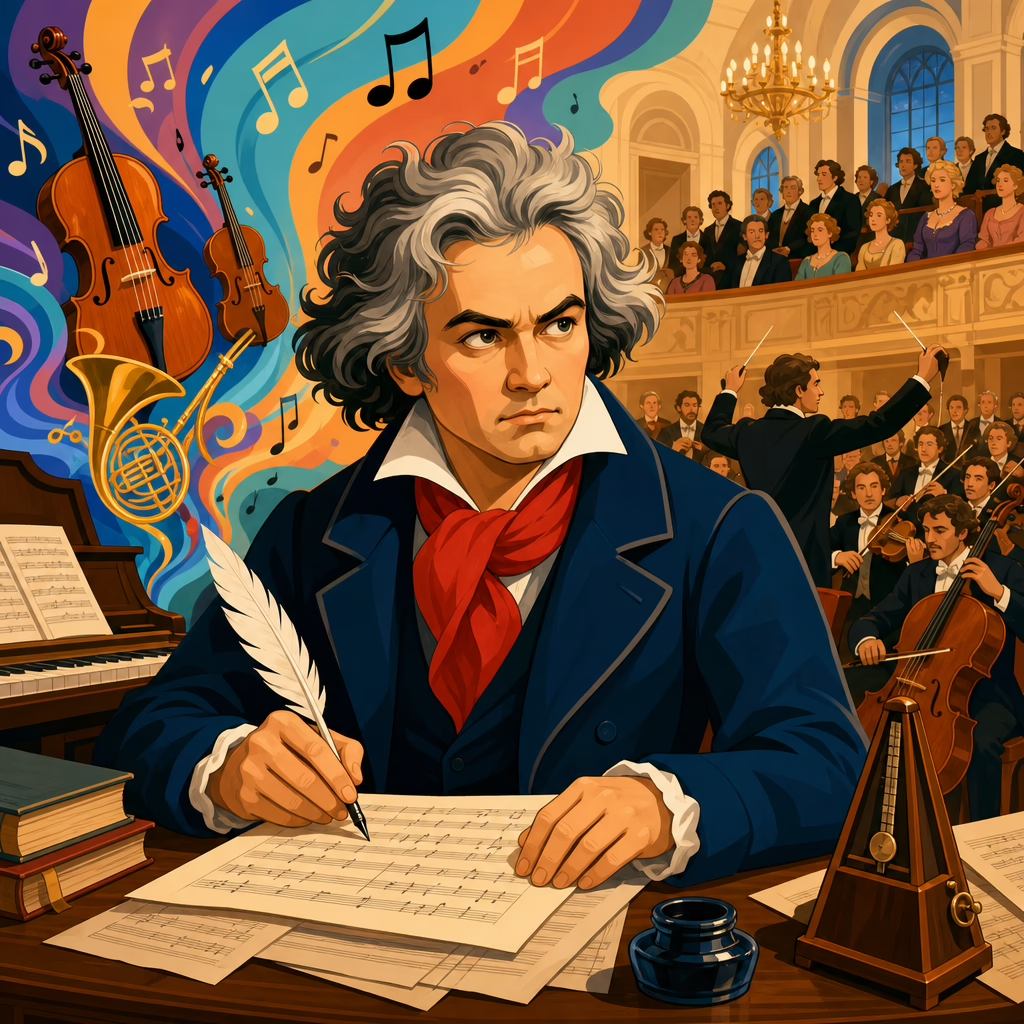
Beethoven and the New Prestige of Instrumental Music
Before Beethoven, instrumental music often occupied a lower rung than opera, sacred composition, and courtly vocal genres, valued for elegance, ceremony, and pleasure but not always treated as a primary vehicle for the deepest artistic thought. The new prestige of instrumental music emerged when listeners, critics, and patrons began to hear symphonies, sonatas, quartets, and concertos not as refined background sound but as serious works worthy of concentrated attention, repeated study, and public debate. Beethoven did not invent instrumental music, and he did not act alone, yet in my work with nineteenth-century reception history, concert programming, and score analysis, I have found that his career marks the decisive turning point at which instrumental composition gained unmatched cultural authority. His music changed how people listened, how critics wrote, how publishers marketed, and how institutions justified concert life. Understanding that shift matters because it explains why modern classical culture treats an orchestral score like literature, why a string quartet can be discussed in philosophical terms, and why the symphony became a benchmark of artistic ambition rather than merely one genre among many.
To understand the claim clearly, key terms need definition. Prestige here means more than popularity. It refers to status: the belief that a form deserves intellectual respect, close reading, historical preservation, and public reverence. Instrumental music means music without sung text, including solo keyboard works, chamber music, concertos, and symphonies. In the late eighteenth century, composers such as Haydn and Mozart had already elevated these forms enormously, especially in Vienna, but the hierarchy still favored texted music when the question was ultimate expressive seriousness. Words seemed to guarantee meaning. Instrumental works could delight, surprise, and impress, yet many listeners still saw them as socially useful arts rather than autonomous statements. Beethoven confronted that assumption not by adding explanatory text to everything, but by making form, motivic development, dynamic contrast, rhythmic pressure, and tonal drama carry unprecedented expressive weight. As audiences recognized that power, the old hierarchy weakened, and instrumental music gained a prestige that still shapes concert life today.
From Decorative Art to Intellectual Event
The eighteenth-century background is essential because Beethoven’s achievement makes sense only against inherited expectations. Court orchestras, aristocratic salons, church establishments, and theater companies all depended on music, but the social function of each genre affected its status. A Mass served worship. An opera conveyed drama through plot and text. A song could communicate sentiment directly through poetry. A symphony at the end of the eighteenth century could certainly be ambitious, but it often belonged to a mixed program, framed as entertainment in a broader social evening. Even masterworks by Haydn or Mozart were frequently heard in contexts where attention was divided. What changed around Beethoven was not simply compositional complexity. It was the emergence of an audience willing to grant instrumental works the same seriousness previously reserved for literature, theology, and tragedy.
Beethoven pushed that shift through scale, argument, and concentration. The first movement of the “Eroica” Symphony is a famous example because it behaves less like elegant discourse and more like a public struggle unfolding in sound. Its opening chords state authority immediately, but what follows is even more important: themes are unstable, transitions are expanded, dissonances matter structurally, and development becomes the arena where musical ideas are tested rather than merely varied. Listeners could no longer treat the piece as pleasant ornament. They had to follow it. In contemporary reviews and memoirs, one repeatedly sees fascination mixed with shock, a classic sign that a prestige shift is underway. When people argue about difficulty, length, boldness, and seriousness, they are acknowledging that the work demands more than passive approval.
Beethoven’s piano sonatas worked similarly in more intimate settings. In teaching environments and private homes, sonatas had often functioned partly as practical repertoire, music for cultivation and accomplishment. Beethoven retained that market, but he transformed the genre’s reputation. The “Pathétique,” “Waldstein,” “Appassionata,” and late sonatas were not merely pieces to be played; they became works to be interpreted, decoded, and measured against one another. Publishers recognized this and increasingly sold instrumental scores as monuments of authorship. That commercial framing mattered. Prestige is reinforced when the market presents a composition as a durable object for study rather than disposable entertainment.
How Beethoven Made Instrumental Music Speak Without Words
The central reason Beethoven raised the standing of instrumental music is straightforward: he persuaded listeners that tones alone could sustain complex meaning. He did this through motivic economy, long-range tonal planning, and dramatic pacing. A tiny rhythmic cell could generate an entire movement, as in the Fifth Symphony, where the opening figure does not simply start the work but governs its identity. This kind of coherence gave instrumental music a new rhetorical force. Instead of hearing disconnected melodies strung together, audiences encountered arguments. Themes returned altered by conflict, keys acquired expressive direction, and codas acted like final judgments rather than routine endings.
In practical analysis sessions, I often point to Beethoven’s control of expectation. He knew exactly when to confirm a cadence, when to delay it, and when to destabilize it so thoroughly that the listener felt suspense without any text telling them what to feel. The slow introduction to the Fourth Symphony, for example, creates uncertainty through harmonic ambiguity before the main Allegro bursts in with bright certainty. The opening of the Ninth begins in a space that seems to emerge from nothing, then gradually clarifies into a forceful trajectory. These are not abstract technical tricks. They are narrative strategies in sound, and audiences learned to treat them as meaningful in their own right.
His middle-period works especially demonstrate how instrumental forms could project public significance. The “Eroica,” the Fifth, the Violin Concerto, the “Razumovsky” Quartets, and the “Appassionata” all ask listeners to engage with continuity over large spans. That demand itself fostered prestige. Art forms rise in status when they reward knowledge, memory, and repeated exposure. Beethoven’s music did exactly that. The more one listened, the more one heard hidden connections, structural payoffs, and expressive logic. Critics responded by writing in terms once used for poetry and philosophy. Instrumental works came to be treated as texts for interpretation.
| Work | Technique | Why It Raised Prestige |
|---|---|---|
| Symphony No. 3 “Eroica” | Expanded development and heroic scale | Presented the symphony as a monumental artistic statement |
| Symphony No. 5 | Motivic unity across movements | Showed that a short idea could sustain deep structural meaning |
| Piano Sonata Op. 57 “Appassionata” | Extreme dynamic contrast and long-range tension | Turned the piano sonata into high drama for serious listening |
| String Quartet Op. 131 | Continuous multi-movement design | Encouraged reverent study of chamber music as advanced art |
Public Concerts, Criticism, and the Culture of Serious Listening
Compositional innovation alone does not create prestige; institutions have to support it. Beethoven benefited from and accelerated the rise of public concert culture in Vienna and beyond. As music moved more decisively from aristocratic rooms into ticketed concert spaces, the conditions of listening changed. Audiences gathered specifically to hear compositions, not merely to accompany dinner, dancing, or conversation. Beethoven’s larger works fit this new environment perfectly because they rewarded focused attention and could anchor an entire event. The concert itself became a ceremony of listening, and instrumental music became its central object.
Criticism amplified the change. Early nineteenth-century reviewers increasingly described Beethoven’s instrumental works as profound, difficult, original, and inexhaustible. Those adjectives matter because they create prestige language. A piece called “pleasing” may be liked; a piece called “profound” is granted authority. Writers such as E.T.A. Hoffmann treated Beethoven’s instrumental music as the highest expression of Romantic art, especially in discussing the Fifth Symphony. Hoffmann’s essays are important not because they flatter Beethoven, but because they codify a new listening model: instrumental music reaches beyond surface charm toward the infinite, the spiritual, and the sublime. Once that idea entered criticism, audiences began hearing symphonies differently.
Programming practices followed. Beethoven works increasingly occupied climactic positions in concerts, and repeated performances helped canon formation. Canon is not just a list of old favorites; it is a system that confers enduring value. By the mid-nineteenth century, Beethoven stood at the center of that system. Orchestras used his symphonies to demonstrate seriousness, pianists used his sonatas to prove artistic depth, and chamber ensembles used his quartets as tests of interpretive legitimacy. That institutional afterlife is part of the story of prestige, and it remains visible in modern repertoire planning. For a broader view of this transformation within symphonic history, see this guide to how Beethoven reinvented the symphony.
The Composer as Autonomous Artist
Another decisive factor was Beethoven’s public identity. Earlier composers certainly possessed strong artistic personalities, but Beethoven helped establish the modern image of the composer as an autonomous creator whose inner vision outweighed immediate utility. His career was still shaped by patrons, commissions, and market realities, yet he resisted the role of obedient servant more visibly than many predecessors. That stance affected the status of instrumental music because it recast compositions as expressions of artistic necessity. If the composer is a serious creative mind rather than a supplier of agreeable pieces, then his instrumental works can claim the dignity of independent art.
This was reinforced by biography. Beethoven’s increasing deafness, difficult temperament, legal struggles, and relentless revision habits all fed a public narrative of genius wrestling with fate. Some of that narrative was romanticized after his death, but its cultural effect was real. Listeners approached the music expecting depth, struggle, and revelation. Instrumental works became sites where the life of the mind was heard in sound. The Heiligenstadt Testament, though not published in his lifetime, later intensified this image by framing perseverance in artistic terms. Prestige often depends on stories as much as scores, and Beethoven’s story made instrumental music appear morally and spiritually weighty.
The late works sharpened this effect. The final piano sonatas, the Missa solemnis, the Diabelli Variations, the late quartets, and the Ninth Symphony were received by many contemporaries as challenging, even perplexing, but also as products of an extraordinary imagination unconcerned with easy approval. Difficulty can lower popularity in the short term, yet it often increases prestige when institutions and critics interpret it as evidence of depth. Beethoven’s late style encouraged exactly that response. Works once regarded as strange became touchstones of ultimate seriousness.
Long-Term Effects on Music History
The prestige Beethoven secured for instrumental music reshaped the nineteenth century. After him, major composers approached instrumental genres as primary arenas of ambition. Schubert expanded the symphony and piano sonata with Beethoven’s precedent in mind. Mendelssohn and Schumann wrote symphonies and chamber music for audiences prepared to listen analytically. Brahms felt the burden of Beethoven so strongly that his First Symphony was long judged in direct relation to him. Even Wagner, though devoted to music drama, acknowledged Beethoven as the figure who transformed instrumental form and prepared later conceptions of musical meaning. The result was not simply imitation. It was a durable hierarchy in which instrumental composition stood at the center of artistic prestige.
This legacy also shaped institutions of education and preservation. Conservatories built curricula around Beethoven’s sonata forms, motivic development, and contrapuntal craft. Editions, commentaries, and analytical traditions multiplied. Performers cultivated interpretive seriousness by presenting Beethoven as a rite of passage. The silent, attentive concert hall that modern listeners take for granted developed partly because repertory like Beethoven’s seemed to require disciplined concentration. In that sense, the prestige of instrumental music changed audience behavior as much as compositional values.
There were limits and tradeoffs. The elevation of instrumental music sometimes encouraged a narrow hierarchy that undervalued opera, song, improvisation, dance music, and popular traditions. It could also foster intimidating concert etiquette and a museum mentality around canonical works. Still, the central achievement remains clear. Beethoven proved on an unprecedented scale that instrumental music could bear philosophical seriousness, public ceremony, emotional complexity, and historical permanence without relying on words. That conviction transformed listening culture.
The new prestige of instrumental music did not appear overnight, and it was not the work of one genius in isolation. Haydn, Mozart, public concerts, publishers, critics, and changing middle-class audiences all prepared the ground. Yet Beethoven became the figure through whom the change turned irreversible. He enlarged musical forms, intensified motivic logic, demanded concentrated listening, and embodied the image of the independent artist. Because of that combination, symphonies, sonatas, quartets, and concertos came to be heard as central statements of culture rather than supporting arts.
That shift still governs classical music today. When orchestras build seasons around Beethoven cycles, when students analyze a sonata movement as closely as a poem, and when listeners sit in silence for a string quartet, they are participating in the prestige system his career helped create. The deepest benefit of understanding this history is that it clarifies why Beethoven matters beyond fame: he changed the cultural meaning of listening itself. If you want to hear that transformation directly, return to the “Eroica,” the Fifth Symphony, or a late quartet and follow how instrumental sound alone can think, argue, and move with extraordinary authority.
Frequently Asked Questions
Why was instrumental music considered less prestigious before Beethoven?
Before Beethoven’s time, much of European musical culture placed the highest prestige on genres tied to words, ritual, and public function. Opera carried dramatic storytelling, sacred music served religious life, and courtly vocal genres were linked to ceremony, status, and social display. Instrumental music certainly mattered, but it was often valued for grace, entertainment, elegance, and atmosphere rather than for expressing the most profound intellectual or emotional ideas. A symphony or sonata might be admired as beautifully crafted, but many listeners did not automatically assume that it demanded the same kind of deep interpretation as a tragedy on the opera stage or a large-scale sacred work.
This hierarchy reflected broader cultural assumptions. Texted music seemed naturally suited to serious meaning because words could state themes directly: love, grief, faith, heroism, politics, and morality. Instrumental music, by contrast, spoke without language, so some critics and patrons treated it as more abstract, decorative, or socially functional. It could enliven a gathering, accompany a banquet, display aristocratic taste, or provide pleasure in a salon, all important roles, but not always roles associated with the highest artistic seriousness.
That began to change in the late eighteenth and early nineteenth centuries as musical audiences, critics, and composers increasingly argued that instrumental works could embody thought, struggle, structure, and emotional depth in uniquely powerful ways. Beethoven became central to that shift because his music made it difficult to hear instrumental composition as merely polished entertainment. His works asked for attention, patience, and repeated listening, and they encouraged audiences to hear instrumental music as a form capable of philosophical and artistic weight equal to, or even greater than, traditional prestige genres.
How did Beethoven help raise the status of instrumental music?
Beethoven helped transform the cultural standing of instrumental music by composing works that felt unmistakably consequential. His symphonies, piano sonatas, string quartets, and concertos were not simply attractive pieces designed to please in the moment. They often projected conflict, development, surprise, large-scale architecture, and a sense of inner necessity. Listeners began to hear that these works were doing something more than filling space beautifully; they were unfolding arguments, journeys, and struggles through purely musical means.
One reason this mattered so much is that Beethoven wrote instrumental music that seemed to demand concentrated listening. Themes return in altered forms, small motives generate entire movements, contrasts become dramatic events, and finales often feel earned rather than merely decorative. In his hands, form itself became expressive. A sonata movement could feel like a contest of forces. A symphony could suggest public grandeur, moral seriousness, or visionary aspiration. A quartet could sound inward, searching, and intellectually rigorous. This changed audience expectations. Instrumental music was no longer something to half-hear while socializing; it increasingly became something to study, discuss, and revisit.
Beethoven also benefited from, and contributed to, changing institutions of musical life. Public concerts, music publishing, criticism, and a growing middle-class culture of serious listening all helped elevate the reputation of instrumental genres. His music fit this new environment perfectly because it rewarded analysis and cultivated the idea of the masterpiece. Critics and admirers began presenting instrumental works as enduring artistic achievements rather than temporary occasions for entertainment. Beethoven did not create the prestige of instrumental music by himself, but he became its defining emblem because his works convinced many people that music without words could carry immense emotional, structural, and even moral significance.
What does “the new prestige of instrumental music” actually mean?
The phrase refers to a major cultural revaluation. Instrumental music had long been admired, but in Beethoven’s era it increasingly came to be treated as one of the highest forms of art rather than as a secondary or decorative one. The “new prestige” means that symphonies, sonatas, quartets, and concertos were heard as serious artistic statements worthy of focused listening, public criticism, repeated performances, and long-term preservation in the repertoire.
In practical terms, this meant several things. First, audiences began approaching instrumental works with greater attentiveness and respect. Instead of serving mainly as court entertainment or cultivated background sound, they became central events in concert life. Second, critics wrote about instrumental music in elevated language, discussing unity, originality, depth, and genius. Third, patrons and publishers supported the circulation of instrumental works as lasting artistic objects. A Beethoven sonata or quartet was not just a functional piece for a particular evening; it was increasingly understood as something to be studied, owned, performed again, and interpreted across generations.
There was also an ideological dimension. As Romantic aesthetics developed, many writers argued that instrumental music was uniquely capable of expressing what words could not fully capture. That idea gave instrumental composition a special aura. Rather than seeing the absence of text as a limitation, listeners began to hear it as a source of freedom and mystery. Under this new view, instrumental music could suggest inner life, transcendence, and profound feeling with unusual intensity. Beethoven stood at the center of this change because his works seemed to prove the claim in sound.
Did Beethoven accomplish this shift alone, or was he part of a broader historical change?
Beethoven was crucial, but he was not acting in isolation. The rise in prestige of instrumental music was part of a broader transformation in European culture at the end of the eighteenth century and the beginning of the nineteenth. Composers such as Haydn and Mozart had already expanded the expressive and formal possibilities of instrumental genres, especially the symphony, quartet, and piano sonata. Their music laid essential groundwork by showing that instrumental forms could sustain coherence, wit, drama, and emotional richness on a large scale.
At the same time, social and institutional changes were reshaping how music was heard. Public concert culture grew beyond strictly courtly settings. Music publishing expanded access to scores and parts. Amateur music-making in middle-class homes increased interest in piano sonatas, chamber works, and arrangements. Journalism and criticism gave writers a platform to interpret and rank musical works. New ideas about genius, originality, and serious art also encouraged people to think differently about composers and their creations. In this environment, instrumental music was especially well positioned to gain stature.
What made Beethoven exceptional was the force with which he concentrated all these developments. He became a symbolic figure for artistic seriousness, independence, and the idea that a composer could reshape cultural values. His works did not merely participate in the new prestige of instrumental music; they became some of its strongest evidence. So the most accurate answer is that Beethoven was both a product of a larger historical shift and the artist who came to personify it more powerfully than anyone else.
Why does Beethoven’s elevation of instrumental music still matter today?
It still matters because modern concert culture is built on many of the assumptions that took shape around Beethoven and his contemporaries. When audiences sit quietly through a symphony, read program notes, debate interpretations, and return to canonical works over and over, they are participating in a listening culture shaped by the idea that instrumental music deserves sustained intellectual and emotional attention. The modern notion of the classical “masterpiece” owes a great deal to the prestige that attached to Beethoven’s instrumental works.
This legacy also affects how we value musical meaning. Beethoven helped establish the belief that music does not need words to be profound. Today, people routinely treat a symphony, quartet, or piano sonata as capable of expressing struggle, triumph, intimacy, tragedy, and transcendence. That assumption may feel natural now, but it was historically earned. Beethoven’s music played a decisive role in convincing listeners that sound alone could sustain deep artistic experience.
Finally, Beethoven’s example continues to influence composers, performers, scholars, and audiences because it expanded the ambitions of instrumental writing. Later composers inherited a world in which instrumental music could aspire to philosophical depth, public importance, and lasting cultural authority. Whether one embraces or questions that tradition, it remains central to how Western art music has been understood ever since. In that sense, the new prestige of instrumental music is not just a historical episode. It is one of the foundations of the way classical music is still heard, taught, and valued today.