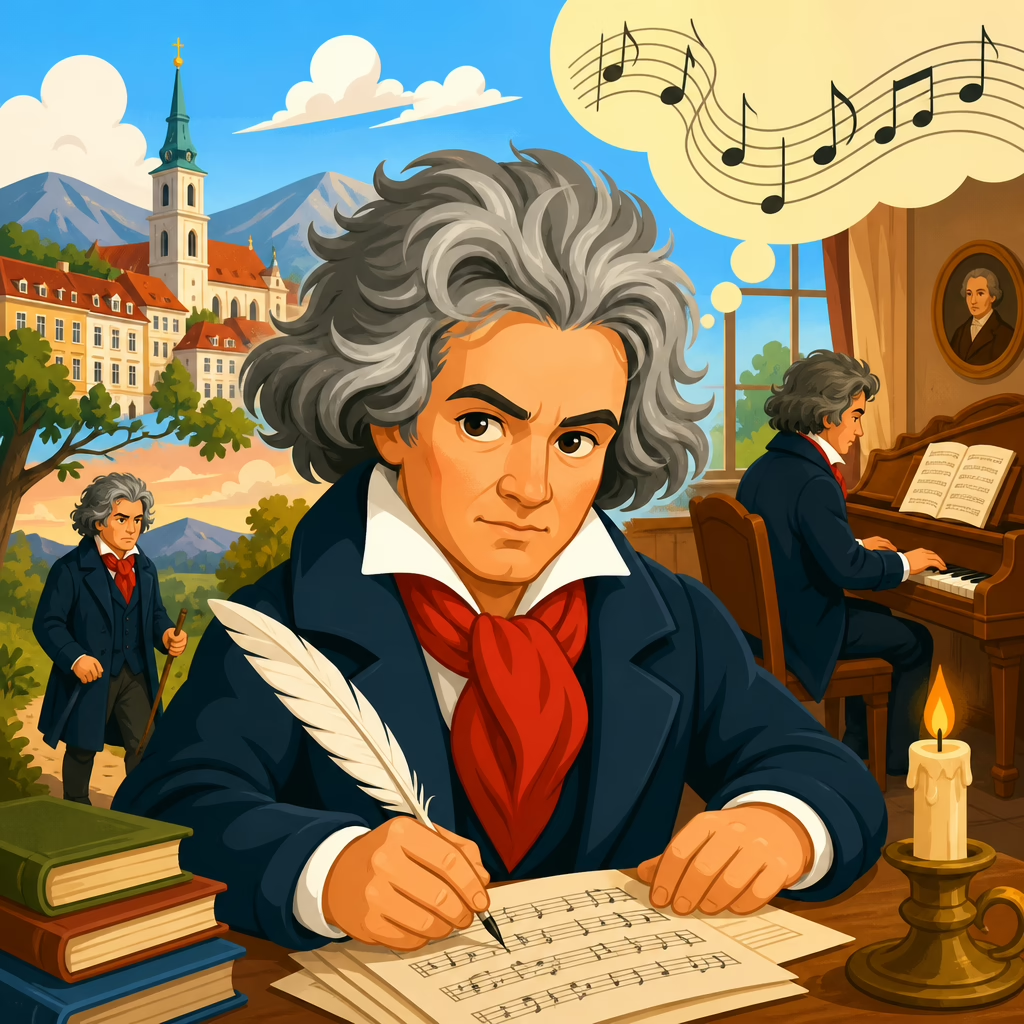
A Short Biography of Beethoven for First-Time Readers
Ludwig van Beethoven stands at the center of Western music history because his life joined personal struggle, artistic ambition, and radical innovation in ways that still feel immediate to first-time readers. Born in Bonn in 1770 and active mainly in Vienna until his death in 1827, Beethoven transformed the forms he inherited, including the symphony, piano sonata, string quartet, and concerto. A short biography of Beethoven should do more than list dates and famous works. It should explain who he was, what shaped him, why his music mattered in his own time, and why his story remains compelling now.
For beginners, a few terms help. A composer writes music. A pianist performs on the piano, often as both interpreter and creator. Patronage refers to financial support from nobles or institutions, a crucial system before modern recording and mass publishing. The Classical style, represented by Haydn and Mozart, prized balance, clarity, and formal proportion. The Romantic impulse, which Beethoven helped unleash, valued emotional intensity, individual expression, and bold expansion of inherited rules. Beethoven did not belong neatly to one era. He absorbed the Classical tradition and then stretched it until later generations heard something entirely new.
His biography matters because it illuminates a rare combination of discipline and defiance. Beethoven was not merely a tragic genius who wrote while going deaf, though that fact is important. He was also a hard-working professional who negotiated with publishers, studied counterpoint rigorously, tested instruments, revised constantly, and managed complicated relationships with patrons, friends, students, and family. I have found that first-time readers understand Beethoven best when they see him not as a marble monument but as a working artist under pressure, making practical decisions while pursuing ideals that often exceeded what his world expected from music.
Even basic biographical facts require care. His exact birth date is not documented, though his baptism was recorded in Bonn on December 17, 1770, and infants were usually baptized soon after birth. For readers who want the documentary basis behind that point, the clearest summary is this guide to what Beethoven’s birth record actually tells us. That small uncertainty is a useful reminder that Beethoven’s life, despite his fame, comes to us through records, letters, legal papers, memoirs, and later interpretations, not through legend alone.
Early Life in Bonn: Family, Training, and First Impressions
Beethoven was born into a musical family in Bonn, then part of the Electorate of Cologne within the Holy Roman Empire. His grandfather, also named Ludwig van Beethoven, had been a respected Kapellmeister, or court music director, and remained an important symbol of dignity for the younger Beethoven. His father, Johann van Beethoven, worked as a tenor and instrumentalist at court but struggled with alcoholism and inconsistency. That contrast between a revered grandfather and a troubled father shaped Beethoven’s early environment. Music promised status and livelihood, yet domestic life could be unstable and harsh.
Many early accounts describe Johann trying to present his son as a child prodigy in the model of Mozart. Some stories were exaggerated later, but the central point is clear: Beethoven received intensive musical instruction young, and not always gently. He learned keyboard, violin, and viola, and by his early teens he was already serving as an assistant court organist. Christian Gottlob Neefe, a more constructive teacher, recognized his talent and introduced him to the works of Bach, especially The Well-Tempered Clavier. That exposure mattered. Beethoven’s later command of structure and counterpoint did not appear suddenly in middle age; its roots were in disciplined study begun in Bonn.
Bonn also gave him access to a wider intellectual climate than the stereotype of an isolated prodigy suggests. The city had theatrical life, court ensembles, and readers interested in Enlightenment ideas. Beethoven encountered literature, politics, and philosophy through educated circles connected to the court. He played viola in the opera orchestra, absorbing dramatic pacing from the inside. That practical experience helps explain why so much of his instrumental music feels theatrical even without words. By his late teens he had published early works and was known locally as a gifted keyboard player whose improvisations could astonish listeners.
Vienna and the Making of a Career
In 1792 Beethoven moved permanently to Vienna, the capital that offered the richest musical opportunities in the German-speaking world. Mozart had died the year before, Haydn was Europe’s most famous living composer, and aristocratic households supported chamber music, lessons, and private concerts. Beethoven arrived with introductions from Bonn and quickly built a reputation as a pianist of unusual force and imagination. Contemporary reports emphasize not polished sweetness but power, surprise, rhythmic drive, and the ability to develop ideas spontaneously at the keyboard. In an age that prized improvisation, this was a serious professional advantage.
He studied composition in Vienna, most famously with Haydn, though the relationship was respectful rather than easy. Beethoven also worked with Johann Georg Albrechtsberger on counterpoint and with Antonio Salieri on vocal writing and Italian text setting. These studies corrected a common misunderstanding: Beethoven was no untutored genius exploding through convention. He trained intensely, accepted criticism when necessary, and strengthened weak areas. At the same time, he guarded his independence. Patrons such as Prince Lichnowsky supported him, but Beethoven resisted behaving like a servant. That stance anticipated the modern image of the autonomous artist, though in practice he still depended on aristocratic networks and commissions.
His first major Viennese success came through piano trios, piano sonatas, and concert appearances. Works such as the three Piano Trios, Opus 1, announced a composer who understood Haydn and Mozart yet pushed textures, dynamics, and dramatic contrasts further. The “Pathétique” Sonata, Opus 13, gave listeners a concentrated example of his approach: grave introduction, abrupt mood shifts, strong motivic unity, and emotional seriousness. Beethoven’s career was becoming legible to the public. He was not just a dazzling pianist who also composed. He was a composer-performer with a distinctive voice, making every genre sound more urgent.
Crisis, Deafness, and the Heroic Middle Period
The most famous turning point in Beethoven’s life was the onset of hearing loss, which began in his late twenties and worsened over time. For a performing musician, especially a pianist, this was professionally and psychologically devastating. In 1802, while staying in Heiligenstadt near Vienna, Beethoven wrote a document now known as the Heiligenstadt Testament, addressed to his brothers but never sent. In it he described despair, social withdrawal, and the temptation of suicide, then declared his resolve to continue living for his art. That statement should not be treated as melodrama. It is one of the clearest windows into how Beethoven understood his vocation.
After this crisis, his music entered what scholars often call the heroic period. The label is useful if handled carefully. It does not mean every piece became loud or triumphant. It means Beethoven increasingly wrote on a larger scale, with stronger contrasts, more concentrated motivic development, and a sense that instrumental music could embody struggle, conflict, and resolution. The Third Symphony, originally linked to Napoleon before Beethoven angrily withdrew the dedication, changed what a symphony could be: longer, weightier, and ethically charged in the ears of many listeners. The Fifth Symphony turned a compact rhythmic cell into a whole drama. The “Appassionata” Sonata and the Violin Concerto showed similar expansion in different forms.
| Period | Approximate Years | Key Features | Representative Works |
|---|---|---|---|
| Early | 1790s to 1802 | Classical balance with increasing boldness | Op. 1 Trios, “Pathétique,” First Symphony |
| Middle | 1803 to 1814 | Expanded scale, drama, public ambition | “Eroica,” Fifth Symphony, “Appassionata,” Fidelio |
| Late | 1815 to 1827 | Compression, introspection, contrapuntal depth | Late Quartets, Ninth Symphony, Missa Solemnis |
Beethoven’s deafness did not proceed in a simple straight line, and he did not become totally cut off overnight. He tried ear trumpets, sought medical advice, and continued to compose while adapting his social habits. Yet the broad fact remains: as his hearing deteriorated, he increasingly relied on inner hearing, memory, craft, and imagination rather than normal auditory feedback. That reality has encouraged myths, but it also underlines something concrete. Beethoven’s greatest achievements were not products of suffering alone. They emerged from technical mastery sustained under extreme limitation.
Personal Life, Reputation, and Daily Realities
First-time readers often ask whether Beethoven was happy, whether he married, and what he was like in ordinary life. The answers are mixed. He never married, though he formed intense attachments to several women, most of them socially unavailable to him. The famous 1812 letter to the “Immortal Beloved” reveals deep feeling, but the recipient remains debated. He could be affectionate, loyal, witty, and generous. He could also be suspicious, abrupt, chaotic in domestic arrangements, and exhausting to friends. Landlords complained about disorder; copyists complained about revisions; patrons admired him yet found him difficult. These details matter because they restore proportion. Greatness in art did not make daily life orderly.
Financially, Beethoven was more successful than many composers before him, though never entirely secure. He earned from commissions, performances, teaching, dedications, and especially publishing. In 1809, three aristocratic supporters, Archduke Rudolph, Prince Kinsky, and Prince Lobkowitz, promised him an annuity to keep him in Vienna when another position tempted him elsewhere. Inflation and political turmoil later reduced its value, but the arrangement signaled his stature. Beethoven had become someone cities competed to retain. That kind of recognition was unusual for a composer not employed in a fixed court post.
One of the most painful chapters of his later life involved the custody battle over his nephew Karl after the death of Beethoven’s brother Caspar Carl in 1815. Beethoven fought Karl’s mother in court for guardianship, convinced that he alone could shape the boy’s moral future. The struggle consumed years, exposed Beethoven’s controlling tendencies, and ended unhappily. Karl suffered under the pressure and attempted suicide in 1826. Biographically, this episode is essential because it shows Beethoven’s idealism turning rigid and destructive. He could apply the same uncompromising standards to family life that had fueled his art, with far worse results.
Late Works, Final Years, and Enduring Legacy
Beethoven’s late period is often described as difficult, but first-time readers should not mistake difficulty for coldness. From about 1815 onward, his output slowed, partly because of illness, legal troubles, and changing public taste, yet the works he completed reached extraordinary depth. The Hammerklavier Sonata, Opus 106, stretched the piano sonata almost beyond precedent. The Missa Solemnis pursued sacred grandeur on a scale that challenged performers and congregations alike. The Ninth Symphony joined chorus and orchestra in its final movement, setting Schiller’s “Ode to Joy” and permanently altering the horizon of the symphonic genre.
Then came the late string quartets, works that musicians still study for their formal freedom, contrapuntal density, abrupt contrasts, humor, intimacy, and spiritual concentration. Pieces like Opus 131 move through multiple connected movements, refusing conventional expectations while sounding inevitable once heard. I have seen new listeners worry that these works are too advanced for them. In practice, even a first encounter can register their emotional range: prayerful stillness, rustic dance, private grief, and flashes of wit. The challenge is real, but so is the direct human presence inside the music.
Beethoven’s health declined seriously in his final years. He suffered from chronic abdominal illness and liver disease, among other problems, and endured several painful medical procedures. He died in Vienna on March 26, 1827. His funeral drew an enormous crowd, a sign that he had become not merely a respected craftsman but a public cultural figure. Later generations elevated him further into a symbol of artistic freedom, moral seriousness, and human perseverance. Some of that hero worship simplified the man, yet the scale of his influence is undeniable. Brahms, Wagner, Mahler, and countless others composed under his shadow, while performers and audiences continue to measure musical ambition against standards he helped define.
For first-time readers, the clearest takeaway is that Beethoven’s life was not a simple legend of triumph over deafness. It was the life of a fiercely intelligent, technically formidable, emotionally complicated composer who changed music by reimagining what it could express. He grew from a gifted court musician in Bonn into an independent artist in Vienna, survived profound physical loss, and produced works that expanded every major form he touched. If you want to begin exploring him, start with the “Pathétique” Sonata, the “Eroica” Symphony, the Fifth Symphony, the Violin Concerto, and one late quartet such as Opus 132. Then return to his biography and hear how the life and the music illuminate each other.
Frequently Asked Questions
Who was Ludwig van Beethoven, and why is he so important in music history?
Ludwig van Beethoven was a German composer and pianist born in Bonn in 1770 who later built his career mainly in Vienna, where he became one of the most influential figures in Western music. For first-time readers, the simplest way to understand his importance is to see him as a composer who stood between two eras and transformed both. He inherited the elegant, balanced musical language of the Classical period shaped by composers such as Haydn and Mozart, but he expanded it with greater emotional depth, structural boldness, and personal intensity. In doing so, he helped open the door to the Romantic era.
Beethoven matters not just because he wrote famous pieces, but because he changed what music could express. Before him, many large musical forms followed established patterns. Beethoven kept those forms, including the symphony, piano sonata, concerto, and string quartet, but stretched them in scale, drama, and meaning. His music could sound heroic, intimate, defiant, tender, tragic, or triumphant, often within the same work. That range made later composers rethink what was possible. Even readers with no musical background can appreciate that Beethoven’s career represents more than technical achievement: it is the story of an artist who turned private struggle and public ambition into works that still feel powerful today.
What was Beethoven’s early life like, and how did he become a composer?
Beethoven was born into a musical family in Bonn, then part of the Electorate of Cologne. His father, Johann van Beethoven, was a singer, and his grandfather had been a respected musician as well. From an early age, Beethoven showed unusual musical talent, especially at the keyboard. His childhood, however, was not especially easy. His father is often described as strict and sometimes harsh, and the household was marked by instability. These early pressures likely shaped Beethoven’s serious work ethic and strong-willed personality.
As a young musician in Bonn, Beethoven received important training from Christian Gottlob Neefe, who recognized his gifts and helped him develop as a performer and composer. By his teens, Beethoven was already working professionally, playing organ, performing at court, and publishing early compositions. Bonn gave him a foundation, but Vienna offered larger opportunities. He moved there in the 1790s, studied with major teachers including Haydn, and quickly gained attention as a brilliant pianist with an improvisational style that impressed audiences and fellow musicians alike.
His rise was not instantaneous in the modern celebrity sense, but it was steady and remarkable. Patrons from the aristocracy supported him, and his reputation grew through performances, published works, and personal connections. Over time, he shifted from being known primarily as a virtuoso pianist to being recognized as a composer of unusual depth and originality. For first-time readers, this progression is important: Beethoven did not appear fully formed as a legend. He developed through training, performance, discipline, and a fierce determination to make his own artistic mark.
How did Beethoven’s deafness affect his life and music?
Beethoven’s hearing loss is one of the most striking parts of his biography, and it has become central to how many people understand his life. He began noticing hearing problems while still relatively young, likely in his late twenties, and the condition worsened over time. For a composer and performer, this was devastating. Hearing was not simply part of his profession; it was the medium through which he experienced and shaped his art. The emotional toll was immense, and his writings reveal periods of despair, frustration, and isolation.
One of the most revealing documents from his life is the Heiligenstadt Testament of 1802, a personal statement in which he described his anguish and his temptation to withdraw from the world. Yet the same document also shows his decision to continue living for the sake of his art. That choice is crucial to understanding Beethoven. His deafness did not end his creativity. In fact, many of his greatest works were composed after his hearing had seriously declined, and some came when he was profoundly deaf.
It is important, though, not to reduce Beethoven to a simple story of “genius overcoming disability.” His hearing loss affected his social life, his performing career, and his emotional well-being in complex ways. He became more withdrawn and found conversation increasingly difficult. At the same time, his music grew ever more ambitious and inward-looking. Rather than hearing his deafness as a romantic legend alone, first-time readers should see it as a real human struggle that shaped the conditions of his work. That struggle helps explain why his music can feel so intensely personal, searching, and resilient.
What are Beethoven’s most famous works, and where should beginners start?
Beethoven wrote in several major genres, and many of his best-known works are ideal starting points for new listeners and readers. Among the symphonies, the Third Symphony, often called the “Eroica,” is a landmark because it dramatically expanded the scale and ambition of the symphonic form. The Fifth Symphony is probably the most instantly recognizable, with its famous opening motif and powerful sense of struggle and victory. The Sixth, or “Pastoral,” offers a different side of Beethoven, more lyrical and evocative of nature. The Ninth Symphony stands as one of the most celebrated works in music history, especially for its choral finale, the “Ode to Joy.”
His piano music is equally important. The “Moonlight Sonata” is often the first Beethoven piano piece many people encounter, though it represents only one part of his style. The “Pathétique” and “Appassionata” sonatas reveal his dramatic power, while later sonatas show a more introspective and experimental voice. His piano concertos, especially the Third, Fourth, and Fifth, are also excellent entry points because they combine virtuosity with emotional range. In chamber music, his string quartets are among his deepest achievements, though some of the late quartets can be challenging for beginners. A more approachable place to start might be one of the middle-period quartets.
For readers new to Beethoven, the best approach is not to begin with a checklist of masterpieces, but with a few works that show his range. The Fifth Symphony, the “Moonlight Sonata,” and the Ninth Symphony provide a strong introduction to his dramatic energy, lyrical gift, and historical importance. From there, listeners can move into the “Eroica,” the violin concerto, the piano concertos, and selected quartets. Beethoven’s music rewards repeated listening, and a short biography becomes much richer when readers connect the life story to specific works that reflect different stages of his artistic development.
Why does Beethoven still matter to first-time readers today?
Beethoven still matters because his life and work speak to questions that remain deeply recognizable: how a person responds to suffering, how ambition can be shaped into lasting achievement, and how art can push beyond inherited limits. He is not simply a historical monument or a name attached to famous melodies. He is compelling because his biography combines discipline, conflict, vulnerability, and creative daring. First-time readers often respond to Beethoven because he feels both larger than life and intensely human.
His continued relevance also comes from the way his music communicates across time. Even without technical knowledge, listeners can hear tension, release, struggle, joy, grandeur, and intimacy in his works. That emotional directness helps explain why Beethoven remains central in concert halls, classrooms, films, and popular culture. At the same time, he rewards deeper study. The more readers learn about the periods of his life, his changing style, and the historical world around him, the more meaningful the music becomes.
A short biography of Beethoven is valuable when it does more than present dates from 1770 to 1827. It should show how a musician from Bonn rose to prominence in Vienna, reshaped major musical forms, endured progressive deafness, and continued composing works of extraordinary force and imagination. That combination of historical importance and personal immediacy is why Beethoven remains one of the best entry points into classical music for first-time readers. He helps people see that great art is not distant or abstract. It grows out of real life, real hardship, and a relentless drive to create something new.