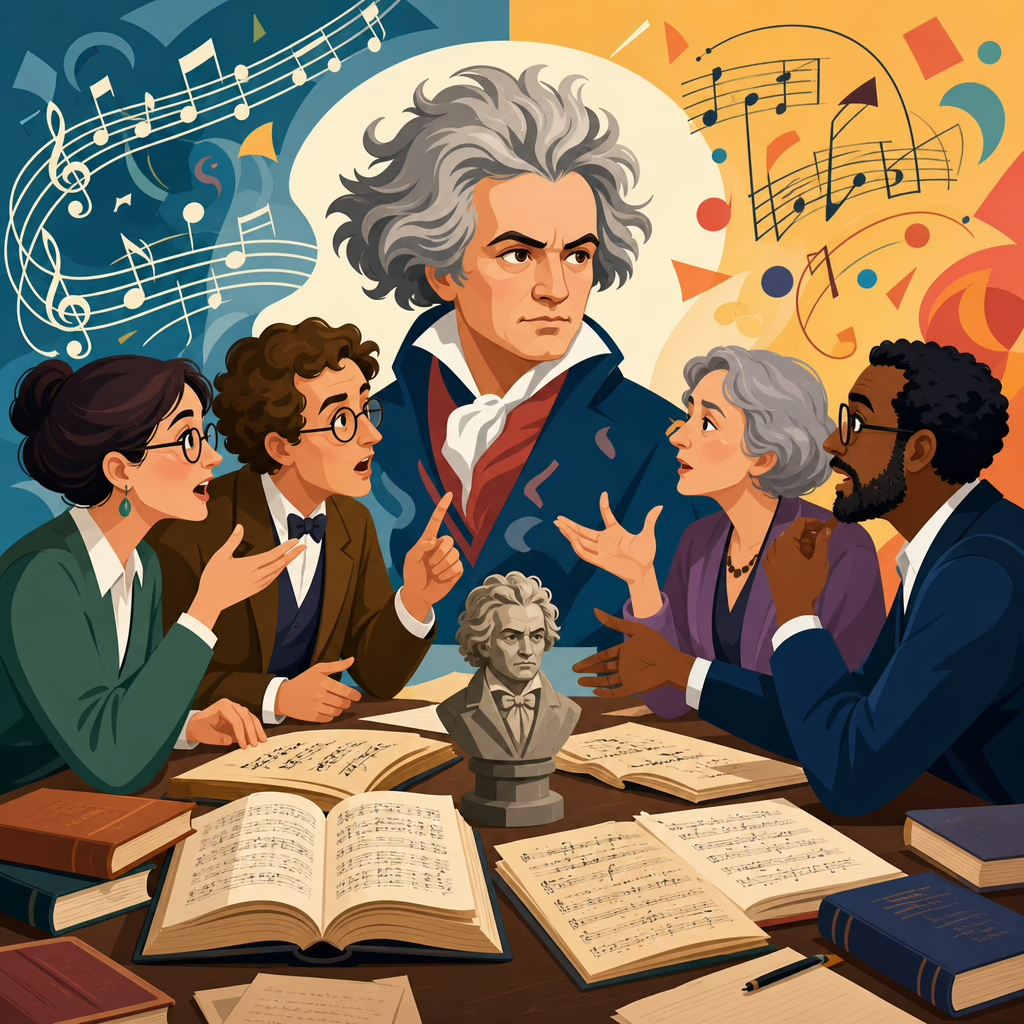
The Scholarship Debate Over Beethoven’s Late Style
Beethoven’s late style remains one of the most argued-over subjects in musicology because it seems to combine radical innovation with deep continuity, severity with intimacy, and formal concentration with expressive unpredictability. In scholarship, “late style” usually refers to the works of Beethoven’s final decade, especially the late piano sonatas, the Diabelli Variations, the Missa solemnis, the Ninth Symphony, and the late string quartets. Yet the term is not merely chronological. It names a cluster of traits scholars repeatedly debate: compression of motives, abrupt contrasts, fugue and variation procedures, remote harmonic turns, fragmentation, spiritual inwardness, and a distinctive relationship to tradition. Why this matters is simple. How scholars explain Beethoven’s late style shapes how performers pace a fugue, how listeners hear discontinuity, and how analysts define coherence in works that often seem to resist ordinary expectations.
I have worked through these pieces in score study, rehearsal rooms, and seminar discussions, and one lesson returns every time: the debate is not about whether the music is great, but about what kind of greatness it represents. Is late Beethoven the culmination of Classical form, the beginning of modernism, or a singular endpoint that belongs fully to neither category? Different answers produce different analytical priorities. One critic hears Op. 131 as organic unity stretched to an extreme; another hears a deliberate refusal of smooth unity in favor of juxtaposition, memory, and rupture. The disagreement persists because the music supports both claims. Beethoven’s late style matters, then, not as a museum label but as a live scholarly problem that tests the limits of analysis, aesthetics, and historical interpretation.
How Scholars Define Beethoven’s Late Style
Most scholars define Beethoven’s late style through a recurring set of musical behaviors rather than through dates alone. The standard repertory begins around 1816 and includes the Piano Sonatas Opp. 101, 106, 109, 110, and 111; the Cello Sonatas Op. 102; the Diabelli Variations Op. 120; the Missa solemnis; the Ninth Symphony; and the Quartets Opp. 127, 130, 131, 132, 133, and 135. Across these works, analysts point to intensified contrapuntal writing, especially fugue; greater reliance on variation and transformational processes; wider expressive polarities; and a tendency to place simple, almost archaic materials within highly complex structures. Charles Rosen described this repertory as both more concentrated and more expansive than the middle-period works, a useful paradox that still frames discussion.
Definition becomes contested because late style is partly descriptive and partly interpretive. Some writers emphasize technical procedures. They note, for example, that Op. 110 binds its movements through motivic recall and through a large-scale dramatic progression from arioso to fugue to inversion, making late style a matter of compositional method. Others stress expressive stance: distance from public rhetoric, resistance to easy resolution, and an inward, searching tone. Theodor W. Adorno, in a famously difficult account, argued that lateness in Beethoven does not reconcile contradictions but exposes them, leaving fragments, ruptures, and convention standing in stark tension. His view has been enormously influential, even among scholars who reject its philosophical absolutism.
There is also a practical reason the definition remains fluid. The same feature can support opposing readings. Counterpoint may indicate reverence for older traditions, particularly Bach and Handel, or a radical remaking of those traditions under new pressures. Simplicity may sound transcendent or skeletal. Repetition may project monumental stability or obsessive fixation. Because the works operate at such high levels of craft, almost every local detail can be heard simultaneously as structure and as sign. That is why debates over late Beethoven never stay confined to notes on the page. They quickly expand into questions about history, subjectivity, and whether coherence in art must appear smooth to be real.
Continuity or Break: The Central Historical Argument
The longest-running argument asks whether Beethoven’s late style continues the logic of his earlier music or breaks decisively from it. The continuity camp stresses that the late works push established habits to their limit rather than abandoning them. Sonata procedure still matters, motivic development still drives large spans, and tonal planning remains rigorous even when the surface becomes strange. Analysts in this tradition often show how apparently erratic passages derive from tightly controlled cells. The opening of Op. 111, for instance, presents a severe dotted-rhythm gesture and diminished harmonies that seem disruptive, yet the entire movement unfolds from these concentrated premises with remarkable discipline. What sounds new, on this view, is the intensification of existing Beethovenian habits.
The break thesis emphasizes genuine discontinuity. Here the late works do not simply extend middle-period practice; they change the terms of discourse. Multi-movement continuity in Op. 131, the disruptive scale and density of the Große Fuge, and the suspended, hymnlike temporality of the “Heiliger Dankgesang” from Op. 132 all challenge assumptions inherited from Haydn, Mozart, and even Beethoven’s own “heroic” style. Scholars who argue for rupture note features that weaken teleological drive: static variation fields, recitative intrusions, abrupt changes of texture, and endings that dissolve rather than triumph. In performance, these passages often feel unlike anything in the Eroica or Fifth Symphony, less public argument than private meditation interrupted by flashes of violence.
The strongest recent scholarship avoids choosing one side exclusively. It shows that continuity and break are mutually dependent in late Beethoven. The music often invokes inherited forms only to test their resilience from within. A fugue is not just a fugue; it is a field where discipline, memory, and struggle become audible. A sonata movement remains legible as sonata, but its normative functions may be displaced, compressed, or redistributed. Readers seeking a broader explanation of formal continuity can consult the main guide on how Beethoven expands sonata form without breaking it, which clarifies why late works can sound disruptive while still maintaining deep structural logic.
Form, Fragmentation, and the Problem of Coherence
One reason scholars disagree so sharply is that late Beethoven forces a reconsideration of what counts as coherence. Traditional formal analysis often assumes that coherence arises from balanced themes, clear tonal goals, and proportionate phrase structures. Late works repeatedly complicate those expectations. Op. 130 juxtaposes six movements of strikingly different character; Op. 110 interrupts continuity with recitative and lament; Op. 111 replaces the expected sonata-cycle closure with a transcendental variation movement whose ending seems to evaporate. If one expects coherence to look symmetrical, these works can appear broken. If one allows coherence to emerge through memory, motivic recurrence, and conceptual design, they become extraordinarily unified.
Joseph Kerman’s writing on the quartets was crucial here because he treated expressive meaning and formal design as inseparable. Later theorists, including William Kinderman and Robert Hatten, expanded this approach by tracing narrative trajectories, topic shifts, and gesture types. Their analyses show that fragmentation in Beethoven is often strategic rather than accidental. A sudden caesura, an isolated recitative, or an archaic chorale can function as a hinge in a larger argument. In Op. 132, the alternation between modal chorale writing and “Neue Kraft fühlend” episodes is coherent precisely because it dramatizes recovery through contrast. The work’s integrity lies not in smoothness but in the ordered return of transformed states.
| Work | Feature debated | Common scholarly question | Typical conclusion |
|---|---|---|---|
| Op. 111 | Two-movement design | Is the missing finale a rupture or a higher closure? | Closure shifts from dramatic resolution to transcendence through variation |
| Op. 130/133 | Große Fuge finale | Is excess a failure of proportion or a new formal ideal? | Scale becomes an argument about form itself |
| Op. 131 | Seven linked movements | Does continuity replace conventional cycle structure? | Unity arises through uninterrupted transformation |
| Op. 132 | “Heiliger Dankgesang” | How can static prayer coexist with forward motion? | Contrast and return create process within apparent stasis |
From long experience with these scores, I would put the issue plainly: the late works ask analysts to hear across interruptions. Their coherence is often retrospective. A strange event may not make sense in the moment, yet it becomes necessary when later material reframes it. This is why the scholarship keeps returning to memory as an analytical category. Beethoven’s late style teaches listeners to connect dispersed points across time. That is not the absence of form. It is form operating at a more demanding level than immediate symmetry.
Counterpoint, Tradition, and the Weight of the Past
No aspect of late Beethoven has generated more consensus, and more disagreement about meaning, than his turn to counterpoint. By the 1810s Beethoven was studying Bach’s Well-Tempered Clavier, Handel’s choruses, Fux’s Gradus ad Parnassum, and older liturgical styles with unusual intensity. The result was not antiquarian imitation. In works such as the fugue of Op. 110, the finale of Op. 106, and the Große Fuge, strict procedures are subjected to fierce rhythmic pressure, registral extremes, and dramatic interruption. Scholars often describe this as a fusion of learned style and subjective urgency. The old techniques remain recognizable, but they are revoiced in a way that feels unstable, even combative.
The debate centers on what this historical backward glance means. One interpretation sees Beethoven claiming the authority of tradition at a moment of personal and cultural crisis. Deafness, social isolation, and the post-Napoleonic climate all encouraged a stance of inwardness and seriousness, and the learned style offered durable materials equal to that seriousness. Another interpretation argues that Beethoven uses inherited forms critically, not reverently. In this reading, the Große Fuge is so dense, dissonant, and metrically dislocated that it effectively explodes the genre from inside. Igor Stravinsky later called it “an absolutely contemporary piece of music forever,” a remark still cited because it captures how a rigorously historical technique can sound startlingly modern.
These positions are not incompatible. Counterpoint in late Beethoven does carry historical authority, but it also becomes a laboratory for new kinds of musical argument. The inversion fugue in Op. 110 is a clear example. Its subject is not merely manipulated according to rule; it becomes the means by which collapse is reversed. After the despairing arioso dolente, the fugue’s return in inversion is heard less as technical display than as existential reconstitution. Scholarship is persuasive when it keeps both sides in view: counterpoint as inherited craft and counterpoint as dramatic engine. Reducing it to either textbook procedure or pure emotion misses Beethoven’s distinctive synthesis.
Philosophical Readings: Transcendence, Difficulty, and Late Style Theory
Late Beethoven attracts philosophy because the music seems to ask what art can say when ordinary public language fails. Adorno’s account remains foundational. He argued that Beethoven’s late works renounce the rounded harmony of classicism and instead present fractured conventions, unresolved tensions, and a stubborn refusal of reconciliation. For Adorno, lateness is not serene wisdom but the hard truth of nonintegration. Many musicologists have challenged his tendency to generalize from selected moments, yet his central claim endures because it names something listeners genuinely encounter: these works often feel difficult on purpose. Their awkwardness can be expressive, not defective.
Against this negative dialectical view stands a long tradition of transcendence readings. Donald Francis Tovey, among others, heard in works like Op. 111 and Op. 132 a spiritual elevation that exceeds conflict rather than merely displaying it. Performers often reinforce this reading through tempo choices, tonal pacing, and a cultivated sense of luminous arrival in variation finales or chorale passages. The risk, however, is sentimentality. If transcendence becomes a vague atmosphere detached from compositional detail, it tells us little. The most convincing scholarship ties the elevated effect to specific devices: rhythmic thinning, registral ascent, reduction of harmonic friction, and the transformation of dance rhythms into suspended pulse, as in the Arietta variations of Op. 111.
Current debate is healthiest when it resists turning these works into evidence for a single philosophy. Some late pieces are indeed abrasive, others consoling, and many are both within a few pages. In my own work with performers, I have found that the philosophical dispute becomes practical at once. If you treat the Cavatina from Op. 130 as pure inward transcendence, you may underplay its fragility and interruption; if you treat it only as rupture, you can miss its tenderness. Scholarship earns its value here by refining perception. It should not force the music into a doctrine, but give us better language for its simultaneous hardness and grace.
Why the Debate Still Matters
The scholarship debate over Beethoven’s late style endures because the works continue to challenge the categories used to understand them. Analysts still argue over whether form is best heard as continuity, rupture, or transformation through memory. Historians still ask whether the turn to fugue and variation signals retrospective classicism, religious seriousness, or proto-modern experimentation. Philosophically minded critics still divide over whether these pieces reconcile conflict or refuse reconciliation. None of these questions is academic in the trivial sense. They shape editions, programming, rehearsal priorities, recording aesthetics, and the language by which new listeners are introduced to difficult masterpieces.
The clearest takeaway is that Beethoven’s late style cannot be reduced to a single formula. It is neither simply the perfection of Classical balance nor simply the birth of modern fragmentation. Its power lies in making those descriptions collide. The best scholarship therefore combines close reading of scores with historical awareness and interpretive humility. It names precise technical features, but also admits that the experience of these works often exceeds tidy explanation. That balance is essential for anyone studying Op. 110, Op. 111, the Missa solemnis, or the late quartets in serious depth.
For readers focused on analysis and scholarship, the real benefit of this debate is sharper listening. Once you know what is at stake, abrupt transitions, fugues, strange silences, and variations stop sounding merely eccentric. They become evidence in an ongoing argument about how music holds together, how tradition can be remade, and how expressive meaning emerges from formal risk. Return to one late work with these questions in mind, follow the scholarship patiently, and you will hear not confusion but a deliberately demanding kind of coherence.
Frequently Asked Questions
What do scholars mean when they talk about Beethoven’s “late style”?
In musicology, Beethoven’s “late style” usually refers to the works of his final decade, especially the late piano sonatas, the Diabelli Variations, the Missa solemnis, the Ninth Symphony, and the late string quartets. But the term means more than simply “music written late in life.” Scholars use it to describe a distinctive artistic manner that seems to crystallize in these years: a style marked by extraordinary compression and expansion at once, abrupt contrasts, heightened contrapuntal thinking, formal experimentation, spiritual intensity, and an unusual freedom in handling inherited conventions. In other words, “late style” is both chronological and aesthetic.
That is one reason the concept remains so debated. Some researchers stress continuity, arguing that the features often labeled “late” had been developing in Beethoven’s music for decades. Others emphasize rupture, hearing these works as a profound reimagining of what sonata form, variation, fugue, slow movement, or quartet writing could be. The disagreement matters because it shapes how Beethoven’s final works are interpreted: either as the culmination of a long artistic trajectory or as a body of music that deliberately resists previous models, including Beethoven’s own middle-period heroic manner.
Another important point is that “late style” is partly a scholarly construction. It helps organize discussion, but it can also oversimplify. Not every late work behaves the same way, and the category can flatten the differences between, say, the monumental public rhetoric of the Ninth Symphony and the inward, experimental language of the late quartets. For that reason, many scholars use the term carefully. They recognize its usefulness while also asking what gets included, what gets excluded, and whether “late style” names a stable musical language or a cluster of tendencies that emerge with varying intensity across Beethoven’s final works.
Why is Beethoven’s late style so controversial in scholarship?
The controversy arises because Beethoven’s late music seems to invite opposing interpretations with equal force. It sounds radical, yet deeply rooted in older techniques. It can feel austere and severe, but also intimate, playful, devotional, and even humorous. It often displays remarkable formal concentration, while also producing moments of startling unpredictability. Scholars have long debated how to reconcile these apparent contradictions. Is this music best understood as experimental modernism ahead of its time, as a return to learned and historical styles, or as a fusion of both? That tension is at the center of the debate.
One major point of disagreement concerns historical narrative. Some writers place the late works at the beginning of musical modernity, hearing in them fragmentation, discontinuity, and resistance to easy closure. Others hear a composer engaging more deeply than ever with tradition, especially counterpoint, variation, fugue, sacred style, and older formal procedures. From this perspective, Beethoven’s late manner is not a break from the past but a profound reworking of it. The debate is therefore not just about musical details; it is about how Beethoven fits into the broader history of Western art music.
There is also disagreement over how biography should factor into interpretation. Because these works were written amid deafness, illness, isolation, and intense personal struggle, some scholars have linked their unusual character to Beethoven’s life circumstances. Others caution against reducing complex musical decisions to biography alone. They argue that the late works should be understood primarily through compositional technique, genre history, patronage, performance context, and philosophical aesthetics. The controversy persists because Beethoven’s late style sits at the intersection of all these issues: form, expression, history, identity, and the very question of how music should be interpreted.
Which musical features are most often associated with Beethoven’s late style?
Several musical traits recur in discussions of Beethoven’s late style, though scholars differ on which are most central. One of the most frequently cited is formal experimentation. Beethoven stretches, compresses, interrupts, and reorders familiar forms in ways that can make the music feel simultaneously rigorous and surprising. Movements may unfold through intense motivic concentration rather than broad thematic contrast; transitions can become structurally decisive; codas can take on unprecedented weight; and seemingly marginal ideas may return with transformative force. This gives the music a sense of inevitability without predictability.
Another defining feature is the heightened role of variation and counterpoint. In late Beethoven, variation is not merely decorative; it becomes a fundamental way of thinking. Entire movements evolve through the continual reinterpretation of a small musical idea, whether in the Diabelli Variations, the Arietta of the Piano Sonata in C minor, Op. 111, or the slow movements of the late quartets. At the same time, fugue, canon, and other contrapuntal devices assume unusual expressive power. Beethoven does not use learned technique as academic display alone. He turns it into drama, struggle, prayer, wit, and transcendence.
Scholars also point to extremes of texture, register, rhythm, and affect. Late Beethoven can move abruptly from hymn-like stillness to explosive dissonance, from rustic simplicity to almost abstract intricacy. Silences become structural events. Registers are stretched. Rhythmic ambiguity becomes expressive rather than merely ornamental. There is often a striking juxtaposition of the sublime and the ordinary, the monumental and the fragmentary. This is part of what makes the late works so compelling: they refuse a single emotional or stylistic posture, and instead create meaning through sharp, sometimes unsettling, contrasts.
How do scholars balance continuity and innovation in interpreting Beethoven’s final works?
For many scholars, the most productive way to understand Beethoven’s late style is not to choose between continuity and innovation, but to see the two as inseparable. Beethoven’s final works are innovative precisely because they emerge from a deep engagement with tradition. He revisits older genres, contrapuntal procedures, liturgical styles, dance types, and variation principles, yet he subjects them to intense transformation. The result is music that sounds new not because it abandons the past, but because it absorbs and reconfigures it with unusual freedom.
This balance is especially clear in discussions of genre and form. The late string quartets, for example, inherit the quartet tradition of Haydn, Mozart, and Beethoven’s own earlier works, but they reshape expectations of continuity, proportion, and expressive range. The Missa solemnis engages the long history of sacred composition, yet its scale, complexity, and interpretive demands make it unlike any conventional liturgical setting. The Ninth Symphony preserves the symphonic ideal while also destabilizing it through vocal forces, formal expansion, and philosophical ambition. In each case, Beethoven does not simply continue a tradition or reject it; he turns tradition into the medium of innovation.
That is why the continuity-versus-rupture debate remains so active. Some scholars foreground the lineage of compositional techniques and hear the late works as the culmination of long-developing concerns. Others emphasize how strange these pieces must have seemed, and in many ways still seem, to listeners and performers. Both views capture something essential. Beethoven’s late style is powerful partly because it draws authority from recognizable forms and inherited practices even as it pushes them to their limits. The music feels rooted and unstable at the same time, and that paradox lies at the heart of its scholarly fascination.
Why do Beethoven’s late piano sonatas and string quartets play such a central role in the debate over late style?
The late piano sonatas and string quartets stand at the center of the debate because they present Beethoven’s most concentrated and challenging experiments in form, expression, and musical thought. These works are often less public in orientation than the Ninth Symphony or Missa solemnis, which makes their unusual qualities especially exposed. In the sonatas and quartets, listeners encounter abrupt changes of character, intricate contrapuntal writing, profound slow movements, enigmatic transitions, and endings that can feel revelatory, unresolved, or deliberately elusive. They seem to demand interpretation at every level.
The late piano sonatas are especially important because they compress Beethoven’s late concerns into a medium closely associated with personal utterance and structural innovation. Works such as Opp. 109, 110, and 111 combine lyric inwardness with formidable architectural control. They fuse fugue, variation, recitative-like writing, hymn textures, and dramatic rupture in ways that challenge simple labels. Scholars have long treated these sonatas as key evidence for whatever they think “late style” means: introspection, transcendence, fragmentation, synthesis, or resistance to conventional closure.
The late string quartets intensify the debate even further because they seem to create a musical world all their own. They are at once intimate and encyclopedic, deeply rooted in quartet tradition yet startlingly unconventional in layout, pacing, and expressive logic. A single quartet may move from dance to lament, from learned counterpoint to folk-like directness, from mystical stillness to rough humor. This range has made the quartets a testing ground for larger theories about Beethoven’s final period. For many scholars, if one can explain why these works sound so singular while remaining unmistakably Beethovenian, one comes close to explaining the larger puzzle of his late style itself.