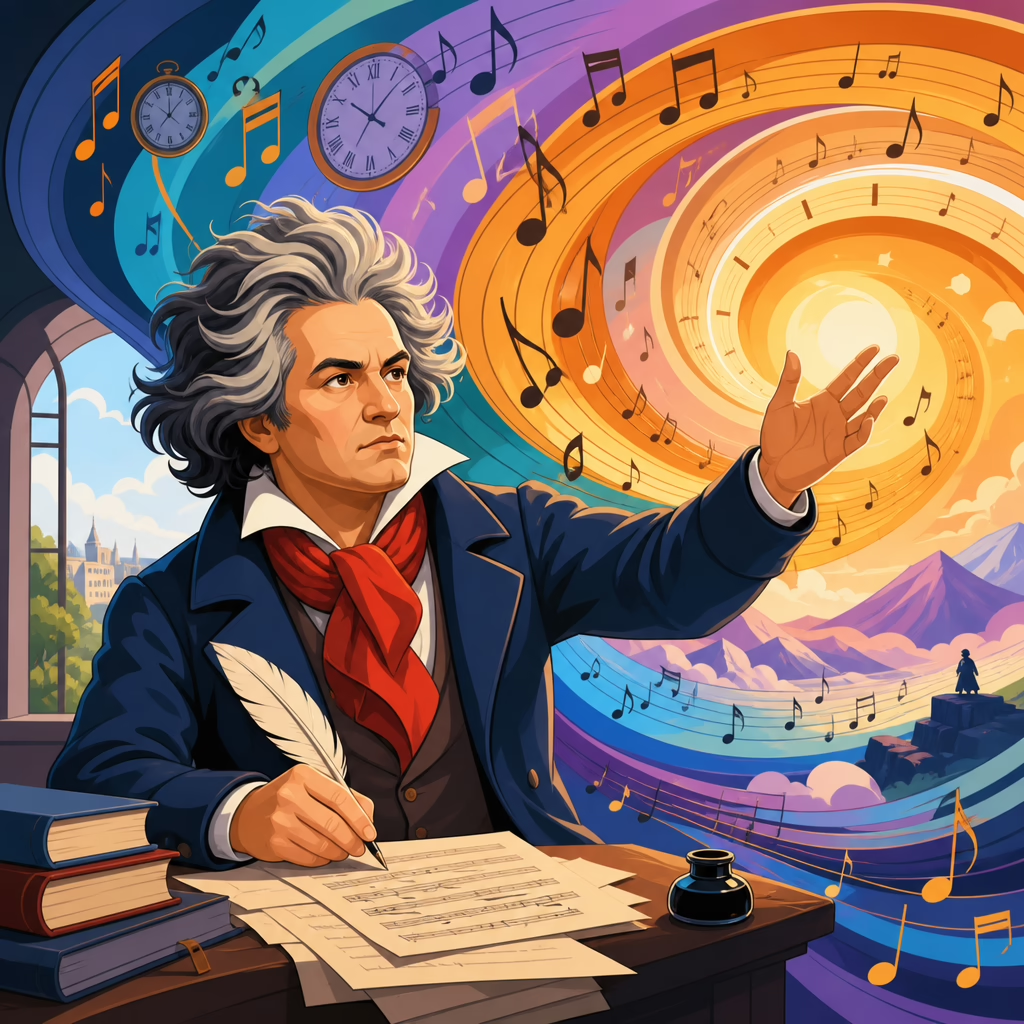
Beethoven and the Expansion of Musical Time
Ludwig van Beethoven changed how listeners experience duration in music. “Musical time” in his work does not simply mean tempo markings or the number of measures on a page. It refers to perceived time: how long an introduction can suspend arrival, how insistently a motive can delay closure, how a development can turn a minute into an ordeal or an instant into revelation. In Beethoven’s hands, form became a temporal art of pressure, release, memory, and expectation. He inherited late eighteenth-century conventions from Haydn and Mozart, but he stretched them from within, making time feel denser, more dramatic, and more psychologically charged without abandoning intelligible structure.
This matters because Beethoven’s expansion of musical time sits at the center of his historical importance. Analysts often discuss harmony, motive, and sonata form separately, yet in practice Beethoven fused them into a new way of pacing large spans. He learned that a single rhythmic cell could govern hundreds of measures; that a transition could become a battlefield rather than a bridge; that a coda could function as a second development; and that silence, repetition, and tonic delay could reshape the listener’s inner clock. These techniques affected not only symphonies and sonatas but also quartets, concertos, and overtures, influencing Schubert, Brahms, Wagner, and Mahler. To understand Beethoven’s formal innovation, one must understand his command of temporal perception.
When musicians speak about expansion of musical time, they usually mean three related processes. First, there is literal expansion: longer introductions, broader codas, enlarged development sections, and more extended transitions. Second, there is perceptual expansion: passages that feel longer because Beethoven withholds cadence, destabilizes meter, fragments motives, or drives repetition to unusual intensity. Third, there is structural expansion: events gain weight because they are prepared more extensively and recalled more strategically. I have found in rehearsal and score study that Beethoven’s timing rarely depends on one device alone. He layers rhythmic insistence, harmonic delay, registral design, and formal reinterpretation so that listeners sense enlargement even when the thematic material itself is economical.
From Clock Time to Lived Time
Beethoven did not merely write longer works than his predecessors; he altered the ratio between material and duration. A striking example is the first movement of the Eroica Symphony. Its opening theme is not especially elaborate, yet the movement unfolds on a scale unprecedented for a symphonic sonata movement at the time. The expansion comes from process. Beethoven treats modulations as dramatic regions, not quick formal obligations. He dwells on sequences, destabilizes harmonic goals, and lets motivic particles continue working after a theme has apparently finished. The result is lived time rather than clock time: the listener feels inside a developing argument.
This distinction helps explain why Beethoven can make a short idea feel vast. The famous four-note cell of the Fifth Symphony occupies only a moment, but its reiteration, transformation, displacement, and interruption stretch that moment across an entire movement cycle. In performance, this means resisting the temptation to treat repetition as redundancy. Each return lands in a new harmonic or rhetorical context, so time expands through reinterpretation. Beethoven often composes as though memory itself were part of form. Earlier events remain active in the ear, making later passages feel heavier, more inevitable, or more delayed.
Slow Introductions and the Art of Suspension
One of Beethoven’s clearest methods for expanding musical time is the slow introduction. Haydn had already made introductions meaningful, but Beethoven intensified their temporal function. In the Pathétique Sonata, Op. 13, the Grave introduction does more than set a mood. It creates a separate temporal field, weighted by dotted rhythms, rests, diminished sonorities, and rhetorical pauses. By the time the Allegro di molto e con brio arrives, listeners do not simply hear a fast movement beginning; they hear an argument released from tension that has already accumulated. The introduction lengthens the experience of arrival.
The Fourth Symphony offers another instructive case. Its Adagio introduction famously hovers in harmonic ambiguity before the bright B-flat major Allegro vivace bursts forth. That opening does not feel like neutral prefatory material. It delays tonal confirmation and withholds energetic identity, so the first firm establishment of the home key becomes an event in time. Beethoven understood that beginnings need not begin immediately. By slowing the approach to the main tempo and by making uncertainty audible, he enlarges the listener’s awareness of formal thresholds.
This technique became foundational for nineteenth-century symphonic writing. Yet Beethoven’s introductions remain distinctive because they are tightly integrated into the logic of what follows. Their gestures foreshadow later conflicts, especially around cadence and tonal arrival. Readers interested in the broader mechanics of this strategy can compare this temporal perspective with a focused discussion of form at this guide to how Beethoven expands sonata form without breaking it.
Repetition, Compression, and Motivic Pressure
Beethoven’s expansion of musical time often begins with compression of material. Instead of relying on many contrasting themes, he can derive long spans from tiny cells. This creates pressure. Because the material is so concentrated, every repetition demands attention, and every variation acquires structural meaning. In the first movement of the Fifth Symphony, the repeated short-short-short-long figure is not a slogan pasted onto the surface. It drives accompaniment patterns, bridges, codettas, and developmental passages. Time expands because the motive refuses to become background.
In practical analysis, it helps to distinguish Beethovenian repetition from literal restatement. He repeats to intensify, to dislocate meter, to delay cadence, or to reframe what came before. Consider the opening of the Piano Sonata in F minor, Op. 57, Appassionata. The hushed broken-chord idea returns with subtle changes in register, dynamic contour, and harmonic implication. Each recurrence deepens uncertainty. The passage seems to circle, yet it is moving inward, storing kinetic force. This is a classic Beethoven effect: the music feels suspended and urgent at once.
| Work | Temporal device | How time expands |
|---|---|---|
| Pathétique Sonata, Op. 13/I | Slow introduction | Delays the Allegro and magnifies the sense of arrival |
| Symphony No. 3, Eroica/I | Extended development | Turns tonal exploration into large-scale drama |
| Symphony No. 5/I | Motivic saturation | Makes a tiny cell govern long spans and heightens continuity |
| Appassionata Sonata, Op. 57/I | Cadential deferral | Creates suspense through recurring instability and withheld closure |
| Symphony No. 9/IV | Formal recollection | Uses memory of earlier material to enlarge narrative time |
Cadential Deferral and Harmonic Delay
If one asks how Beethoven makes passages feel longer than they are, the most direct answer is cadential deferral. He regularly postpones authentic cadences through sequence, deceptive motion, dominant prolongation, registral interruption, or rhythmic insistence. This was not unique in itself; what is distinctive is the scale and dramatic purpose of the delay. In the Waldstein Sonata, Op. 53, the first movement repeatedly drives toward arrival only to reopen space through harmonic redirection and figuration. The listener perceives time as stretched because expected endings become new beginnings.
Cadential delay also explains the extraordinary power of Beethoven’s codas. In many Classical works, the coda confirms what the recapitulation has already secured. Beethoven often withholds full closure until the coda, effectively relocating the emotional endpoint. The first movement of the Fifth Symphony and the finale of the Eroica are famous examples. Their codas are not decorative afterthoughts. They consume time in order to earn finality. In rehearsal, these passages only make sense when players understand that Beethoven is not extending for ornament; he is redefining where the form truly ends.
Harmony plays a decisive role here. Beethoven often prolongs dominant function beyond ordinary Classical proportions, but he also intensifies local delay through chromatic inflection and diminished-seventh sonorities that seem to promise resolution while suspending it. This creates a sharpened temporal awareness: listeners are made conscious of waiting. Musical time expands most vividly when expectation is precise, and Beethoven is masterful at making the ear know exactly what it wants before denying it.
Development as Temporal Laboratory
The development section became Beethoven’s primary laboratory for temporal expansion. In Haydn and Mozart, developments could already be adventurous, but Beethoven enlarged both their dimensions and their psychological weight. The Eroica’s first-movement development is the watershed. It is long, unstable, and cumulative, traversing remote keys, obsessing over motivic fragments, and generating crises that exceed simple contrast with exposition. The notorious horn entry before the recapitulation is telling: Beethoven manipulates formal expectation so boldly that listeners momentarily inhabit two temporal possibilities at once, premature return and continued development.
The point is not simply size. Beethoven turns development into a zone where memory is tested. Themes no longer appear in their original identities; they are compressed, sequenced, splintered, and reharmonized. This destabilization slows perception because the listener must continually compare present fragments with remembered wholes. In the first movement of the Razumovsky Quartet in F major, Op. 59 No. 1, Beethoven uses broad harmonic spans and persistent textural working-out to make the development feel less like passagework and more like a second universe inside the movement. Time expands because orientation itself becomes labor.
Later composers adopted long developments, but Beethoven’s model remained distinctive in its combination of motivic discipline and tonal drama. He does not merely wander. Even in the most exploratory passages, the developmental field is energized by identifiable cells and long-range dominant planning. This gives the enlargement coherence. Without that coherence, length would feel diffuse. Beethoven almost never allows that.
Codas, Memory, and the Weight of Endings
Perhaps Beethoven’s most revolutionary temporal move was to make endings do new structural work. Analysts often call some of his codas “second developments,” and the phrase is justified. In the first movement of the Eroica, the coda revisits conflict, extends process, and creates an ending proportionally large enough to balance the movement’s ambitions. The finale of the Fifth Symphony likewise devotes enormous energy to closing, not because the argument is already over, but because the triumph must be temporally demonstrated. Beethoven understood that arrival is convincing only when the path toward it has been fully measured.
Memory intensifies this effect. By the late style, Beethoven increasingly composes endings that gather earlier times into the present. In the Ninth Symphony’s finale, the instrumental “recitative” rejects previous movements before opening a new course, turning recollection into form. The effect is not only thematic but temporal: earlier events remain active as remembered possibilities. Similar procedures appear in the late quartets, where variation, return, and interruption create layered temporal planes. The listener hears not a line but a field of remembered and anticipated moments.
Beethoven’s expansion of musical time therefore rests on a paradox. He makes forms larger by making relationships tighter. Motives bind remote spans, delays sharpen expectations, and codas carry the burden of proof. The result is music that seems to think in time rather than merely proceed through it. That is why these works continue to challenge performers and reward analysts. To hear Beethoven well is to hear duration as meaning. Revisit a single movement score, trace where cadence is postponed and where memory is reactivated, and his temporal imagination will become unmistakable.
Frequently Asked Questions
What does “the expansion of musical time” mean in Beethoven’s music?
In Beethoven’s case, the expansion of musical time refers to the way he reshaped a listener’s sense of duration from within the music itself. This is not simply a matter of writing longer pieces, choosing slower tempos, or adding more measures. Rather, Beethoven learned how to make time feel stretched, compressed, suspended, or intensified through harmony, rhythm, motivic repetition, formal delay, and large-scale dramatic design. A short passage can feel monumental if it circles obsessively around a small musical idea, refusing easy resolution. Conversely, a long span can seem to pass quickly if it is propelled by continuous transformation and mounting expectation.
What makes this especially important is that Beethoven inherited Classical forms that already had clear conventions of balance and proportion, yet he treated those forms as living dramatic processes rather than fixed containers. Introductions linger longer than expected, transitions gain unusual weight, codas become second developments, and climaxes arrive only after prolonged resistance. The result is that listeners do not merely hear structure; they experience time as pressure, anticipation, memory, and release. Beethoven turns form into an active temporal drama, asking audiences to feel how musical events relate to what has already happened and what still seems about to happen.
How did Beethoven differ from earlier Classical composers in his treatment of musical time?
Earlier Classical composers such as Haydn and Mozart certainly played with expectation, surprise, and proportion, and Beethoven learned a great deal from both. But Beethoven tended to intensify these procedures, making them more forceful, more psychologically charged, and often more structurally consequential. In much late eighteenth-century music, formal balance and clarity remain central values, even when there are dramatic excursions. Beethoven increasingly pushes against those inherited expectations by enlarging transitions, extending developments, delaying recapitulations, and making codas carry extraordinary expressive and structural significance.
One major difference lies in his treatment of small motives. Beethoven often takes a tiny cell of rhythm or interval and subjects it to relentless repetition, fragmentation, and development. This can alter the listener’s sense of time because the music seems to dwell inside a single idea while constantly redefining it. Instead of moving gracefully from one theme to another, the music can feel as though it is wrestling with itself, generating tension over an extended span. Another difference is his handling of arrival and closure. Beethoven often makes cadence into a hard-won event rather than a routine punctuation point. The listener waits, remembers, and anticipates over larger spans, and that expanded temporal horizon is one of the clearest signs of his originality.
What musical techniques did Beethoven use to make listeners feel time differently?
Beethoven used a remarkably wide range of techniques to manipulate perceived time. One of the most powerful was delay. He could postpone a cadence, withhold a clear tonic arrival, or prolong a transition so that the expected formal destination seemed to recede just as it approached. This creates a sense of suspended time, where the listener remains caught in expectation. He also used repetition in highly strategic ways. A motive repeated insistently can make a brief passage feel weighty and inescapable, while sequential patterning can create momentum that seems to stretch a single gesture across a large expanse.
Harmony was equally important. Beethoven often intensifies temporal experience by dwelling on unstable harmonic regions, especially in developments and introductions, so that resolution becomes a dramatic event rather than a simple return. Rhythm also plays a major role. Syncopation, sforzando accents, rhythmic displacement, and obsessive ostinato patterns can make time feel urgent, unsettled, or suspended. In addition, Beethoven’s formal thinking itself is temporal manipulation. He expands codas, treats transitions as sites of conflict, and recalls earlier material in ways that activate memory. The listener is not just hearing what is present in the moment but also measuring that moment against what has already been heard and what is still anticipated. This layered awareness is central to Beethoven’s reimagining of musical time.
Are there specific Beethoven works that clearly demonstrate this expansion of musical time?
Yes, many of Beethoven’s most famous works vividly demonstrate this quality. The “Eroica” Symphony is a landmark example because it enlarges symphonic scale while also intensifying internal temporal drama. Its first movement does not simply unfold at greater length; it creates a sense of heroic struggle through prolonged development, unstable transitions, and a coda that feels large enough to reshape the whole movement’s meaning. The Fifth Symphony offers another clear case. Its opening motive is compact, but Beethoven uses it so insistently and transformatively that it governs the listener’s experience of time across an entire symphonic argument.
The slow introduction to the Seventh Symphony is another revealing example, since it creates anticipation with exceptional breadth before the main body arrives. In the “Pathétique” Sonata and the “Waldstein” Sonata, Beethoven shows how keyboard form can expand through charged introductions, long-range harmonic design, and delayed resolutions. His late works go even further. In the late string quartets and the Ninth Symphony, time is not merely expanded but reimagined: contrasts can be abrupt, contemplation can coexist with propulsion, and formal boundaries become more porous. These works ask listeners to inhabit a temporal world in which memory, expectation, interruption, and transcendence are all active at once.
Why does Beethoven’s expansion of musical time matter for music history and for listeners today?
It matters historically because Beethoven transformed the relationship between musical form and human experience. He showed that a composition could do more than present elegant proportion or pleasing contrast; it could create a lived drama of waiting, conflict, endurance, recognition, and release. This had enormous consequences for nineteenth-century music. Composers after Beethoven inherited not just larger forms, but a new understanding of time as expressive substance. Symphonies, sonatas, quartets, and even shorter genres increasingly became spaces where musical events could carry psychological and philosophical weight across extended spans.
It also matters for listeners today because Beethoven’s music still teaches us how to listen actively. His works reward attention to process rather than surface alone. A repeated figure is rarely just repetition; it is often pressure building. A delay is not empty space; it is charged expectancy. A return is not merely familiar material coming back; it is memory transformed by everything that has intervened. That is why Beethoven can still feel so immediate. He composes not only sounds but experiences of duration itself, making us feel how music can suspend time, intensify it, and release it with extraordinary force. In that sense, the expansion of musical time is not just a technical achievement in Beethoven’s work. It is one of the deepest reasons his music continues to sound urgent, modern, and profoundly human.