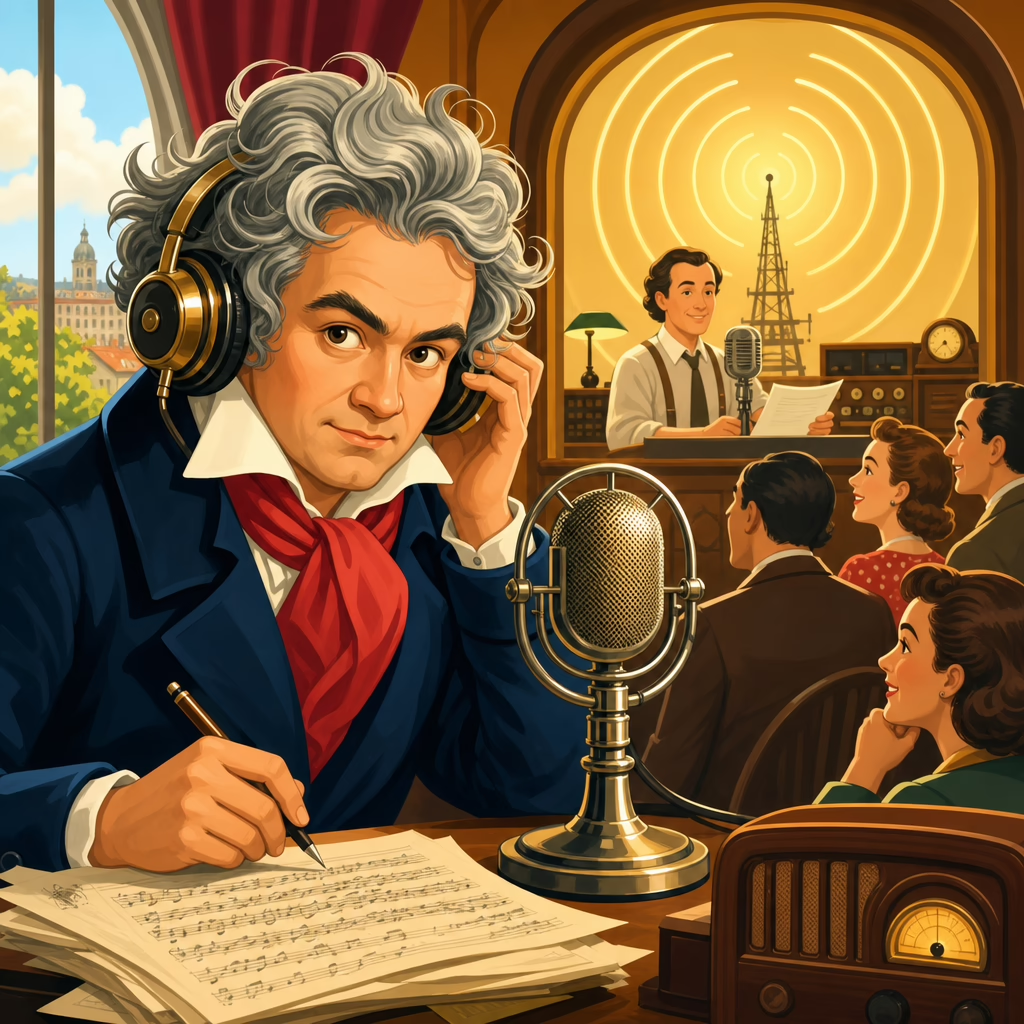
Beethoven and the Golden Age of Radio Broadcasts
Beethoven and the Golden Age of Radio Broadcasts belong together more closely than many listeners realize. During the first half of the twentieth century, radio turned symphonic music from an event limited by geography, ticket prices, and concert hall schedules into a shared public experience heard in living rooms, factories, classrooms, and military barracks. Beethoven, already central to concert programming, became one of the composers most frequently transmitted across national networks because his works combined recognizability, emotional range, and symbolic prestige. In my own archival listening and programming research, Beethoven broadcasts consistently reveal how radio reshaped performance style, audience education, and the commercial life of recordings.
The phrase Golden Age of Radio usually refers to the period from the 1920s through the 1950s, when network broadcasting matured before television displaced it as the dominant home medium. For classical music, that era mattered because radio did more than relay concerts. It created studio orchestras, commissioned announcers who explained musical form in plain speech, standardized timing for overtures and symphonies, and introduced millions of listeners to canonical repertory. Beethoven sat at the center of that system. His Fifth Symphony could open a wartime broadcast with instant dramatic force. The Sixth could support educational programming about orchestral color. The Ninth could function as a civic statement, a diplomatic offering, or a season finale.
This miscellany hub within Performance and Recordings matters because Beethoven on radio cannot be understood through one angle alone. It involves live concerts, transcription discs, sponsor funding, microphone technique, announcer scripts, conductors’ cuts, national identity, listener clubs, and the crossover from broadcast fame into the record catalog. To study Beethoven and the Golden Age of Radio Broadcasts is to study how a composer became a mass-media presence without losing artistic seriousness. That combination explains why these broadcasts still matter to collectors, historians, and anyone tracing how modern listening habits were formed.
How radio made Beethoven a household composer
Radio expanded Beethoven’s reach by removing three barriers at once: distance, price, and prior musical training. Before national broadcasting, hearing a major Beethoven cycle often required living near a strong orchestra or traveling to a festival city. Once stations such as NBC, CBS, the BBC, and major European public networks built reliable schedules, Beethoven became repeat listening. Audiences no longer encountered the Fifth or the Emperor Concerto once a year. They heard them repeatedly, often introduced by familiar hosts who framed what to listen for in the opening motif, slow movement contrast, or finale architecture.
That repetition changed perception. A listener who first approached Beethoven as difficult could gradually recognize recurring forms and thematic development simply through exposure. Broadcasters understood this and leaned into works with strong profiles: the Fifth Symphony, Seventh Symphony, Piano Concerto No. 5, violin sonatas in recital formats, and overtures such as Egmont and Coriolan. Educational series often paired excerpts with explanation, making Beethoven one of the best-taught composers on air. In practical terms, radio made his music part of ordinary weekly life rather than occasional high culture.
National moments amplified the effect. During World War II, the short-short-short-long rhythm of the Fifth Symphony was famously aligned in Allied broadcasting with the Morse code letter V for victory. That association did not invent the symphony’s popularity, but it gave Beethoven fresh political visibility. Broadcasters used his music as a language of resilience and seriousness. In Britain, Germany, the United States, and occupied Europe, Beethoven carried different meanings, yet his presence remained constant. Few composers could operate simultaneously as concert masterwork, public emblem, and educational staple.
Broadcast formats, studio practice, and the sound listeners heard
Radio Beethoven was not one thing. It appeared in live concert relays from major halls, network studio performances designed around microphone placement, school broadcasts with commentary, sponsored variety programs featuring a concerto movement, and special commemorative marathons. Each format shaped interpretation. In a studio, conductors often adjusted balances because early microphones compressed dynamics and favored certain frequencies. Brass could overload. Inner strings could vanish. Engineers and conductors therefore learned to produce a clearer, tighter Beethoven than some halls naturally encouraged.
Timing also mattered. Network slots were rigid. A symphony that ran beyond schedule could disrupt news, sponsor announcements, or linked affiliates. As a result, radio performance practice sometimes favored brisk tempos, reduced repeats, or carefully controlled applause. This was especially true before magnetic tape made editing easier. Live relays carried a palpable sense of occasion, but studio sessions offered precision. Arturo Toscanini’s NBC Symphony broadcasts are a prime example. They were promoted as authoritative Beethoven and reached enormous audiences, yet they were also products of a highly controlled radio environment in which discipline, clarity, and transmission quality were central values.
Announcers were part of the musical experience. A good host translated technical material into accessible language without patronizing the audience. The best scripts identified the opening fate motif of the Fifth, the dance propulsion of the Seventh, or the chorus entry in the Ninth, then stepped aside. This explanatory layer distinguished radio from the traditional concert hall, where printed programs did most of the educational work. In radio, the spoken word and Beethoven’s score collaborated.
| Broadcast format | Typical Beethoven use | Strength | Limitation |
|---|---|---|---|
| Live concert relay | Symphonies, concertos, festival events | Authentic atmosphere and audience energy | Variable sound and strict scheduling risks |
| Studio network performance | Symphonies, overtures, complete cycles | Controlled balance and higher consistency | Less hall ambience, sometimes reduced spontaneity |
| Educational broadcast | Excerpts, explained movements, youth programs | Built listener confidence and musical literacy | Often excerpted rather than complete works |
| Sponsored mixed program | Single movements, overtures, concerto finales | Reached broad mainstream audiences | Commercial interruptions could weaken continuity |
Conductors, orchestras, and signature Beethoven broadcasts
Several conductors became inseparable from Beethoven on radio. Toscanini, through NBC, offered lean textures, rhythmic drive, and a reputation for fidelity to the score that broadcasters marketed aggressively. Wilhelm Furtwängler, heard through German and later postwar transmissions, projected a more elastic, architecturally expansive Beethoven, especially in the Third, Fifth, and Ninth symphonies. Bruno Walter, Otto Klemperer, Adrian Boult, and Serge Koussevitzky each reached listeners through radio in ways that complemented their concert and recording careers. Their broadcasts taught audiences that Beethoven interpretation was not fixed but contested.
Orchestras also built identity through Beethoven. The BBC Symphony Orchestra, the Berlin Philharmonic, the Vienna Philharmonic in relays, the New York Philharmonic, and the NBC Symphony all used Beethoven as a benchmark repertory. If an orchestra sounded disciplined in Beethoven, listeners assumed depth and seriousness. Radio made those institutional reputations portable. Someone hundreds of miles from London or New York could develop loyalty to an orchestra they had never seen.
One overlooked aspect is the role of staff orchestras and regional ensembles. Not every influential Beethoven broadcast came from a world-famous hall. Public broadcasters across Europe maintained capable radio orchestras that presented overtures, symphonies, and chamber arrangements for regular listeners. These ensembles normalized Beethoven as a public good rather than an elite possession. They also trained generations of players in repertory discipline under the pressure of microphones and fixed airtimes.
From broadcast to record shelf: how radio shaped recordings
The relationship between Beethoven radio broadcasts and commercial recordings was reciprocal. Broadcast exposure drove record sales by familiarizing audiences with repertory and star interpreters. At the same time, the recording industry borrowed broadcast authority to market releases as events, anniversaries, or definitive interpretations. In many cases, collectors first encountered a conductor’s Beethoven over the air, then purchased shellac albums or later LPs to revisit the experience. Radio effectively created demand through repetition and trust.
Technical crossover mattered too. Electrical recording, improved microphones, transcription discs, and eventually tape narrowed the gap between what could be broadcast and what could be sold. Some broadcast performances survived because they were preserved on lacquer or transcription discs made for delayed transmission or archive use. These documents are now essential for performance history. They capture interpretive choices that studio discographies alone cannot show: different tempos, wartime substitutions, announcer context, even the tension of live recovery after a memory slip.
For Beethoven, this archive is unusually rich. Researchers comparing a conductor’s commercial Eroica with a live radio Eroica often find meaningful differences in pacing and rhetoric. Broadcast Beethoven was sometimes more urgent, less polished, and more revealing. That is why reissue labels and institutional archives remain important. They preserve not only sound but also the media conditions under which Beethoven became modern listening culture.
Why these broadcasts still matter to listeners, collectors, and researchers
Beethoven radio history remains relevant because it answers practical questions about how people learned to listen in the twentieth century. If you want to understand why certain symphonies became canonical favorites, why some conductors attained near-mythic authority, or why concise spoken program notes still shape music journalism, radio provides the missing link. It created habits of guided listening, repeat exposure, and repertory ranking that still influence streaming playlists, podcast formats, and public classical stations.
Collectors value surviving broadcasts because they preserve singular events. A wartime Fifth, a memorial Eroica, a youth concert built around the Pastoral, or a first local hearing of the Ninth tells us more than notes on a page. Researchers use these materials to study tempo trends, orchestral sonority, broadcasting policy, censorship, sponsorship, and audience formation. Even imperfections matter. Surface noise, compression, and announcer interruptions are evidence of historical use, not merely defects.
As a hub for miscellaneous Performance and Recordings topics, Beethoven and the Golden Age of Radio Broadcasts points outward to related subjects: historic conductors, archive restoration, broadcast transcription technology, wartime programming, public music education, and the transition from network radio to LP culture. The central lesson is simple. Radio did not merely distribute Beethoven; it actively reshaped how Beethoven was performed, explained, remembered, and bought. Anyone exploring performance history should follow those signals back through schedules, microphones, and surviving airchecks.
The key takeaway is that Beethoven thrived on radio because his music answered the medium’s needs while the medium expanded his audience on an unprecedented scale. Strong thematic writing, emotional immediacy, symbolic weight, and adaptability across formats made him ideal for live relays, studio sessions, educational programs, and national ceremonies. In return, radio gave Beethoven continuity in everyday life, not just prestige in the concert hall. That legacy still informs how audiences discover major works today.
If you are building a deeper understanding of Performance and Recordings, use this article as your starting point for the miscellaneous branch of the topic. Seek out preserved broadcasts, compare them with commercial releases, and listen for what radio changed: pacing, balance, narration, and public meaning. The more closely you hear those details, the clearer the modern history of Beethoven becomes.
Frequently Asked Questions
Why was Beethoven such a natural fit for the golden age of radio broadcasts?
Beethoven was almost perfectly suited to radio at the moment broadcasting emerged as a mass medium. By the early twentieth century, his symphonies, overtures, concertos, and chamber works were already deeply embedded in concert life, so stations and networks could rely on audiences recognizing his name and responding to his music with a sense of familiarity and prestige. That mattered enormously in radio’s formative decades, when broadcasters wanted programming that could attract broad audiences while also demonstrating cultural seriousness. Beethoven delivered both. He was revered by conductors, orchestras, educators, and policymakers, yet his music also had enough drama, rhythmic force, and emotional directness to make an impact even through the technical limitations of early transmission.
Another reason Beethoven worked so well on radio was the character of the music itself. His scores often present bold themes, strong contrasts, memorable motives, and clear structural arcs that survive relatively well outside the concert hall. Even listeners without formal musical training could follow the tension and release of a Beethoven movement or respond immediately to the familiar opening of the Fifth Symphony, the expansiveness of the “Pastoral,” or the celebratory power of the Ninth. In an era when many people were hearing orchestral music at home for the first time, Beethoven offered an ideal combination of accessibility and depth. Broadcasters could present him as uplifting, educational, patriotic, universal, or inspirational depending on the occasion, which made his work endlessly adaptable across different kinds of programming.
How did radio change the way ordinary people experienced Beethoven’s music?
Radio fundamentally transformed Beethoven from something many people knew about into something they could regularly hear. Before broadcasting became widespread, live orchestral performance was often limited by location, ticket prices, social custom, and time. A major Beethoven symphony might be available in large cities and elite concert halls, but not to everyone who wanted to hear it. Radio broke those barriers. Suddenly, a factory worker, a farm family, a student, or a soldier could listen to a Beethoven broadcast without traveling to a metropolitan center or paying for admission. That shift mattered culturally because it redefined classical music as a public, shared, recurring presence rather than a special event for a relatively narrow audience.
Just as important, radio changed the setting in which Beethoven was heard. Instead of formal silence in a concert hall, listeners encountered his music in domestic and everyday spaces: living rooms, kitchens, classrooms, workplaces, and community gatherings. That altered both habits of listening and the symbolic role of the music. Beethoven became part of family routines, national commemorations, school instruction, and wartime morale-building. Announcers often introduced works with explanations, historical notes, or interpretive guidance, which helped audiences form a relationship with the music over time. Repetition also played a key role. Because the same overtures, symphonies, and movements were rebroadcast across seasons and networks, listeners gradually became more musically literate and more comfortable with longer forms. In that sense, radio did not merely distribute Beethoven; it trained the public to listen to him in new, more widespread ways.
Which Beethoven works were especially popular on radio, and why?
Certain Beethoven pieces became radio staples because they combined musical impact with practical broadcast advantages. The Fifth Symphony was especially prominent thanks to its instantly recognizable opening and its dramatic progression from tension to triumph. Even over early radio equipment, its iconic four-note motive cut through clearly and powerfully. The Sixth Symphony, or “Pastoral,” was also popular because its vivid moods and pictorial qualities made it easy for announcers to describe and for listeners to follow. The Seventh and Ninth Symphonies appeared frequently as well, often in special or ceremonial programming, because they carried a sense of grandeur and public significance. Overtures such as Egmont and Coriolan were ideal for shorter time slots or introductory segments, while the “Emperor” Concerto and the Violin Concerto gave star soloists attractive repertory for prestige broadcasts.
Broadcasters also favored works that could serve multiple purposes. Beethoven’s music could open a concert, anchor a full symphonic evening, accompany holiday or memorial observances, or support educational programs that walked audiences through musical form and thematic development. Some pieces were selected because of their emotional immediacy; others because they had already acquired symbolic associations with heroism, struggle, liberty, or human brotherhood. The Ninth Symphony, especially its choral finale, became a particularly potent radio event because it could be framed as a statement of unity and civilization. In practical terms, stations and orchestras also tended to repeat repertory that their conductors knew well and that audiences had already embraced. Since Beethoven occupied the core of the orchestral canon, his major works were continually available, repeatedly rehearsed, and easy to promote, making them some of the most reliable choices in the radio era.
Did radio broadcasts influence Beethoven’s cultural image during the twentieth century?
Yes, very strongly. Radio did not simply preserve Beethoven’s existing reputation; it amplified and reshaped it for mass modern audiences. In the nineteenth century, Beethoven had already come to symbolize genius, artistic seriousness, and moral depth. Radio extended those associations into a new media environment and made them part of daily public culture. Because networks often presented Beethoven in contexts of commemoration, civic identity, and national prestige, listeners came to hear his music not only as art but also as a marker of cultural authority. A Beethoven broadcast could signal refinement, educational purpose, and participation in a larger cultural tradition. As a result, his image became even more monumental in the public imagination.
At the same time, radio made Beethoven seem more immediate and present. Voices on air introduced him, interpreted him, and connected his music to contemporary events. During times of political tension and war, broadcasters in different countries could claim Beethoven as a symbol of endurance, freedom, or shared European heritage, even when those meanings competed with one another. Educational programming further contributed to his image by portraying him as both a great master and an approachable composer whose themes listeners could learn to recognize. Over time, these repeated broadcasts helped fix a familiar narrative: Beethoven as the central composer of the symphonic tradition and as a figure whose music belonged to everyone, not just experts or concertgoers. That broad, public-facing image owes a great deal to radio’s reach and repetition.
What is the lasting legacy of the radio era for how people listen to Beethoven today?
The radio era established many of the listening habits and expectations that still shape Beethoven reception in the present. One lasting legacy is the idea that major classical works should be available beyond the concert hall as part of ordinary cultural life. Long before streaming platforms and digital archives, radio taught audiences to expect that they could hear Beethoven at home, hear him repeatedly, and hear him in curated contexts with commentary and interpretation. It normalized remote listening and made recorded or broadcast performance a legitimate path to serious musical engagement. That was a major historical shift, and it remains foundational to how people now encounter classical music through public media, podcasts, online concerts, and on-demand services.
The radio era also helped standardize a core Beethoven repertory and a recognizable style of presentation. Many listeners today still know Beethoven first through the same works heavily favored by broadcasters in the twentieth century: the Fifth, Sixth, Seventh, and Ninth Symphonies, selected overtures, and a handful of concertos and piano sonatas. In addition, the announcer-led format of explaining a work before playing it survives in modern educational broadcasting and classical programming. Perhaps most importantly, radio proved that Beethoven could function simultaneously as high art and mass cultural experience. That dual identity remains central to his place in musical life. Whether someone encounters him in a concert hall, through a symphony stream, on public radio, or in a documentary soundtrack, they are participating in a listening culture that radio helped create and popularize.