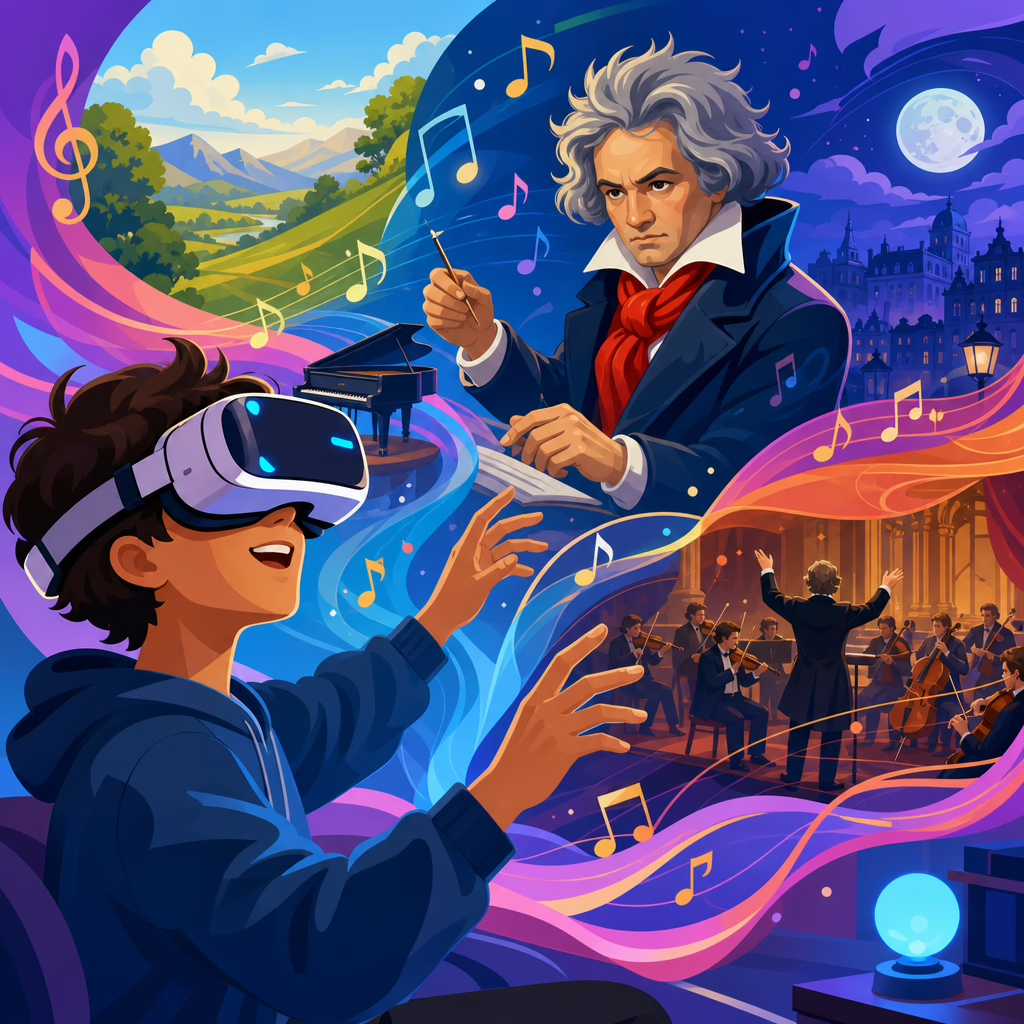
Virtual Reality Experiences Based on Beethoven’s Music
Virtual reality experiences based on Beethoven’s music are moving classical listening from passive appreciation to embodied exploration, giving audiences a way to step inside rhythm, harmony, and historical context rather than simply hearing a symphony from a seat. In this multimedia gallery hub, “virtual reality” means computer-generated environments viewed through headsets such as Meta Quest, HTC Vive, Apple Vision Pro, or PC-tethered systems, while “Beethoven’s music” spans the familiar concert staples—Symphonies Nos. 3, 5, 6, 7, and 9, the late string quartets, the piano sonatas, and shorter works frequently adapted for educational or artistic installations. This topic matters because Beethoven sits at the intersection of cultural recognition and emotional force: his work is globally known, structurally rich, and dramatic enough to support narrative, abstract visualization, historical reconstruction, and interactive learning. I have worked on music-led digital exhibits where audiences responded more strongly when sound, image, and movement were mapped with intention rather than spectacle, and Beethoven is especially well suited to that treatment. His music offers sharply defined motifs, dynamic contrasts, and formal architecture that can be translated into space. For readers exploring the wider multimedia gallery, this page functions as a hub for miscellaneous Beethoven VR formats: concert simulations, educational environments, therapeutic applications, museum installations, game-like interpretations, and experimental audio-visual art.
What Beethoven in Virtual Reality Actually Includes
Beethoven VR is not one format. In practice, it includes at least six distinct categories. First, there are immersive concert experiences that place the viewer onstage, inside the orchestra, or in an idealized acoustic hall. Projects modeled on symphonic performance often use volumetric capture, 360-degree video, or real-time 3D rendering so a user can look toward the brass at the climax of Symphony No. 5 or turn toward strings during the Allegretto of Symphony No. 7. Second, there are educational explorable environments. These break down form, leitmotif-like recurring cells, key changes, instrumentation, and historical background, often synchronizing visual cues to the score. Third, some experiences reconstruct Vienna, Bonn, or salon settings associated with Beethoven’s life, combining archival design references with narration and music excerpts. Fourth, abstract visualizations convert pitch, timbre, dynamics, and harmony into shape, color, and motion; these are common in galleries because they avoid the cost of full historical realism. Fifth, there are interactive performance tools that let users conduct, remix stems, isolate sections, or trigger adaptive visuals through gestures. Sixth, a smaller but important group focuses on accessibility and therapeutic listening, using haptics, captioning, gaze-based navigation, or breathing-guided immersion. When people search for Beethoven virtual reality experiences, they often expect only a “VR concert,” but the field is broader. The strongest hub pages clarify that diversity because users, curators, teachers, and developers all come with different goals.
Why Beethoven Works So Well in Immersive Media
Beethoven adapts unusually well to immersive design because his music is both emotionally direct and structurally legible. A four-note opening such as the famous motif in Symphony No. 5 can be represented visually and spatially with immediate recognition. The “Pastoral” Symphony invites environmental world-building through storm, countryside, brook, and village imagery. The Ninth supports large-scale communal experiences because the choral finale already implies shared human space and collective feeling. The late piano sonatas and quartets, by contrast, suit introspective VR rooms where users can trace variation, fugue, or fragmentation in a more contemplative way. In production terms, this matters because good VR requires a coherent relationship between user attention and sensory change. Beethoven’s abrupt dynamic shifts, motivic development, and clear sectional logic provide strong anchors for interaction design. I have seen abstract music visualizations fail when the source material lacked enough contrast to guide movement or expectation. Beethoven rarely has that problem. His scores create arcs that can become navigable pathways, changing architecture, responsive particles, or embodied timelines. Even his biography contributes to immersion design: themes of struggle, innovation, deafness, and artistic persistence can be integrated without reducing the work to biography. That balance—between music analysis, emotional storytelling, and cultural history—is why Beethoven remains one of the most practical composers for serious VR development.
Core Production Methods Behind Beethoven VR Projects
The technical backbone of a Beethoven VR experience usually combines spatial audio, motion design, interaction systems, and one of three capture approaches: 360 video, volumetric capture, or real-time 3D. Spatial audio is the non-negotiable element. Without it, users may admire the visuals but will not feel meaningfully inside the orchestra or environment. High-quality ambisonics, binaural rendering, object-based mixing, and careful head-tracking are essential if the horns should sound behind the listener in a reconstructed performance of the “Eroica” or if a solo piano sonata should feel intimate rather than flattened. Real-time engines such as Unity and Unreal Engine are standard because they support responsive environments, gesture input, and optimization across devices. Middleware and audio tools including FMOD, Wwise, Max/MSP, or custom DSP pipelines help map musical events to visual or haptic responses. For historically grounded scenes, teams often consult concert hall dimensions, period instruments, and costume references; for abstract pieces, they analyze MIDI, score annotations, or spectral features to drive generative visuals. Good projects also decide early whether users are observers, participants, or co-creators. That choice affects everything from camera comfort and scene density to interaction latency. If users conduct Beethoven, the system needs low-latency tracking and forgiving gesture recognition. If they roam inside a symphony, transitions must avoid nausea and preserve musical continuity. The difference between a compelling Beethoven VR experience and a forgettable one is usually not budget alone; it is the discipline of aligning musical structure with technical design.
Common Experience Formats and Their Strengths
Different formats serve different audiences, and the most successful multimedia hubs make those distinctions clear. Museum installations favor short sessions, simple onboarding, and high visual impact because throughput matters. Educational versions used in schools or universities need guided narration, chapter markers, and teacher-ready modules tied to music history or theory standards. Consumer headset releases benefit from replayability, intuitive menus, and comfort settings because users explore at home without staff support. Festival and gallery works can be more experimental, leaning into abstraction, room-scale movement, or mixed-reality overlays. Live hybrid performances are another growing category: an orchestra performs Beethoven while some attendees wear headsets that add visual layers, translated subtitles, instrument highlights, or synchronized scenography. This format can be powerful, but it is technically demanding because timing drift is unforgiving in classical performance. I have worked on synchronized media installations where even slight latency damaged trust; in Beethoven, where rhythmic expectation is strong, slippage becomes obvious fast.
| Format | Best Use | Main Advantage | Main Limitation |
|---|---|---|---|
| 360 concert VR | Audience immersion | Fast to understand | Limited interactivity |
| Real-time 3D exploration | Education and repeat visits | Interactive and scalable | Higher development cost |
| Museum installation | Public cultural venues | Curated impact | Short session length |
| Abstract audiovisual art | Galleries and festivals | Creative freedom | May need interpretation |
| Conducting simulator | Learning and engagement | Embodied participation | Gesture tracking challenges |
| Therapeutic or accessible VR | Wellbeing and inclusion | Broader reach | Needs specialist design |
For a Beethoven-themed miscellaneous hub, covering all these formats matters because readers may be searching for headset apps, museum exhibits, classroom tools, or commissioning references. A strong hub article points them toward the right branch instead of treating every immersive music project as the same thing.
Educational, Therapeutic, and Accessibility Uses
One of the most valuable aspects of Beethoven VR is that it can deepen understanding without requiring advanced musical training. In educational builds, users can walk through sonata form as if it were architecture: exposition areas introduce themes, development spaces fracture and transform them, and recapitulation zones return material with changed perspective. This sounds conceptual, but when designed well it is memorable. Students who struggle to follow formal analysis on paper often understand it faster when harmonic tension changes the room, instrument groups light up with entries, and motifs visibly travel across space. Beethoven’s “Pastoral” also supports interdisciplinary teaching by linking music to environmental imagery, eighteenth- and nineteenth-century culture, and programmatic listening. On the therapeutic side, immersive music environments have been explored for stress reduction, emotional regulation, reminiscence work, and sensory engagement, though claims should stay measured. VR is not a substitute for clinical treatment, and Beethoven’s intensity is not suitable for every user or context. Still, guided slow-breathing sessions built around selected adagios or carefully mixed piano works can help focus attention and reduce external distraction. Accessibility deserves equal emphasis. Captioning for sung text in the Ninth, visual rhythm cues, optional sign-language overlays, haptic wearables that translate pulse and dynamics, seated navigation, and low-vision interface design all expand who can participate. Beethoven is historically linked to hearing loss, so accessible immersive design carries special symbolic weight when done thoughtfully and without sentimentality.
Challenges, Rights, and Quality Standards
The biggest misconception about Beethoven VR is that public-domain music means effortless production. Beethoven’s compositions are public domain in many jurisdictions, but specific recordings, performances, editions, and visual assets may still be protected. A developer can use the notes of Symphony No. 9, yet still need licenses for an orchestra’s recorded performance, a conductor’s filmed likeness, or proprietary sample libraries. Beyond rights, there are artistic and technical standards to respect. Spatial mixes should be built from the listener’s intended position, not faked at the end. Motion should follow comfort guidelines established across the XR industry: limited forced acceleration, stable horizons where appropriate, clear teleportation options, and session lengths matched to headset fatigue. Visual metaphor also requires discipline. Not every crescendo needs an explosion of particles, and not every minor-key section needs darkness. Users notice when visuals merely decorate the music instead of interpreting it. Historically oriented projects must avoid turning Beethoven into a stereotype of tragic genius detached from context. Vienna’s patronage systems, changing concert culture, instrument technology, and political upheaval all shaped the music. Finally, testing matters more than many creative teams expect. Musicians, educators, museum staff, children, older adults, and first-time VR users will all read the same piece differently. The best projects iterate with those audiences early, not after the concept is locked.
How to Explore This Multimedia Gallery Hub Effectively
As a sub-pillar hub under Multimedia Gallery, this page should help readers navigate every major miscellaneous angle of Beethoven-based virtual reality. If you are a casual visitor, start with immersive concert experiences and abstract visualizations; they deliver the quickest sense of what Beethoven VR feels like. If you are an educator, prioritize classroom-ready modules, conducting simulators, and explorable music theory environments. If you work in museums or digital humanities, focus on historical reconstructions, exhibition case studies, and accessibility design. If you are commissioning or producing, compare capture methods, spatial audio workflows, rights requirements, and comfort standards before choosing a platform. The central takeaway is simple: the best virtual reality experiences based on Beethoven’s music do not just add visuals to famous works. They translate musical form, emotional pacing, and cultural context into spaces people can inhabit and understand. That is the real benefit of this medium. It can make canonical music feel newly legible without making it simplistic, and it can widen access without flattening complexity. Use this hub as your starting point, then follow the related articles in the multimedia gallery to find the format, audience, and production model that matches your goals.
Frequently Asked Questions
What are virtual reality experiences based on Beethoven’s music?
Virtual reality experiences based on Beethoven’s music are immersive digital environments that translate his compositions into spaces you can look around in, move through, and interact with using a VR headset. Instead of simply listening to a symphony in a concert hall or through headphones, the audience is placed inside a visual and spatial interpretation of Beethoven’s musical world. A slow movement might appear as a floating architectural landscape shaped by harmony and orchestration, while a powerful finale could become a sweeping, kinetic environment driven by rhythm, tension, and release. These experiences often combine spatial audio, animated visuals, motion-tracked interaction, and historical storytelling to create a richer connection to the music.
What makes this format distinctive is that it can represent both the emotional structure and the cultural context of Beethoven’s work. A VR experience may guide users through a stylized Vienna, place them beside a virtual orchestra, or visualize musical motifs as light, color, and movement. Some projects are designed primarily as artistic interpretations, while others function as educational tools that explain form, instrumentation, and biography in accessible ways. In both cases, the goal is the same: to transform Beethoven from something you observe at a distance into something you explore from within.
How does VR change the way people experience Beethoven compared with a traditional concert or recording?
VR changes the experience by shifting the listener from a fixed audience position to an active point of presence inside the music. In a traditional concert, your role is largely observational: you sit, listen, and watch the performers from one physical perspective. In a recording, that perspective is narrowed even further, because the sound mix and presentation are already decided for you. Virtual reality introduces a sense of embodiment. You may be able to stand among instrumental sections, follow a musical theme as it moves through space, or trigger visual layers that reveal how a passage is constructed. This makes the experience more exploratory and often more intuitive, especially for people who are new to classical music.
It also changes comprehension. Beethoven’s music is famous for dramatic contrasts, motivic development, and emotional intensity, and VR can make those qualities easier to grasp by giving them visual and spatial form. A recurring motif can appear as a recognizable object or pathway. A modulation can be felt as a change in the environment around you. Crescendos can affect scale, motion, and lighting in real time. For experienced listeners, this can deepen appreciation by offering a new interpretive layer. For newcomers, it can reduce the intimidation factor often associated with classical music and replace it with curiosity, discovery, and direct sensory engagement.
What kinds of Beethoven works are best suited for virtual reality adaptation?
Many of Beethoven’s best-known works are especially well suited to VR because they already contain strong dramatic architecture and vivid emotional contrasts. The symphonies, particularly the Fifth, Sixth, Seventh, and Ninth, are natural candidates because they offer clear shifts in mood, momentum, and orchestral texture that can be translated into immersive environments. The Fifth Symphony’s iconic opening motif lends itself to bold visual identity and narrative progression, while the “Pastoral” Symphony is ideal for environmental world-building, with its evocation of countryside scenes, weather, and human feeling in nature. The Ninth can support both abstract and communal experiences, especially when interpreted around the scale and emotional reach of the “Ode to Joy.”
Other works can be just as compelling. Piano sonatas such as the “Moonlight,” “Pathétique,” and “Appassionata” offer intimate emotional landscapes that work beautifully in more personal, introspective VR settings. String quartets may be adapted for close listening experiences that place users inside the ensemble, allowing them to perceive dialogue between instruments in a highly focused way. Even shorter overtures and concert excerpts can be effective when the goal is education, accessibility, or gallery-based exhibition. Ultimately, the best Beethoven works for VR are those with strong internal tension, clear structural identity, and enough expressive range to support both sound design and spatial storytelling.
Do you need expensive equipment or prior classical music knowledge to enjoy a Beethoven VR experience?
No, and that accessibility is one of the strongest advantages of the format. Most Beethoven VR experiences are designed so that first-time users can understand the basics quickly, whether they are using a standalone headset like Meta Quest, a more advanced device such as Apple Vision Pro, or a PC-connected system like HTC Vive. In many gallery, museum, and educational settings, the hardware is provided and the experience is guided, so users simply put on the headset, adjust the fit, and follow clear prompts. Developers typically build intuitive navigation and limited interaction into these experiences because they want the music, not the controls, to remain the focus.
Likewise, you do not need a background in music theory or Beethoven scholarship. A well-designed VR project can introduce key ideas gradually by combining what you hear with what you see and do. For example, rather than explaining sonata form in technical language, the experience might let you move through contrasting spaces that represent themes, conflict, development, and return. Historical references can also be woven into the environment instead of delivered as dry lecture material. This makes Beethoven more approachable for casual audiences while still offering enough depth to satisfy students, educators, and long-time classical listeners. In short, the best experiences meet people where they are and use immersion to build understanding naturally.
What educational and cultural value do virtual reality experiences based on Beethoven’s music offer?
These experiences offer significant educational value because they make abstract musical ideas tangible. Beethoven’s compositions are often taught through concepts such as motif, structure, dynamics, orchestration, and historical influence, but those concepts can feel remote to non-specialists when presented only through text or lecture. VR can bridge that gap by turning musical relationships into navigable experiences. A user might see individual instrumental lines emerge around them, witness the build of a crescendo as environmental transformation, or compare different interpretations of the same passage in a way that is immediate and memorable. This can support classroom learning, museum education, lifelong learning programs, and public outreach in ways that traditional formats sometimes cannot.
Culturally, VR also helps reposition Beethoven for contemporary audiences without diminishing the importance of the original music. Rather than replacing concerts, recordings, or scholarship, it creates a new entry point into the repertoire. This matters because Beethoven is often treated as monumental and untouchable, which can unintentionally discourage engagement. Immersive media can humanize him, situate his work in historical context, and show why these compositions still resonate today. When thoughtfully produced, Beethoven VR experiences can connect music history, digital art, performance practice, and interactive design into a single platform, opening classical culture to broader and more diverse audiences while preserving the emotional power that made the music endure in the first place.