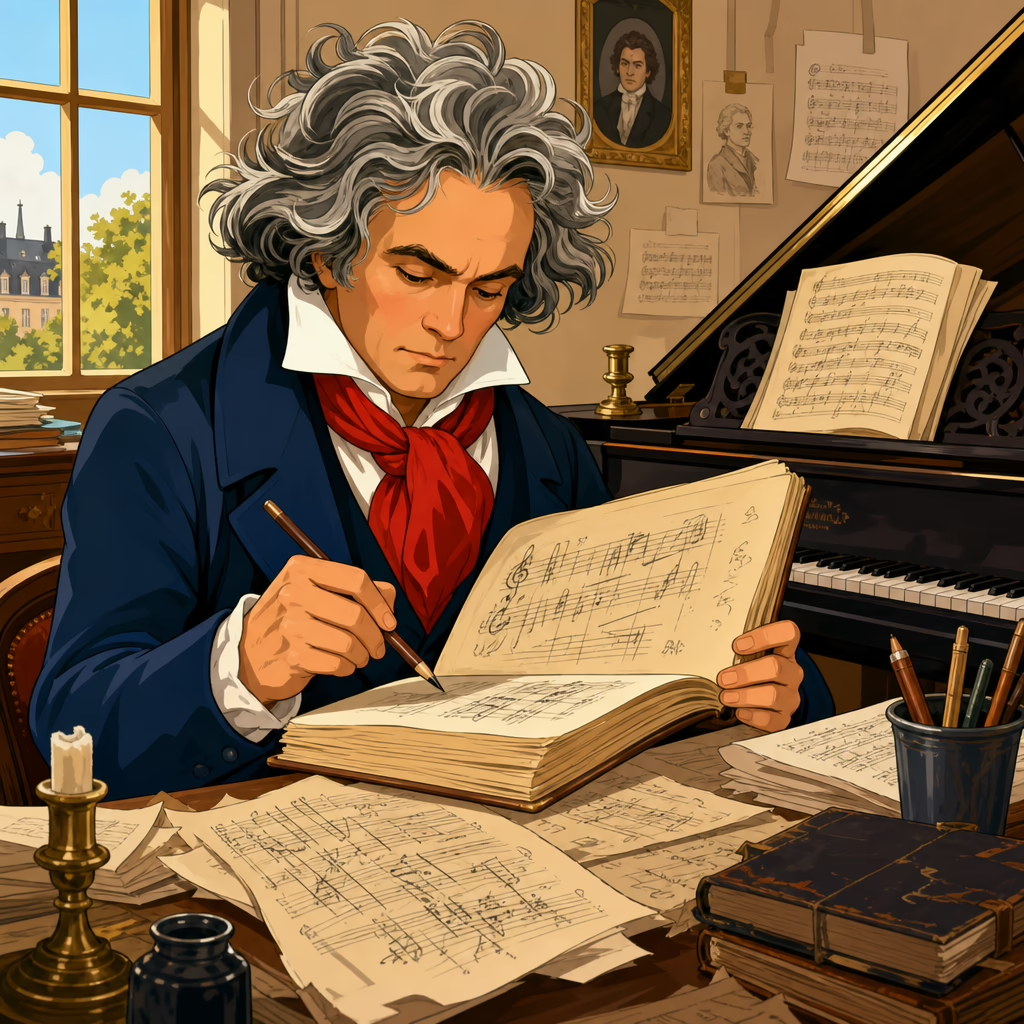
The Role of the Sketchbook in Beethoven’s Process
Beethoven’s sketchbooks were not casual notebooks but working laboratories where musical ideas were tested, broken apart, rebuilt, and pushed toward the form we now hear in his finished scores. In the broad topic of Beethoven’s compositional tools, the sketchbook belongs to the miscellaneous category because it connected everything else: keyboard experiments, loose sheets, conversation books, publishers’ copies, and the practical demands of writing for performers. When scholars discuss Beethoven’s process, they mean the chain of decisions between first impulse and final notation. The sketchbook is the richest surviving record of that chain. It matters because it shows composition as revision, not inspiration alone, and because no other source reveals so clearly how Beethoven developed motives, planned structure, and solved technical problems across works in nearly every genre.
Having worked through facsimiles and modern editions of the sketch materials, I can say the most striking lesson is how stubbornly Beethoven returned to tiny cells of rhythm and interval. A few notes in a sketchbook often become the driving force of an entire movement. The notebooks preserve alternate openings, abandoned transitions, voice-leading corrections, and reminders to himself about orchestration or formal balance. They also help explain why Beethoven’s music feels both inevitable and hard won. The page records uncertainty. That uncertainty is valuable for listeners, performers, teachers, and researchers because it replaces the myth of effortless genius with visible craft. For a hub on Beethoven’s compositional tools, the sketchbook is the central miscellaneous source because it ties together evidence from manuscripts, paper studies, dating, and the daily habit of making music through writing.
In practical terms, a Beethoven sketchbook can be a bound notebook, a gathering of leaves, or a more loosely assembled workbook that later entered an archive. Some are pocket-sized and clearly meant for carrying ideas during walks; others are larger drafting spaces for sustained compositional planning. Scholars distinguish between sketchleaves, desk sketchbooks, pocket sketchbooks, and score sketches. Those categories matter because each format encouraged a different kind of thinking. Pocket books capture flashes: motives, bass lines, reminders. Desk books support larger continuity: thematic development, movement plans, contrapuntal trials. Score sketches move closer to finished notation. Together they show that Beethoven did not simply write down completed music from memory. He discovered music by drafting it.
What Beethoven’s sketchbooks were and how he used them
Beethoven used sketchbooks across much of his career, from Bonn and early Vienna through the late period, though the surviving record is uneven. A sketchbook was not a diary in the literary sense. It was a problem-solving surface. One page might contain a piano sonata idea, another a mass setting, another a fragment of canonic writing, and another a calculation about text underlay or instrumentation. He reused space, crossed out passages heavily, and often wrote in compressed, difficult shorthand. That density tells us the notebooks were private working tools, not documents meant for display. Their function was immediate utility.
In my own reading of these pages, the most consistent pattern is iterative compression and expansion. Beethoven would start with a bare rhythm or melodic contour, then test several continuations, then pull back and rethink the whole. A famous example appears in studies related to the Third Symphony, where short motivic germs are turned repeatedly until a broad symphonic argument emerges. Similar behavior appears in piano sonatas and string quartets. The notebook lets him hear possibilities before committing ink to a cleaner manuscript. This method is one reason Beethoven’s middle and late styles feel tightly integrated: the sketchbook is where integration was engineered.
These books also reveal that composition was physical. Beethoven wrote at the piano, away from the piano, indoors, and outdoors. Contemporary accounts describe his habit of carrying paper on walks. The sketchbook therefore functioned as an external memory system. For a composer dealing with increasing hearing loss, that function became even more important. He could preserve a musical thought instantly, return later, and refine it through visual and tactile means. The page was not a substitute for hearing, but it became a durable field where musical imagination could be manipulated with extraordinary control.
How sketchbooks shaped motives, form, and revision
The clearest answer to the question “What did Beethoven use sketchbooks for?” is this: he used them to develop motives into structure. In many works, the seed is astonishingly small. A rhythm, an interval, a repeated note, or a bass progression appears first. Then Beethoven subjects it to sequence, inversion, displacement, fragmentation, and recombination. What later sounds monumental often began as a terse experiment. This is especially important for understanding sonata form in Beethoven. Exposition themes, transition material, codettas, development episodes, and recapitulation revisions are often visible in rough order before they become coherent on the fair copy.
The Fifth Symphony offers the best-known example of motivic concentration, even if not every stage survives in a single continuous notebook. The short-short-short-long rhythm was not merely a catchy opening; Beethoven explored how such a compact cell could control momentum across movements. In sketch sources for many works, one sees him rejecting more decorative alternatives in favor of stronger profiles. That choice explains why his themes often feel less ornamental than those of some contemporaries. The sketchbook helped him strip away the nonessential until the structural core remained.
Revision in these books was not cosmetic. Beethoven regularly reconsidered proportion, tonal pacing, and thematic order. He might replace a smoother melodic line with something more resistant because resistance generated stronger development. He might alter register to clarify the bass or intensify a climax. He might defer a cadence to enlarge dramatic tension. This is why sketchbooks matter to performers. They do not merely show discarded notes; they show the priorities behind the final text. When a performer understands that a passage emerged from repeated efforts to sharpen rhythm or motivic identity, interpretation becomes less generic and more grounded in compositional intent.
| Sketchbook feature | What it reveals | Example of musical consequence |
|---|---|---|
| Repeated motive variants | Beethoven tested identity before expansion | A compact opening gains long-range structural power |
| Crossed-out transitions | He revised pacing and tonal direction | Modulations feel more dramatic and less routine |
| Layered contrapuntal trials | Texture was engineered, not added late | Fugues and imitative passages achieve unusual density |
| Short reminders and verbal notes | He tracked orchestration, text, or formal balance | Later drafts show more deliberate scoring and proportion |
What the surviving sources tell scholars and performers
Not every Beethoven sketchbook survives, and not every surviving source is easy to date. That limitation matters. Scholars reconstruct chronology through handwriting, watermarks, paper type, associated works, and documentary records. Institutions such as the Beethoven-Haus Bonn, the Berlin State Library, and other major repositories preserve key materials, while landmark editorial projects have organized many sources into usable form. The standard modern cataloging of Beethoven’s works, including Kinsky-Halm numbers and later thematic and manuscript studies, helps connect sketches to completed compositions. Without that technical scholarship, the notebooks would remain fascinating but far less interpretable.
For musicologists, sketchbooks are evidence of process, chronology, and aesthetic choice. They can show whether Beethoven conceived sections continuously or in blocks, whether a finale was planned early, or whether a borrowed contrapuntal device entered late. They also expose the danger of oversimplifying style periods. Early, middle, and late Beethoven are convenient labels, but the sketchbooks reveal continuity in his habits of testing, revising, and compressing motives. What changes over time is scale, abstraction, and the complexity of connections between ideas.
For performers, the value is different but just as concrete. A violinist studying late quartets, a pianist preparing a sonata, or a conductor shaping a symphony can learn where Beethoven fought hardest for clarity or tension. If a final score contains an awkward leap, a severe accent, or an apparently stubborn repetition, sketches may show that the effect was deliberate rather than accidental. This can change articulation, tempo flexibility, pedaling, bow distribution, or balance. In rehearsal, those choices matter more than biographical anecdotes. The sketchbook gives working evidence.
Connections to other compositional tools in Beethoven’s workshop
As a hub page within Beethoven’s compositional tools, this topic must connect the sketchbook to other miscellaneous materials rather than treat it in isolation. The sketchbook interacted constantly with loose sketchleaves, bifolios, autograph scores, copyists’ manuscripts, corrected proofs, and, later in Beethoven’s life, conversation books. Loose leaves often carried ideas too large or too immediate for a bound notebook. Autograph scores represent a later stage, but they still contain revision traces that can often be linked back to notebook experiments. Copyists’ manuscripts reveal yet another layer, because Beethoven continued correcting after preparation of performance materials.
The keyboard also remained part of the system. Beethoven was a formidable pianist, and many sketches imply tactile thinking: figuration under the hand, registral spacing, pedal resonance, and dynamic attack. Yet the notebook proves he was never dependent on improvisation alone. He translated sonic intuition into visual planning. That balance between instrument and page is one reason his music can feel both idiomatic and architecturally rigorous. The sketchbook mediated between spontaneous invention and durable structure.
Conversation books belong to the miscellaneous orbit for a different reason. In the late years, visitors wrote remarks and questions because Beethoven could not hear them well. These books are not sketchbooks, but they help situate the working environment in which late compositions emerged. Combined with desk sketches and score drafts, they remind us that Beethoven’s process was distributed across objects. No single source explains everything. The sketchbook is central because it records musical formation most directly, but it becomes even more meaningful when read alongside the wider paper trail of daily work.
Why the sketchbook remains essential to understanding Beethoven
The main benefit of studying Beethoven’s sketchbooks is simple: they show how masterpieces were made. They demonstrate that musical greatness can come from relentless revision, close attention to small details, and the courage to discard attractive but weaker ideas. They also correct a common misunderstanding. Beethoven was certainly capable of sudden inspiration, but the surviving notebooks prove that inspiration alone did not produce the Eroica, the late quartets, the piano sonatas, or the Missa solemnis. Those works were built through experimentation on paper.
For students and general readers, the sketchbook offers an accessible entry into serious Beethoven study because it makes abstract claims visible. Instead of saying “Beethoven develops motives intensively,” one can point to pages where he does exactly that. Instead of claiming “his forms are dynamic,” one can observe how transitions, codas, and climaxes were revised. For teachers, these materials are ideal for explaining composition as process. For researchers, they remain indispensable primary sources. For performers, they sharpen interpretation by clarifying what Beethoven insisted on and what he reconsidered.
If you are exploring Beethoven’s compositional tools, start with the sketchbook and then follow the links outward to autograph scores, loose leaves, copyists’ manuscripts, and conversation books. Read the page not as a relic but as an active workshop. That perspective turns Beethoven from a monument into a working composer, and that is the most useful way to understand him. Study the sketches, compare them with the finished scores, and you will hear the music with deeper precision, stronger historical grounding, and greater respect for the labor behind its power.
Frequently Asked Questions
What exactly were Beethoven’s sketchbooks, and why do they matter so much?
Beethoven’s sketchbooks were working documents used to develop music in progress, not polished journals or casual notebooks. They contain themes in embryo, rhythmic cells, harmonic experiments, revisions, abandoned passages, structural plans, and reminders to himself about how a piece might unfold. In other words, they preserve composition as an active process rather than as a finished result. That is why they matter so much: they allow scholars, performers, and readers to see Beethoven thinking on the page.
What makes them especially important is that they reveal how far Beethoven was from the popular myth of effortless inspiration. The sketchbooks show a composer testing possibilities, rejecting weak ideas, reshaping promising ones, and returning to the same musical problem again and again until it achieved the necessary force and coherence. A simple motive might appear in several altered forms before finding its place in a sonata, quartet, or symphony. Through these pages, we can watch Beethoven convert raw material into large-scale structure.
They also matter because they sit at the center of his broader compositional toolkit. Beethoven worked at the keyboard, on loose sheets, in formal manuscript scores, and in other practical documents connected to copying, revision, and performance. The sketchbook links these stages together. It is often the place where an idea first acquires shape before moving into a more stable draft or score. For that reason, the sketchbook is not just supplementary evidence; it is one of the clearest windows into how Beethoven’s music was actually made.
How did Beethoven use sketchbooks during the act of composition?
Beethoven used sketchbooks as laboratories for trial and transformation. Rather than writing down complete works from beginning to end, he often began with small fragments: a contour, a bass line, a rhythmic pattern, or a harmonic motion. In the sketchbook, these fragments could be turned over from multiple angles. He might compress a phrase, expand it, sequence it, shift its accents, alter its interval pattern, or place it in a new key area. This kind of testing shows that the sketchbook was where possibility remained open.
Just as important, the sketchbooks show Beethoven working simultaneously at local and large scales. He did not only refine individual themes; he also grappled with transitions, recapitulations, codas, and the balance of an entire movement. A page might contain a tiny motive next to an outline for a broader formal plan. This is one reason the sketchbooks are so revealing: they demonstrate that Beethoven’s process was not simply melodic invention followed by orchestration. He was building relationships among motives, sections, and dramatic trajectories from early on.
The sketchbook also gave him a flexible place to interrupt, return, and rethink. A musical idea could be left unresolved on one page and resumed later in a different context. This stop-and-start quality was productive rather than accidental. It let Beethoven preserve possibilities without forcing immediate decisions. The result is a record of composition as sustained problem-solving, where the act of writing itself becomes a way of hearing, testing, and clarifying musical thought.
Did Beethoven’s sketchbooks prove that he revised heavily instead of composing in a single burst of inspiration?
Yes, very clearly. The sketchbooks are some of the strongest evidence that Beethoven revised extensively and deliberately. They show crossed-out measures, rewritten themes, alternate continuations, false starts, and major reworkings of formal design. This does not mean inspiration played no role in his work; rather, the sketchbooks show that inspiration was only the beginning. What made Beethoven distinctive was his ability to subject an inspired idea to intense scrutiny until it carried structural weight and expressive necessity.
This record of revision is crucial because it changes how we understand creative genius. Beethoven’s greatness did not depend on instantly producing flawless music. Instead, the sketchbooks reveal a composer with exceptional critical judgment about his own material. He knew when an idea had energy but lacked direction, when a transition failed to persuade, or when a theme needed further compression to become truly powerful. Revision was not evidence of uncertainty in a negative sense; it was evidence of artistic discipline.
For modern readers, this can be one of the most compelling aspects of the sketchbooks. They humanize Beethoven without diminishing him. We see difficulty, persistence, and decision-making. We also see that many famous works emerged through accumulation and refinement rather than through sudden completion. The finished score can look inevitable, but the sketchbook shows that inevitability was achieved, not given. That insight is one of the central reasons these documents remain indispensable in Beethoven studies.
How do Beethoven’s sketchbooks connect to his other compositional tools, such as the keyboard, loose sheets, and publishers’ copies?
Beethoven’s sketchbooks did not exist in isolation. They were part of a larger network of compositional tools, and their importance lies partly in how they connect those tools. At the keyboard, Beethoven could test sonorities, voicings, textures, and immediate physical effects. On loose sheets, he might pursue a passage more expansively or jot down ideas that arose outside the bound sketchbook. In more formal manuscripts, those ideas moved toward legibility, continuity, and performable form. Publishers’ copies then carried the music into circulation, often with further corrections and adjustments. The sketchbook sits near the center of this chain because it often captures the transition from impulse to design.
This is why the sketchbook belongs to the “miscellaneous” category in discussions of Beethoven’s materials, even though its role was anything but minor. It touched everything else. A passage tested at the piano could appear as a compressed notation in a sketchbook, then re-emerge on a loose sheet with fuller detail, and finally enter a score prepared for copyists or publishers. The sketchbook is therefore a connective medium, where different kinds of musical thinking meet: physical experimentation, conceptual planning, notation, revision, and practical preparation for performance.
It also reflects the realities of Beethoven’s working life. He composed under deadlines, negotiated with publishers, revised for performers, and often had to manage multiple projects at once. The sketchbook provided continuity amid that complexity. It helped him preserve ideas across changing contexts and stages of production. For scholars, that means sketchbooks are not merely interesting side documents; they are often the key to reconstructing how Beethoven moved from one compositional medium to another.
What do scholars learn from studying Beethoven’s sketchbooks today?
Scholars learn an enormous amount from Beethoven’s sketchbooks, especially about chronology, method, and artistic intention. Because sketches can often be linked to known works, researchers can trace when certain ideas first appeared, how long they remained in development, and how they changed before reaching the finished score. This helps establish timelines for composition and can clarify relationships among works that were being developed at the same time. In some cases, the sketchbooks show that a musical idea had a much longer history than the finished piece alone would suggest.
They also help scholars understand Beethoven’s habits of thought. For example, the sketchbooks can reveal whether a movement grew from a rhythmic idea, a harmonic scheme, or a thematic fragment. They show how Beethoven handled motivic unity, how he approached formal tension, and how he balanced spontaneity with control. This matters not just for biography, but for musical interpretation. Conductors, performers, and editors can gain insight into emphasis, pacing, articulation, and structural logic by seeing what Beethoven struggled with and what he chose to preserve.
Finally, the sketchbooks remind scholars that a masterpiece is a history of decisions. They expose alternatives that were possible but rejected, which sharpens our understanding of the choices Beethoven ultimately made. That does not reduce the authority of the final score; if anything, it deepens it. By studying the sketches, we understand more fully how Beethoven shaped intensity, unity, contrast, and momentum. The sketchbooks are therefore invaluable not only as historical artifacts, but as active evidence of one of music history’s most searching and rigorous creative minds.