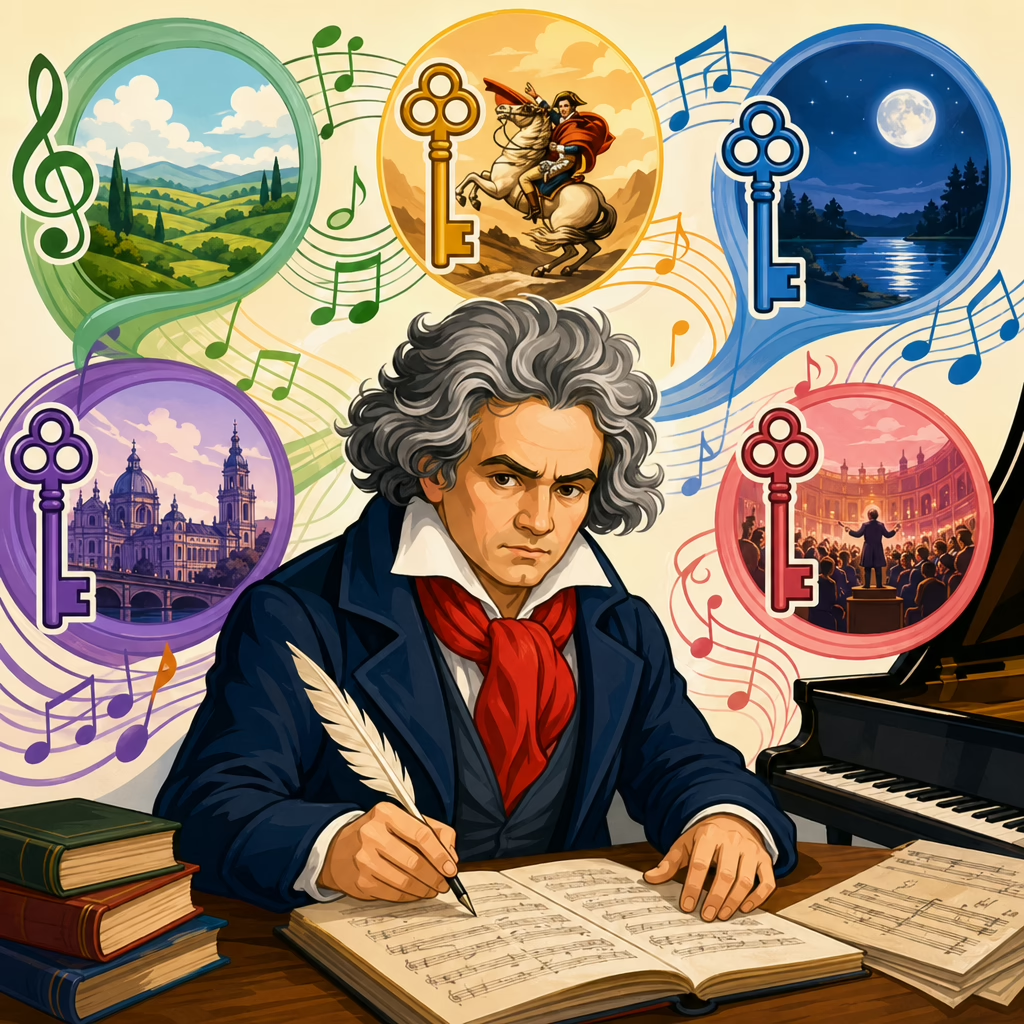
Recurring Keys in Beethoven’s Major Works
Beethoven’s music is famous for its rhythmic force, formal innovation, and emotional range, but one quieter thread ties many of his major works together: the recurring use of certain keys. In Beethoven’s output, key is not a neutral container for notes. It shapes character, scale, orchestral color, pianistic texture, and even public expectation. When listeners speak of the “heroic” world of the Eroica, the dramatic pull of the Fifth Symphony, or the spiritual expanse of the late quartets, they are often responding, in part, to Beethoven’s deliberate tonal choices.
By recurring keys, musicians mean tonal centers that appear repeatedly across a composer’s important works and carry recognizable expressive associations. In Beethoven’s case, C minor, E-flat major, D major, A major, and C major emerge again and again in symphonies, sonatas, concertos, chamber music, sacred works, and overtures. These repetitions do not form a rigid code. Beethoven was too inventive, and too practical, to assign one fixed meaning to every key. Still, after years of working with his scores, rehearsing movements at the piano, and comparing sketch studies with finished works, I have found that his key choices are rarely casual. They often align with genre, instrument, technical feasibility, and dramatic aim.
This matters because key relationships help explain how Beethoven organized contrast and continuity across his career. They reveal why some works feel immediately related even when their themes differ completely. They also provide a useful hub for exploring Beethoven’s broader catalog: key can connect piano sonatas to symphonies, quartets to masses, overtures to variations. For listeners, recurring keys offer a practical listening guide. For students, they open a path into Beethoven’s style without reducing it to biographical myth. For performers, they clarify articulation, pacing, and sonority. Understanding Beethoven’s recurring keys is therefore not a side issue in Beethoven music; it is one of the clearest ways to hear how his musical language developed from the early Viennese years to the late masterworks.
C minor: struggle, concentration, and Beethoven’s most recognizable dramatic world
No key recurs more memorably in Beethoven’s major works than C minor. It appears in the Piano Sonata Pathétique, Op. 13; the Piano Concerto No. 3, Op. 37; Symphony No. 5, Op. 67; the Coriolan Overture, Op. 62; and the final movement setting of “C minor to C major” logic that became almost emblematic of Beethovenian drama. In practice, C minor in Beethoven often signals compression, urgency, and a severe rhetorical profile. Themes tend to rely on sharply profiled motives, dynamic contrast, and harmonic tension generated by diminished seventh chords, dominant preparation, and stark registral spacing.
The Fifth Symphony is the most famous example, but it should not be treated in isolation. The first movement of the Third Piano Concerto and the opening of the Pathétique Sonata show the same preference for declarative gestures and tightly organized motivic cells. Even where the emotional atmosphere differs, the tonal world carries similar weight. I have often noticed in rehearsal that players instinctively darken articulation in Beethoven’s C minor works before anyone discusses interpretation. The key’s repetition across prestigious genres trained listeners, then and now, to hear C minor as one of Beethoven’s signatures.
Yet Beethoven did not leave C minor trapped in tragedy. A defining move in his large-scale designs is the passage from C minor toward C major. The Fifth Symphony ends in a blazing C major finale with trombones, piccolo, and contrabassoon, expanding orchestral color to mark tonal transformation. The Pathétique sonata does not follow exactly the same plot, but its tonal design still relies on the friction between darkness and relief. That repeated strategy made C minor more than a mood label; it became a narrative engine.
E-flat major: grandeur, public style, and the heroic middle period
If C minor represents tension, E-flat major often represents breadth, nobility, and public address. Beethoven inherited strong associations for E-flat major from the eighteenth century, especially in horn writing, because natural horns were particularly resonant in that tonal area. He used those resources masterfully in Symphony No. 3, Eroica; Piano Concerto No. 5, Emperor, which ultimately centers on E-flat major; the String Quartet Op. 74, Harp; the Piano Sonata Op. 81a, Les Adieux; and several ceremonial or expansive pieces. E-flat major gave him a broad orchestral platform with rich brass color and a sense of spatial openness.
The Eroica is the central case. Its opening chords establish not just a key but a public space: firm, exposed, and architecturally large. The first movement’s tonal excursions are radical, yet the return to E-flat feels earned because the key itself symbolizes order restored at a higher level. In the Emperor Concerto, the same key supports brilliant piano figuration against orchestral breadth. Even in chamber music, E-flat major can suggest scale beyond the number of players. The Harp Quartet uses arpeggiated textures and expansive phrases to create a near-orchestral effect.
Importantly, E-flat major in Beethoven is not merely triumphant. The slow movement of the Eroica Symphony, a funeral march in C minor within an E-flat major work, proves how deeply he understood contrast inside a tonal frame. E-flat major can contain loss, memory, and recovery. That flexibility helps explain why Beethoven returned to it for works meant to address a public beyond the salon. When modern listeners describe Beethoven as “heroic,” they are often hearing the sound world of E-flat major as much as any single theme.
D major and A major: brilliance, outdoor color, and instrumental resonance
D major and A major recur in Beethoven wherever brilliance, rhythmic lift, and instrumental resonance matter most. These were favorable keys for strings because of open strings, and for trumpets and timpani in classical orchestral practice. Beethoven exploited those practical advantages without becoming predictable. Symphony No. 2 is in D major, as is the Violin Concerto, Op. 61. The Piano Sonata Op. 10 No. 3 closes in D major. The late String Quartet Op. 18 No. 3 and the great Missa solemnis also show how D major could range from festive to transcendent. A major appears in Symphony No. 7, the Cello Sonata Op. 69, the Piano Sonata Op. 101, and the Violin Sonata Kreutzer, which begins in A major before expanding into something much more volatile.
In performance, D major often gives Beethoven a bright, projecting sonority. The Violin Concerto’s opening movement benefits from the violin’s natural resonance on the A and E strings, while the orchestra gains clarity from the key’s clean brass and timpani profile. Symphony No. 2 uses D major to support extroversion and wit rather than metaphysical struggle. The Missa solemnis, however, demonstrates that D major can also support sacred brilliance. Beethoven chose a key long linked with ceremonial trumpets, but he infused it with counterpoint, harmonic daring, and spiritual intensity.
A major functions differently. It often feels more interior, singing, and flexible, especially in chamber music and late piano works. The Cello Sonata Op. 69 uses A major to produce warmth and bloom without losing strength. The Seventh Symphony gives A major an athletic, dancing profile, yet even there the second movement’s modal inflections complicate any simple “happy key” reading. These recurring choices show Beethoven’s practical genius: he selected keys that fit the instruments physically, then used those same keys to build distinct emotional worlds.
| Key | Representative works | Typical Beethoven effect |
|---|---|---|
| C minor | Pathétique Sonata, Piano Concerto No. 3, Symphony No. 5, Coriolan Overture | Urgency, conflict, concentrated motive work, dark-to-bright trajectory |
| E-flat major | Eroica Symphony, Emperor Concerto, Harp Quartet, Les Adieux Sonata | Grandeur, public scale, brass warmth, heroic breadth |
| D major | Symphony No. 2, Violin Concerto, Missa solemnis | Brilliance, resonance, ceremonial or radiant sonority |
| A major | Symphony No. 7, Cello Sonata Op. 69, Op. 101, Kreutzer Sonata | Warmth, propulsion, lyric flexibility, singing line |
| C major | Symphony No. 1, Waldstein Sonata, Symphony No. 8, String Quartet Op. 59 No. 3 | Clarity, light, structural affirmation, luminous release |
C major and the logic of arrival: clarity, affirmation, and transformed light
C major recurs in Beethoven not because it is simple, but because it can function as the clearest possible point of arrival. We hear it in Symphony No. 1, the Waldstein Sonata’s final tonal destination, Symphony No. 8, the String Quartet Op. 59 No. 3, and many endings where Beethoven wants radiance without sentimentality. C major in Beethoven is often bright, but it is rarely naïve. He frequently approaches it through harmonic effort, dramatic delay, or textural transformation, so that the key sounds earned rather than given.
The Waldstein Sonata is the textbook example. The first movement, in C major, already stretches classical sonata procedure through repeated chords, pedal effects, and large keyboard spans. But the finale’s emergence after the Introduzione creates a new kind of C major: shimmering, expansive, almost orchestral at the piano. Beethoven uses register, tremolo figuration, and sustained pedal sonority to make the return to the tonic feel like revelation. In the Razumovsky Quartet Op. 59 No. 3, the slow introduction clouds orientation before the main body’s C major propulsion dispels uncertainty through kinetic energy.
For Beethoven, C major could also represent structural legitimacy. Symphony No. 1 famously opens with harmonic ambiguity before establishing its home territory, almost as if Beethoven were testing how much instability a “classical” C major symphony could absorb. Later, in the Eighth Symphony, C major becomes playful, compressed, and witty. The repetition of C major across such different works demonstrates that Beethoven treated it as a foundational resource: the key of clarity, yes, but clarity achieved through argument.
Key recurrence across genres: sonatas, symphonies, quartets, and sacred music
One reason recurring keys matter is that Beethoven reused tonal areas across multiple genres, allowing ideas of character to migrate from one medium to another. C minor is not confined to orchestral tragedy; it appears in keyboard and overture repertory. E-flat major is not restricted to symphonic monumentality; it informs chamber and keyboard writing. D major works differently in violin-led textures than in sacred choral architecture, but the underlying brilliance remains audible. This cross-genre recurrence helps explain why Beethoven’s catalog feels unified despite its stylistic evolution.
Take the relationship between keyboard and orchestra. Beethoven’s Third Piano Concerto in C minor shares rhetorical DNA with the Fifth Symphony, though their themes are entirely different. The Emperor Concerto in E-flat major extends the same large-scale rhetoric heard in the Eroica, but translated into concerto dialogue. In chamber music, the late style complicates these associations rather than abandoning them. A major in Op. 101 and Op. 69 points toward intimacy and songfulness, while D major in the Missa solemnis turns resonance into a sacred, almost architectural principle.
This is also why a Beethoven music hub benefits from linking works by key as well as by opus, period, or genre. Listeners who admire the Fifth Symphony often respond strongly to the Third Piano Concerto and Coriolan once they recognize the common C minor language. Those drawn to the Eroica frequently find related breadth in the Emperor Concerto and Harp Quartet. Key does not replace thematic analysis, but it creates a reliable map of Beethoven’s expressive territories.
How to listen for recurring keys without forcing a rigid key symbolism
It is tempting to assign one emotional meaning to each key, but Beethoven resists simplistic charts. Historical theorists such as Christian Schubart proposed fixed affects for different keys, and those ideas circulated widely. Yet tuning systems varied, instruments differed, and actual composition always exceeded theory. In Beethoven’s practice, key character arises from several interacting factors: tessitura, instrumental design, harmonic vocabulary, texture, genre, tempo, and the surrounding tonal journey. A major in the Seventh Symphony does not mean exactly what A major means in Op. 101, even though family resemblance exists.
The best listening method is comparative. Start with two or three works in the same key and ask concrete questions. Does Beethoven favor short motives or broad melody? Are brass prominent? Does the music aim toward a parallel major ending? How are transitions handled? When I compare the Pathétique Sonata, Third Piano Concerto, and Fifth Symphony with students, they quickly hear common traits in attack, harmonic tension, and rhetorical pacing. When we compare the Eroica with the Emperor Concerto, they notice how E-flat major supports scale and ceremonial breadth across completely different forms.
It also helps to listen for exceptions. Beethoven’s ability to surprise depends on setting up expectations and then revising them. A recurring key gives him shared ground with the listener; invention comes from what he builds on that ground. That balance between recurrence and disruption is central to Beethoven’s art, and it is why tonal study remains useful even in an age more interested in biography or broad cultural narrative.
Recurring keys in Beethoven’s major works provide one of the clearest maps through his vast catalog. C minor concentrates conflict and often drives toward hard-won transformation. E-flat major expands music into public, noble, and often heroic scale. D major and A major show Beethoven’s sensitivity to instrumental resonance, balancing brilliance with lyric warmth. C major, far from being merely plain, often marks achieved clarity after tension and exploration. Across sonatas, symphonies, quartets, concertos, overtures, and sacred music, these tonal centers return often enough to shape how Beethoven sounds in the ear and how his works relate to one another.
The main benefit of hearing Beethoven through recurring keys is practical understanding. You can connect pieces faster, listen more deeply, and recognize why certain works feel related even when their themes, forms, or periods differ. This approach also makes a strong hub for further exploration of Beethoven music, because each key opens pathways into multiple genres and stages of his career. If you want to go further, choose one key—C minor or E-flat major is the best place to start—and compare three works in that tonal family from score, recording, and live performance. Beethoven’s tonal thinking becomes unmistakable once you hear recurrence as design, not coincidence.
Frequently Asked Questions
Why do certain keys seem to recur so often in Beethoven’s major works?
Because for Beethoven, key was never just a technical starting point. It functioned as part of the expressive identity of a piece. When certain keys return again and again in major works, that pattern reflects both artistic preference and practical musical thinking. A key affects resonance, instrumental color, register, ease or difficulty of execution, and the kind of rhetorical weight a work can project. Beethoven understood all of that deeply, and he used key as one more way to shape meaning.
Some keys seem to have attracted him because they supported particular dramatic worlds. E-flat major, for example, became strongly associated with breadth, grandeur, public statement, and what many listeners describe as the “heroic” Beethoven. C minor often serves as a field of tension, struggle, compression, and forward-driving energy. D major can sound open, brilliant, and ceremonial. These associations were not rigid formulas, but they are recognizable enough that recurring keys in his output feel intentional rather than accidental.
There is also a structural reason for recurrence. Beethoven often thought on a large scale. He was interested in how a work unfolds through contrast, conflict, and resolution, and key was one of his most powerful tools for organizing that process. Returning to favored keys allowed him to revisit a musical terrain while changing the genre, the scale, or the emotional outcome. In other words, the same key could become a laboratory for different kinds of expression across symphonies, sonatas, concertos, and chamber music.
So when listeners notice recurring keys in Beethoven’s major works, they are picking up on something real. Those keys help connect pieces that otherwise differ greatly in form and mood. They create a loose network of expressive centers across his career, revealing that Beethoven’s sense of key was imaginative, strategic, and deeply bound up with character.
Is E-flat major really Beethoven’s “heroic” key?
E-flat major is the key most often linked with Beethoven’s heroic style, and that reputation is well earned, even if it should not be treated too mechanically. Several of his most imposing and outward-looking works are in E-flat major, most famously the Symphony No. 3, the “Eroica.” The key there is not incidental. It supports a large orchestral sound, a broad harmonic field, and a sense of public scale that fits the work’s revolutionary ambition. Beethoven uses E-flat major in a way that sounds expansive and monumental, and that helped cement the key’s later reputation in discussions of his music.
That association becomes even stronger when you look beyond a single piece. Beethoven repeatedly turned to E-flat major for music that projects confidence, stature, brilliance, or ceremonial force. The “Emperor” Concerto, although different in tone from the “Eroica,” also occupies an elevated, spacious sound world. Even when the emotional content varies, E-flat major in Beethoven often carries a sense of largeness and declaration. It can feel architectural, almost civic in scale, as though the music is intended not merely to speak but to proclaim.
At the same time, calling E-flat major his heroic key should not imply that every E-flat major work is triumphant or that heroism exists only there. Beethoven was too subtle for that. He could place strain, ambiguity, nobility, tenderness, and even vulnerability within the same tonal world. What matters is that E-flat major gave him a particularly fertile space for combining weight with breadth. It allowed brass-rich orchestral writing, strong harmonic pillars, and a sonorous texture that audiences often perceive as grand and elevated.
So yes, E-flat major is fairly described as a recurring heroic key in Beethoven’s major works, but it is best understood as a tendency rather than a rule. It is one of the clearest examples of how a tonal center in Beethoven can become associated with an entire expressive world.
What makes C minor so important in Beethoven’s music?
C minor occupies a special place in Beethoven’s output because it so often becomes the setting for urgency, conflict, determination, and dramatic concentration. Many listeners instinctively associate Beethoven with C minor because some of his most recognizable works draw immense force from it. The Fifth Symphony is the obvious example, but the same key also appears in major piano sonatas and other works where struggle seems built into the musical fabric. Beethoven found in C minor a tonal environment that could sustain high tension without losing clarity.
Part of the reason is sonic. C minor offers strong contrasts and a direct harmonic profile that Beethoven could exploit with exceptional power. It supports terse motives, firm bass lines, and sharply defined rhythmic writing. Since Beethoven’s style is so closely tied to motivic development and rhythmic insistence, C minor became an especially effective vehicle for his language. In this key, ideas can sound compressed, focused, and relentless, qualities that suit his most dramatic musical arguments.
But C minor in Beethoven is not just about darkness. It frequently participates in a larger narrative of transformation. One of Beethoven’s most characteristic procedures is to begin in a world of tension and drive toward a more radiant conclusion, often involving a move to C major or another brighter harmonic region. This is one reason C minor feels so central to his art: it is often the starting point for becoming, not just suffering. The key can hold struggle, but it also holds momentum, and Beethoven often uses that momentum to create a sense of earned emergence.
That is why C minor has become almost emblematic of Beethoven’s dramatic voice. It captures the side of him that is severe, concentrated, and confrontational, yet always oriented toward development. In his hands, C minor is less a static mood than a dynamic field of pressure and possibility.
Did Beethoven assign fixed meanings to keys, or are modern listeners reading too much into them?
It would be too simplistic to say Beethoven assigned rigid, dictionary-style meanings to every key. There is no reliable evidence that he operated with a fixed code in which one key always meant one emotion and another key always meant something else. That kind of one-to-one system does not fit the flexibility and inventiveness of his music. However, it would be equally mistaken to treat key as neutral. In Beethoven’s world, key mattered enormously, and repeated use of certain tonalities in comparable expressive settings strongly suggests that he heard differences in character among them.
Listeners of Beethoven’s time were also more attuned to key character than many modern audiences are. Instrument construction, tuning systems, and performance practice could make keys feel more distinct in color and resistance than they do on a modern, evenly tempered piano. For orchestral and chamber music alike, the choice of key affected string resonance, wind writing, brilliance, darkness, and the natural behavior of instruments. Beethoven, as both composer and pianist, was acutely sensitive to those effects.
So modern listeners are not imagining things when they hear patterns. What matters is how carefully those patterns are described. It is more accurate to speak of recurring associations than fixed meanings. E-flat major often supports grandeur; C minor often intensifies conflict; D major often lends brilliance; late Beethoven may treat key with even greater ambiguity and spiritual depth. But Beethoven could complicate these expectations at any moment. He could make a “bright” key sound searching, or a “dark” key sound noble and luminous.
The best approach is to think of key in Beethoven as expressive terrain rather than emotional labeling. Certain keys offered recurring possibilities that he repeatedly explored, but each work reshapes those possibilities in its own way. That balance between pattern and individuality is exactly what makes the subject so rewarding.
How do recurring keys help us understand Beethoven’s style across symphonies, sonatas, and late chamber works?
Recurring keys help reveal continuity across Beethoven’s career and across genres that can otherwise seem very different. A symphony, a piano sonata, and a string quartet do not use the same forces, but when Beethoven returns to a familiar key, he often revisits related questions of scale, tension, sonority, and expressive direction. That means key can act like a thread connecting public and private Beethoven: the orchestral dramatist, the keyboard innovator, and the late chamber visionary.
In the middle-period works especially, recurring keys can show how Beethoven built broad expressive categories without repeating himself. E-flat major might carry public breadth in a symphony, imperial command in a concerto, or architectural strength in another genre. C minor might embody terse struggle in one work and tragic momentum in another. The tonal center stays the same, but the compositional problem changes, allowing us to hear Beethoven testing how far a key’s character can stretch.
In the late works, the picture becomes even more fascinating. Beethoven’s mature handling of key is often less about straightforward character and more about distance, memory, inwardness, and unexpected harmonic relationships. Yet the recurrence of certain keys still matters. It reminds us that the late style did not emerge from nowhere. It grew out of earlier habits of tonal thinking, then pushed them into more searching and spiritually expansive territory. In late quartets and sonatas, key often feels less like a label and more like a space through which consciousness moves.
For readers and listeners, this perspective is valuable because it deepens listening without reducing the music to a formula. Recurring keys do not explain everything in Beethoven, but they illuminate a great