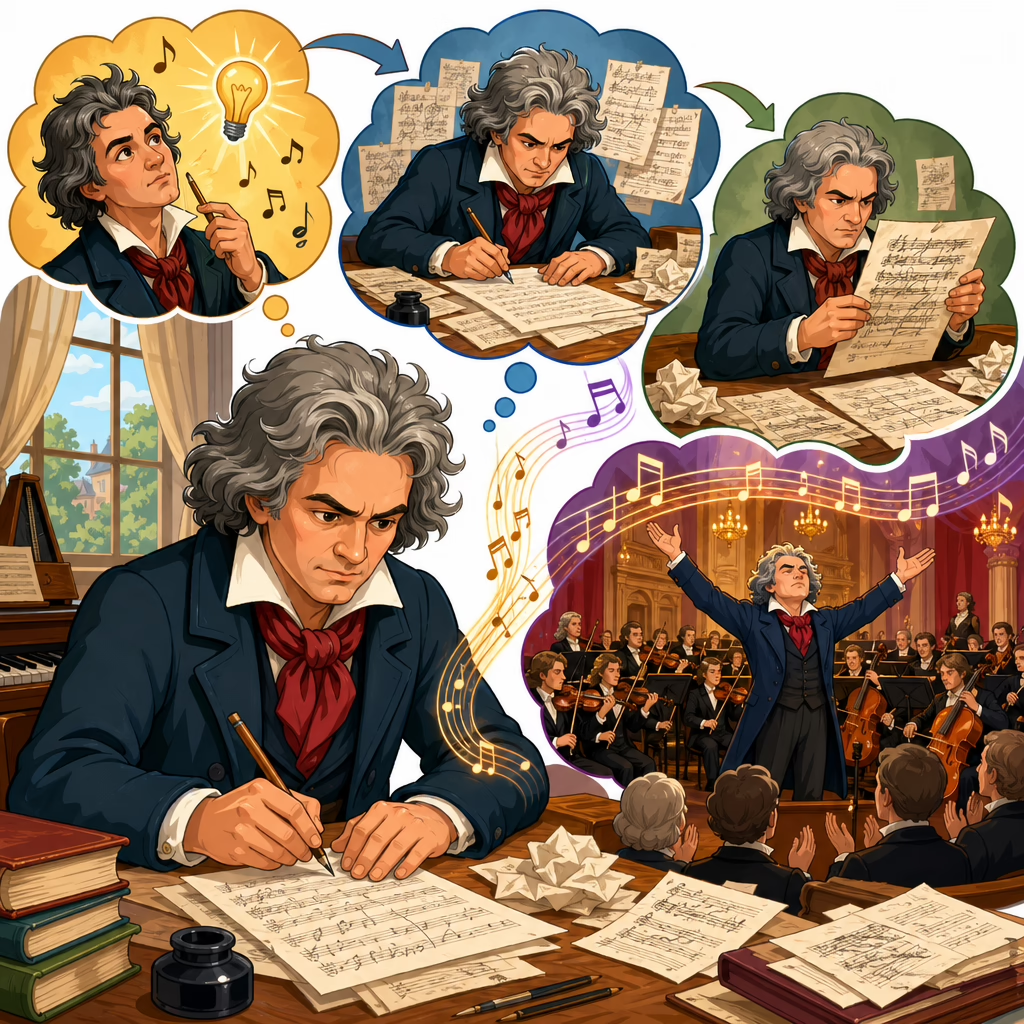
Beethoven’s Sketch Process: From Idea to Masterpiece
Beethoven’s sketch process reveals how musical genius is built through revision, testing, and relentless refinement rather than sudden inspiration alone. For listeners who know the symphonies, sonatas, and quartets as finished monuments, the surviving notebooks offer something even more compelling: a direct record of thought becoming sound. In Beethoven studies, a sketch is any written trace of composition before the final score, including brief melodic jottings, harmonic plans, contrapuntal exercises, continuity drafts, and near-complete working manuscripts. Together, these documents show how Beethoven developed themes, adjusted structure, solved technical problems, and reshaped emotional character over time.
This subject matters because Beethoven left an unusually rich paper trail. Thousands of pages survive in libraries and archives, including the Berlin State Library, the Beethoven-Haus in Bonn, and major collections in Vienna. Scholars have reconstructed chronology from watermarks, handwriting, paper types, and references to known works. As a result, Beethoven’s sketchbooks do more than satisfy curiosity. They change how performers interpret phrasing and tempo, how historians date works, and how ordinary listeners understand creativity itself. When I first spent time with facsimiles of the sketchbooks, what struck me most was not perfection but pressure: bars crossed out, motives squeezed into margins, rhythmic cells tried again in different meters, and structural plans revised after entire sections had already been drafted.
Beethoven’s working habits also matter because they challenge the myth of the composer as a passive vessel waiting for inspiration. He certainly valued sudden ideas, especially motifs caught during walks or improvised at the keyboard, but he trusted labor more than luck. His methods combined memory work, improvisation, counterpoint training, motivic transformation, and a practical understanding of instruments and performers. The result was a compositional process both disciplined and exploratory. This hub article covers that miscellaneous terrain comprehensively: what the sketches are, how Beethoven used them, what they reveal about famous works, how scholars read them, and why they remain central to the larger world of Beethoven music.
What Beethoven’s sketches actually include
Beethoven did not use a single neat system, so “sketch process” covers several kinds of documents. Some surviving pages are pocket sketchbooks, small enough to carry outdoors, where he captured motives, bass lines, or rhythmic patterns in compressed notation. Others are desk sketchbooks used for longer continuity drafts, where episodes are linked, transitions planned, and tonal architecture tested. Separate leaves contain canons, fugal studies, text underlay for vocal works, and reminders about instrumentation. There are also conversation books from his later years, though these are mainly tools of communication rather than composition. The broad picture is clear: Beethoven composed through layers, and each layer left different evidence.
One useful distinction is between concept sketches and continuity sketches. A concept sketch isolates material: a turn figure, a cadential pattern, an opening harmonic progression, or a dynamic profile. A continuity sketch connects ideas into sequence, often reducing texture while preserving form. In practice Beethoven moved constantly between the two. He might draft a theme in short score, then interrupt himself with an isolated experiment on accompaniment, then return to the larger span with altered harmony. This zigzag method explains why single pages can look chaotic. They are not random; they preserve competing solutions side by side.
Because this page serves as a miscellaneous hub within Beethoven music, it is helpful to note the neighboring subtopics these sketches touch. They connect directly to the symphonies, piano sonatas, string quartets, sacred works, songs, and variation sets. They also open into biography, performance practice, music theory, manuscript studies, and reception history. If a reader wants to understand why the “Eroica” feels inevitable yet surprising, why the Fifth Symphony compresses so much energy into so little motivic material, or why the late quartets seem simultaneously free and rigorously controlled, the sketches are the bridge between idea and masterpiece.
How Beethoven moved from motive to structure
The most important lesson from the notebooks is that Beethoven often began small. Instead of starting with a complete melody, he frequently worked from a compact cell: an interval, a rhythm, a bass gesture, or a short harmonic turn. He then generated larger spans by repetition, sequence, contrast, fragmentation, and recombination. This is not unique to him, but he pursued it with unusual concentration. In the first movement of the Fifth Symphony, for example, the famous short-short-short-long rhythm is not merely an opening tag. Sketch evidence and the finished score both show it functioning as a generative unit, shaping melody, accompaniment, pacing, and dramatic expectation across the movement.
He also thought architecturally from an early stage. Even when pages appear to focus on local details, they often include clues about tonal goals or formal proportions. Beethoven might note a destination key, mark a transition idea before completing the exposition, or test multiple cadences to delay closure. In sonata form movements, he was intensely alert to the balance between thematic identity and tonal motion. A theme had to be memorable, but the route it traveled mattered just as much. This is why his sketches can show many revisions to a passage that sounds straightforward in performance. The issue was often not whether the notes were attractive, but whether they carried the drama correctly toward the next formal point.
My own experience reading these pages is that Beethoven’s process feels less like decoration and more like engineering. He repeatedly stress-tested material. Can this motive sustain development? Can it appear in inversion or sequence without losing character? Will the bass support orchestral weight? Does the transition need propulsion or suspense? These are the kinds of questions the sketches answer. They remind us that a masterpiece is not a first thought preserved untouched; it is a system of musical decisions hardened through revision.
What the sketchbooks reveal about famous works
Specific works become clearer when viewed through their drafts. The “Eroica” Symphony shows Beethoven wrestling with scale. Early ideas indicate not only thematic invention but concern with length, continuity, and the integration of heroic rhetoric with disciplined form. The funeral march did not simply arrive complete; its pacing, contrapuntal density, and climactic design emerged through substantial reworking. In the Piano Sonata in C minor, Op. 111, sketches reveal how Beethoven refined the contrast between the compressed, storm-driven first movement and the expansive Arietta variations. What feels spiritually inevitable in the finished sonata was achieved through careful calibration of register, rhythm, and variation design.
The late quartets are especially revealing. Their reputation for mystery can tempt modern readers to treat them as products of private vision beyond analysis. The sketchbooks argue the opposite. They show Beethoven testing fugue subjects, rearranging movement order, and revising transitions with painstaking care. The Große Fuge, Op. 133, demonstrates this vividly. Its ferocious complexity rests on disciplined contrapuntal planning, not chaos. Likewise, the Missa solemnis emerges from sketches as a work of extraordinary deliberation, where text setting, formal balance, and devotional intensity were negotiated measure by measure.
| Work | What the sketches show | Why it matters |
|---|---|---|
| Symphony No. 3 “Eroica” | Expansion of themes, revised pacing, large-scale structural planning | Explains how Beethoven sustained unprecedented symphonic breadth |
| Symphony No. 5 | Motivic concentration built from rhythmic cells and tonal strategy | Shows why the opening idea governs the whole movement |
| Piano Sonata Op. 111 | Reworked contrasts between terse drama and variation-based transcendence | Clarifies the sonata’s extreme expressive compression |
| Late Quartets | Fugal planning, reordered sections, revised continuity drafts | Counters the myth that late style was purely spontaneous |
| Missa solemnis | Detailed text setting and architectural revision across movements | Demonstrates Beethoven’s fusion of liturgical meaning and musical form |
Tools, habits, and working conditions behind the pages
Beethoven’s sketches were shaped by ordinary practical realities as much as by abstract musical thought. He worked at desks, pianos, and on foot. Pocket notebooks let him catch ideas away from the house, and reports from contemporaries describe his habit of walking while thinking. He improvised extensively at the keyboard, using physical experiment to test sonority, spacing, and momentum. He also copied and studied music by Bach, Handel, Mozart, Haydn, and others, absorbing procedures he could adapt rather than imitate. The sketch process therefore sat inside a larger craft routine built on reading, playing, hearing inwardly, and rewriting.
His growing deafness changed this routine but did not stop it. In the early period he still relied heavily on performance and auditory feedback from instruments. Later, he increasingly composed through inner hearing, tactile knowledge of the keyboard, and the visual logic of notation. The sketchbooks document this transition indirectly. They become not less precise but often more concentrated, as if the page had to carry a greater share of experimentation. For modern readers, that fact is crucial. Beethoven’s late style was not the result of isolation from sound; it was the result of a composer whose mental hearing had become exceptionally strong.
Working conditions were often unstable. He changed lodgings frequently, dealt with health problems, financial negotiations, family conflict, and the legal battle over his nephew Karl. Yet the manuscripts show remarkable continuity of purpose. Paper stock varied, handwriting density shifted, and deadlines sometimes pressed, but the underlying method remained consistent: capture, test, revise, expand, and only then fix the score. That consistency is one reason sketch studies remain so valuable across every phase of his career.
How scholars reconstruct Beethoven’s process
Reading Beethoven’s sketches requires more than musical literacy. Manuscript scholars compare paper types, rastral rulings, watermarks, ink color, and handwriting habits to determine when a page was written and how it relates to other sources. Cataloging projects at Beethoven-Haus Bonn and other institutions have made this work far more accessible, but interpretation still demands caution. A crossed-out idea is not necessarily rejected forever; Beethoven often returned to abandoned material later. Likewise, a polished draft is not always late. Sometimes he wrote a clean passage early, then revised it heavily in a rougher source.
Critical editions draw on this evidence to establish reliable texts. Editors consult autograph scores, copyists’ manuscripts, first editions, correspondence, and sketches, weighing each source for authority. The process resembles forensic reconstruction. If a movement exists in several conflicting forms, the editor asks which reading best reflects Beethoven’s final intention, while also preserving a record of earlier states. For performers, this matters in practical ways. Articulation, dynamics, slurs, and even notes can differ among sources, and sketches occasionally explain why. A passage that seems inconsistently notated may reflect a late expressive decision rather than careless copying.
There are limits, and they should be acknowledged plainly. Not every step survives. Some notebooks are lost, many pages were dispersed, and chronology can remain contested. Scholars sometimes disagree about whether a jotted idea belongs to a specific work or to a broader reservoir of material. Even so, the surviving evidence is extensive enough to support firm conclusions. Beethoven was a deliberate reviser, a long-range planner, and a composer who treated sketches as active tools rather than disposable preliminaries.
Why the sketch process still matters to listeners and performers
For performers, sketches can sharpen interpretive choices without turning music into an academic exercise. When a draft shows that Beethoven repeatedly intensified syncopation, delayed a cadence, or rebalanced accompaniment under a melody, the performer learns where tension truly lies. In rehearsal, I have seen musicians change bow distribution, pedal timing, and phrase direction after studying draft evidence because the structural function of a passage became clearer. That kind of insight does not replace artistry; it supports it.
For listeners, the benefit is equally strong. Sketches teach active listening. Instead of hearing only surface beauty, one starts hearing process: motives returning in altered form, harmonic goals prepared far in advance, and apparent digressions serving structural purpose. Beethoven’s music becomes more human and more astonishing at the same time. Human, because the pages show struggle. Astonishing, because struggle yields works of such coherence. That is the central lesson of this miscellaneous hub within Beethoven music. The sketchbooks connect biography, theory, manuscripts, performance, and listening into one vivid story of creation.
If you want to go further, use this page as a starting point for deeper reading on individual works, source studies, and performance practice across the Beethoven catalog. Explore facsimiles, compare editions, and listen with the notebooks in mind. Beethoven’s masterpieces did not descend intact. They were built, tested, and rebuilt until idea became form and form became enduring music. Follow that process, and the entire Beethoven world opens more fully.
Frequently Asked Questions
What do Beethoven’s sketches actually show about how he composed?
Beethoven’s sketches show that his music was usually not the result of a single burst of inspiration, but of a long, disciplined process of invention, testing, rejection, and revision. In the surviving sketchbooks, loose leaves, and working notebooks, we can watch ideas appear in rough form, sometimes as just a short motif, a bass line, a rhythmic cell, or a harmonic outline. Those fragments are then expanded, rearranged, crossed out, rewritten, and reconsidered from multiple angles. This is one of the most important lessons of Beethoven’s sketch process: the finished masterpiece was often built from repeated experimentation rather than instant perfection.
These materials also reveal how deeply Beethoven thought about structure. He was not only searching for a beautiful melody; he was examining how a motive could generate an entire movement, how one rhythmic idea could drive tension, or how harmonic motion could shape dramatic pacing. A sketch might contain several alternate continuations of the same opening, showing that he was actively weighing different formal outcomes. This helps explain why the final works feel so concentrated and inevitable. Their power often comes from the fact that Beethoven had already tested many less successful possibilities before arriving at the version we know.
Just as importantly, the sketches humanize genius without diminishing it. They show Beethoven as relentless, analytical, and patient. He revised obsessively because he cared about making every detail serve the larger expressive and architectural goal. For modern readers and listeners, that is one of the most compelling aspects of the notebooks: they preserve the living process behind the monuments, allowing us to hear composition not as magic alone, but as thought becoming sound through effort and refinement.
Why are Beethoven’s sketchbooks so important to music historians and performers?
Beethoven’s sketchbooks are invaluable because they provide direct evidence of compositional thinking in motion. Most finished scores tell us what a composer decided; sketches show how those decisions were reached. For music historians, that difference is enormous. The notebooks help reconstruct chronology, trace the development of particular works, and clarify how Beethoven’s style evolved across periods. They can reveal when a theme first appeared, how long he worked on it, whether it was originally intended for another project, and how his ideas changed as he shaped a movement or an entire composition.
For scholars, these documents are also essential for understanding Beethoven’s working habits. They show the range of materials he considered part of composition: melodic jottings, harmonic plans, contrapuntal exercises, formal layouts, text underlay, and revised passagework. In Beethoven studies, a sketch is not limited to something that resembles a neat draft score. It can be any written trace left before the final version. That broad definition matters because it captures the full spectrum of his creative labor, from fleeting intuition to highly worked-out planning.
Performers benefit as well. While sketches do not override the authority of the published score, they can illuminate phrasing, articulation, balance, and character by revealing what Beethoven emphasized or struggled to clarify. If a transition was repeatedly revised, that may suggest it carried unusual structural weight. If a motive was simplified over several drafts, that may hint that clarity and force mattered more than decorative complexity. In this way, sketch study can deepen interpretation. It encourages performers to think less in terms of isolated notes and more in terms of process, tension, motive, and design—the very elements Beethoven was refining on the page.
Did Beethoven compose everything in sketches first, or was some music written more directly into score?
Beethoven was an extensive sketcher, but not every passage followed exactly the same path from idea to final notation. Some musical thoughts seem to have emerged first as brief jottings, while others were developed in more continuous drafts or partial scores. In many cases, he moved fluidly between fragmentary notes and more complete working manuscripts. That means his sketch process was not a rigid formula. Instead, it was a flexible system that allowed him to capture inspiration quickly, then subject it to sustained critical examination.
Short motifs and structural plans often appear early in rough form, especially when Beethoven was trying to determine the identity and trajectory of a movement. At other times, he seems to have advanced more directly into fuller notation once a concept was secure enough. Even then, “direct” does not mean effortless. A more complete draft could still contain heavy revision, replacement passages, or major recomposition. Beethoven’s manuscripts frequently show that he continued to revise well beyond the earliest sketching phase, so the boundary between sketch, draft, and finished score was often porous.
This is one reason Beethoven’s surviving materials are so fascinating. They do not present composition as a straight line. Instead, they show a layered process in which ideas could be planted early, set aside, revived later, transformed dramatically, or migrated into different works. Some themes that feel perfectly natural in their final setting may have passed through numerous earlier states. So while Beethoven certainly relied on sketches as a central tool, the larger truth is that he composed through a continuum of notation, constantly refining his materials until they achieved the expressive concentration he wanted.
How do Beethoven’s sketches change the way listeners understand famous works like the symphonies and sonatas?
Beethoven’s sketches change listening by revealing that many familiar themes, transitions, and climaxes were carefully constructed through revision rather than simply received whole. When listeners encounter the final version alone, it can feel inevitable, as if the piece could never have been any other way. The sketches challenge that impression in the most productive sense. They show that inevitability was crafted. Beethoven often reached it by trying alternatives, compressing material, sharpening rhythm, strengthening harmonic direction, and finding more powerful ways to unify a movement.
This insight can make famous works feel even more impressive. The opening of a symphony or the development of a piano sonata is no longer just admired as a finished event; it can be heard as the outcome of intense problem-solving. A tiny motive that drives an entire movement becomes more astonishing when we realize Beethoven deliberately tested how much expressive and structural weight it could bear. Listeners begin to hear concentration, economy, and transformation not as abstract analytical terms, but as the audible result of artistic choices made under pressure and revised with extraordinary persistence.
There is also an emotional effect. The sketches bring us closer to Beethoven as a working artist, not only as a monumental figure. They let listeners sense uncertainty, experimentation, and persistence behind music that later came to seem immovable. That can create a richer connection to the works themselves. The sonatas, quartets, and symphonies remain masterpieces, but they also become records of labor, imagination, and decision-making. In that sense, sketch study does not diminish the mystery of Beethoven’s genius; it relocates it in his ability to transform rough, unstable beginnings into music of lasting force and coherence.
What is the biggest misconception about Beethoven’s creative genius that the sketches help correct?
The biggest misconception is the romantic idea that Beethoven composed primarily through sudden, complete inspiration, as though masterpieces arrived nearly finished in his mind. The surviving sketches strongly suggest a different picture. Beethoven certainly had remarkable imagination, but his greatness lay equally in what he did after the first idea appeared. He interrogated his material, stretched it, condensed it, compared options, discarded weak solutions, and kept working until the musical argument had maximum strength. The sketches show genius as a fusion of invention and relentless judgment.
This does not mean inspiration played no role. Beethoven could generate striking ideas of unusual originality and expressive power. What the documents correct is the notion that inspiration alone was enough. Again and again, the notebooks demonstrate that even compelling ideas had to earn their place through development. A theme might be rewritten rhythmically, reharmonized, reordered, or integrated into a tighter formal design. Transitional passages, codas, developmental sequences, and contrapuntal textures often underwent especially heavy revision. In other words, the brilliance of the final works comes not just from themes themselves, but from how rigorously Beethoven shaped relationships between them.
That correction matters beyond Beethoven scholarship. It offers a more truthful and more useful understanding of artistic achievement. Beethoven’s sketches remind us that mastery is often built through revision, patience, and the willingness to rethink. Far from reducing his stature, this makes his accomplishments more profound. The notebooks reveal a composer who could hear possibility in rough material and who possessed the discipline to refine that possibility into enduring art. For readers, musicians, and listeners alike, that is perhaps the most inspiring lesson of all.