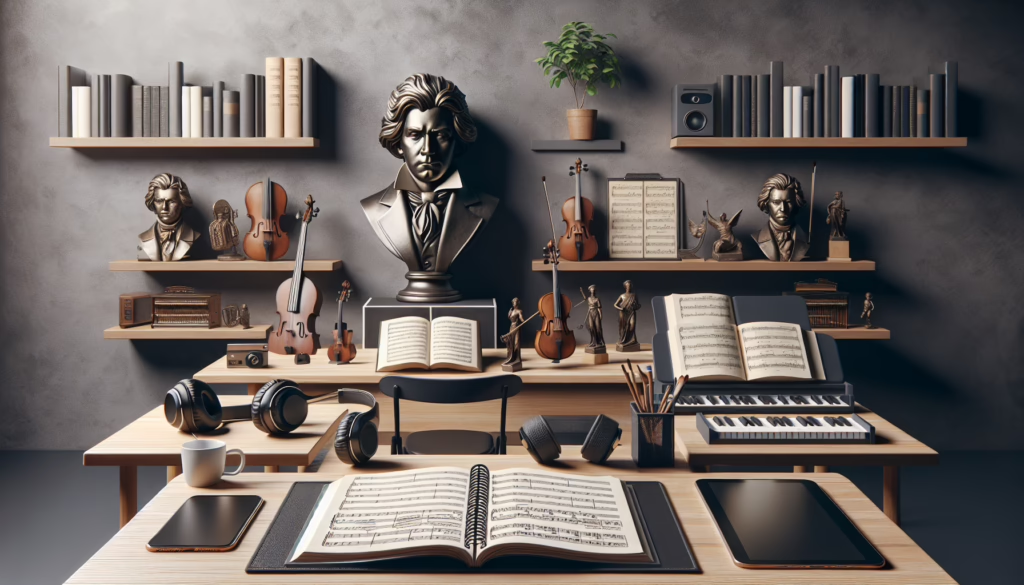
Top Resources for Teaching Beethoven to Beginners
Teaching Beethoven to beginners works best when the teacher treats the composer not as a monument, but as a doorway into listening, history, rhythm, form, and creative expression. In classrooms, private studios, homeschool settings, and community programs, I have seen the same pattern repeatedly: students engage faster when Beethoven is introduced through carefully chosen resources rather than dense biography or intimidating masterworks alone. For beginners, “resources” includes simplified scores, guided listening tools, age-appropriate biographies, classroom games, video lessons, rhythm activities, historical timelines, and project-based materials that connect music to broader learning. This matters because Beethoven sits at the center of Western music education. His works illuminate sonata form, motif development, dynamics, emotional contrast, and the transition from Classical style to Romantic expression. Strong beginner resources make those ideas concrete, memorable, and achievable. Weak resources do the opposite, reducing Beethoven to trivia, difficult piano pieces, or a famous portrait with wild hair. A useful hub page should help teachers sort through options, understand what each resource type does well, and choose materials that fit different ages, abilities, and teaching goals. That is the purpose of this guide.
What beginners need before they study Beethoven in depth
Before selecting materials, define what “beginner” means in your setting. In elementary general music, beginners may be students who cannot yet read notation fluently but can identify loud and soft, fast and slow, and repeated rhythmic patterns. In early piano study, beginners may read on the staff yet have limited hand coordination and little stamina for long works. In middle school humanities, beginners may have no musical training at all, but they can compare ideas, discuss emotions, and work with historical context. The best Beethoven resources meet learners where they are.
Start with three teaching goals. First, beginners need auditory anchors: one or two pieces they can recognize instantly, such as the opening of Symphony No. 5 or “Ode to Joy” from Symphony No. 9. Second, they need simple conceptual anchors: motif, contrast, dynamics, and form. Third, they need human context: Beethoven as a working composer in Vienna, a musician who revised constantly, performed, taught, struggled with hearing loss, and changed musical expectations. When those three anchors are in place, nearly every later lesson becomes easier.
I recommend building a beginner sequence around short, repeated encounters instead of one “Beethoven week” packed with facts. A five-minute listening routine, a one-page biography excerpt, a movement activity, and a short performance task create stronger retention than a single lecture. This is why the most effective resources are modular. They can be revisited across several lessons and linked to broader units on composers, instruments, orchestras, or the Classical era.
Best core resource categories for teaching Beethoven
If you are building a Beethoven resource set from scratch, organize it into categories rather than chasing individual worksheets online. Each category solves a different teaching problem. The table below shows the resource types I rely on most and what they are best used for with beginners.
| Resource type | Best use | Recommended beginner example | Main caution |
|---|---|---|---|
| Guided listening materials | Helping students hear motifs, dynamics, tempo, and form | Color-coded map for Symphony No. 5, first movement | Can become passive if students only fill blanks |
| Age-appropriate biographies | Introducing Beethoven’s life in story form | Illustrated children’s composer biography | Avoid books that overdramatize deafness |
| Simplified performance scores | Letting beginners play Beethoven themes | Easy piano or recorder arrangement of “Ode to Joy” | Some arrangements distort rhythm and phrasing |
| Primary-source excerpts | Showing Beethoven as a real historical figure | Short letter excerpt with teacher commentary | Needs heavy scaffolding for younger learners |
| Video demonstrations | Visualizing instruments, orchestra roles, and performance practice | Conductor-led explanation of the Fifth Symphony motif | Many videos are too long for beginners |
| Creative response activities | Checking understanding through art, writing, or movement | Motif drawing or dynamic map project | Should connect back to actual listening goals |
This mix matters because no single resource can carry the whole unit. A biography creates narrative, but does not teach students to hear sonata form. A video may inspire interest, but without discussion prompts it often stays superficial. A simplified score helps students perform, yet performance alone may not explain why Beethoven sounds different from Mozart or Haydn. Combining categories produces a fuller picture.
Listening resources that make Beethoven understandable
For beginners, listening resources are the foundation. Beethoven’s reputation often intimidates students because they expect long, serious works they cannot decode. Guided listening changes that. A good listening sheet does not ask ten vague questions. It directs attention to one musical event at a time: “Listen for the four-note motif,” “Raise your hand when the music gets suddenly soft,” or “Circle the instrument family that carries the theme.” This approach turns a famous recording into an active lesson.
Start with pieces that reveal Beethoven’s style quickly. Symphony No. 5, first movement, works because the opening motif is unmistakable and structurally important. “Ode to Joy” works because it is singable and harmonically clear. Fur Elise is useful in some settings because students recognize it, but it can mislead them if it becomes their only Beethoven model. Beginners should hear both lyrical and dramatic Beethoven.
Use reputable recordings. For orchestral listening, performances by the Berlin Philharmonic, Vienna Philharmonic, or Cleveland Orchestra provide strong models, while educational videos from major symphony organizations often include clear commentary. On the classroom side, platforms such as Carnegie Hall’s educator materials, the New York Philharmonic’s learning resources, BBC Teach, and Classics for Kids frequently provide structured support instead of isolated audio clips. These are especially helpful when you need lesson-ready prompts.
When possible, teach listening with visual maps. I have had excellent results with simple timelines marked by motif returns, tempo changes, or shifts between loud and soft. Students who cannot yet read notation still understand shape, repetition, and contrast. That is a crucial beginner breakthrough.
Biographies, stories, and historical context that support learning
Students need Beethoven’s life story, but they need it in the right proportion. Beginners do not need every patron, catalog number, or date. They need selected facts that explain the music and the era. Effective biography resources show Beethoven as a child musician in Bonn, a young artist building a career in Vienna, a composer influenced by Haydn and Mozart, and an innovator whose hearing loss changed his working life without defining his entire identity.
Choose biographies with documented timelines, illustrations, and short chapters. For younger readers, composer series from established educational publishers are often more reliable than random web summaries because they simplify without inventing scenes. For older beginners, brief excerpts from Beethoven’s letters, the Heiligenstadt Testament, or contemporary accounts can be powerful if you frame them carefully. Students should understand that primary sources are not simple facts; they are human documents shaped by emotion, purpose, and audience.
Historical context resources should also explain Vienna around 1800, the growth of the public concert culture, changing piano technology, and the political backdrop of the Napoleonic era. Even one page on these topics can clarify why Beethoven wrote differently from earlier Classical composers. If students understand that the fortepiano was lighter than the modern piano, for example, they immediately grasp why performance choices and sound expectations differ.
Performance resources for classrooms and beginner musicians
Many teachers make Beethoven accessible by letting beginners perform him early, and that instinct is correct. Performance resources create ownership. The key is choosing materials that preserve the musical idea while reducing technical barriers. “Ode to Joy” remains the strongest entry point because it fits voice, recorder, ukulele, boomwhackers, Orff instruments, beginning strings, and easy piano. Good arrangements keep the phrase structure intact and avoid overloading students with unnecessary accompaniment patterns.
For piano beginners, method-book arrangements of Beethoven themes can work well if the edition clearly marks fingering, articulation, and dynamics. I prefer resources from established pedagogical publishers such as Faber, Alfred, and the Royal Conservatory ecosystem because editorial decisions are usually transparent. Avoid arrangements that flatten Beethoven into constant quarter notes or remove every dynamic contrast; students may learn the tune but miss the style.
In ensemble settings, teacher-created layered arrangements are often best. One group can play the melody, another can keep a pulse, and advanced students can add a drone or simple harmonic support. This allows mixed-ability classes to participate without turning Beethoven into background noise. The performance goal for beginners is not authenticity in a scholarly sense. It is meaningful contact with musical structure, expression, and confidence.
Digital tools, printable materials, and interdisciplinary projects
Digital resources can significantly improve beginner Beethoven instruction when they are chosen for clarity instead of novelty. Interactive notation tools such as Noteflight and Flat let students see themes, reorder phrases, or compose their own four-note motifs inspired by Beethoven’s developmental technique. Ear-training apps can reinforce interval recognition through familiar themes. Museum and library archives, including collections from major European institutions and the Library of Congress, offer images, manuscripts, and historical artifacts that make the composer real.
Printable materials still matter. Teachers consistently need reliable timelines, composer fact sheets, instrument diagrams, listening journals, and exit tickets. The best printables do one job well. A one-page motif tracker is more useful than a twelve-page packet students rush through. If you maintain a broader curriculum site, this hub should point readers toward focused materials such as Beethoven listening lessons, easy “Ode to Joy” arrangements, Beethoven biography printables, and classroom composer activities. Strong internal connections help teachers move from overview to action quickly.
Interdisciplinary projects are especially effective for miscellaneous Beethoven teaching because they widen access. Students can compare Beethoven portraits in art, map Bonn and Vienna in geography, examine Enlightenment and Napoleonic history in social studies, or write reflective journal entries on perseverance and adaptation. The caution is simple: keep the music central. Cross-curricular work should illuminate Beethoven’s music, not replace it.
How to choose the right Beethoven resources for different ages
For ages five to eight, prioritize short listening excerpts, movement, call-and-response rhythm work, picture books, and singable themes. For ages nine to twelve, add guided listening maps, elementary notation tasks, simple biographies, and beginner performance arrangements. For teens and adult beginners, introduce form diagrams, short primary-source excerpts, historical background, and comparison listening between Beethoven and other composers.
Always evaluate resources for accuracy, musical integrity, and cognitive load. Ask four questions. Is the information correct? Does the material preserve something essential about Beethoven’s style? Is the task appropriate for the learner’s reading and musical level? Does the resource lead to observable understanding, such as singing a motif, identifying a contrast, or explaining a historical connection? If the answer to any of those questions is no, keep looking.
One final rule has improved nearly every Beethoven unit I have taught: teach fewer works, more deeply. Beginners remember what they revisit. Two pieces studied through listening, performance, story, and discussion will accomplish more than ten excerpts played once. Build your Beethoven resource collection around that principle, and the composer becomes not a difficult obligation, but a lasting entry point into music. Explore the linked lessons and materials in your Beethoven in Education collection, choose one listening resource and one performance activity, and start there this week.
Frequently Asked Questions
What are the best types of resources for teaching Beethoven to beginners?
The best resources for teaching Beethoven to beginners are the ones that make his music feel approachable, playable, and meaningful from the very first lesson. In practice, that usually means using a combination of simplified scores, guided listening materials, short historical background, rhythm activities, and creative projects rather than relying on advanced repertoire or dense biography alone. Beginners respond especially well to resources that let them hear a clear musical idea, recognize a pattern, and then try it themselves. For example, simplified arrangements of themes like “Ode to Joy” can introduce phrasing, melody, and dynamics without overwhelming students technically. Listening guides with prompts such as “Where does the melody repeat?” or “Does this section sound strong or gentle?” help students become active listeners instead of passive consumers.
It also helps to choose materials that fit the teaching setting. In a classroom, visual timelines, group rhythm games, and short video excerpts can build context quickly. In private lessons, leveled piano arrangements, composer-themed worksheets, and ear-training activities often work better because they can be tailored to the student’s pace. In homeschool or community settings, cross-curricular resources are especially effective, such as combining Beethoven study with art, journal writing, movement, or simple composition. The key idea is that beginners do not need “less Beethoven”; they need Beethoven presented through the right doorway. Good resources reveal the energy, structure, and emotional clarity of the music in a form students can grasp immediately.
How can simplified scores help beginners learn Beethoven without losing the essence of the music?
Simplified scores are one of the most useful starting points because they preserve recognizable melodies and musical character while reducing technical barriers. For beginners, the problem is rarely lack of interest; it is that original Beethoven textures can demand skills they have not built yet, such as large hand positions, dense chord voicings, rapid figurations, or complex coordination. A well-made simplified score removes those obstacles without stripping away the core identity of the piece. Students can still experience Beethoven’s rhythmic drive, phrase structure, dynamic contrast, and memorable themes, which are often the very elements that make his music so compelling in the first place.
The most effective simplified arrangements are pedagogically intentional. They keep the musical line clear, use comfortable hand positions, reduce unnecessary complexity, and highlight foundational skills like articulation, balance, and steady pulse. A teacher can use these versions to introduce larger concepts such as sonata form, motive development, and contrast between sections. Even a short, accessible excerpt can become a rich teaching tool if the teacher asks the right questions: What pattern repeats here? How does Beethoven create excitement? Where does the phrase feel complete? In this way, simplified scores are not a compromise; they are a bridge. They give beginners a real encounter with Beethoven while building the confidence and musicianship needed to approach more authentic versions later.
What listening resources are most effective when introducing Beethoven to new students?
The most effective listening resources are the ones that guide attention. Beginners often need help knowing what to listen for, so the best materials do more than simply provide a recording. They include short listening excerpts, focused questions, visual listening maps, and comparisons between performances or sections. Instead of assigning an entire symphony at once, it is usually more successful to begin with a short passage that highlights one clear musical feature, such as a famous four-note motive, a dynamic contrast, or a recurring melody. Students gain confidence when they can identify something specific and hear it return.
Teacher-created listening guides are especially valuable because they can be matched to age and experience level. Younger students may respond to prompts about mood, movement, and pattern, while older beginners can notice form, texture, and instrumental color. High-quality recordings also matter. Choose performances with clarity and energy so that Beethoven sounds vivid rather than distant. Video performances can be helpful too, especially for beginners who benefit from seeing instruments, conducting, or ensemble interaction. In many cases, the listening resource becomes strongest when paired with another activity: clapping a rhythm, tracing the shape of a melody, drawing what the music suggests, or identifying repeated motives on a worksheet. The goal is not just exposure to Beethoven, but active engagement that turns listening into understanding.
How much historical background should beginners learn about Beethoven?
Beginners usually need just enough historical background to make the music human, memorable, and connected to a real life. Too much biography too soon can make Beethoven feel like a distant monument rather than a composer whose ideas students can actually enter. A concise introduction works best: who he was, when he lived, why he is important, and a few carefully chosen details that illuminate the music rather than overshadow it. For example, students often connect well with the fact that Beethoven was a bold, independent musical thinker and that he continued composing despite hearing loss. Those details can inspire curiosity and resilience without turning the lesson into a lecture.
The most useful historical resources are short composer profiles, simple timelines, portraits, maps, and stories linked directly to the pieces students are hearing or playing. Context should support musical understanding. If students are learning “Ode to Joy,” a brief explanation of its later cultural significance may be relevant. If they are listening to a symphonic excerpt, it may help to explain the orchestra of Beethoven’s time and how his music expanded expressive possibilities. The teacher’s job is to filter history through beginner-friendly relevance. Historical background should answer the student’s natural question: “Why should I care about this music?” When presented this way, context adds depth without intimidation and helps Beethoven feel both important and accessible.
How can teachers make Beethoven engaging for beginners in classrooms, private lessons, and homeschool settings?
Teachers make Beethoven engaging by turning him into an experience rather than a subject to memorize. That starts with choosing entry points that students can respond to immediately: a strong rhythm to clap, a melody to play, a listening game, a story about musical struggle and creativity, or a visual map of a piece. In classrooms, this may look like group call-and-response with famous motives, movement activities tied to dynamics, or collaborative listening tasks. In private lessons, a teacher might pair a simplified Beethoven arrangement with improvisation based on the same motive or ask the student to shape a phrase using contrasting touch and dynamics. In homeschool settings, Beethoven can be integrated into broader study through art projects, history connections, journaling, and composer notebooks.
Creative expression is especially important. Beginners often understand Beethoven more deeply when they are invited to respond musically themselves. They can compose a short piece using a repeated motive, create a rhythm pattern inspired by a Beethoven theme, compare two performances, or describe how a section changes emotionally from beginning to end. These kinds of activities reinforce listening, form, rhythm, and interpretation all at once. The most successful teaching does not present Beethoven as untouchable greatness; it presents him as a powerful model for how music communicates. When teachers use the right resources and structure lessons around curiosity, participation, and small successes, beginners often connect with Beethoven far sooner than many adults expect.