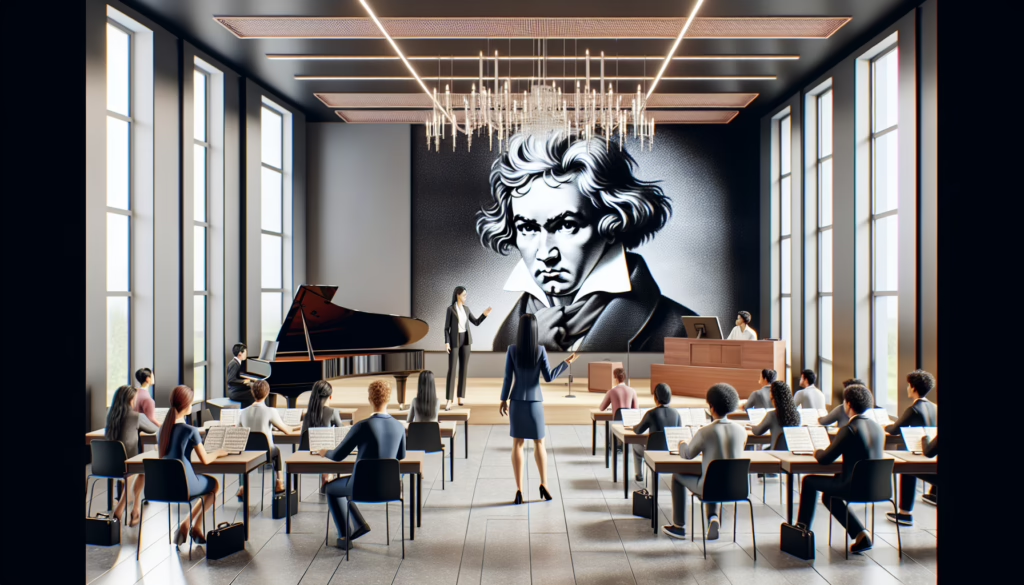
How Beethoven Is Taught in Modern Music Schools
Beethoven remains central to modern music schools because his works connect technique, history, analysis, performance practice, creativity, and cultural debate in one teachable body of music. In conservatories, universities, community music programs, and specialist pre-college academies, “teaching Beethoven” does not mean assigning a few famous sonatas and moving on. It means using Ludwig van Beethoven as a framework for explaining harmony, form, pianism, orchestration, chamber collaboration, ear training, conducting, musicology, and even questions about disability, canon formation, and public memory. I have seen this firsthand in curriculum planning meetings and studio classes: when faculty need repertoire that reveals how students think, listen, phrase, count, and communicate, Beethoven appears quickly on the syllabus.
Modern music schools teach Beethoven differently than schools did a generation ago. The older model often centered on reverence, score fidelity, and a narrow sequence of masterworks. Today, that core remains, but it is expanded by historically informed performance research, digital score study, critical pedagogy, wellness-based technical training, and broader contextual discussion. Students may study a piano sonata through Schenkerian analysis, compare Urtext editions from Bärenreiter and Henle, listen to period-instrument recordings, examine autograph sources, discuss metronome controversies, and then perform the piece in a studio class with feedback on articulation, voicing, posture, and rhetorical pacing. That layered method reflects how serious institutions now approach Beethoven: not as a monument to admire from a distance, but as a living educational tool.
As a hub within Beethoven in Education, this article explains how Beethoven is taught across modern music schools, what teachers emphasize, which methods and materials they use, and why his music still anchors training. It also points to the many directions this subject opens: piano pedagogy, orchestral rehearsal, chamber coaching, theory instruction, aural skills, conducting seminars, music history surveys, and interdisciplinary study. For students, parents, and teachers asking what Beethoven education looks like today, the clearest answer is this: schools use Beethoven to teach both the craft of music-making and the discipline of musical thinking.
Beethoven in performance training: piano, strings, winds, and voice
In applied lessons, Beethoven is taught as repertoire that exposes fundamentals under pressure. For pianists, the sonatas are not simply prestige pieces; they are structured tests of touch, voicing, pedaling, rhythmic stability, motivic awareness, and long-form pacing. A teacher may assign Sonata in G major, Op. 14 No. 2 to an intermediate student because its transparency reveals uneven finger work and weak phrasing, while an advanced student may confront Op. 31 No. 2 or Op. 57 to address architecture, tension control, and tonal projection. In my experience, even one page of Beethoven can show whether a student hears bass direction, understands harmonic arrival, and can shape a phrase beyond bar lines.
String players meet Beethoven through sonatas, string quartets, symphonic excerpts, and concerto literature. Violin studios use the “Spring” Sonata or the Romances to teach classical bow distribution and singing line, then move toward the Violin Concerto for larger structural control. Cellists work on sonatas that demand dialogue rather than accompaniment, a lesson in equality between parts that remains pedagogically valuable. Wind and brass students encounter Beethoven in orchestral excerpt classes, where exposed passages from the symphonies train articulation, subdivision, breathing plans, and stylistic discipline. Vocal departments teach Beethoven less extensively than Mozart or Schubert, yet art songs, concert arias, and the Missa solemnis still appear where diction, sustained line, and ensemble awareness matter.
What makes Beethoven unusually effective in performance training is the combination of clarity and difficulty. The writing often looks cleaner on the page than Romantic repertory, but that simplicity leaves students nowhere to hide. If rhythm sags, articulation blurs, intonation slips, or phrase goals are unclear, listeners hear it immediately.
How theory, analysis, and ear training use Beethoven
Music theory departments rely on Beethoven because his works illustrate core concepts with exceptional precision. Sonata form, motivic development, phrase expansion, harmonic sequence, tonicization, enharmonic reinterpretation, pedal point, and coda design all become more memorable when attached to famous, audible examples. In first- and second-year theory, instructors may use a Beethoven movement to show how a tiny rhythmic cell generates an entire section. In upper-level analysis, the same movement can support discussions of form-functional theory, Caplin’s formal functions, Schenkerian voice leading, Hepokoski and Darcy’s sonata theory, or topic theory. Beethoven is one of the few composers whose music can sustain both introductory explanation and graduate-level debate.
Aural skills classes also benefit from his music because the motives are distinctive and the tonal plans are teachable. Dictation exercises often adapt themes from piano sonatas or symphonies; students sing modulating passages, identify cadence types, and trace phrase rhythm. Teachers use Beethoven to connect hearing with seeing. For example, a class might compare the opening motive of Symphony No. 5 in C minor with a reduction on the board, then identify how repetition, sequence, and harmonic support create momentum. Students are not merely memorizing a famous tune; they are learning to hear structure in real time.
Modern schools increasingly connect analysis with performance decisions. If a student identifies an expanded transition, deceptive cadence, or registral transfer, that analytical insight should affect timing, dynamic planning, fingering, bow speed, or breath placement. That bridge from theory to execution is one reason Beethoven remains indispensable.
Historical context, research skills, and critical interpretation
In music history courses, Beethoven is taught not just as a “great composer” but as a figure embedded in specific social, political, technological, and aesthetic conditions. Students learn about Vienna’s patronage networks, publication markets, amateur music-making, changing pianos, the aftermath of the French Revolution, Napoleonic politics, and the rise of public concerts. They read letters, conversation books, Heiligenstadt Testament excerpts, early reviews, and modern scholarship. This matters because biography alone can distort teaching. Hearing loss, for instance, is important, but modern schools place it alongside craft, labor, revision practice, and professional strategy rather than reducing Beethoven to a myth of suffering genius.
Research assignments often ask students to compare editions, evaluate source reliability, or assess claims about tempo and instrumentation. A class may examine why metronome markings in some works remain contested, or how performance conventions changed from early nineteenth-century Vienna to the modern concert hall. Students learn the difference between an Urtext edition and an editorial edition, and why that distinction matters when deciding slurs, ornaments, or pedal. This is where schools build habits of musical evidence. Assertions must be tied to sources, not tradition alone.
Critical interpretation now includes discussion of canon formation and curricular balance. Many institutions still teach Beethoven as central, but they also ask why certain composers became central and how repertory choices shape student identity. That does not diminish Beethoven’s importance; it makes his place in education more intellectually honest.
Ensemble rehearsal, conducting, and collaborative musicianship
Large ensemble directors teach Beethoven because his orchestral writing sharpens collective discipline. The symphonies require rhythmic unanimity, transparent balance, precise dynamic terracing, and sustained awareness of structure. In rehearsal, conductors use Beethoven to train section listening: strings must understand wind interjections, winds must phrase with harmonic rhythm, timpani must stabilize pulse without heaviness, and everyone must recognize when accompaniment becomes thematic material. Symphony No. 7, for example, is a masterclass in rhythmic propulsion; Symphony No. 3 tests architecture and stamina; Symphony No. 9 introduces choral-orchestral coordination on a monumental scale.
Conducting students frequently analyze and rehearse Beethoven because the scores demand clear beat patterns and informed stylistic choices. Young conductors learn that over-conducting can suffocate this music, while vague gestures invite disorder. They must decide tempo relationships, bowings in consultation with strings, articulation length, and fermata handling, all while understanding the score’s formal logic. Chamber music programs do something similar on a smaller scale. Beethoven’s string quartets, piano trios, and sonatas teach cueing, negotiation, and interpretive language. Coaches push students to justify decisions with score evidence rather than personality or habit.
| Area | Common Beethoven material | Main skills taught |
|---|---|---|
| Piano studio | Sonatas, Bagatelles, Variations | Voicing, form, pedaling, texture control |
| Strings | Sonatas, quartets, concerto excerpts | Bowing, dialogue, intonation, phrase shape |
| Orchestra | Symphonies, overtures | Rhythm, balance, ensemble listening, style |
| Theory and aural skills | Themes and movements across genres | Form, harmony, dictation, motivic hearing |
| Music history | Letters, editions, premieres, reception | Research, source criticism, context |
The collaborative lesson is fundamental: Beethoven is rarely taught as isolated individual expression. Schools use his music to show that great performance depends on shared timing, shared rhetoric, and mutual accountability.
Technology, editions, and modern teaching tools
One major difference in current Beethoven instruction is the range of tools surrounding the score. Students now use digital libraries such as IMSLP for public-domain access, though faculty usually pair that convenience with warnings about edition quality. In stronger programs, students compare freely available scans with scholarly editions from Henle, Bärenreiter, Wiener Urtext, or Breitkopf. They annotate PDFs on tablets, slow down recordings with practice apps, mark harmonic functions in notation software, and watch masterclasses from institutions such as Curtis, Juilliard, or the Royal Academy of Music. Technology has not replaced close reading, but it has made comparison easier and more rigorous.
Recording is another powerful teaching tool. When students film a Beethoven sonata movement and watch it back, they hear rushed transitions, dynamic flattening, and unclear articulation more objectively than during live practice. Faculty also use waveform and metronome tools to test tempo stability, though good teachers treat those devices as diagnostic aids rather than artistic dictators. In ensemble settings, sectional recordings reveal balance issues instantly. Libraries and online databases give students access to journal articles from Cambridge, Oxford, and JSTOR-indexed publications, expanding the research base behind interpretive choices.
At the same time, schools caution against mistaking information for understanding. Twenty recordings of the “Moonlight” Sonata do not teach style by themselves. Students still need guided listening, comparative questions, and historical framing. The best modern Beethoven teaching combines old disciplines, score study, slow practice, memorization, and live feedback, with new tools that improve access and precision.
What modern schools are changing about Beethoven pedagogy
The strongest change is breadth. Beethoven is no longer taught only as a heroic genius whose intentions are beyond question. He is taught as a composer whose music rewards evidence-based interpretation, historical awareness, and technical problem solving. Faculty discuss instrument evolution, including lighter early pianos and gut-string practice, to explain articulation and balance. They also address student wellness by avoiding brute-force technique in dense sonatas and emphasizing efficient movement, healthy repetition limits, and recovery. This matters because Beethoven is often where young musicians injure themselves by confusing intensity with tension.
Another change is access. Community schools and group piano programs now introduce simplified Beethoven earlier, often through thematic fragments, dances, or scaffolded arrangements that prepare students for complete works later. Done well, this does not trivialize the music; it builds literacy and familiarity. Institutions are also more likely to pair Beethoven with underrepresented composers, asking students to compare formal strategies, public reception, and historical narratives. That broader frame helps learners understand both Beethoven’s extraordinary influence and the limits of a curriculum built around a single canon.
Ultimately, modern music schools teach Beethoven because his music remains one of the most efficient ways to train complete musicians. It develops technique without empty display, analysis without abstraction, and interpretation without guesswork. Students who learn Beethoven well usually emerge with stronger listening, stronger structural awareness, and stronger artistic judgment. If you are building a Beethoven in Education resource path, start here, then continue into focused study of piano pedagogy, theory applications, chamber coaching, performance practice, and curriculum design. Beethoven still belongs in modern schools, but the best teaching now shows exactly why.
Frequently Asked Questions
Why is Beethoven still taught so heavily in modern music schools?
Beethoven remains central in modern music education because his music brings together nearly every major area students need to study: technique, form, harmony, rhythm, interpretation, ensemble communication, historical context, and artistic identity. In practical teaching terms, his works are unusually useful because they can be approached at many levels. A younger pianist may encounter Beethoven through shorter sonatinas or selected movements that teach clarity, articulation, and phrase structure, while advanced conservatory students may work on late sonatas, string quartets, symphonies, or variation sets that demand sophisticated analysis and interpretive maturity. Teachers value Beethoven not simply because he is “important,” but because his music reveals how musical ideas are built, transformed, and dramatized in real time.
Modern schools also use Beethoven as a bridge between periods and traditions. His output sits at a critical point between Classical balance and Romantic intensity, so students learn how style evolves rather than seeing music history as a set of disconnected eras. A Beethoven class or studio assignment can open discussions about sonata form, motivic development, orchestral color, the changing role of the composer, public concert culture, and the social meaning of “masterworks.” For that reason, Beethoven is often taught not as a single historical figure to be admired from a distance, but as a framework through which students can understand broader musical systems and debates that still shape training today.
How do music schools use Beethoven to teach music theory and analysis?
Beethoven is one of the most effective composers for teaching theory and analysis because his music makes structural thinking audible. In the classroom, instructors often use his sonatas, symphonies, quartets, and smaller keyboard works to show how short motives can generate entire movements. Students may begin by identifying a simple rhythmic cell or intervallic idea, then trace how Beethoven sequences it, fragments it, revoices it, destabilizes it harmonically, and reintroduces it in altered form. This helps learners move beyond labeling chords and forms toward hearing how musical logic unfolds across time. Beethoven’s writing is especially valuable because it combines clarity with complexity: the architecture is strong enough for beginners to grasp, but rich enough to sustain advanced Schenkerian, formal, harmonic, and hermeneutic analysis.
Teachers also rely on Beethoven to demonstrate how theoretical concepts become expressive choices. A deceptive cadence is not just a textbook term in Beethoven; it can become a dramatic interruption. A remote modulation is not just harmonic color; it can feel like rupture, expansion, or psychological uncertainty. Sonata form, variation form, fugue, and cyclic integration become easier to understand when students can hear them operating in repertory that is vivid and memorable. In many programs, analysis assignments ask students to mark phrase structure, identify thematic transformations, compare editions, examine sketch materials, or connect harmonic design with performance decisions. That makes Beethoven ideal for integrated pedagogy: students are not merely learning abstract theory, but seeing how theory informs interpretation, listening, and compositional thinking.
What performance skills do students learn by studying Beethoven?
Studying Beethoven develops a wide range of performance skills because his music demands both technical control and deep musical judgment. For pianists, Beethoven is often used to teach voicing, balance, articulation, pedaling discipline, rhythmic steadiness, dynamic range, and long-line phrasing. His keyboard writing can seem transparent, which is precisely why it is so instructive: unclear fingerwork, weak structural pacing, or exaggerated rubato are exposed quickly. Students learn how to shape contrasts without distorting the score, how to project inner voices, how to differentiate texture, and how to connect local details to larger formal goals. The same is true for string players, singers, conductors, and chamber musicians, all of whom encounter Beethoven as training in precision, rhetoric, and expressive restraint alongside intensity.
In ensemble settings, Beethoven is especially valuable for teaching listening and coordination. His chamber music requires players to negotiate dialogue rather than simply accompany a melody, and his orchestral music trains conductors and instrumentalists to think in terms of architecture, tension, pacing, and sectional balance. Because so much of Beethoven’s music is familiar in reputation, schools also use it to teach a crucial professional skill: avoiding cliché. Students are encouraged to question inherited habits, compare historical recordings, consider tempo debates, study period instruments, and justify interpretive choices with evidence. In this way, Beethoven performance training is not about copying a “correct” tradition. It is about learning how to combine stylistic awareness, technical command, and individual artistic responsibility.
Do modern music schools teach Beethoven differently than they did in the past?
Yes, very much so. While Beethoven was once often taught primarily as an untouchable genius whose scores represented unquestioned musical authority, many modern schools take a broader and more critical approach. His music is still treated with seriousness, but the pedagogy has become more interdisciplinary, historically informed, and self-aware. Students are now more likely to study Beethoven through multiple lenses at once: score analysis, performance practice, archival sources, cultural history, philosophy, disability studies, reception history, and debates about canon formation. Rather than presenting his works as timeless objects isolated from social context, teachers increasingly ask how Beethoven’s reputation was built, how his image changed over time, and why institutions continue to center him so strongly.
This does not mean Beethoven has become less important. It means the teaching has become more nuanced. Faculty may discuss issues such as nationalism, hero narratives, editorial intervention, race and access in the classical canon, or the difference between nineteenth-century Beethoven worship and present-day classroom goals. Historically informed performance has also changed how students approach articulation, tempo, ornamentation, instrument type, and notation. At the same time, digital tools now allow students to compare manuscripts, hear multiple recordings instantly, and study analytical visualizations alongside traditional lessons. So modern teaching keeps Beethoven at the center, but it no longer assumes that technical mastery alone is the whole story. Students are asked to understand not only how to play or analyze Beethoven, but also why he has occupied such a powerful place in music education.
Is Beethoven only studied by advanced conservatory students, or do beginners learn him too?
Beethoven is taught at many levels, not just in elite conservatories. Beginners and intermediate students often encounter him through carefully selected repertoire that introduces the essentials of Classical style: balanced phrases, clear textures, motivic coherence, dynamic contrast, and formal awareness. In community music programs, pre-college academies, school music curricula, and private studios, teachers may assign simpler dances, bagatelles, easier variations, or adapted excerpts to help students learn stylistic fundamentals. These pieces can teach students how to count accurately, shape phrase endings, control articulation, and hear harmonic movement without overwhelming them technically. Because Beethoven’s musical language is so structurally strong, even relatively accessible works can become powerful teaching tools.
As students advance, the role of Beethoven expands. Intermediate players may study selected sonata movements or chamber repertoire to develop stamina, tonal control, and formal understanding. Advanced university and conservatory students often engage with Beethoven in a much more comprehensive way, including sketch study, source criticism, historically informed performance questions, and large-scale repertory such as late sonatas, quartets, concerti, and symphonies. The important point is that Beethoven is scalable in education. He can be introduced as a foundation for basic musicianship and revisited repeatedly as students gain technique, historical knowledge, and interpretive depth. That recurring presence is one reason he remains so prominent in modern music schools: his works continue to reveal new lessons at every stage of training.