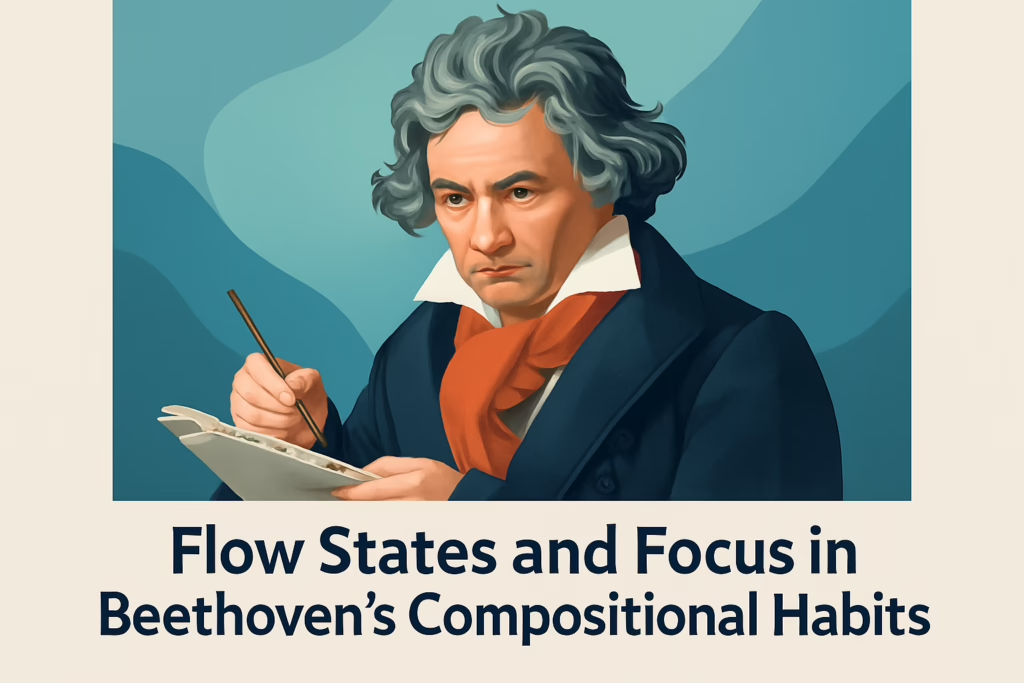
Flow States and Focus in Beethoven’s Compositional Habits
Flow states and focus shaped Beethoven’s compositional habits so deeply that they offer one of the clearest windows into how sustained concentration can produce enduring art. In this subtopic of Beethoven and the Mind, “miscellaneous” does not mean random leftovers. It means the connected set of habits, environments, mental triggers, interruptions, notebooks, walks, routines, and working constraints that influenced how Beethoven entered, protected, and extended periods of intense creative absorption. A flow state is a condition of deep task engagement in which attention narrows, self-consciousness recedes, and work proceeds with unusual continuity. Focus, by contrast, is the practical capacity to direct attention deliberately despite distraction, fatigue, noise, stress, or competing demands. In Beethoven’s case, these two ideas were inseparable. His sketches, letters, reported routines, and revisions show a composer who did not wait passively for inspiration. He built conditions in which concentration could survive long enough for musical ideas to develop from fragments into large-scale structures. That matters because Beethoven’s output was not simply the result of talent. It was also the result of repeatable working behaviors: carrying sketchbooks, revisiting motifs relentlessly, taking long walks, changing lodgings when noise became unbearable, and using revision as a cognitive tool rather than as evidence of failure. For readers exploring the wider Beethoven and the Mind theme, this hub matters because it connects creative psychology with observable practice. It shows how attention worked in real life, under pressure, illness, social friction, and hearing loss.
What flow looked like in Beethoven’s daily work
When I study Beethoven’s working patterns, the first thing that stands out is that his concentration was active, not mystical. He often rose early, worked in the morning, and used the first part of the day for serious composition. Contemporary accounts and biographical research repeatedly point to a disciplined rhythm: coffee, desk work, sketching, drafting, and then movement outdoors. Morning work mattered because it reduced social interruption and gave him a stable mental runway. In practical terms, Beethoven’s flow state often began with material already in motion. He did not rely on a blank-page burst. He returned to motifs, harmonic plans, and rhythmic cells from earlier notes, then pushed them forward. That continuity is one of the strongest predictors of deep focus in any field.
His sketchbooks are central evidence. They reveal not smooth dictation from genius to paper, but iterative concentration. A short motive might appear in rough form, then be altered repeatedly across pages before taking on final character. This process resembles what modern cognitive researchers would call externalized working memory. By placing fragments on paper, Beethoven reduced the load on immediate recall and freed attention for transformation. The notebooks were not archives alone; they were thinking devices. Many composers sketched, but Beethoven’s surviving sketch material is especially revealing because it shows how often he tested alternatives. Flow for him did not mean effortless output. It meant staying with a problem long enough for possibility space to narrow into decision.
Environment also mattered. Beethoven was notoriously sensitive to disturbance. He moved frequently, and noise complaints were not trivial temperament issues. For a composer working through intricate counterpoint, motivic development, and large architectural spans, uncontrolled sound could fracture the thread of thought. He sought rooms conducive to work, and his long walks likely functioned as cognitive resets. Walking was not leisure detached from composing. It was part of composition. Themes could be turned over mentally, tensions released, and attention restored before returning to the desk. Many creators report this alternation between concentrated effort and embodied movement; in Beethoven’s case, it appears repeatedly in the record.
How notebooks, revision, and repetition created sustained focus
One reason Beethoven’s compositional habits still feel modern is that he treated revision as the engine of clarity. He was not unusual in revising, but he was exceptional in the degree to which revision served thought itself. In my experience analyzing creative process, this is where many people misunderstand focus. They assume focus means producing a flawless first draft. Beethoven’s practice shows the opposite. Focus often looks like returning to the same material dozens of times without losing commitment. The opening motive of the Fifth Symphony is famous partly because of its final inevitability, yet that inevitability was built through testing proportion, pacing, orchestration, and structural placement. Revision protected flow because it gave Beethoven a defined object of attention.
Repetition also reduced decision fatigue. Instead of confronting endless novelty, Beethoven could work within bounded musical problems: how to intensify a transition, rebalance a phrase, clarify a cadence, delay a resolution, or transform a motive into a developmental engine. This is how large works become manageable. Attention is easier to sustain when the task is specific. Beethoven’s manuscript evidence shows local problem-solving embedded within global ambition. He did not compose symphonies only at the level of grand inspiration. He composed them by solving one exact question after another. That structure likely helped him regain flow after interruptions, because each session had a reentry point.
The habits below summarize the practical mechanisms that supported his concentration.
| Habit | How it supported focus | Example in Beethoven’s practice |
|---|---|---|
| Carrying sketchbooks | Captured ideas before they faded and reduced reliance on memory alone | Motivic fragments and harmonic plans recorded during daily life |
| Morning composition | Protected high-value mental energy from later interruptions | Regular early work sessions before social obligations |
| Long walks | Restored attention and allowed incubation away from the desk | Country walks linked by biographers to idea development |
| Extensive revision | Turned vague inspiration into stable structure through repeated testing | Dense layers of changes in surviving sketches |
| Noise avoidance | Protected fragile mental continuity during demanding compositional work | Frequent concern about unsuitable lodgings and disturbance |
These habits are useful because they convert an abstract idea like focus into observable behavior. Beethoven did not need every day to feel inspired. He needed systems that made progress likely. That is a more durable model of creativity than romantic myth.
Beethoven’s hearing loss, inner audition, and selective attention
Any serious discussion of Beethoven and focus must address hearing loss. It would be simplistic to claim that deafness somehow granted artistic power. The reality was harsher. His progressive hearing impairment caused isolation, frustration, practical difficulty, and emotional strain. Yet it also changed the terms under which concentration operated. As his hearing deteriorated, Beethoven increasingly depended on inner audition: the ability to imagine and manipulate sound mentally without full reliance on external acoustic feedback. For composition, that skill is not decorative; it is foundational. Hearing loss likely made this internal hearing even more central, especially in later years.
There is a cognitive tradeoff here. Reduced hearing can impair social ease and performance conditions, but internal compositional work can, in some circumstances, become less tied to immediate sound in the room. Beethoven still used instruments, conversation books later in life, and physical vibration, and he certainly did not cease to need external reference. Still, the late works suggest remarkable command of internally sustained musical logic. The late string quartets and piano sonatas demand large-scale tracking of tension, register, rhythm, and formal relation. Such writing requires exceptional selective attention. The composer must hold multiple structural layers in mind while resisting the pull of easy symmetry or conventional closure.
Selective attention also appears in his willingness to pursue difficult ideas beyond immediate listener expectation. Beethoven could lock onto a developmental problem and follow it rigorously. In the “Eroica,” the scale alone demands prolonged control of attention across expanding form. In the late quartets, abrupt contrasts and fugue writing require concentrated handling of continuity beneath disruption. This is not accidental. It reflects a mind trained to sustain internal reference points despite instability. If focus means choosing what to keep active in the mind and what to ignore, Beethoven’s mature style offers repeated examples of that discipline.
Interruptions, emotion, and the limits of concentration
Beethoven’s focus was formidable, but it was not effortless or unlimited. Financial pressures, legal disputes, poor health, digestive complaints, family conflict, and unstable domestic arrangements repeatedly disrupted his work. His struggle over the guardianship of his nephew Karl consumed years of emotional energy. Letters show irritability, urgency, and preoccupation. Anyone looking for a realistic account of flow states should pay attention here: deep work does not remove life stress. More often, it coexists uneasily with it. Beethoven’s achievement becomes more impressive, not less, when viewed against these frictions.
Emotional intensity could both drive and threaten concentration. Beethoven’s music clearly channels conflict, struggle, release, and defiance, but biography should not be turned into crude one-to-one explanation. The better point is that emotion supplied energy while craft supplied direction. Without craft, strong feeling disperses. With craft, it becomes form. Beethoven’s habits repeatedly transformed agitation into work by giving the mind a musical problem to handle. That may be why sketching mattered so much. When experience was turbulent, notation offered traction. It turned mood into manipulable material.
There were also practical limits. Flow is easier to romanticize than to maintain. Copyists, publishers, patrons, housing issues, and illness all interrupted continuity. Beethoven sometimes missed deadlines and negotiated aggressively with publishers. He was not a serene productivity machine. This matters for the Beethoven and the Mind framework because it replaces myth with mechanism. His concentration was powerful, but it required protection, recovery, and adaptation. Readers exploring related articles in this miscellaneous hub should connect these themes to routine, stress regulation, environmental control, and revision psychology. They belong together.
What Beethoven’s compositional habits teach about modern focus
Beethoven’s example remains useful because it translates across centuries. The tools have changed, but the cognitive principles have not. First, capture ideas externally. His sketchbooks function much like today’s note apps, manuscript software drafts, or voice memos, except with greater discipline. Second, schedule high-value thinking when attention is strongest. Beethoven’s morning work anticipated what productivity research now confirms: demanding cognition should happen before communication overload fragments the day. Third, treat walking and physical movement as part of thinking, not as escape from it. Fourth, expect revision. Deep focus is not proven by speed; it is proven by the quality of sustained return.
There is also a warning in his life. Focus can be undermined by unmanaged environment and unresolved strain. Beethoven fought noise, instability, and conflict because these conditions taxed cognition. Modern workers face different versions of the same problem: notifications, open offices, multitasking, and perpetual responsiveness. The lesson is not to imitate Beethoven’s temperament. It is to imitate his seriousness about conditions. Protect attention, create reentry points, keep working notes, and define the next problem before ending a session. Those small choices make flow more available.
As a hub article for the miscellaneous branch of Beethoven and the Mind, this page should anchor further reading on routines, sketchbooks, walking, hearing loss, revision, domestic environments, stress, and creative endurance. The central takeaway is simple. Beethoven’s compositional habits show that flow states are not lucky accidents reserved for geniuses. They are supported by systems: deliberate routine, external memory, environmental control, movement, repetition, and rigorous revision. Study those habits closely, and Beethoven becomes more than a monument of musical history. He becomes a practical case study in how focused minds build lasting work under imperfect conditions. If you are exploring creativity, attention, or musical thinking, use this hub as your starting point and follow each connected topic in depth.
Frequently Asked Questions
How did flow states shape Beethoven’s compositional process?
Flow states were central to the way Beethoven developed musical ideas, revised them, and transformed small motifs into large-scale works. Rather than composing only in brief flashes of inspiration, he often worked through extended periods of intense concentration in which his attention narrowed around musical problems. In those stretches, he could test variations, reorganize structure, and hear relationships between themes, harmonies, and rhythms with unusual depth. This matters because Beethoven’s music is rarely casual or decorative in its construction. It is often built through pressure, development, and persistence, all of which point to a mind capable of staying engaged with a creative problem far beyond the first impulse.
What makes Beethoven especially interesting in discussions of focus is that his process combined spontaneity with relentless refinement. He did not simply wait for masterpieces to arrive fully formed. He entered states of immersion where the work became absorbing enough to sustain him through repeated revision. Sketchbooks show that many ideas evolved slowly, sometimes through numerous reworkings. That pattern suggests that his creative breakthroughs often came not from isolated moments of genius, but from prolonged mental absorption. In modern terms, flow for Beethoven was less about effortless productivity and more about deep engagement strong enough to hold complexity in mind until something coherent and powerful emerged.
What habits helped Beethoven enter and maintain deep focus while composing?
Beethoven relied on a cluster of reinforcing habits rather than a single secret routine. He was known for working with remarkable seriousness, and his days often revolved around conditions that supported concentration. Regular routines, periods of solitude, and disciplined work habits all helped create a mental environment where sustained attention could take hold. He also used sketchbooks extensively, which gave him a way to capture fragments quickly and then return to them later. That practice reduced the risk of losing ideas while also extending his focus across time. Instead of treating composition as a one-step act, he built systems that allowed concentration to continue from one session to the next.
His walks were another important part of this rhythm. Walking gave him a setting in which musical ideas could move freely without the social and practical interruptions of indoor life. For many creative people, motion supports thought, and Beethoven appears to have used walks as an extension of the compositional process, not as a break from it. He also valued environments that protected his mental space, even if his living arrangements were not always peaceful. When viewed together, his notebooks, routines, solitude, and movement formed a practical architecture of focus. They helped him return repeatedly to difficult musical tasks until a deeper state of creative absorption became possible.
Did Beethoven’s notebooks and sketches play a role in sustaining creative absorption?
Yes, and they are one of the clearest pieces of evidence for how Beethoven’s mind worked under sustained concentration. His notebooks and sketchbooks were not merely storage devices for finished ideas. They were active workspaces where he tested themes, altered passages, and tracked the development of musical material over time. This is crucial because it shows that Beethoven’s focus was dynamic. He did not always move in a straight line from inspiration to completion. Instead, he used writing as a way to remain in dialogue with his own ideas, extending concentration across multiple sessions and preserving continuity even when interruption was unavoidable.
These documents also reveal how deeply he was willing to stay with unresolved material. A motif might appear in rough form, be revised repeatedly, and only much later become part of a finished work. That patience reflects a kind of long-form focus that is often overlooked. Creative absorption is not always dramatic in the moment; sometimes it appears as an ongoing commitment to returning, testing, and refining. Beethoven’s notebooks helped externalize memory, reduce cognitive overload, and keep musical possibilities alive until they could be fully shaped. In that sense, the sketchbooks were not separate from flow. They were tools that made sustained flow more durable and more productive.
How did interruptions, constraints, and Beethoven’s personal circumstances affect his ability to focus?
Beethoven’s focus did not develop in ideal conditions, which makes his working habits even more revealing. He faced frequent disruptions in daily life, complicated personal relationships, financial concerns, health issues, and, most significantly, progressive hearing loss. These pressures could have shattered creative continuity, yet they also forced him to develop methods for protecting concentration. His reliance on sketches, routines, and private working time can be understood partly as a response to the instability around him. Rather than depending on perfect circumstances, he built practices that allowed serious work to continue under strain.
Constraints may also have sharpened his concentration in unexpected ways. Limits can intensify attention by narrowing the field and forcing deeper engagement with what remains. In Beethoven’s case, adversity did not simply stand outside the work; it likely changed how he approached mental immersion itself. His increasing deafness, for example, pushed composition further inward, toward an internal auditory imagination of extraordinary power. That does not mean suffering automatically produces art, but it does suggest that Beethoven learned to create fiercely protected zones of concentration within difficult conditions. His example shows that flow is not always the product of ease. Sometimes it emerges through disciplined resistance to distraction, instability, and loss.
What can modern readers learn from Beethoven’s compositional habits about focus and creative flow?
One of the most valuable lessons is that deep creative work usually depends on systems, not just talent. Beethoven’s habits suggest that flow becomes more likely when a person repeatedly returns to meaningful work, protects time for concentration, captures ideas reliably, and accepts revision as part of the process. He did not treat unfinished thoughts as failures. He treated them as raw material worthy of continued attention. That mindset is especially useful today, when distraction is constant and many people expect creativity to happen instantly. Beethoven’s example reminds us that major work often grows out of deliberate re-entry into the same problem over and over again.
Another lesson is that focus can be strengthened by pairing structure with flexibility. Beethoven maintained routines, but he also allowed space for walking, sketching, and gradual development. He worked in ways that supported both discipline and discovery. Modern creators, writers, students, and professionals can apply the same principle by building repeatable rituals, reducing interruptions, keeping a notebook close at hand, and respecting the value of uninterrupted thought. Just as important, Beethoven shows that concentration is not merely a productivity trick. It is a way of going deep enough into an idea that its hidden form begins to emerge. That is why his habits still matter: they reveal how sustained focus can turn fragments into enduring art.