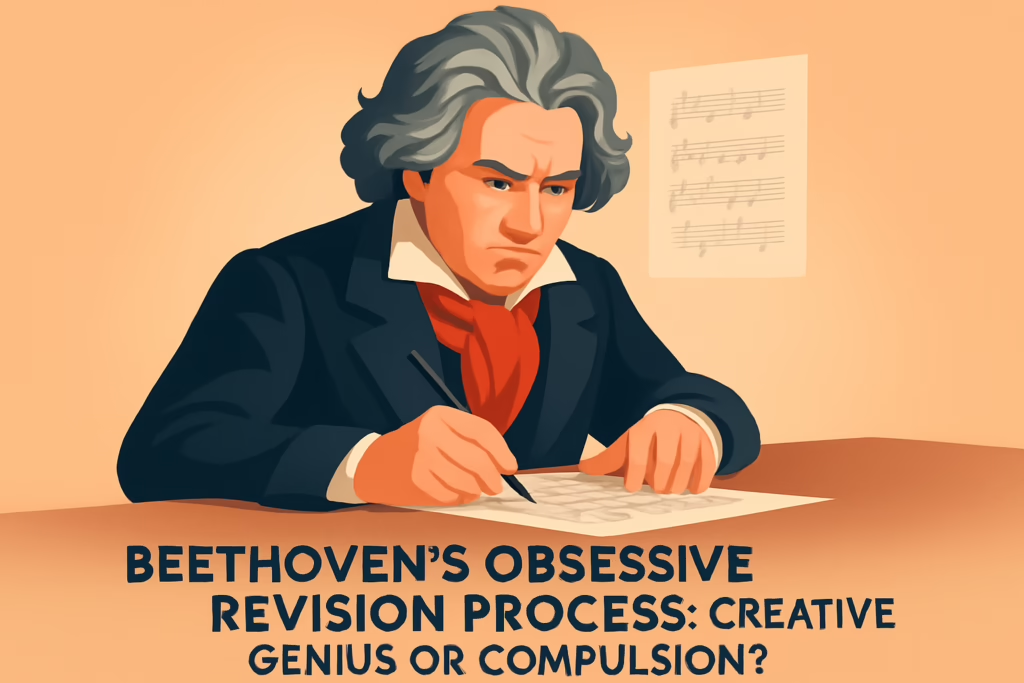
Beethoven’s Obsessive Revision Process: Creative Genius or Compulsion?
Beethoven’s obsessive revision process sits at the center of any serious discussion about Beethoven and the Mind because it reveals how artistic greatness can emerge through relentless reworking, mental strain, and uncompromising standards rather than effortless inspiration. In practical terms, revision means the repeated alteration of sketches, drafts, harmonic plans, rhythmic figures, and large-scale structures before a composition reached a form Beethoven considered necessary, if never fully perfect. Scholars have long contrasted this method with the image of the divinely inspired genius who simply heard masterpieces whole, wrote them down, and moved on. Beethoven shattered that myth. His surviving sketchbooks, corrected proofs, and heavily reworked manuscripts show a composer who tested, erased, rewrote, recombined, and sharpened musical ideas with extraordinary intensity.
This matters beyond music history because Beethoven’s working habits raise a wider psychological question: when does disciplined persistence become compulsion? That question is not merely biographical gossip. It affects how we interpret creativity, productivity, self-criticism, and even mental health in high performers. Having worked through Beethoven sketch studies with performers and students, I have seen how startling the evidence is. A seemingly inevitable opening motive often began as something flatter, longer, or less memorable. Through revision, Beethoven compressed it, increased tension, and made it unforgettable. His process therefore offers a concrete case study in cognition: attention, error detection, pattern refinement, auditory imagination, and emotional regulation all appear on the page.
As a hub for the miscellaneous branch of Beethoven and the Mind, this article connects several linked themes: Beethoven’s sketchbooks, perfectionism, working memory, deafness, frustration tolerance, and the line between productive obsession and destructive fixation. It also helps answer searchers’ direct questions. Did Beethoven revise obsessively? Yes, unmistakably. Did revision improve the music? In many documented cases, yes. Was his process evidence of a clinical disorder? No diagnosis can be made responsibly from manuscripts alone, though certain behaviors resemble modern descriptions of compulsive traits. The most accurate conclusion is that Beethoven’s revision process was both a tool of creative genius and, at times, a manifestation of intense inner compulsion.
To understand that balance, we need to look at the documents themselves, the musical results they produced, and the limits of modern psychological interpretation. Beethoven left enough evidence to move this discussion beyond myth. The revision marks are not decorative traces of effort; they are the workshop of the mind, preserved in ink. For readers exploring Beethoven’s personality, cognition, and creative method, this hub article provides the essential foundation and points toward the broader network of subtopics within Beethoven and the Mind.
What Beethoven’s Sketchbooks Actually Show
Beethoven’s sketchbooks are the strongest evidence for his obsessive revision process because they capture composition in motion rather than in polished retrospect. Unlike Mozart, whose surviving drafts often suggest rapid inscription, Beethoven preserved an unusually extensive paper trail of false starts, variant themes, harmonic experiments, and structural recalculations. These materials include pocket sketchbooks, desk sketchbooks, loose leaves, and conversation-linked drafting habits from later years. Musicologists such as Alan Tyson, Joseph Kerman, Douglas Johnson, and Lewis Lockwood have used them to reconstruct how works evolved over time, sometimes across months or years.
The key point is simple: Beethoven rarely accepted the first version of an idea. He would extract a motive, test it in multiple meters, shift accents, tighten intervals, and rethink transitions with almost forensic concentration. In the Eroica Symphony, for example, sketch evidence shows that themes and formal balances were revised repeatedly before the final architecture emerged. In the Fifth Symphony, the famous short-short-short-long cell gains power not because it appeared magically complete, but because Beethoven refined how it drives continuity, modulation, and dramatic expectation. Revision for him was not cosmetic editing. It was core invention.
I often tell students that Beethoven composed by interrogation. He asked what a motive could become under pressure. Could it be shortened? Could it carry an entire movement? Could its rhythm destabilize the listener before restoring order? That habit explains why his manuscripts look crowded and combative. He was arguing with the material. This is one reason Beethoven remains central to discussions of creativity and cognition: his papers show the mind not as a passive receiver of inspiration but as an active engine of selection and transformation.
Creative Genius or Compulsion? The Psychological Distinction
Calling Beethoven obsessive can clarify his intensity, but it can also mislead if used carelessly. In everyday language, obsession means extreme preoccupation. In clinical language, obsession refers more specifically to intrusive, unwanted thoughts, often linked to anxiety and compulsions aimed at reducing distress. Beethoven’s revision habits share some surface similarities with compulsive behavior: repetition, dissatisfaction, checking, and difficulty stopping. Yet the available evidence does not justify a retrospective diagnosis of obsessive-compulsive disorder. Historical psychiatry requires caution, and manuscripts are not medical charts.
Still, the question is worth asking because it sharpens our understanding of productive versus maladaptive repetition. Productive repetition improves the work. Compulsive repetition can become detached from outcomes and serve mainly to relieve inner tension. Beethoven appears to occupy a complicated middle ground. His revisions clearly generated superior musical results, but accounts from contemporaries also suggest a temperament marked by irritability, intensity, and relentless self-demand. He could become fixated on details while still maintaining extraordinary long-range control. That combination is unusual and psychologically important.
A more defensible framework is perfectionism. Modern psychology distinguishes adaptive perfectionism, which involves high standards and disciplined effort, from maladaptive perfectionism, which includes excessive self-criticism, fear of error, and inability to disengage. Beethoven shows evidence of both. He revised because he heard possibilities others did not, but also because acceptable was often intolerable to him. This is why the debate should not be framed as genius versus compulsion, as though only one can be true. In Beethoven’s case, compulsion-like persistence may have fueled genius, while genius gave that persistence productive direction.
How Revision Changed the Music
The strongest argument for Beethoven’s revision process is the music itself. Revision transformed raw material into concentrated drama, structural inevitability, and emotional depth. In sonata movements, he frequently reworked transitions so modulation felt earned rather than merely functional. In slow movements, he refined ornamentation and spacing to intensify expressive stillness. In finales, he reorganized thematic returns so culmination arrived with greater force. These are not abstract claims. They can be heard when comparing sketches and completed passages in works such as the Piano Sonata in C minor, Op. 13, the Waldstein Sonata, Op. 53, and the late string quartets.
One recurring pattern in Beethoven’s drafts is compression. Early versions may state too much too soon. Final versions often cut, condense, or delay. That creates tension. Another pattern is motivic integration. A figure that begins as local decoration becomes structural glue, binding sections together across a movement. This is a hallmark of Beethoven’s mature style and a reason his works reward repeated listening. Revision allowed him to turn fragments into systems.
| Revision habit | What Beethoven changed | Musical result |
|---|---|---|
| Compression | Shortened themes and removed filler bars | Stronger memorability and forward drive |
| Motivic integration | Reused small cells across sections | Greater unity and structural coherence |
| Harmonic recalibration | Adjusted pivot chords and cadences | More dramatic modulation and release |
| Rhythmic sharpening | Shifted accents, rests, and syncopations | Higher tension and clearer character |
| Formal restructuring | Moved climaxes and reordered returns | More convincing large-scale architecture |
From a craft perspective, this is why Beethoven remains indispensable in composition study. He demonstrates that first ideas are rarely the final truth of a piece. The great gain from revision is not polish alone; it is discovery. Beethoven found the identity of a work by forcing it through alternatives until only the necessary remained.
Deafness, Control, and the Inner Ear
No analysis of Beethoven’s revision process is complete without addressing deafness. As his hearing declined, external sound became less reliable, and the inner ear became increasingly central. This likely intensified revision in two ways. First, he depended more heavily on mental audition, which can encourage repeated testing of imagined sound against notation. Second, loss of hearing may have increased his need for control on the page, since performance feedback and spontaneous correction through listening were harder to access in ordinary ways. Deafness did not create his revision habit, but it almost certainly heightened its stakes.
This is where simplistic storytelling fails. Beethoven was not a tragic figure mechanically compensating for disability, nor was he a superhuman genius untouched by frustration. He was a working composer adapting under severe constraints. The sketchbooks from middle and late periods show that his conceptual grip on harmony, counterpoint, and form remained astonishingly powerful. In fact, some late works suggest even greater abstraction and internal coherence. That indicates that revision was supported by robust cognitive representation, not merely by anxious overchecking.
In my experience discussing these works with performers, the late music often makes sense only when one understands how exact Beethoven wanted relationships of interval, register, and articulation to be. Revision was his method of securing precision in an increasingly private acoustic world. Rather than hearing less musically, he appears to have heard more internally. The cost was likely exhaustion. The benefit was music of exceptional concentration, especially in the late sonatas and quartets.
What Modern Creators Can Learn from Beethoven
Beethoven’s obsessive revision process offers a practical model for writers, composers, designers, and knowledge workers, but only if its lessons are applied carefully. The useful lesson is not to glorify suffering or endless tinkering. It is to separate generation from evaluation, preserve drafts, and revise with specific goals. Beethoven did not revise randomly. He revised for greater necessity: tighter motives, stronger contrast, clearer architecture, and deeper expressive logic. That is a transferable discipline.
Modern tools make this both easier and harder. Software such as Sibelius, Dorico, Finale, Scrivener, and version-controlled writing platforms allow infinite changes, but they also encourage low-cost overediting. Beethoven worked with friction. Every correction took time and left traces. That friction can improve judgment because it forces conscious decisions. A modern equivalent is deliberate versioning: save major drafts, compare alternatives, and define what each revision pass is for. One pass can address structure, another pacing, another clarity, another detail.
There is also a warning in Beethoven’s example. High standards become damaging when revision no longer improves the work, only postpones release. Professionals need stopping rules. Editors use deadlines, performance preparation uses rehearsal calendars, and software teams use release criteria. Beethoven often had publishers, performers, and patrons imposing external limits. Without such constraints, even a brilliant reviser can disappear into refinement. The healthy takeaway is disciplined iteration, not romantic self-destruction.
The Broader Beethoven and the Mind Hub
As a miscellaneous hub within Beethoven and the Mind, this article connects outward to several adjacent questions that deserve their own focused treatment. One concerns Beethoven’s temper and whether irritability functioned as emotional fuel or social liability. Another examines memory and how he could retain large formal plans while revising local details. A third explores sketchbooks as evidence of working memory, auditory imagery, and executive control. A fourth asks how deafness changed not just his hearing but his sense of agency, isolation, and identity. Each of those topics gains clarity once revision is placed at the center.
Revision is the hub because it links personality, technique, and psychology in one observable practice. It is where abstract claims about Beethoven become testable. If someone says he was meticulous, the sketches show how. If someone says he was tortured, the drafts reveal whether struggle led to stronger outcomes. If someone says genius is effortless, Beethoven refutes it in ink. For internal linking across a Beethoven and the Mind content cluster, this page naturally supports articles on perfectionism, creative cognition, deafness, late style, daily routine, and the myth of inspiration.
The most reliable answer, then, is nuanced and firm. Beethoven’s obsessive revision process was not a side note to genius; it was one of its operating mechanisms. Yet it also reflects a mind that may have found rest difficult, closure elusive, and standards painfully high. Readers interested in the psychology of creativity should treat Beethoven neither as a diagnostic specimen nor as a saint of suffering. He is more useful than either stereotype. He shows that greatness can be built through revision so intense it sometimes resembles compulsion, while still producing enduring artistic order. Explore the connected Beethoven and the Mind articles next to see how this pattern appears across his life, habits, and music.
Frequently Asked Questions
Why is Beethoven’s revision process so important to understanding his creative mind?
Beethoven’s revision process matters because it overturns the romantic myth that great music simply appeared in a flash of inspiration. His surviving sketchbooks, draft pages, and heavily reworked manuscripts show a composer who tested ideas relentlessly, rejected promising material, and returned again and again to the same passage until it achieved the expressive force he wanted. That makes revision central to any discussion of Beethoven and the Mind. It suggests that his genius did not operate apart from struggle, but through it. He thought composition into existence by revising it.
In practical terms, Beethoven revised at every level. He altered motives, reshaped harmonic progressions, refined rhythmic tension, redistributed textures, and sometimes reimagined the architecture of an entire movement. A short figure that seems inevitable in the finished score may have gone through numerous earlier versions before reaching its final form. This is one reason his music often feels both organic and intensely purposeful: the final result is not merely written, but pressure-tested.
His revision process also reveals something psychologically important. Beethoven appears to have held himself to standards so severe that “good enough” was rarely acceptable. That uncompromising stance could be artistically productive, but it also hints at mental strain. The question is not simply whether he revised a lot, but what that relentless reworking tells us about concentration, dissatisfaction, ambition, and the burden of inner necessity. In that sense, studying revision is not a side issue. It is one of the clearest windows into how Beethoven’s creative intelligence actually worked.
Did Beethoven’s constant revising come from perfectionism, or could it reflect something more compulsive?
The most responsible answer is that it likely involved both, though historians should be careful not to impose modern clinical labels too quickly. Beethoven was unmistakably perfectionistic. He demanded structural coherence, emotional intensity, and originality at a level few composers of his era pursued so aggressively. He did not just want a piece to function; he wanted it to sound necessary. That kind of artistic perfectionism naturally leads to revision, especially in a composer trying to stretch inherited forms into something more dramatic and psychologically complex.
At the same time, the sheer intensity of his reworking invites broader questions. Some passages were revised not once or twice, but repeatedly, as if he were driven by an internal standard that remained just out of reach. This can look compulsive in the everyday sense of the word: repetitive, exacting, and difficult to stop. It reflects a mind unwilling to leave an idea alone until it had been interrogated from multiple angles. Whether that should be understood as a clinical compulsion is a different matter, and one modern scholars approach cautiously. The evidence is rich about his working habits, but limited when it comes to diagnosing psychological conditions retrospectively.
What can be said with confidence is that Beethoven’s revision practice was not incidental. It appears deeply tied to his temperament: intense, analytical, self-critical, and resistant to compromise. That combination can produce extraordinary art, but it can also create enormous pressure. So the most accurate framing is not genius or compulsion as a simple choice between opposites. Rather, Beethoven’s creative process may show how exceptional artistic achievement can emerge from a mind in which discipline, dissatisfaction, obsession, and imagination were tightly intertwined.
How do Beethoven’s sketches and drafts change the way we hear his finished music?
Beethoven’s sketches change listening from passive admiration into active awareness. Once you know how much revision lies behind the finished score, the music can sound less like a miraculous arrival and more like the result of intense creative negotiation. Seemingly simple openings, dramatic silences, unexpected modulations, and tightly controlled motivic developments often gain new depth when heard as choices Beethoven fought for rather than ideas that appeared fully formed. The finished work begins to sound not effortless, but earned.
His drafts also reveal how much expressive power can depend on tiny details. A revised rhythm may sharpen urgency. A different bass motion can darken the emotional atmosphere. A changed transition can make an entire movement feel more inevitable. Beethoven often worked through these micro-decisions with extraordinary care, and the cumulative effect is immense. The listener may never know each discarded version, but understanding that these alternatives existed helps explain why the final score feels so concentrated.
On a larger scale, the sketches show that Beethoven’s formal innovations were often built gradually. He did not merely break classical forms for the sake of novelty. He pushed against them through revision, testing how far a motive could generate an entire movement, how tension could be prolonged, or how a coda could become structurally decisive rather than decorative. Hearing the final music with that knowledge can be transformative. You begin to hear Beethoven not just as a master of inspiration, but as a master of revision-driven thought, shaping form through repeated acts of refinement and resistance.
Was Beethoven unusual among composers in how obsessively he revised his works?
Many major composers revised, so Beethoven was not unique in revising per se. Composition has always involved experimentation, correction, and rethinking. What sets Beethoven apart is the intensity, extent, and documentary visibility of that process. He left behind an unusually rich body of sketch material that allows scholars to trace his decisions in remarkable detail. This evidence reveals a composer who often built works through repeated reconfiguration rather than through straightforward notation of already settled ideas.
He was also unusual in how deeply revision penetrated the structure of his music. Some composers revise surface details after establishing the broader conception. Beethoven certainly did that, but he also reworked foundational elements: thematic identity, tonal trajectory, developmental logic, pacing, and proportion. He could take a small motive and test numerous ways it might generate a larger musical argument. That method contributes to the distinctive density and inevitability associated with his mature style.
It is worth noting that Beethoven’s historical position may have intensified this habit. He inherited the classical traditions of Haydn and Mozart, yet he also felt compelled to expand them. Revision became a way of transforming received forms into vehicles for unprecedented expressive and structural ambitions. So while he was not the only composer to revise obsessively, his process stands out because revision was not merely corrective. It was generative. It was the engine through which much of his originality took shape.
What does Beethoven’s relentless rewriting ultimately suggest about creative genius?
Beethoven’s relentless rewriting suggests that creative genius is often less about effortless brilliance than about sustained confrontation with difficulty. His example challenges the idea that greatness depends on immediate perfection. Instead, it points toward a more demanding model: genius as the capacity to hear possibilities beyond the first draft, endure dissatisfaction, and continue refining until a work reaches uncommon depth and force. In Beethoven’s case, revision was not evidence that inspiration had failed. It was the means by which inspiration became durable form.
This also helps explain why his music can feel so inevitable and so hard-won at the same time. The final score often projects certainty, but that certainty was achieved through uncertainty, trial, rejection, and rethinking. There is something profoundly human in that. It reminds us that artistic mastery can emerge through friction between vision and execution. Beethoven’s manuscripts preserve that friction. They show a composer arguing with his own ideas until they yielded something stronger.
At the same time, his process warns against romanticizing suffering too easily. Relentless self-criticism can produce remarkable art, but it can also reflect strain, restlessness, and the inability to feel satisfied. Beethoven’s legacy therefore resists simple moral conclusions. His revision habits were a source of extraordinary creative power, yet they may also reveal the emotional costs of living under extreme inner demands. That tension is exactly why the topic remains so compelling. Beethoven’s genius may not be separable from compulsion, but neither can it be reduced to it. His work shows how artistic greatness can arise from a mind driven to rework, refine, and wrestle with form until necessity itself seems audible.