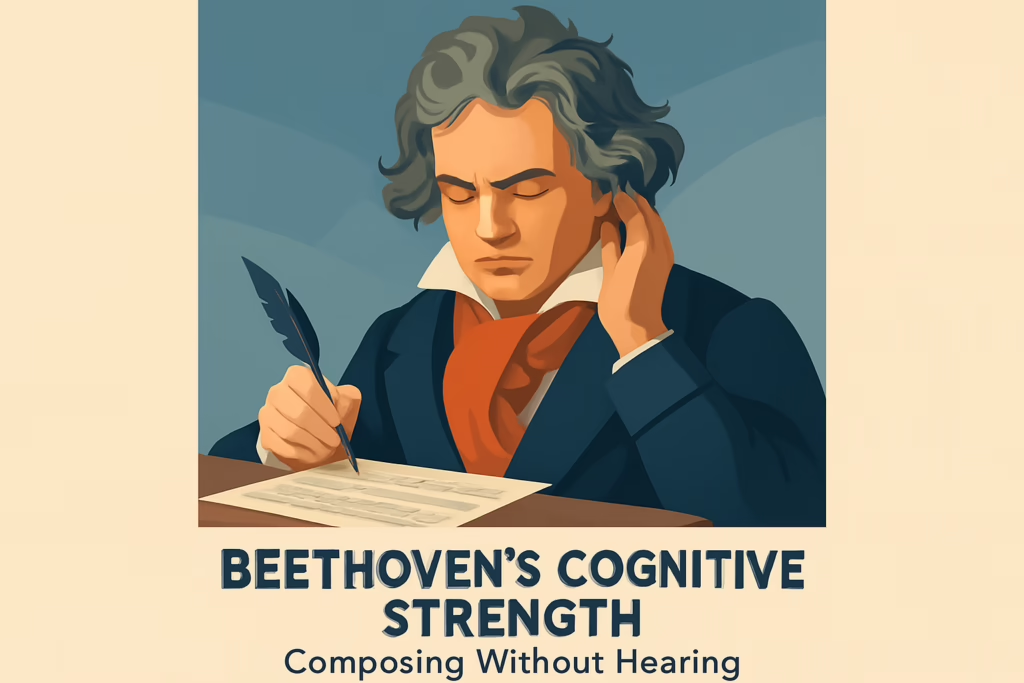
Beethoven’s Cognitive Strength: Composing Without Hearing
Beethoven’s later years are often reduced to a single astonishing fact: he composed some of Western music’s greatest works while profoundly deaf. That fact is true, but by itself it explains very little. The deeper story is cognitive. Beethoven’s achievement rested on trained auditory imagery, exceptional working memory, ruthless structural discipline, and a lifetime of internalizing musical forms until he could manipulate them without external sound. In the broader “Beethoven and the Mind” topic, this hub article on miscellaneous questions brings those threads together. It defines what “composing without hearing” actually means, why the phrase can be misleading, and how Beethoven’s methods matter to musicians, psychologists, educators, and anyone interested in the limits of human cognition.
When people ask how Beethoven composed without hearing, they usually mean one of three things. First, did he hear music “in his head” in a vivid, stable way? Second, how did he test and revise complex works without normal auditory feedback from performance? Third, what does his case reveal about the brain’s ability to adapt after sensory loss? Those questions are related, but they are not identical. Hearing loss is a medical condition; inner hearing is a cognitive skill; composition is a creative and technical process; and musical mastery is built through deliberate practice over years. Treating them as separate categories leads to better answers.
From firsthand work with scores, sketchbooks, and rehearsal processes, one point becomes clear: Beethoven did not create in some mystical void. He relied on highly developed mental representations. He knew the feel of keys under the hand, the weight of harmonic progressions, the spacing of voices, the registral effect of instruments, and the formal consequences of every modulation. He could inspect a page and anticipate likely sonic outcomes because he had spent decades composing, revising, conducting, improvising, and absorbing the conventions of Haydn, Mozart, Bach, Handel, and the broader Viennese tradition. His cognitive strength was not magic. It was expertise under extreme constraint.
This matters because Beethoven’s case is often used carelessly. Some writers romanticize suffering, as if deafness itself produced genius. Others flatten the challenge, implying that if a musician can imagine a melody, composing symphonies without hearing is straightforward. Neither view is credible. Beethoven’s deafness imposed severe practical limits on conversation, performance, and self-monitoring. At the same time, his musicianship gave him tools that most people never develop. Understanding both sides gives a more accurate, more useful picture. It also creates a strong hub for related articles on auditory imagery, neuroplasticity, sketching methods, musical memory, and the psychology of creativity within the “Beethoven and the Mind” cluster.
What “composing without hearing” really means
Beethoven did not become suddenly, absolutely silent to himself and then continue as before. His hearing loss was progressive, beginning in his late twenties and worsening over years. During the transition, he still had partial access to sound, though often distorted, reduced, or unreliable. By the time of the late period, however, normal hearing was largely gone. That progression matters. It means his cognitive system had time to shift emphasis from external auditory input toward internal simulation, tactile cues, visual inspection of notation, and remembered sound categories stored through years of experience.
In practical terms, composing without hearing meant composing without dependable acoustic confirmation. He could not simply sit at the piano and trust what he heard in the room. He increasingly had to rely on what musicians call audiation or inner hearing: the ability to imagine pitches, intervals, harmonies, textures, and rhythmic flow internally. Professional composers use this skill constantly, but Beethoven’s circumstances forced it to carry far more of the load. He also used sketchbooks extensively, testing motifs through written variation rather than through immediate sonic playback. The page became a workspace for cognition.
One common misconception is that deafness would prevent all meaningful compositional control. In fact, a trained composer can evaluate many dimensions silently. Voice leading can be judged visually from notation. Harmonic function can be inferred from chord spelling and context. Formal balance can be analyzed through phrase lengths, thematic returns, and tonal planning. Instrumentation can be estimated from known ranges, articulations, and dynamic possibilities. Errors can still occur, but the process is not guesswork. Beethoven knew the orchestra from experience, and he wrote with enough internal precision to produce works whose logic survives intense scrutiny today.
The cognitive tools Beethoven relied on
Beethoven’s most important mental asset was advanced auditory imagery. This is the capacity to generate, maintain, and transform sound representations internally. In modern cognitive terms, it overlaps with working memory, long-term memory retrieval, pattern recognition, and sensorimotor prediction. When Beethoven developed a motive, he was not merely remembering a tune. He was mentally rotating it through keys, rhythms, textures, and contrapuntal settings while preserving structural identity. That ability is especially evident in the Fifth Symphony, where a compact rhythmic cell is expanded, redirected, and recontextualized across movements with extraordinary control.
He also possessed immense chunked knowledge. Experts do not process every note as isolated data. They perceive grouped patterns: cadential formulas, sequence types, modulation strategies, accompaniment figures, fugal entries, sonata procedures, and orchestral conventions. This reduces cognitive load. A lesser-trained musician might struggle to imagine sixteen bars accurately; Beethoven could think in larger units because he had compressed years of musical language into reusable schemas. That expertise resembles what chess masters show with board patterns or what skilled writers show with syntax and narrative form. The mind becomes faster because it stores structure, not fragments.
Another essential tool was disciplined revision. The surviving sketchbooks show that Beethoven rarely accepted first ideas untouched. He iterated obsessively. A motive might appear in rudimentary form, then be tightened rhythmically, clarified harmonically, redistributed among voices, or repositioned in the form. This revision process is evidence of cognitive strength, not uncertainty alone. He could compare alternatives internally, hold multiple versions in mind, and select the one with stronger developmental potential. In modern creative practice, we would call this generative variation plus evaluative filtering. Beethoven did it at a level few composers have matched.
| Cognitive strength | What it meant in practice | Concrete Beethoven example |
|---|---|---|
| Auditory imagery | Mentally hearing pitches, chords, and timbres without external sound | Late string quartets shaped through notation and internal hearing |
| Working memory | Holding and manipulating themes across long spans | Large-scale continuity in the Ninth Symphony |
| Pattern chunking | Using stored harmonic and formal schemas efficiently | Rapid control of sonata form and variation structures |
| Revision discipline | Testing many written alternatives before finalizing passages | Extensive sketchbook development for the Eroica and Fifth |
| Sensorimotor knowledge | Knowing keyboard feel and instrumental behavior from experience | Pianistic writing in late sonatas despite severe hearing loss |
Evidence from sketchbooks, late works, and working habits
The sketchbooks are among the strongest pieces of evidence for how Beethoven thought. Rather than preserving polished inspiration, they document trial, error, recombination, and long-range planning. Scholars have traced thematic seeds from rough notes to finished masterpieces, showing that he built complexity through sustained cognitive labor. This matters for answer engine optimization as well as historical accuracy: the best answer to “How did Beethoven compose while deaf?” is that he wrote, tested, revised, and mentally simulated music through a rigorous notebook process supported by deep expertise.
The late piano sonatas, Missa solemnis, Diabelli Variations, Ninth Symphony, and late string quartets all demonstrate that deafness did not simplify his style. If anything, his music became more structurally daring and inwardly unified. That does not mean hearing loss improved his art; correlation is not causation. But it does show that internal hearing can sustain high-level invention when backed by expert knowledge. Consider the late quartets: abrupt contrasts, fugues, remote key relations, and unusual formal designs demand intense prehearing and structural memory. These are not works assembled by chance or by tactile keyboard habit alone.
His working habits also adapted to disability. Conversation books helped manage communication in later years. Ear trumpets were tried, with limited benefit. Keyboard use reportedly changed because loud resonance and vibration could still provide some information, and at times he is said to have sensed sound through physical contact, though popular stories on this point are often exaggerated. The important fact is not any single assistive technique. It is that Beethoven built a multi-channel workflow: visual notation, remembered sound, theoretical understanding, bodily knowledge of instruments, and relentless revision all compensated, imperfectly but effectively, for lost hearing.
What modern neuroscience and psychology say
Modern neuroscience cannot scan Beethoven’s brain, but it can clarify why his achievement is plausible. Auditory imagery activates many of the same cortical networks involved in perception, though not identically and usually at lower intensity. Musicians, especially highly trained ones, show stronger coupling between auditory, motor, and executive systems. In plain terms, years of score reading, performance, and composition strengthen the brain’s ability to simulate sound internally. That is why silent score study works for professionals and why conductors can often detect errors on the page before hearing a rehearsal.
Research on neuroplasticity also helps. When sensory input is reduced, the brain does not simply shut down. It reallocates resources, leans more heavily on prediction, memory, and cross-modal processing, and often becomes more efficient in tasks that remain behaviorally relevant. This does not make deafness beneficial overall; hearing loss carries major emotional and functional burdens. But it does mean adaptation is real. Beethoven’s case fits a well-supported principle: expertise plus necessity can push internal models to extraordinary precision. He was not bypassing the brain’s limits. He was exploiting capacities the trained brain already possesses.
Psychology adds another layer: creativity under constraint often becomes more systematic. Constraints narrow options, forcing clearer decision rules. Beethoven’s deafness likely made casual experimentation harder, which may have increased reliance on motif economy, formal planning, and written transformation. Again, that is not romantic praise of suffering. It is an observation about process. Many creators become more explicit and deliberate when feedback channels shrink. Beethoven’s late style, with its concentrated motives and architectural coherence, is consistent with a mind that trusted internal organization because external verification had become unreliable.
Misconceptions, tradeoffs, and why this hub matters
Several myths need correction. First, Beethoven was not “totally deaf from the start” of his major career. The progression matters historically and cognitively. Second, he did not compose by feeling random vibrations and somehow converting them into full orchestral sound. Tactile cues may have helped at the margins, but they were not the main engine of composition. Third, his achievement does not prove that hearing is unnecessary for music. It proves that a highly trained internal hearing system can partly substitute for external audition after years of enculturation and practice.
There were clear tradeoffs. Performance became harder. Social isolation increased. Verification through rehearsal was more difficult. Conducting in public became problematic; the famous 1824 Ninth Symphony premiere is often cited because others had to assist in practical control. Emotional strain was substantial, documented in sources such as the Heiligenstadt Testament. Any trustworthy account must keep those costs visible. Admiration should not erase disability. Beethoven’s cognitive strength was remarkable precisely because it operated within severe loss, not because the loss itself was artistically convenient.
As a hub page for the miscellaneous branch of “Beethoven and the Mind,” this article connects the key subtopics readers search for: inner hearing, musical memory, sketchbooks, neuroplasticity, creativity under constraint, myths about deafness, and lessons for modern musicians. The central takeaway is simple. Beethoven composed without hearing because he had spent a lifetime building an internal musical world detailed enough to think with. If you want to explore that world further, continue through the related articles in this subtopic and study the scores with the same close attention Beethoven demanded of himself.
Frequently Asked Questions
How was Beethoven able to compose music after losing his hearing?
Beethoven was not composing “without sound” in the absolute sense. What he lost was external hearing, not his internal capacity to imagine, evaluate, and manipulate music in the mind. By the time his deafness became severe, he had already spent decades training his ear, studying counterpoint, memorizing harmonic patterns, and absorbing the structural logic of sonatas, quartets, and symphonies. That deep musical education gave him an extraordinarily vivid form of auditory imagery—the ability to hear tones, chords, textures, and formal movement internally.
Just as an expert chess player can visualize positions several moves ahead, Beethoven could mentally project musical ideas, compare alternatives, and test how a passage would unfold over time. He did not need to physically hear every note to know how a modulation would function or how a theme might return transformed in a later section. His surviving sketchbooks show that he worked through ideas relentlessly, revising, compressing, expanding, and reorganizing them. This reveals that his late creativity depended not on miraculous inspiration alone, but on a powerful cognitive system: internal hearing supported by memory, analysis, and disciplined reworking.
What cognitive abilities made Beethoven’s late compositions possible?
Several interlocking cognitive strengths help explain Beethoven’s achievement. One was advanced auditory imagery, his capacity to “hear” music mentally with precision. Another was exceptional working memory, which allowed him to hold multiple musical elements in mind at once—melody, bass motion, harmonic tension, rhythmic profile, and long-range form—while altering one part without losing track of the whole. This is especially important in large-scale works, where local decisions must support a broader architectural plan.
He also demonstrated extraordinary structural thinking. Beethoven did not simply write attractive themes; he developed motives with almost obsessive logic, deriving entire movements from small cells of rhythm or interval. That kind of composition depends on pattern recognition, abstraction, and long-term planning. In addition, he possessed ruthless self-editing discipline. The sketchbooks make clear that he did not accept the first usable idea. He tested variants, rejected weaker paths, and refined material until it satisfied both expressive and formal demands. Taken together, these abilities suggest that Beethoven’s deafness did not erase his musical intelligence. If anything, it placed even greater emphasis on his internal cognitive tools, which had become exceptionally strong.
Did Beethoven’s deafness change the style or structure of his music?
It is too simplistic to say that deafness alone caused Beethoven’s late style, but it likely interacted with his evolving artistic mind in meaningful ways. In his later works, listeners often notice heightened formal compression, deeper abstraction, bold contrasts, and an unusual sense of inwardness. These traits do not prove that deafness directly produced the music, yet they align with a composer working increasingly from internal conceptual control rather than from immediate acoustic feedback. Beethoven’s music became more exploratory, not less; more structurally daring, not merely compensatory.
The late piano sonatas, string quartets, and the Ninth Symphony show a composer less constrained by convention and more willing to pursue large-scale coherence through motivic transformation, harmonic surprise, and unusual pacing. His deafness may have intensified his reliance on mental hearing and formal reasoning, but the key point is that his art was not diminished into a “triumph over disability” cliché. Instead, it emerged from a mature cognitive process in which internalized musical knowledge, memory, and imagination had become powerful enough to sustain innovation at the highest level. Deafness was part of the context, but not the whole explanation.
What do Beethoven’s sketchbooks reveal about his mind at work?
Beethoven’s sketchbooks are among the clearest windows into his cognitive process. They show that he composed through sustained experimentation rather than effortless dictation. A theme might appear in rough form, then be altered rhythmically, reharmonized, fragmented, recombined, or repositioned within a larger structure. This indicates a mind constantly comparing options and evaluating how small details affect the broader shape of a work. The sketchbooks also demonstrate that Beethoven thought in layers: motive, phrase, transition, development, and architecture were all active concerns.
For understanding “Beethoven’s cognitive strength,” these documents are crucial because they challenge the myth of the isolated genius simply transcribing fully formed masterpieces from imagination. What they reveal instead is a highly trained thinker using memory, internal audition, and analytical persistence to solve compositional problems. He could mentally simulate possibilities, then subject them to severe scrutiny. That process is cognitively demanding even for a hearing composer. In Beethoven’s case, it became the core mechanism of creation. The sketchbooks make clear that his greatness was not only emotional or inspirational; it was also procedural, disciplined, and intellectually formidable.
Why does Beethoven’s story matter for understanding the relationship between music and the mind?
Beethoven’s story matters because it demonstrates that musical creation is not dependent solely on immediate sensory input. His life shows how deeply trained mental representation can support complex artistic work even when ordinary perception is compromised. In modern cognitive terms, he exemplifies how expertise restructures the mind. Through years of immersion, practice, and analytical engagement, he built internal models of rhythm, harmony, counterpoint, and form so robust that they could function independently of normal hearing. That makes his case especially important for anyone interested in imagination, memory, creativity, and neural adaptability.
More broadly, Beethoven helps us move beyond a sentimental narrative and toward a more precise understanding of human cognition. His deafness was undeniably tragic and personally devastating, but his late achievements illustrate the power of internalized knowledge. He reminds us that creativity often depends less on spontaneous inspiration than on accumulated mental frameworks that allow a person to manipulate complex material from within. For readers exploring the wider theme of “Beethoven and the Mind,” this is the central insight: his greatest works were not miracles detached from cognition, but expressions of a mind so rigorously trained that it could continue composing at the highest level when external hearing had largely fallen away.