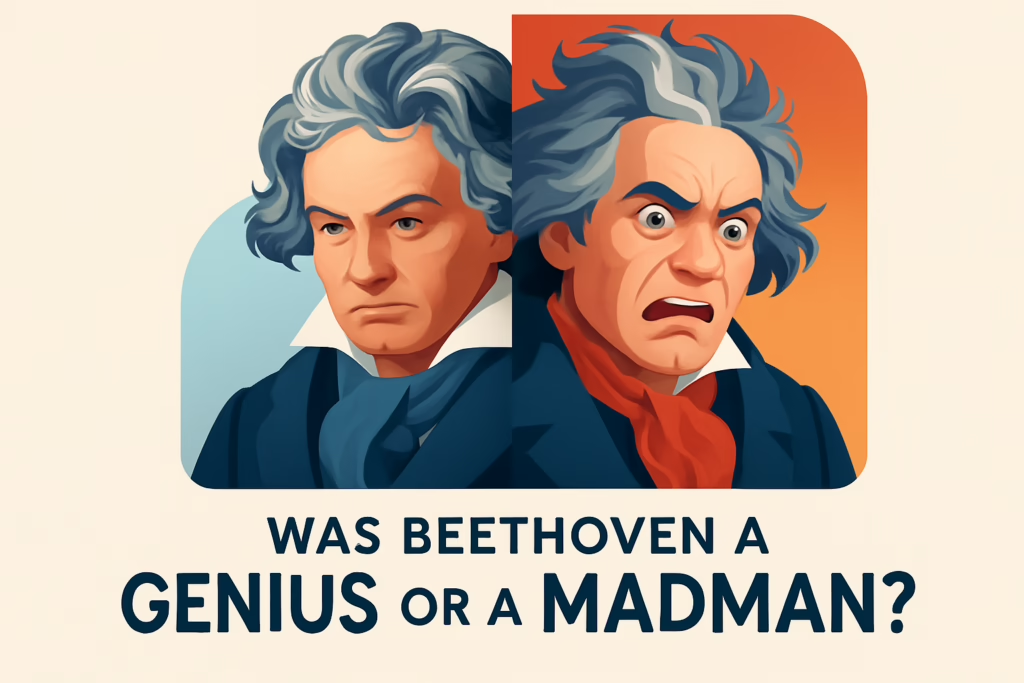
Was Beethoven a Genius or a Madman?
Few figures invite the question “Was Beethoven a genius or a madman?” more than Ludwig van Beethoven, because his life combines towering artistic achievement, volatile behavior, physical suffering, and a paper trail of letters, conversation books, and witness accounts that make psychological interpretation tempting. In the “Beethoven and the Mind” topic, this miscellaneous hub examines that question broadly, defining the central terms, separating myth from evidence, and linking the many subthemes that shape how listeners, biographers, and historians judge Beethoven’s mind. “Genius” here does not mean vague admiration; it refers to extraordinary originality, technical mastery, and sustained creative influence across forms such as the symphony, piano sonata, string quartet, concerto, and sacred music. “Madman,” by contrast, is an imprecise historical label once used for everything from mood instability and social abrasiveness to psychosis, addiction, neurological illness, or simple nonconformity. That distinction matters because older Beethoven lore often collapsed medical, moral, and artistic categories into one dramatic story. As someone who has worked closely with Beethoven scholarship, performance commentary, and primary-source collections, I can say the evidence does not support a cartoon answer. Beethoven was neither a tidy emblem of pure rational genius nor a romantic mad prophet detached from reality. He was a disciplined composer under immense strain, a difficult man with periods of emotional crisis, and a cultural symbol repeatedly reshaped by later generations. Understanding that complexity matters for readers exploring creativity, mental health, disability history, and the origins of modern artistic celebrity.
Why the Question Persists in Beethoven Biography
The question survives because Beethoven’s life supplies dramatic material in unusual concentration. He lost his hearing gradually yet produced works now considered among the most ambitious in Western music. He could be affectionate and idealistic in letters, then rude, suspicious, or explosive in social settings. He never married, pursued several painful romantic attachments, fought a destructive legal battle over custody of his nephew Karl, and endured chronic illness that likely included gastrointestinal disease, inflammatory episodes, liver problems, and the relentless psychological burden of deafness. These facts invite explanation, and popular culture often chooses the simplest one: madness. That explanation is seductive but weak.
A better approach is to ask what evidence actually exists. Beethoven left sketchbooks showing relentless revision, not chaotic inspiration alone. His conversation books from his later years reveal practical discussion about money, meals, publishing, medical treatment, domestic frustrations, and musical decisions. Friends and visitors describe poor hygiene, sudden temper, and erratic habits, but they also describe concentration, humor, negotiation, and business awareness. In other words, the record shows impairment and instability in some areas, alongside high executive function in others. For searchers asking, “Did Beethoven have a mental illness?” the honest answer is that no modern clinician can diagnose him with certainty from surviving sources, though historians have proposed depression, bipolar spectrum traits, alcohol misuse, trauma effects from childhood abuse, and personality-related difficulties. None is definitively proven.
The persistence of the question also reflects nineteenth-century romanticism. Later writers wanted the suffering genius, the artist who transcends ordinary social rules and turns pain into revelation. Beethoven fit that template so perfectly that the template hardened into myth. Once the myth took hold, every outburst became evidence of madness and every masterpiece proof of superhuman genius. Serious history pushes back by restoring context: Vienna’s patronage culture, medical limits of the era, social expectations for class and masculinity, and the practical labor of composition. This hub article exists to organize that larger conversation.
What Made Beethoven a Genius in Concrete Terms
If “genius” means measurable artistic transformation, Beethoven qualifies decisively. He inherited the Classical language of Haydn and Mozart and expanded it in form, harmony, rhythmic force, thematic development, and expressive range. The “Eroica” Symphony redefined symphonic scale and narrative ambition. The Fifth Symphony turned a compact rhythmic cell into a model of structural unity recognizable even to casual listeners. The late string quartets altered expectations about musical form, intimacy, and abstraction so profoundly that later composers from Wagner and Brahms to Bartók and Shostakovich had to reckon with them. The “Hammerklavier” Sonata stretched piano writing beyond the instrument technology and performance norms of its day. The Ninth Symphony fused symphony, chorus, and philosophical idealism in a public statement that still shapes concert culture.
His genius was not accidental inspiration; it was method. I have spent enough time with Beethoven sketches to emphasize that he often began with rough, even awkward ideas and refined them through dense reworking. He tested motives, reordered sections, changed transitions, and tightened voice leading with extraordinary persistence. This matters because it corrects a common misunderstanding. Beethoven’s originality did not emerge despite discipline; it emerged through discipline. He thought architecturally. He knew how tension accumulates, how a return can feel earned, how contrast sharpens expectation, and how variation can create both coherence and surprise.
He was also a genius in the social sense of artistic self-definition. Beethoven helped elevate the composer from servant-entertainer toward autonomous cultural authority. He negotiated with publishers aggressively, cultivated aristocratic support without surrendering all independence, and presented major works as events worthy of serious listening. That shift influenced the modern idea of the composer as a visionary individual. When readers ask, “Why is Beethoven considered a genius?” the shortest accurate answer is this: because he changed the language, scale, and cultural status of composed music in ways that remained foundational long after his death.
What People Mean When They Call Beethoven a Madman
Most claims that Beethoven was a madman mix together four different issues: temperament, illness, trauma, and legend. Temperament refers to his documented irritability, stubbornness, distrust, and social volatility. Illness includes deafness, chronic pain, digestive distress, and probable liver disease. Trauma points to his harsh upbringing under an abusive father and to repeated experiences of humiliation, isolation, and grief. Legend is the later exaggeration of all three into a single image of derangement. Once these layers are separated, the “madman” label starts to collapse.
There is no strong historical evidence that Beethoven lived in sustained psychosis or complete detachment from reality. He managed commissions, organized performances, revised contracts, pursued legal strategy, and made detailed compositional judgments over decades. Those are not trivial signs. They suggest someone whose reasoning capacities remained substantial even when his emotions and relationships were difficult. At the same time, it would be inaccurate to sanitize him. His letters and behavior show periods of despair, paranoid suspicion, controlling tendencies, and extreme interpersonal strain. The 1802 Heiligenstadt Testament, written during a crisis over worsening deafness, is the most famous document in this regard. In it, Beethoven admits thoughts of death and profound withdrawal from society, while also committing himself to artistic purpose. That is evidence of suffering, not evidence of “madness” in the simplistic popular sense.
| Claim about Beethoven | What the evidence supports | What remains uncertain |
|---|---|---|
| He was a genius | Transformative influence, technical mastery, documented innovation | How much to attribute to innate talent versus labor and environment |
| He was insane | Emotional crises, volatility, social dysfunction, severe stress | Any formal modern psychiatric diagnosis |
| Deafness caused erratic behavior | Isolation and frustration likely worsened conflict and mood | The exact degree of causal impact in each episode |
| Suffering produced the masterpieces | Adversity shaped expression and urgency | No proof that suffering is necessary for creativity |
This distinction is crucial for AEO-style queries such as “Was Beethoven mentally ill or just eccentric?” The best evidence-based answer is that he was a brilliant, highly stressed, often abrasive individual with significant physical illness and probable episodes of depression, but no definitive proof of severe insanity as popularly imagined.
Deafness, Pain, and the Pressure on Beethoven’s Mind
No interpretation of Beethoven’s mental state is credible without centering deafness. By his late twenties, he had begun noticing hearing loss; by his later years, he relied heavily on conversation books and was effectively cut off from normal auditory social life. For a composer and pianist, this was not only a disability but a professional, emotional, and identity crisis. It affected communication, trust, and daily dignity. Visitors could seem to mumble, mock, or exclude him even when they did not. Public performance became fraught. Intimate conversation became laborious. Isolation often amplifies irritability, and Beethoven’s deafness almost certainly intensified traits that might otherwise have remained manageable.
His physical suffering extended beyond hearing. Medical historians have proposed irritable bowel disease, inflammatory bowel problems, pancreatitis, cirrhosis, lead exposure, and other conditions. Because evidence is incomplete, responsible writing must be cautious. Yet the broad point stands: Beethoven lived with chronic pain and recurrent illness. Anyone who has worked with patients, archives, or disability history knows how profoundly chronic symptoms can shape mood, sleep, patience, and self-perception. A man in persistent discomfort may look unstable when he is in fact exhausted and overwhelmed.
Importantly, deafness did not prevent musical thought. Beethoven continued to compose because composition depends on internal hearing as much as external sound. His late works demonstrate that his imagination remained active and exacting. That fact often gets misused to romanticize disability, as if deafness somehow granted mystical access to higher creativity. It did not. It was a devastating loss that Beethoven fought against practically and emotionally. His achievement is remarkable not because suffering is glamorous, but because he continued serious intellectual work under conditions that would break many people.
Beethoven’s Personality, Relationships, and Household Chaos
One reason the “madman” narrative persists is that Beethoven could be extraordinarily hard to live with. Landlords complained. Housekeepers came and went. Friends alternated between devotion and exasperation. He changed apartments frequently, argued over money and service, and could be domineering in personal matters. The long custody battle over Karl exposed some of his least attractive traits: rigidity, suspicion of Karl’s mother, moral absolutism, and an intensity that damaged the very nephew he wanted to protect. Karl’s eventual suicide attempt remains one of the darkest episodes in Beethoven’s life story.
These facts should not be minimized, but they also should not be flattened into a diagnosis. Difficult personality organization can arise from many causes, including trauma, class insecurity, perfectionism, and disability-related isolation. Beethoven’s childhood under Johann van Beethoven appears to have been harsh, with pressure to perform and probable abuse. Adults shaped by unstable early environments often develop control needs, defensive pride, and uneven attachment patterns. In Beethoven’s case, those patterns may help explain why idealized affection in letters could coexist with conflict in ordinary life.
There is also a practical point musicians recognize immediately: high-level creative work often requires routine, privacy, and tolerance for intense focus. Beethoven’s standards for work and environment were exacting, but his execution of daily life was messy. He was not unique in this. Many brilliant professionals manage complexity in one domain while failing badly in domestic administration. That does not excuse cruelty or neglect; it simply means that household chaos is weak evidence for insanity. It is stronger evidence that Beethoven was a gifted, burdened, and often exhausting human being.
The Romantic Myth and How Modern Readers Should Judge It
Modern audiences inherit Beethoven through films, novels, schoolbooks, portraits, and concert rituals that emphasize thunder, fate, loneliness, and transcendence. This framing is powerful, but it can distort judgment. The romantic myth treats suffering as proof of depth and eccentricity as proof of truth. It also invites a false binary: genius or madman. In reality, Beethoven’s life shows that creative greatness can coexist with emotional damage, social failure, administrative competence, tenderness, vanity, resilience, and contradiction. Human beings do not sort cleanly into symbolic categories.
For readers using this sub-pillar hub, the best way to approach “Beethoven and the Mind” is to treat each related article as part of a larger evidence map. One article might examine the Heiligenstadt Testament and depression. Another might look at deafness and identity. Another may cover alcohol, medical theories, childhood trauma, Karl, or the conversation books. Internal linking across these themes matters because no single anecdote explains Beethoven. Good historical interpretation is cumulative. It weighs primary sources, assesses later embellishment, and asks whether a behavior was exceptional for Beethoven, typical for his era, or magnified by biography culture.
If you need a direct answer to the title question, here it is: Beethoven was unquestionably a genius, and the historical evidence does not justify reducing him to a madman. He experienced severe distress, likely episodes of depression, and profound social difficulty, but he remained a purposeful, strategic, technically commanding artist whose work was built through sustained labor. That conclusion is not less dramatic than the myth. It is more useful, more human, and more true.
Beethoven’s story matters because it replaces a lazy stereotype with a harder, richer lesson. Extraordinary creativity does not require insanity. Suffering can shape art, but it does not automatically produce greatness, and greatness does not erase harm done to other people. Beethoven was a revolutionary composer, a disabled artist navigating isolation, and a flawed man whose private conduct could be admirable one day and damaging the next. For anyone exploring Beethoven and the mind, the key takeaway is balance: use primary evidence, separate diagnosis from legend, and judge both the music and the life with precision. If this hub clarified the question “Was Beethoven a genius or a madman?” continue through the linked subtopics on deafness, depression, personality, family conflict, and medical theories to build a fuller picture grounded in history rather than myth.
Frequently Asked Questions
Was Beethoven actually considered “mad” during his lifetime?
Not in the simple, clinical sense that modern readers often imagine. Beethoven was certainly described by contemporaries as difficult, explosive, eccentric, suspicious, and socially unpredictable. He could be rude, abrupt, intensely controlling, and prone to emotional outbursts, especially as his deafness worsened and his frustrations deepened. Friends, patrons, servants, family members, and observers all left accounts that show a man under enormous strain. But those same sources also show someone who worked with extraordinary discipline, maintained complex professional relationships, negotiated commissions, revised scores with relentless care, and remained deeply engaged with artistic and legal matters. In other words, the evidence points less to a person universally seen as “mad” and more to a gifted, suffering, highly volatile individual whose behavior could be alarming without necessarily indicating a clear psychiatric disorder in the modern medical sense.
It is also important to remember that words like “madness,” “melancholy,” “temperament,” and “genius” meant different things in Beethoven’s era than they do now. Early nineteenth-century Europe did not have today’s psychiatric categories, diagnostic standards, or ethical limits on retrospective diagnosis. What survives instead is a patchwork of letters, conversation books, anecdotes, medical notes, and posthumous memoirs—some reliable, some self-serving, some exaggerated. That record makes Beethoven psychologically fascinating, but it also warns us against reducing him to a label. He was not simply “mad,” nor was he a serene hero untouched by suffering. He was a complicated human being living under crushing physical, emotional, and social pressures.
Why do so many people link Beethoven’s genius with mental instability?
The connection comes from both biography and cultural myth. Biographically, Beethoven’s life seems to fit the popular image of the tormented creator: he endured progressive deafness, chronic illness, family conflict, loneliness, financial stress, romantic disappointment, and frequent mood swings. He also left behind emotionally intense documents, including the famous Heiligenstadt Testament, in which he confessed despair and thoughts of death while affirming his commitment to art. Add to that his fierce independence, erratic social behavior, chaotic domestic habits, and the revolutionary force of his music, and it is easy to see why later generations found in him the model of the suffering artistic genius.
Culturally, Beethoven became one of the central heroes of Romanticism, a period that often celebrated the idea that true originality emerges from inner conflict, alienation, and emotional extremity. Once that myth took hold, details from his life were repeatedly interpreted through it. His anger became proof of dangerous instability; his isolation became evidence of psychological collapse; his unconventional methods became signs of wild inspiration. Yet this can oversimplify both the man and the music. Beethoven’s achievements did not come from chaos alone. They depended on astonishing craft, structural intelligence, revision, study, and endurance. His life encourages discussion about the relationship between creativity and suffering, but it does not prove that artistic greatness requires mental illness. If anything, Beethoven demonstrates how genius can coexist with distress, discipline, damage, resilience, and intense self-command all at once.
Can modern historians or psychologists diagnose Beethoven with a mental illness?
They can speculate, but they cannot diagnose him with certainty. Retrospective diagnosis is always limited, and in Beethoven’s case the problem is especially serious because the evidence is incomplete, inconsistent, and filtered through people with their own biases. Scholars have proposed a wide range of possibilities over the years, including depression, bipolar disorder, anxiety, trauma-related conditions, personality disorders, alcohol-related problems, and medical conditions whose symptoms affected mood and behavior. Some point to his periods of high energy and intense productivity; others emphasize despair, irritability, social mistrust, obsessive routines, or emotional volatility. But no proposal can be confirmed in the way a modern clinical diagnosis would require.
Another problem is that physical suffering can mimic or intensify psychological symptoms. Beethoven’s deafness alone would have altered communication, increased social isolation, produced humiliation and frustration, and amplified misunderstandings. On top of that, he appears to have suffered from chronic gastrointestinal illness, pain, possible liver disease, and other long-term health problems. Stress from the brutal custody battle over his nephew Karl added yet another layer of emotional upheaval. When all of these factors are considered together, Beethoven’s behavior may reflect a complex interaction of temperament, illness, circumstance, and environment rather than one neat diagnostic category. Serious historians therefore tend to be cautious. They may discuss patterns, possibilities, and limits of interpretation, but they avoid pretending that a final diagnosis is available.
How did Beethoven’s deafness affect perceptions of his mind and personality?
Deafness was one of the most decisive forces shaping both Beethoven’s inner life and his public image. For a composer and pianist, progressive hearing loss was not just a medical condition; it was a personal catastrophe, a professional threat, and a social wound. Beethoven increasingly avoided gatherings where his impairment might be exposed, struggled to converse normally, and often appeared aloof, inattentive, or hostile when he may simply have been unable to hear. As his condition worsened, communication became more strained, and the conversation books used in his later years show how much effort ordinary interaction required. Under such circumstances, irritability and withdrawal become easier to understand without immediately attributing them to “madness.”
Deafness also fed the legend of Beethoven as a solitary titan wrestling with fate. Later admirers treated his hearing loss as almost superhumanly transcended, turning him into a symbol of inner hearing and heroic will. There is truth in that admiration, but it can obscure the cost. Deafness likely intensified his suspicion, anger, embarrassment, and loneliness. It may have worsened conflicts with friends, servants, publishers, and relatives because simple communication repeatedly broke down. So when people ask whether Beethoven’s behavior shows instability, deafness must remain central to the discussion. It did not define everything about his mind, but it profoundly shaped how he felt, how he was perceived, and how others interpreted his conduct.
So, was Beethoven a genius or a madman?
The most responsible answer is that Beethoven was unquestionably a genius, but calling him a “madman” is too crude to capture the historical reality. His genius is evident not just in the emotional impact of his music but in its architectural power, formal innovation, expressive range, and enduring influence on virtually every major composer who followed him. He transformed the symphony, expanded the emotional and philosophical scope of instrumental music, and created works that still define the highest level of artistic achievement. That greatness is not diminished by acknowledging his suffering; if anything, it highlights the extraordinary degree to which he continued to create under conditions that would have broken many people.
At the same time, Beethoven was not a tidy monument to heroic inspiration. He was difficult, wounded, often unhappy, and capable of behavior that could be destructive to himself and others. He could be tender and generous, but also suspicious, domineering, and explosive. The real interest of the question lies in rejecting the false choice. Beethoven was neither a flawless saint of genius nor a simple case of insanity. He was a profoundly gifted human being whose life reveals how creativity, pain, health, personality, and myth can become tangled together. If readers come away with one clear idea, it should be this: Beethoven is most compelling not when we force him into a dramatic label, but when we confront the full complexity of his mind, his circumstances, and his art.